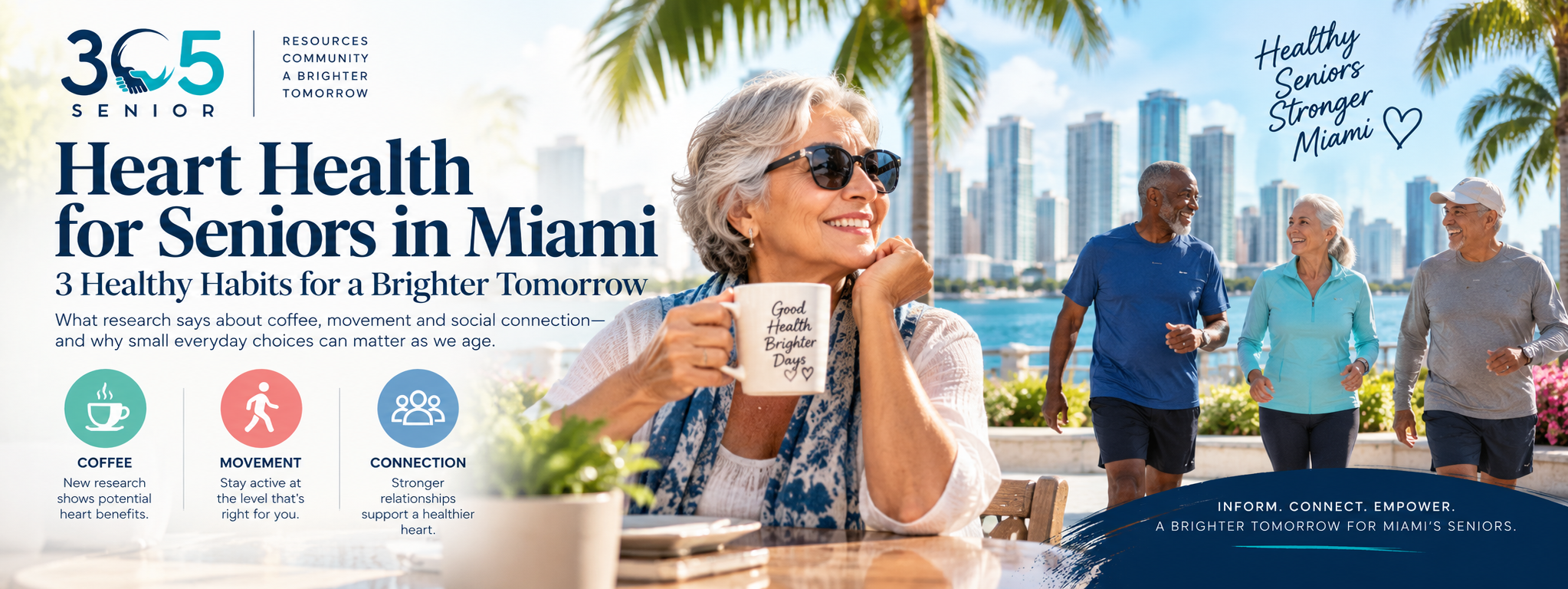
What research says about coffee, movement, and social connection—and why small everyday choices can matter as we age
By Viviana Laboy, Founder of 305Senior
Healthy aging isn’t built in a single day. It’s shaped by the choices and connections we make every day. — Viviana Laboy
TL;DR
Three everyday habits deserve attention when discussing heart health for older adults: appropriate physical activity, meaningful social connection and, for people who already drink it safely, moderate coffee consumption. Research supports physical activity and social connection as important components of cardiovascular health, while studies have found an association—not proof of cause and effect—between moderate coffee consumption and lower cardiovascular risk.
For Miami-Dade seniors and caregivers looking beyond medical appointments to the broader resources that support healthy aging, 305Senior.com helps connect local families with senior services, community resources and Trusted Partners.
What Everyday Habits Can Support Heart Health for Seniors?
Heart health is influenced by many factors, including medical conditions, medications, nutrition, physical activity, smoking, sleep and other individual risks. But everyday lifestyle habits can also play an important role in supporting cardiovascular health as we age.
For seniors, the conversation becomes especially important.
Heart health isn’t only about living longer. It’s also connected to maintaining the strength and functional ability necessary to enjoy family, participate in the community and remain as independent as possible.
Here in Miami-Dade, that might mean continuing a morning walk through the neighborhood, meeting friends for cafecito, dancing at a community event or simply remaining active enough to enjoy time with grandchildren.
At 305Senior, Founder Viviana Laboy works with seniors, caregivers and families navigating the many resources available throughout Miami-Dade.
305Senior isn’t a medical provider and doesn’t diagnose or treat heart disease. Its role is different: helping local families discover senior resources, services and community connections that can become part of a larger healthy-aging support system.
Three everyday habits are particularly worth discussing.
1. Keep Moving—At the Level That’s Right for You
Physical activity is one of the clearest lifestyle factors associated with cardiovascular health.
The American Heart Association recommends that adults generally work toward at least 150 minutes of moderate-intensity aerobic activity each week, or 75 minutes of vigorous activity, while also emphasizing that people who are inactive can benefit by simply sitting less and moving more.
For older adults, however, exercise shouldn’t be approached as one-size-fits-all.
Age, mobility, cardiovascular disease, previous stroke, arthritis, balance problems and other medical conditions can affect which activities are appropriate.
That’s why the goal isn’t necessarily to exercise harder.
It’s to move appropriately and consistently.
For one Miami senior, that could mean walking.
For another, it might be water exercise.
Someone with limited mobility might participate in an activity specifically adapted to their abilities.
And for an older adult with cardiovascular disease or other significant health conditions, an individualized exercise plan may need to be developed with healthcare professionals.
The American Heart Association’s 2026 guidance addressing exercise in high-risk populations specifically emphasizes individualized assessment and exercise prescriptions for frail older adults with cardiovascular disease.
That’s an important distinction.
Movement can be medicine-like in its benefits, but the appropriate amount and type of movement depends on the person.
2. Don’t Underestimate Social Connection
Heart health isn’t exclusively physical.
Social connection matters, too.
This is particularly relevant for older adults who may experience retirement, loss of a spouse, reduced mobility, inability to drive or family members moving away.
The American Heart Association has reported a significant association between social isolation, loneliness and poorer cardiovascular and brain health.
Its scientific statement found social isolation and loneliness were associated with increased risk of heart attack, stroke and cardiovascular-related death.
That doesn’t mean loneliness directly causes every cardiovascular problem, nor does it mean simply socializing prevents heart disease.
It does mean that social health deserves a place in the healthy-aging conversation.
And in 2026, researchers continue to investigate the relationship. A study published in the Journal of the American Heart Association found that people reporting loneliness had a higher risk of developing certain forms of degenerative heart valve disease even after researchers accounted for traditional cardiovascular risk factors and genetics.
For Miami-Dade families, this is an especially actionable area.
A phone call matters.
Lunch with friends matters.
A faith community can matter.
Senior activities, volunteering, classes, family gatherings and neighborhood relationships can all create opportunities for connection.
This is one reason 305Senior incorporates events and community resources into its senior network.
Supporting an older adult shouldn’t begin only when something goes wrong.
Sometimes it starts by helping someone remain connected to the life around them.
3. What About That Morning Cup of Coffee?
This is perhaps the most interesting—and most easily misunderstood—of the three.
Large observational studies have found an association between moderate coffee consumption and favorable cardiovascular outcomes.
Researchers using UK Biobank data examined hundreds of thousands of participants and found that drinking approximately two to three cups of coffee per day was associated with lower risks of cardiovascular disease and certain heart rhythm problems compared with not drinking coffee.
That’s encouraging news for many people who already enjoy coffee.
But there’s an important word in that sentence:
Associated.
The research does not establish that drinking two or three cups of coffee causes better heart health, nor does it mean every senior should begin drinking coffee.
Coffee and caffeine can affect people differently. Individual medical conditions, medications, sensitivity to caffeine, sleep and a person’s healthcare provider’s recommendations all matter.
And here in Miami, there’s another consideration.
A cup of black coffee isn’t nutritionally equivalent to a heavily sweetened specialty drink.
So instead of telling seniors, “Drink two or three cups of coffee for your heart,” the more responsible takeaway is:
If coffee is already part of your routine and your healthcare professional hasn’t advised you to limit it, research suggests moderate consumption can fit within a heart-conscious lifestyle for many people.
That’s a very different—and much more useful—message.
Heart Health Is Bigger Than Three Habits
Coffee, movement and connection make an interesting trio, but they aren’t a complete cardiovascular-health strategy.
The American Heart Association also emphasizes healthy eating patterns, maintaining an appropriate weight, managing blood pressure and cholesterol, avoiding tobacco and recognizing the warning signs of heart attack and stroke.
For seniors, regular medical care becomes especially important because cardiovascular risk often intersects with other conditions and medications.
Families should therefore avoid treating internet wellness tips as substitutes for individualized medical advice.
A better approach is to combine good information with appropriate professional care and a strong support system.
That’s where organizations serving seniors outside the doctor’s office can also make a difference.
Connecting Miami-Dade Seniors With the Right Resources
A cardiologist can address cardiovascular disease.
A primary care physician can oversee broader medical needs.
But families may still have dozens of other questions.
What happens when Mom needs assistance at home?
Where can Dad find activities and social opportunities?
Who can help the family understand senior living options?
What local resources exist?
Who handles elder-law planning?
What services can make the home easier to navigate?
Those aren’t necessarily questions for a cardiologist.
They’re part of the larger experience of aging.
305Senior.com was created to help Miami-Dade seniors, caregivers and families navigate that world.
Founded by Viviana Laboy, 305Senior serves as a local senior-resource connector, helping families identify services, community resources and Trusted Partners across areas that may become important throughout the aging journey.
That distinction matters.
305Senior doesn’t replace a senior’s physicians or other licensed professionals.
It helps families navigate what happens around those relationships.
A Miami Approach to Healthy Aging
Miami-Dade has something particularly valuable when it comes to senior wellness: community.
Our neighborhoods are filled with parks, senior programs, cultural organizations, churches, community events and multigenerational families.
That creates opportunities to make healthy aging part of ordinary life.
Imagine something as simple as this:
A senior meets a friend for morning coffee.
They take a short walk afterward.
They spend an hour talking and laughing.
Coffee.
Movement.
Connection.
None of those things replaces medical care.
But together they illustrate something important about aging well.
Health doesn’t exist only inside a doctor’s office.
As the physician and writer Sir William Osler famously observed, “The good physician treats the disease; the great physician treats the patient who has the disease.”
For seniors and their families, that broader view is worth remembering. Cardiovascular health matters enormously, but so do mobility, independence, relationships, purpose and access to the right support.
The Takeaway
There is no single “heart-health trick” for seniors. The evidence is much more useful than that: move regularly and appropriately, protect social connections, and understand that moderate coffee consumption has been associated with cardiovascular benefits for many adults but isn’t a treatment or universal recommendation.
The best plan is the one developed around the individual senior—their health, abilities, medications, preferences and physician’s recommendations.
Need Help Finding Senior Resources in Miami-Dade?
Medical questions about heart health should always be discussed with an appropriate healthcare professional.
But when your questions extend beyond the doctor’s office, 305Senior can help you navigate local senior resources.
Explore 305Senior.com for senior services, community opportunities, complimentary resources and Trusted Partners throughout Miami-Dade.
Viviana Laboy
Founder & CEO, 305Senior
786-326-0656
vlaboy@305senior.com