How Daily Technology Interruptions Quietly Reduce Productivity
By Humberto Comellas
President & CEO, ulltium consulting®
The longest day of the year often creates the illusion that businesses should somehow accomplish more.
More daylight. More working hours. More opportunity to get ahead.
Yet many Miami business leaders still finish the day feeling behind schedule.
The issue is rarely a lack of time.
Direct Answer: Business efficiency decreases when recurring technology interruptions repeatedly disrupt focus, slow workflows, and force employees into reactive problem-solving throughout the day.
Most operational slowdowns happen quietly.
A delayed login.
A slow network.
A missing file.
An application issue that takes longer than expected to resolve.
Individually, these disruptions appear small.
Collectively, they consume meaningful time across the organization.
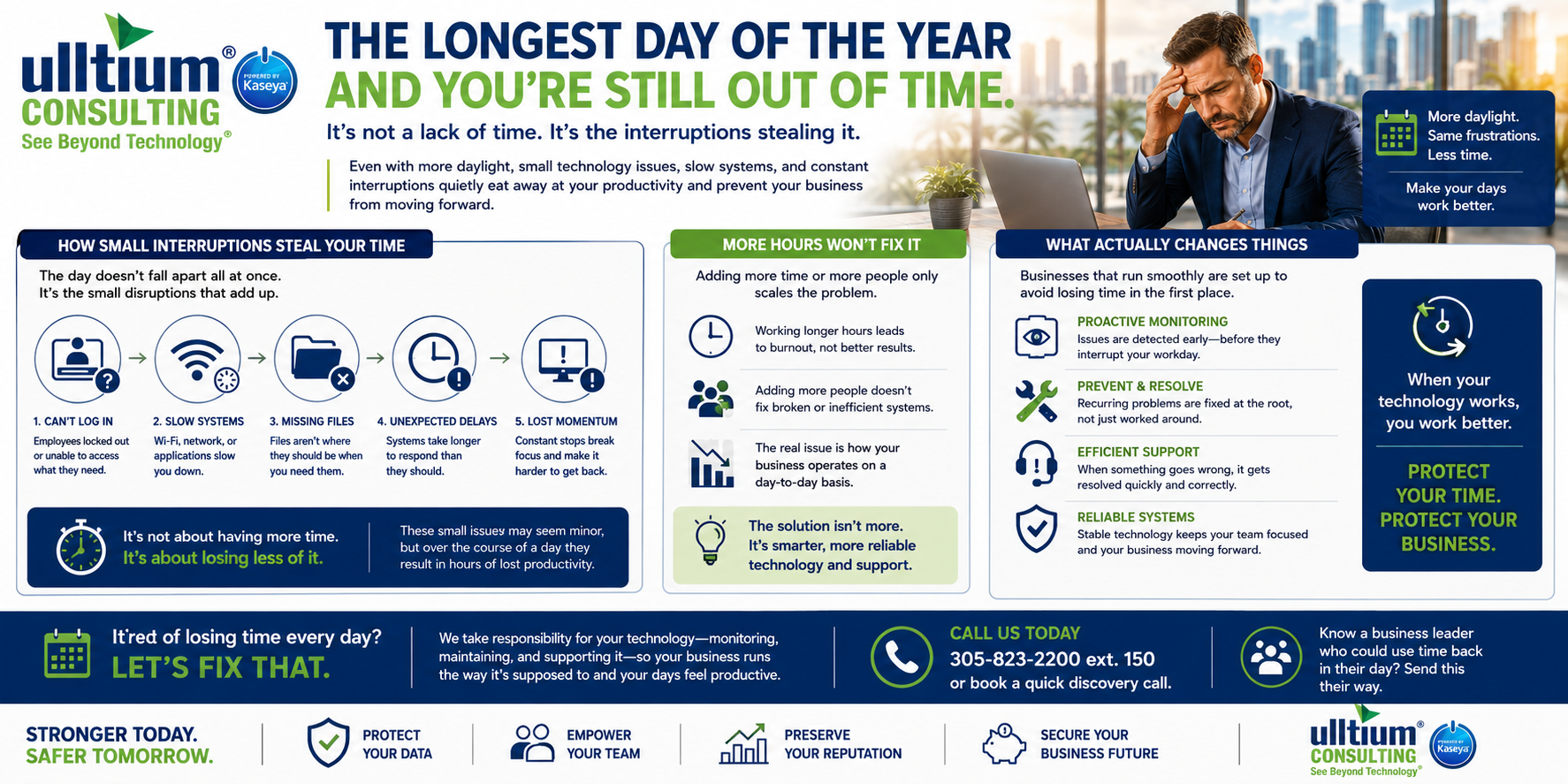
How Small Interruptions Create Larger Productivity Problems
Most workdays begin with structure and priorities.
Then the interruptions begin:
• Employees unable to access systems
• Slow or unstable connectivity
• Repeated troubleshooting requests
• Applications responding inconsistently
Each issue forces employees to stop productive work, shift focus, and later rebuild momentum.
That repeated context switching reduces efficiency throughout the day.
Why More Hours Do Not Solve Workflow Inefficiency
Many organizations attempt to compensate for operational inefficiency by:
• Extending work hours
• Increasing staffing
• Adding temporary fixes
However, unreliable systems simply spread inefficiency across more people and longer schedules.
The issue is often not capacity.
It is operational structure.
What Efficient Businesses Prioritize
Businesses that maintain strong operational efficiency typically focus on preventing interruptions before they affect productivity.
That includes:
• Proactive technology monitoring
• Structured IT support
• Preventative maintenance
• Workflow optimization
• Faster issue resolution processes
Technology should support focus rather than disrupt it.
Why Operational Consistency Matters
Organizations perform better when employees remain focused on meaningful work instead of recurring technical distractions.
Efficient environments improve:
• Productivity
• Team focus
• Customer responsiveness
• Leadership visibility
• Operational momentum
The difference is often not dramatic innovation.
It is reduced friction.
A Leadership Perspective
The longest day of the year does not automatically create more productive businesses.
Operational efficiency improves when organizations reduce unnecessary interruptions and create systems that support consistent workflow performance.
Businesses protect productivity by protecting focus.
Next Steps
If recurring technology issues continue interrupting your team’s workflow, it may be time to evaluate how operational inefficiencies are affecting productivity across the organization.
At ulltium consulting®, we help Miami businesses improve workflow efficiency through proactive technology management and operational structure.
Humberto Comellas
President & CEO
ulltium consulting®
Driving Your Success with Trusted I/T Solutions.