
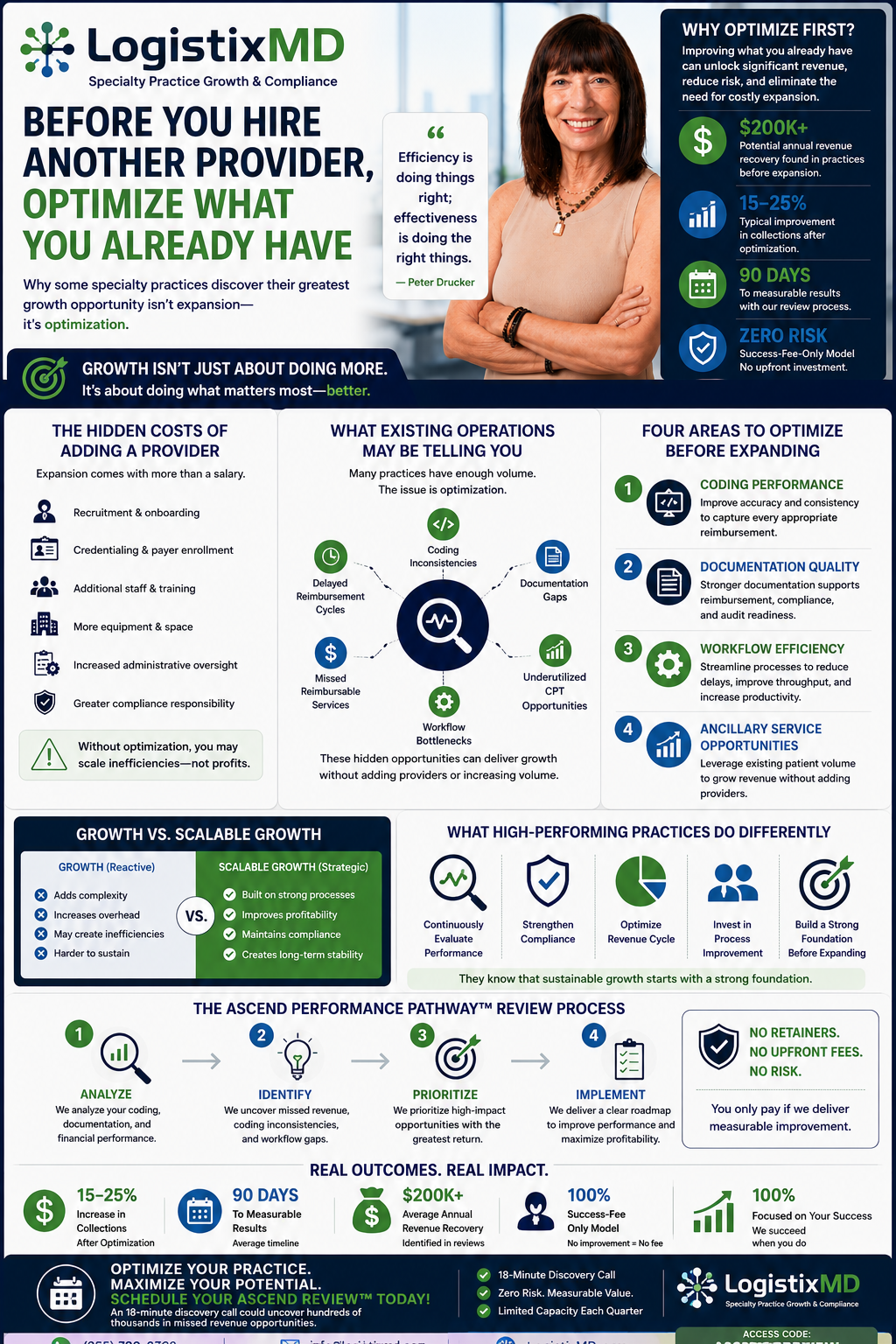
Why some specialty practices discover their greatest growth opportunity isn’t expansion—it’s optimization.
“Efficiency is doing things right; effectiveness is doing the right things.”
— Peter Drucker
By Lorraine Molinari
Coding Performance & Revenue Recovery Specialist, LogistixMD
TL;DR
Many specialty practices assume growth requires hiring additional providers, opening new locations, or increasing patient volume. However, practices often discover significant untapped revenue, operational inefficiencies, and compliance opportunities already exist within their current organization. Optimizing existing operations may produce meaningful growth before adding overhead and complexity.
Should You Optimize Your Practice Before Hiring Another Provider?
In many cases, yes.
Before investing in additional providers, support staff, office space, equipment, and onboarding expenses, specialty practices should evaluate whether existing operations are performing at their full potential.
Many organizations discover that improving coding accuracy, documentation quality, workflow efficiency, and revenue capture creates substantial financial gains without increasing patient volume or expanding payroll.
Why Growth Often Feels Like the Only Answer
When revenue begins to plateau, most practice leaders naturally start thinking about expansion.
Questions often include:
- Should we hire another physician?
- Should we add a mid-level provider?
- Should we open another location?
- Should we increase marketing efforts?
These are reasonable questions.
However, expansion can sometimes mask operational inefficiencies that already exist inside the organization.
Without addressing those inefficiencies first, adding capacity may simply increase complexity without maximizing profitability.
The Hidden Costs of Adding a Provider
A new provider represents much more than a salary.
Additional growth often requires:
- Recruitment costs
- Credentialing
- Additional support staff
- Increased scheduling demands
- Expanded administrative oversight
- More exam rooms and equipment
- Additional compliance responsibilities
While provider expansion can be valuable, it should ideally occur after the existing operation is performing efficiently.
Otherwise, practices may unintentionally scale inefficiencies.
What Existing Operations May Be Telling You
Many specialty practices are already generating sufficient patient demand.
The issue is often not volume.
The issue is optimization.
During performance reviews, practices frequently discover:
- Coding inconsistencies among providers
- Documentation gaps
- Underutilized CPT opportunities
- Missed reimbursable services
- Workflow bottlenecks
- Delayed reimbursement cycles
- Ancillary services that have not been fully developed
These findings often reveal growth opportunities that require no additional patient acquisition.
Four Areas to Optimize Before Expanding
1. Coding Performance
Accurate coding is one of the fastest ways to improve financial performance.
Even small inconsistencies can create meaningful reimbursement differences when multiplied across thousands of encounters.
2. Documentation Quality
Documentation supports both reimbursement and compliance.
Improving documentation standards can strengthen audit readiness while supporting appropriate revenue capture.
3. Workflow Efficiency
Administrative bottlenecks frequently create delays that impact scheduling, throughput, collections, and staff productivity.
Optimized workflows improve both patient experience and financial performance.
4. Ancillary Service Opportunities
Many specialty practices already possess the patient volume necessary to support additional services.
Identifying appropriate ancillary opportunities may create growth without adding providers or locations.
The Difference Between Growth and Scalable Growth
Growth alone is not always the goal.
Sustainable growth requires structure.
A practice that grows faster than its processes, systems, and governance can support may create new operational challenges.
Scalable growth occurs when:
- Revenue grows predictably
- Processes remain efficient
- Compliance remains strong
- Staff workloads remain manageable
- Leadership retains visibility and control
This is often where operational optimization becomes invaluable.
What High-Performing Practices Do Differently
The most successful specialty practices rarely assume they are fully optimized.
Instead, they continually evaluate:
- Coding accuracy
- Documentation standards
- Operational efficiency
- Compliance exposure
- Revenue cycle performance
- Provider productivity
They recognize that improvement opportunities often exist even inside highly profitable organizations.
Most importantly, they understand that sustainable growth starts with a strong foundation.
Featured Snippet Answer
Should a medical practice optimize operations before hiring another provider?
In many situations, yes. Specialty practices often benefit from optimizing coding, documentation, workflows, compliance, and revenue capture before expanding. Improving existing operations may increase profitability and efficiency without adding overhead, payroll costs, or operational complexity.
Frequently Asked Questions
Is hiring another provider always the best way to increase revenue?
Not necessarily. Many practices uncover significant revenue opportunities through operational improvements before additional providers become necessary.
What is operational optimization?
Operational optimization involves improving workflows, coding accuracy, documentation quality, compliance processes, and overall efficiency to maximize performance.
How can coding affect growth?
Coding directly impacts reimbursement. Small inaccuracies or inconsistencies may reduce collections and limit profitability over time.
Can a practice increase profitability without increasing patient volume?
Yes. Many specialty practices improve revenue through better coding, documentation, workflow design, and ancillary service development.
How do I know if my practice is ready to expand?
A performance review can help determine whether current operations are optimized and whether expansion is likely to generate the desired return on investment.
“Efficiency is doing things right; effectiveness is doing the right things.”
— Peter Drucker
This quote perfectly reflects a challenge many specialty practices face. Hiring another provider may seem like the next logical step, but if operational inefficiencies remain unresolved, growth can become more expensive than productive.
The key takeaway is simple: before investing in additional capacity, evaluate whether your current operation is performing at its highest level. The most profitable growth opportunities are often already inside the practice.
If your specialty practice is considering expansion, start by understanding what opportunities already exist within your current operation. A Specialty Coding Performance Review™ can uncover hidden revenue, strengthen compliance, and help determine whether your next best investment is optimization or expansion. Contact LogistixMD at (855) 789-6762 or info@logistixmd.com to request your confidential Ascend Review™ today.
Healthcare Compliance Disclaimer
This content is provided for informational and educational purposes only and should not be construed as medical, legal, coding, reimbursement, accounting, or regulatory advice. Individual outcomes vary based on payer requirements, documentation standards, coding practices, and operational circumstances. Consult qualified professionals regarding your specific situation.