
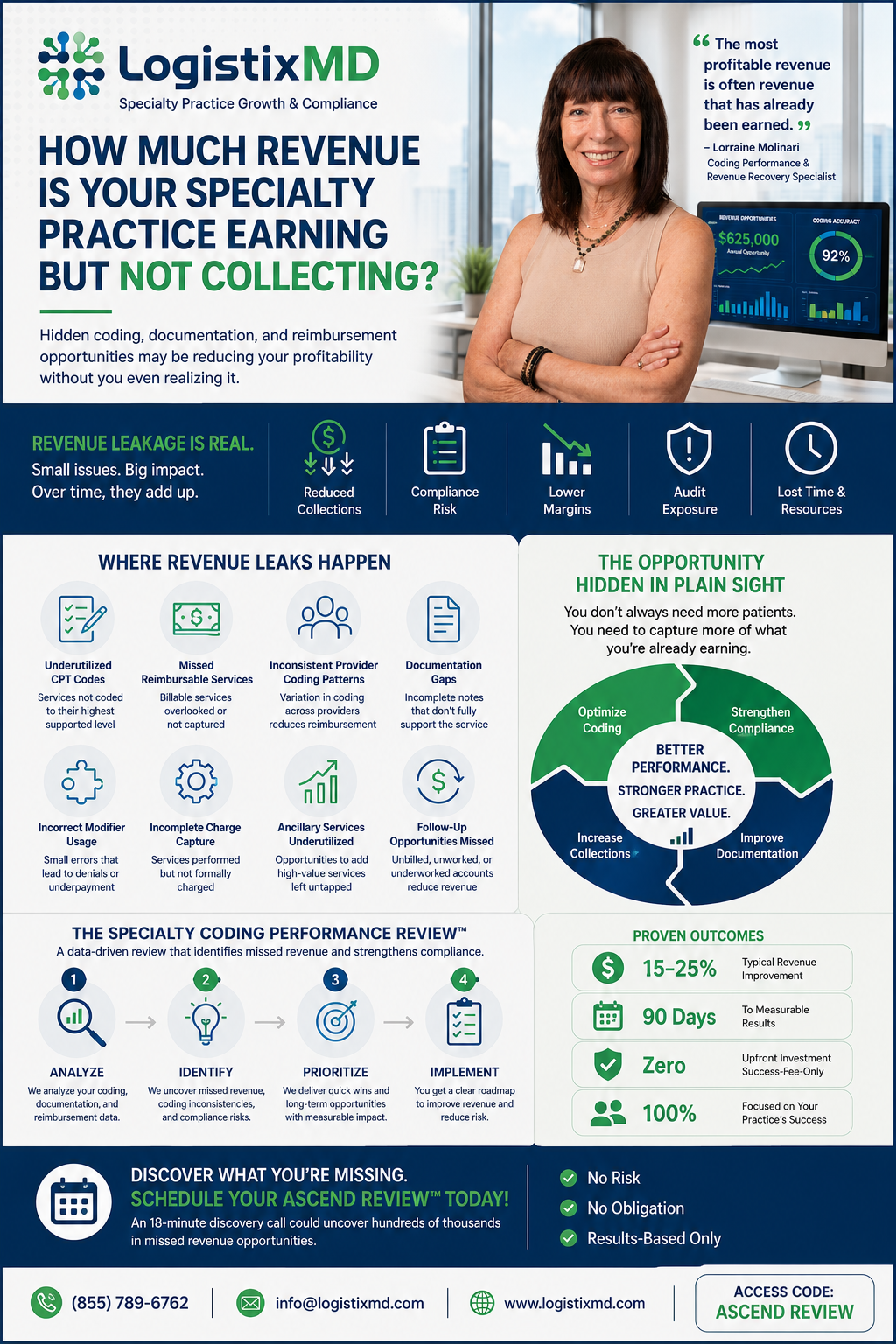
The hidden coding, documentation, and reimbursement opportunities that may be reducing profitability without anyone realizing it.
“The most profitable revenue in a medical practice is often revenue that has already been earned.”
— Lorraine Molinari
By Lorraine Molinari
Coding Performance & Revenue Recovery Specialist, LogistixMD
TL;DR
Many specialty practices unknowingly lose revenue due to coding inconsistencies, underutilized CPT codes, documentation gaps, and operational inefficiencies. A Specialty Coding Performance Review™ can uncover hidden opportunities, strengthen compliance, and improve collections without increasing patient volume or adding providers.
Are Specialty Practices Losing Revenue Without Realizing It?
Yes. Many specialty practices are earning revenue every day that never reaches the bottom line.
In most cases, the issue is not fraud, negligence, or poor management. It is simply the result of coding drift, overlooked reimbursable services, documentation inconsistencies, and operational processes that have evolved over time without periodic review.
The surprising reality is that many profitable practices are leaving significant revenue uncollected while remaining completely unaware of the opportunity.
Why Revenue Leakage Happens
Most physician groups focus on delivering exceptional patient care. Over time, however, operational processes become routine and assumptions become accepted practices.
Coding patterns become standardized. Documentation habits develop. Staff turnover occurs. New services are introduced. Payer requirements change.
Individually, these changes may seem insignificant. Collectively, they can create measurable financial leakage.
Many specialty practices discover they are providing services that are not being fully captured, documented, or reimbursed according to current payer requirements.
The result is often thousands—or even hundreds of thousands—of dollars in unrealized revenue annually.
The Hidden Areas Most Practices Miss
Revenue leakage rarely comes from a single major issue.
Instead, it is usually found within a collection of smaller opportunities.
Examples include:
- Underutilized CPT codes
- Missed reimbursable services
- Inconsistent provider coding patterns
- Documentation deficiencies
- Incomplete charge capture
- Ancillary services not fully optimized
- Incorrect modifier usage
- Missed follow-up billing opportunities
Because these issues occur incrementally, they often go unnoticed for years.
The Hidden Cost of Coding Drift
One of the most common findings during a coding review is coding drift.
Coding drift occurs when providers gradually move away from optimal coding practices over time.
This is rarely intentional. It often develops through changing payer requirements, staff turnover, habit formation, or inconsistent training.
When coding drift occurs, reimbursement can slowly decline while patient volume remains unchanged.
Many physicians assume declining margins are simply part of operating a practice in today’s healthcare environment.
In reality, some of those declining margins may be recoverable.
The Cost of Documentation Gaps
Revenue is only one side of the equation.
Documentation plays a critical role in compliance, audit readiness, and reimbursement support.
A service may be medically necessary and properly performed. However, if documentation does not adequately support the billed service, the practice may face reimbursement challenges or compliance concerns.
Strengthening documentation often improves both financial performance and risk management simultaneously.
This dual benefit is one of the reasons comprehensive coding reviews are so valuable.
What a Specialty Coding Performance Review™ Reveals
At LogistixMD, every engagement begins with a Specialty Coding Performance Review™.
Rather than relying on assumptions, we analyze actual practice data to identify opportunities for improvement.
The review focuses on:
- Coding accuracy
- Documentation quality
- Revenue optimization opportunities
- Compliance exposure
- Provider coding patterns
- Underutilized reimbursable services
- Ancillary service opportunities
The objective is simple:
Identify measurable opportunities using the practice’s own data.
This approach provides clarity, transparency, and a practical roadmap for improvement.
The Opportunity Hidden in Your Existing Patient Volume
Many practice leaders believe growth requires:
- Hiring additional providers
- Opening new locations
- Increasing patient volume
- Expanding marketing efforts
While those strategies can be effective, they also increase complexity and overhead.
Often, the fastest path to growth is improving performance within the patient volume you already have.
Capturing revenue more accurately, strengthening compliance, and optimizing operational workflows can create meaningful financial improvement without disrupting patient care.
That is why many specialty groups begin by examining what is already occurring inside their practice before pursuing expansion.
Featured Snippet Answer
How do specialty practices lose revenue without realizing it?
Specialty practices often lose revenue through coding inconsistencies, documentation gaps, missed reimbursable services, underutilized CPT codes, and operational inefficiencies. These issues typically develop gradually over time and may go unnoticed for years, resulting in significant lost revenue despite stable patient volume and strong clinical performance.
Frequently Asked Questions
How can a specialty practice determine if revenue is being lost?
A comprehensive coding and documentation review can identify missed reimbursement opportunities, coding inconsistencies, and operational inefficiencies that may be affecting collections and profitability.
What is coding drift?
Coding drift refers to gradual changes in coding habits and patterns that reduce reimbursement accuracy over time. It often develops through changing payer requirements, staff turnover, or inconsistent training.
Does improving coding mean increasing compliance risk?
No. Proper coding optimization focuses on accurate and compliant reimbursement. The goal is to ensure services are documented, coded, and billed correctly according to applicable guidelines.
Can revenue improve without increasing patient volume?
Yes. Many practices improve collections by optimizing coding, documentation, charge capture, and operational processes without adding additional patients or providers.
What specialties benefit most from a coding performance review?
Cardiology, gastroenterology, orthopedics, pulmonology, surgical specialties, and other procedure-based specialties often benefit from a detailed review because of the complexity of coding and reimbursement requirements.
“Beware of little expenses. A small leak will sink a great ship.”
— Benjamin Franklin
Benjamin Franklin’s observation applies just as much to medical practices today as it did centuries ago. Small operational and coding inefficiencies may appear insignificant individually, but over time they can create substantial financial consequences.
The key takeaway is simple: profitability and optimization are not the same thing. A practice can be successful, financially healthy, and still have meaningful opportunities for improvement hidden within its existing operations.
If you suspect your specialty practice may be leaving revenue on the table, a Specialty Coding Performance Review™ can provide the clarity needed to identify opportunities, strengthen compliance, and build a roadmap for future growth. Contact LogistixMD today at (855) 789-6762 or email info@logistixmd.com to schedule your confidential Ascend Review™.
Healthcare Compliance Disclaimer
This article is provided for informational and educational purposes only and should not be construed as medical, legal, accounting, reimbursement, coding, or regulatory advice. Individual reimbursement outcomes vary based on payer requirements, documentation standards, coding accuracy, and practice-specific circumstances. Practices should consult qualified healthcare, coding, compliance, and legal professionals regarding their specific situation.