From Engineer to Patent Attorney: How Albert Bordas Helps Innovators Protect Their Ideas
Every great invention begins with an idea.
Whether it’s a revolutionary medical device, a new software application, a consumer product, or a simple improvement to an everyday tool, innovators invest countless hours transforming concepts into reality. But bringing an invention to market requires more than creativity—it requires protecting the intellectual property behind it.
That is where Albert Bordas has dedicated his career.
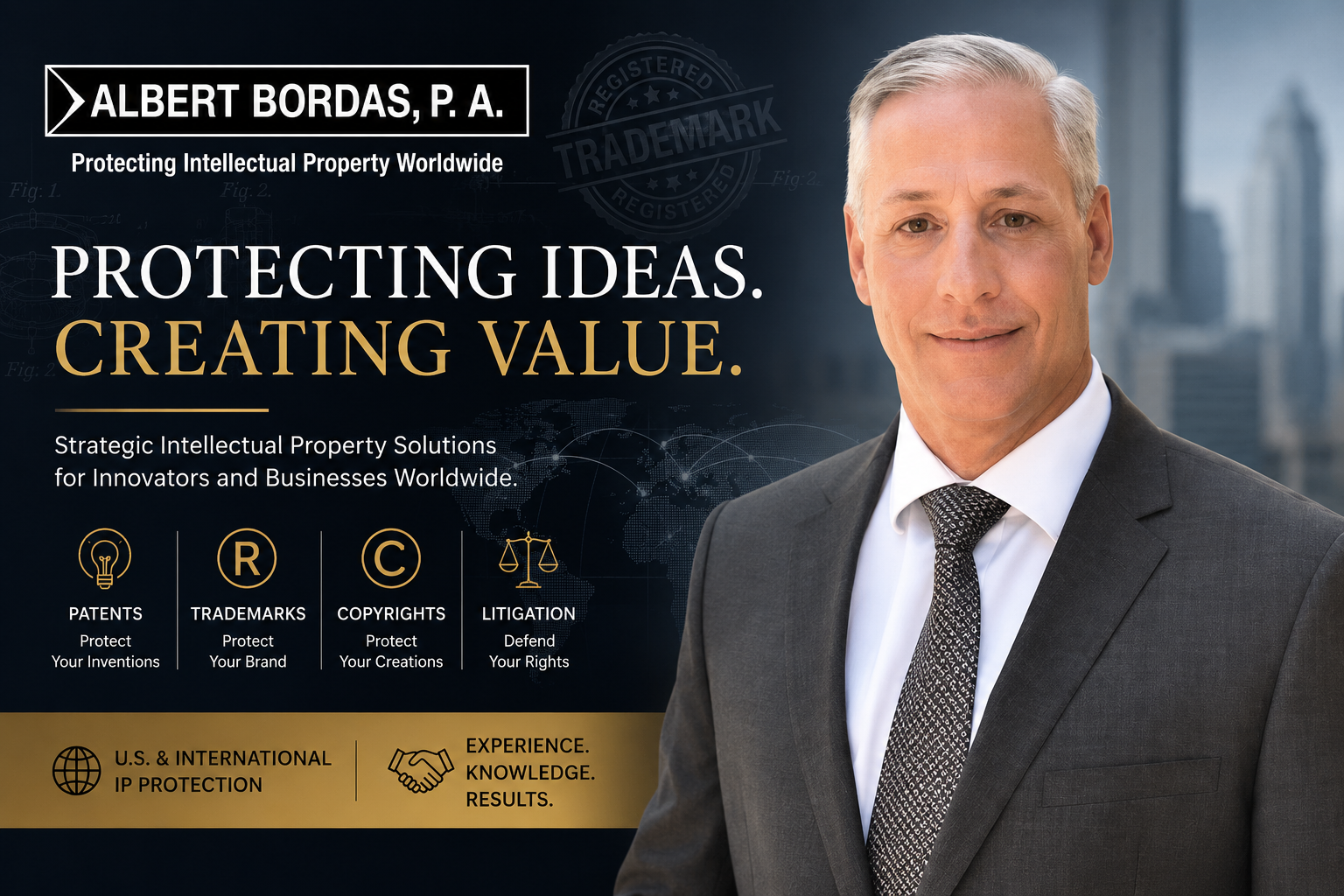
As the founder of Albert Bordas, P.A., Bordas has spent more than 26 years helping inventors, entrepreneurs, startups, and established companies secure patents, trademarks, copyrights, and other forms of intellectual property protection. His approach is unique because long before becoming an attorney, he built successful careers in aviation and engineering, giving him a technical perspective that few intellectual property lawyers possess.
A Career Built on Engineering, Innovation, and Law
Albert Bordas’ professional journey didn’t begin in a courtroom.
After graduating from Miami Springs High School, he pursued aviation by attending George T. Baker Aviation School, where he earned certifications as an FAA-licensed aircraft mechanic. Inspired by his father’s career with Eastern Airlines, Bordas initially envisioned a future in aviation.
As the aviation industry evolved, so did his ambitions.
He transitioned into engineering and joined UPS, where the company’s tuition assistance program allowed him to continue his education. While working full-time, Bordas earned both a Master of Business Administration and a Master’s degree in Engineering from the University of Miami.
Rather than stopping there, he challenged himself once again by attending law school.
The combination of aviation, engineering, business, and law ultimately led him to the practice area that perfectly blended all four disciplines: intellectual property law.
Today, that diverse background allows him to communicate effectively with inventors, engineers, manufacturers, software developers, and entrepreneurs because he understands the technical language behind their innovations.
Understanding the Different Types of Intellectual Property
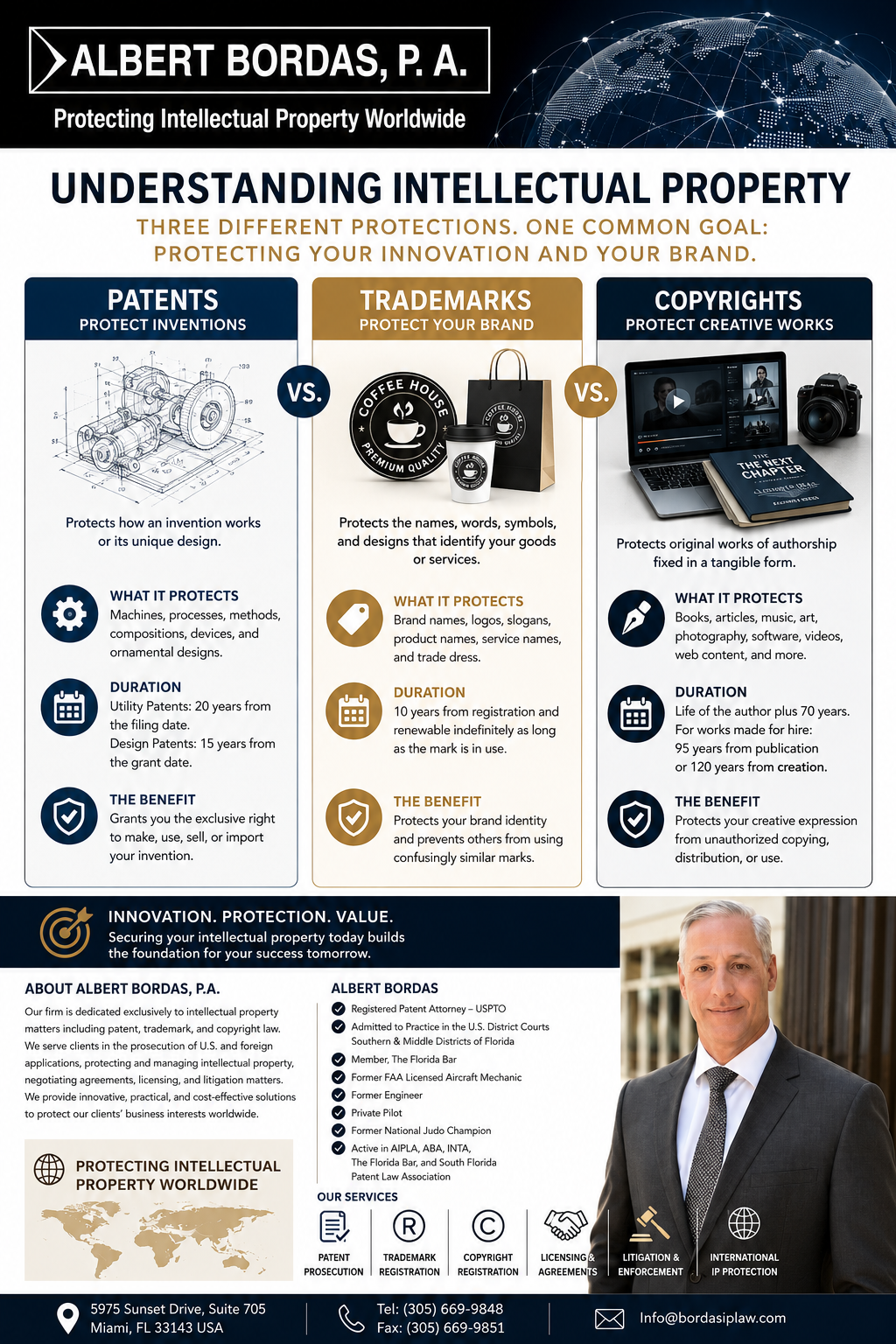
During a recent educational presentation to local business professionals, Bordas explained that many entrepreneurs confuse patents, trademarks, and copyrights. While they all protect intellectual property, each serves a different purpose.
Patents Protect Inventions
A patent protects an invention and grants the inventor exclusive rights to make, use, or sell that invention for a specific period.
Bordas explained that patents generally fall into two primary categories.
Utility patents protect how an invention works. If a product performs a new function, solves a technical problem, or introduces a unique process, a utility patent may provide protection.
Design patents, on the other hand, protect the ornamental appearance of a product. Even if two products function identically, a unique visual design may qualify for design patent protection.
Many products—including smartphones and consumer electronics—can qualify for both.
As Bordas noted, innovation doesn’t always mean inventing something entirely new. Sometimes it’s creating a better version of something people already use every day.
Trademarks Protect Your Brand
For many businesses, trademarks become their most valuable asset.
A trademark can protect:
- Business names
- Product names
- Service names
- Logos
- Taglines
- Slogans
- Brand identities
Bordas encourages business owners to perform comprehensive trademark availability searches before investing significant time and money into branding.
Choosing a name that infringes on an existing trademark can result in costly disputes, forced rebranding, and unnecessary legal expenses.
Federal trademark registration provides significant advantages, especially for businesses operating online or serving customers across state lines. Even a single-location business with a website may qualify for federal protection because its activities affect interstate commerce.
Copyrights Protect Creative Works
While patents protect inventions and trademarks protect brands, copyrights safeguard creative expression.
Copyright protection applies to original works such as:
- Books
- Software
- Mobile applications
- Training materials
- Photography
- Music
- Videos
- Website content
- Marketing materials
For businesses producing valuable digital content, copyright registration adds another important layer of protection.
The Biggest Challenge Isn’t Getting a Patent
One of Bordas’ most memorable observations wasn’t about legal filings.
It was about business.
“The difficult part isn’t always obtaining the patent,” he explained.
“The difficult part is convincing the marketplace that your invention solves a problem people are willing to pay for.”
In other words, protecting an idea is only the first step.
Commercializing it successfully often becomes the greater challenge.
This practical perspective reflects Bordas’ engineering mindset. A successful invention must not only be innovative—it must also solve a real-world problem in a way customers recognize and value.
Real Innovation Comes in Many Forms
Throughout his career, Bordas has worked with inventors across a wide variety of industries.
Some inventions involve sophisticated engineering systems, while others improve everyday products.
One memorable example involved an autonomous umbrella designed to hover above its user using sensors and advanced technology, automatically following the person without being held.
Other clients have developed firearm accessories, holsters, mobile phone accessories, charging devices, consumer products, and numerous innovations serving niche markets.
These examples demonstrate an important truth about innovation.
Groundbreaking ideas don’t always originate inside Fortune 500 companies.
Many begin with entrepreneurs who identify everyday problems and imagine better solutions.
Protecting Intellectual Property Around the World
Albert Bordas, P.A. serves clients seeking intellectual property protection not only throughout the United States but also internationally.
The firm’s services include:
- U.S. patent applications
- International patent filings
- Trademark registration
- Copyright registration
- Intellectual property portfolio management
- Licensing agreements
- Intellectual property litigation
- Internet law
- Domain name disputes
- Brand enforcement
Whether representing startups launching their first product or established businesses expanding globally, the firm’s objective remains the same: protecting valuable intellectual assets before problems arise.
Why Technical Knowledge Matters
One characteristic distinguishes Bordas from many intellectual property attorneys.
He has personally worked as an engineer.
That experience allows him to understand mechanical systems, manufacturing processes, technical drawings, and complex inventions from the inventor’s perspective.
Rather than simply reviewing legal documents, he appreciates the engineering principles behind the innovation itself.
For inventors, that shared technical language often makes the patent process more efficient and collaborative.
Final Thoughts
Innovation fuels economic growth, creates new industries, and improves everyday life.
But even the most promising idea can lose value if it isn’t properly protected.
Albert Bordas has built his career helping innovators safeguard the ideas they work so hard to create. By combining decades of legal experience with a background in engineering and aviation, he offers clients a unique perspective that bridges technology and law.
For entrepreneurs, inventors, and business owners, protecting intellectual property isn’t simply about filing paperwork—it’s about preserving the value of innovation and creating a foundation for long-term success.
FAQ
What does a patent attorney do?
A patent attorney helps inventors protect new inventions by preparing, filing, and prosecuting patent applications while providing legal guidance on intellectual property strategy.
What is the difference between a patent and a trademark?
A patent protects how an invention works or its unique design, while a trademark protects business names, logos, slogans, and brand identity.
Do small businesses need trademarks?
Yes. Registering a trademark helps protect a company’s brand identity and can prevent others from using confusingly similar names.
Can software be protected?
Yes. Depending on the circumstances, software may qualify for copyright protection, patent protection, or both.
Your Next Great Idea Deserves Great Protection.
Whether you’re launching a new business, developing an invention, building a brand, or creating original content, protecting your intellectual property is one of the smartest investments you can make.
Schedule a consultation with Albert Bordas, P.A. and take the first step toward securing your innovation.
📞 (305) 669-9848
📧 Info@bordasiplaw.com
🌐 Protecting Intellectual Property Worldwide
Editorial & Legal Disclaimer
This article is provided by MiamiBusiness.com for general informational and educational purposes only. It is intended to highlight topics of interest within the South Florida business community and should not be construed as legal advice, legal opinion, or a substitute for consultation with a qualified attorney.
The views, comments, and opinions expressed by featured individuals are their own and do not necessarily reflect the views of MiamiBusiness.com, its owners, affiliates, publishers, authors, or contributors. Publication of this article does not constitute an endorsement, recommendation, certification, or guarantee regarding any attorney, law firm, legal service, or potential outcome.
Reading this article, contacting a featured attorney, or submitting information through any referenced website or communication channel does not create an attorney-client relationship. Legal matters are unique, and readers should consult qualified legal counsel regarding their specific circumstances.
Although reasonable efforts are made to present accurate and current information, laws, regulations, court decisions, and administrative rules change over time. MiamiBusiness.com makes no representations or warranties regarding the completeness, accuracy, or continuing applicability of the information contained in this publication and expressly disclaims liability for any actions taken or not taken based upon its contents.
Attorney advertising and legal services are governed by the Rules Regulating The Florida Bar and other applicable laws and regulations. Readers are encouraged to independently evaluate legal professionals and request additional information concerning qualifications, experience, and representation before making hiring decisions.
Copyright Notice
© 2026 MiamiBusiness.com. All rights reserved.
This article is an original editorial work created for MiamiBusiness.com and is protected under United States copyright law. No portion of this publication may be reproduced, republished, distributed, or transmitted in any form or by any means without prior written permission, except as permitted by applicable copyright law.