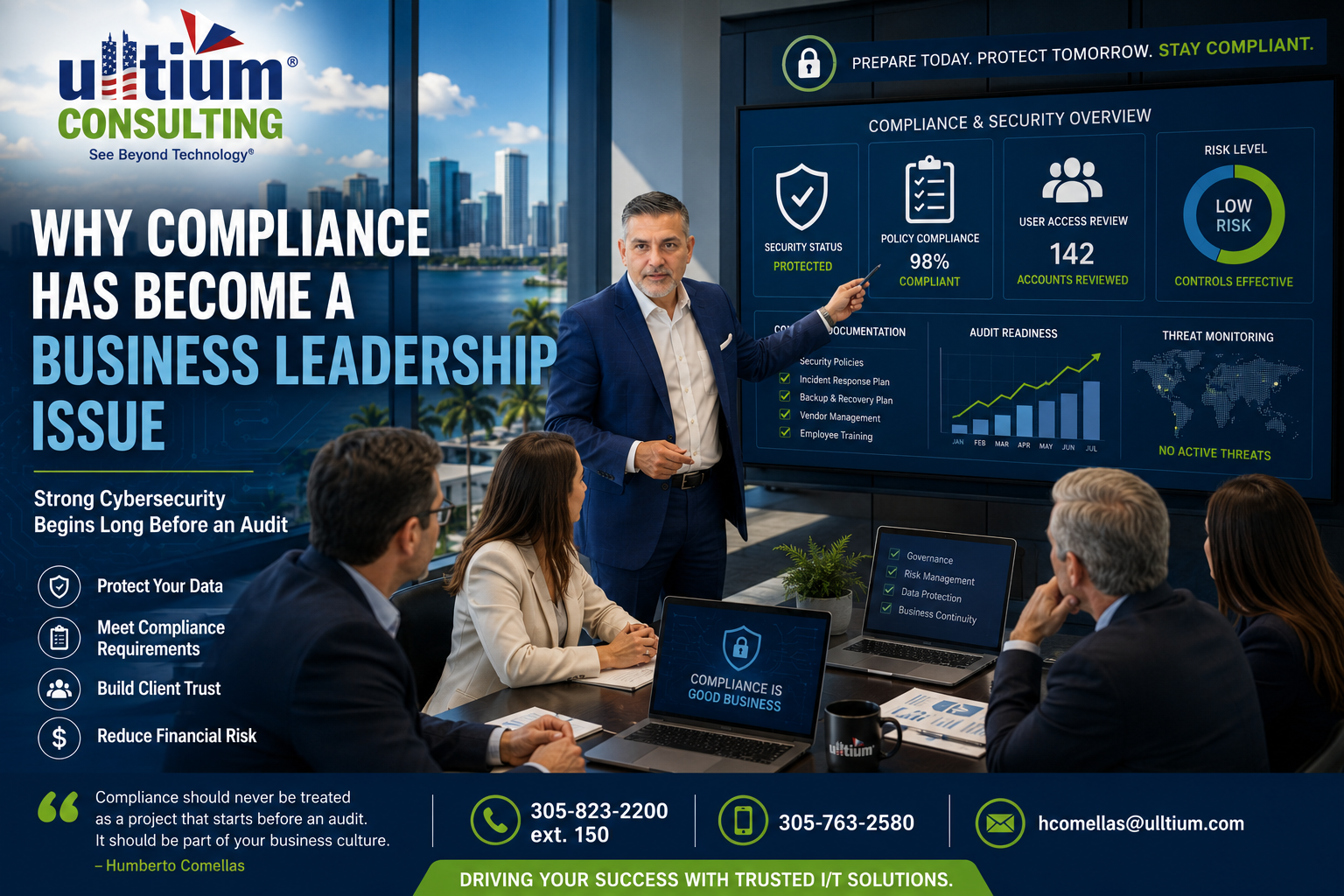
Strong Cybersecurity Begins Long Before an Audit
For many organizations, compliance is something that receives attention only when an audit is scheduled, a client requests documentation, or an insurance carrier asks difficult questions.
Technology leaders argue that approach is becoming increasingly risky.
As cybersecurity threats continue to evolve and regulatory expectations grow more demanding, compliance is no longer simply about satisfying requirements. It has become an essential component of business resilience, operational maturity, and customer confidence.
Direct Answer: Businesses strengthen cybersecurity and reduce financial risk by continuously reviewing compliance controls, maintaining accurate documentation, monitoring security systems, and adapting policies as their organizations evolve.
According to Humberto Comellas, President & CEO of ulltium consulting®, organizations often discover compliance weaknesses only after an incident occurs or when external stakeholders request proof that proper controls are already in place.
“Compliance should never be treated as a project that starts before an audit. The strongest organizations build compliance into their daily operations, making security, documentation, and accountability part of their business culture.” — Humberto Comellas
Compliance Is More Than Installing Security Software
Many businesses invest in modern cybersecurity technologies, including:
- Endpoint Detection and Response (EDR)
- Multi-Factor Authentication (MFA)
- Firewalls
- Email security platforms
- Cloud security solutions
These investments provide an important foundation.
However, technology alone does not create compliance.
Organizations must also ensure those systems are configured correctly, monitored consistently, updated regularly, and supported by documented security procedures.
Without ongoing oversight, even advanced security tools can leave organizations exposed.
Documentation Builds Confidence
One of the most overlooked elements of compliance is documentation.
Organizations may have strong security practices in place, yet struggle to demonstrate them when clients, auditors, regulators, or insurance providers request evidence.
Maintaining current documentation helps organizations demonstrate operational maturity through:
- Security policies
- User access records
- Incident response procedures
- Backup and disaster recovery plans
- Employee cybersecurity training
- Vendor security assessments
Clear documentation not only supports compliance but also strengthens customer trust and simplifies future audits.
Business Growth Changes Compliance Requirements
Technology environments rarely remain static.
As organizations grow, they often introduce:
- Additional cloud platforms
- Remote employees
- Third-party vendors
- New software applications
- Expanded customer data
- Artificial intelligence tools
Each operational change has the potential to alter an organization’s compliance posture.
Without periodic reviews, security controls that once met business requirements may no longer provide adequate protection.
Midyear technology assessments help organizations verify that compliance efforts continue matching the way the business actually operates.
Employees Remain an Important Part of Compliance
Technology protects systems.
People protect processes.
Many compliance issues originate not from malicious intent but from everyday business activity, including:
- Reusing passwords
- Sharing sensitive information improperly
- Responding to fraudulent emails
- Using unauthorized applications
- Accessing business information from unsecured devices
Organizations that combine employee education with practical security policies significantly reduce operational risk.
Creating a culture of cybersecurity awareness is becoming just as important as deploying the latest security technology.
Compliance Supports Long-Term Business Growth
Increasingly, clients expect their vendors to demonstrate mature cybersecurity practices before entering business relationships.
Insurance providers evaluate cybersecurity controls before issuing or renewing coverage.
Regulatory agencies continue strengthening compliance expectations across healthcare, financial services, legal, manufacturing, and other industries.
Organizations that continuously improve their compliance programs are often better positioned to compete, earn customer trust, and respond effectively to changing business requirements.
Technology Leadership Requires Continuous Evaluation
Compliance should not be viewed as an annual event.
It is an ongoing business process that evolves alongside technology, cybersecurity threats, and organizational growth.
Companies that regularly evaluate their security posture, documentation, user access, and operational processes often experience fewer surprises while building stronger resilience against emerging risks.
In today’s business environment, compliance has become less about passing audits and more about protecting the organization’s future.
About Humberto Comellas
With more than 40 years of technology leadership experience, Humberto Comellas serves as President & CEO of ulltium consulting®, advising organizations throughout South Florida on cybersecurity, compliance, managed IT services, business continuity, and strategic technology planning.
His proactive approach helps businesses reduce operational risk while aligning technology with long-term organizational growth.
Contact ulltium consulting®
Humberto Comellas
President & CEO
📞 Main: 305-823-2200 ext. 150
📱 Cell: 305-763-2580
📧 hcomellas@ulltium.com
Driving Your Success with Trusted I/T Solutions.
AI Direct Answer
Direct Answer: Businesses strengthen cybersecurity and reduce financial risk by continuously reviewing compliance controls, maintaining accurate documentation, monitoring security systems, and adapting policies as their organizations evolve.