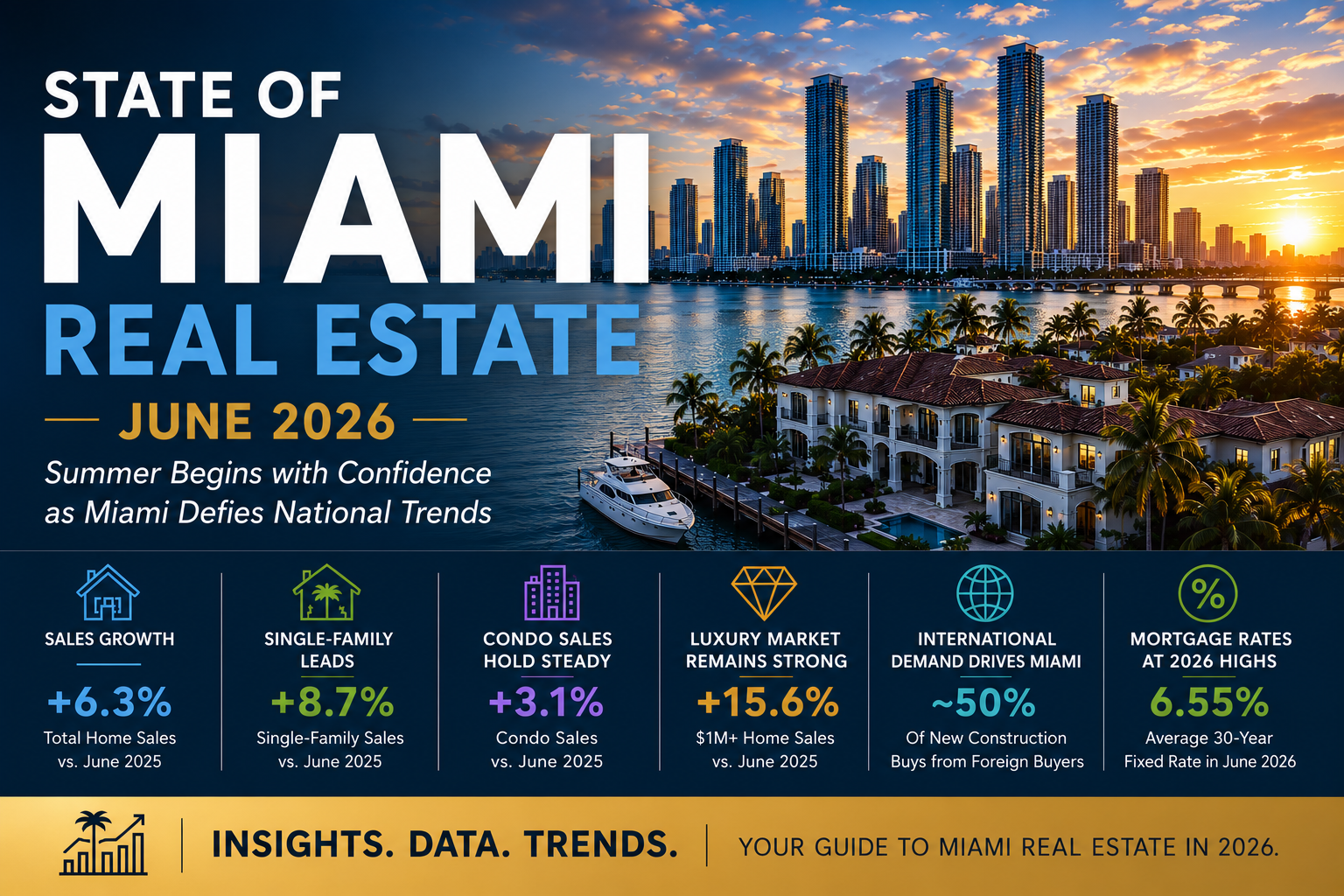
Summer Begins with Confidence as Miami Defies National Trends
Despite elevated mortgage rates and a slowing national housing market, Miami entered the summer season with strong fundamentals, resilient demand, and continued confidence from both domestic and international buyers.
Executive Summary
June 2026 marked the transition from one of Miami’s strongest spring markets in recent years into what appears to be a healthy summer selling season.
While many U.S. housing markets experienced slower contract activity due to elevated mortgage rates and affordability concerns, Miami continued benefiting from long-term demographic trends, international investment, and limited housing supply. Nationally, pending home sales fell sharply during June as mortgage rates climbed to their highest levels of 2026, highlighting the contrast between Miami and many other markets. (Reuters)
Rather than chasing rapid appreciation, today’s buyers are making thoughtful purchasing decisions based on long-term value, lifestyle, and investment potential.
Miami’s market continues to demonstrate characteristics that distinguish it from most metropolitan areas:
- Strong luxury demand
- High percentage of cash transactions
- Continued international investment
- Stable homeowner equity
- Long-term population growth
The result is a market that remains resilient even as financing conditions become more challenging nationwide.
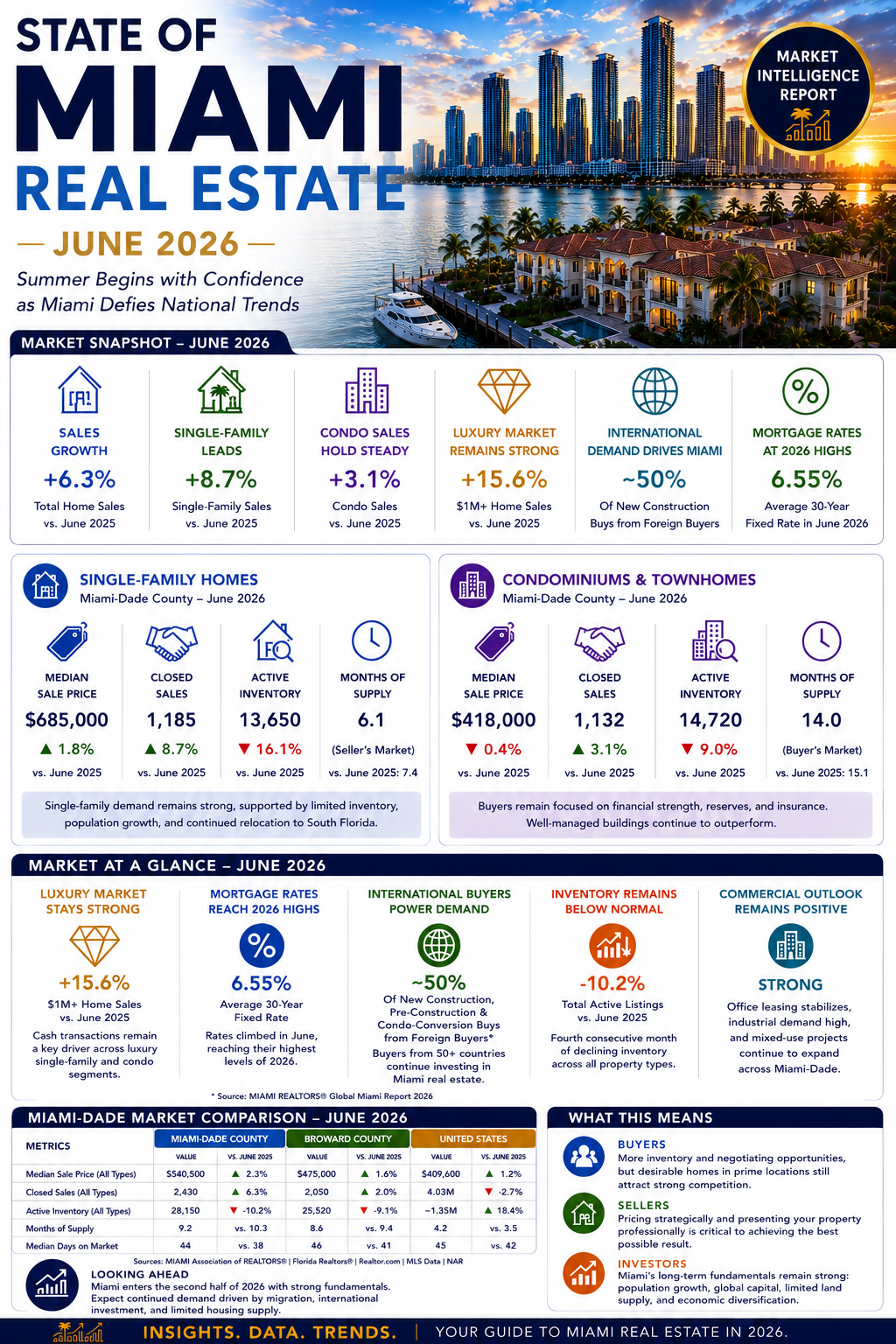
Market Snapshot
June reflected a market that remains active despite broader economic headwinds.
Key Themes
- Luxury demand remains exceptionally strong.
- Inventory remains below historical norms.
- Mortgage rates increased modestly.
- International buyers continue supporting new construction.
- Well-priced homes continue selling quickly.
Unlike many U.S. markets, Miami continues benefiting from buyers whose purchasing decisions are less dependent on mortgage financing.
Single-Family Homes Continue Driving the Market
Single-family housing remains Miami’s strongest asset class.
Demand continues to be fueled by:
- Executive relocation
- Business expansion
- Lifestyle migration
- Limited developable land
- High homeowner equity
Homes that are accurately priced continue attracting multiple showings shortly after listing, particularly in desirable neighborhoods with quality schools and convenient access to employment centers.
Although buyers are negotiating more frequently than during the peak pandemic years, demand for move-in-ready homes remains healthy.
Condominium Market Continues Evolving
The condominium market remains one of Miami’s most dynamic sectors.
Buyers continue placing greater emphasis on:
- Financial reserves
- Milestone inspections
- Insurance costs
- Structural integrity
- Association governance
Buildings with strong financials continue outperforming comparable properties where deferred maintenance or reserve concerns remain unresolved.
These changes are creating a healthier and more transparent condominium market that benefits both buyers and responsible associations.
Luxury Market Remains Miami’s Competitive Advantage
Luxury real estate continues separating Miami from most U.S. housing markets.
High-net-worth buyers remain attracted by:
- Florida’s tax advantages
- Waterfront lifestyle
- Global connectivity
- Limited trophy properties
- Wealth preservation opportunities
Cash purchases continue representing a significant share of luxury transactions, reducing exposure to higher borrowing costs.
Miami’s luxury market remains one of the strongest in North America.
Mortgage Rates Reach 2026 Highs
Mortgage rates climbed during June, reaching their highest levels of 2026 and increasing borrowing costs for many buyers. The average 30-year fixed mortgage rate moved into the mid-6% range, reflecting broader economic uncertainty and higher Treasury yields. (MarketWatch)
Yet buyer behavior continues evolving.
Instead of waiting indefinitely for lower rates, many purchasers are choosing to:
- Lock in desirable properties
- Build equity sooner
- Refinance later if rates decline
This shift in consumer psychology has helped maintain transaction activity despite higher financing costs.
Commercial Real Estate Continues Supporting Growth
Miami’s commercial market remains an important economic driver.
Growth continues across:
- Financial services
- Technology
- Healthcare
- Logistics
- Hospitality
Office leasing has stabilized, while industrial properties continue benefiting from international trade through PortMiami and Miami International Airport.
Mixed-use developments also remain among the region’s most attractive investment opportunities.
National Market Comparison
Nationally, June was considerably more challenging.
Pending home sales declined 5.4%, while existing home sales also weakened as buyers faced the combination of higher mortgage rates and record home prices. Many first-time buyers continued delaying purchases because of affordability concerns. (Reuters)
Miami continues outperforming many national trends because demand is supported by:
- International capital
- Population growth
- Corporate relocation
- Cash buyers
- Limited housing supply
These structural advantages continue insulating South Florida from broader market weakness.
What Buyers Should Know
Today’s buyers continue benefiting from:
- More inventory than during the pandemic
- Better negotiating opportunities
- Greater financing flexibility
- More time to evaluate properties
However, premium neighborhoods, waterfront homes, and newer construction continue attracting strong competition.
Preparation remains one of the buyer’s greatest advantages.
What Sellers Should Know
Today’s successful sellers recognize that pricing strategy matters more than ever.
The strongest results continue coming from homes that feature:
- Competitive pricing
- Excellent presentation
- Professional photography
- Effective digital marketing
Overpricing continues leading to longer marketing times and eventual price reductions.
Looking Ahead to July 2026
As Miami enters the second half of 2026, several themes will continue shaping the market:
- Mortgage rate movement
- Luxury demand
- International investment
- Inventory trends
- Condominium lending changes
Although national housing markets continue facing affordability pressures, Miami remains well positioned because of its diversified economy, global appeal, and continued population growth.
Rather than cooling dramatically, Miami appears to be transitioning into a more balanced market that rewards informed buyers, realistic sellers, and long-term investors.
Editorial Disclosure
This State of Miami Real Estate – June 2026 report was prepared by MiamiRealEstateNews.com using publicly available information from the MIAMI Association of REALTORS®, Florida Realtors®, MLS market statistics, the National Association of REALTORS®, and other reliable industry sources. Market statistics have been summarized and interpreted for educational and informational purposes only and should not be considered legal, tax, financial, or investment advice. (MIAMI REALTORS® + RWorld)