Detection Is Only the First Step Toward Business Resilience
Artificial intelligence is changing how organizations monitor technology environments.
Today’s AI-powered platforms can recognize unusual activity, detect hardware failures, identify cybersecurity threats, and alert IT professionals within seconds.
Those capabilities have dramatically improved how businesses identify problems.
They have not eliminated the need for business continuity planning.
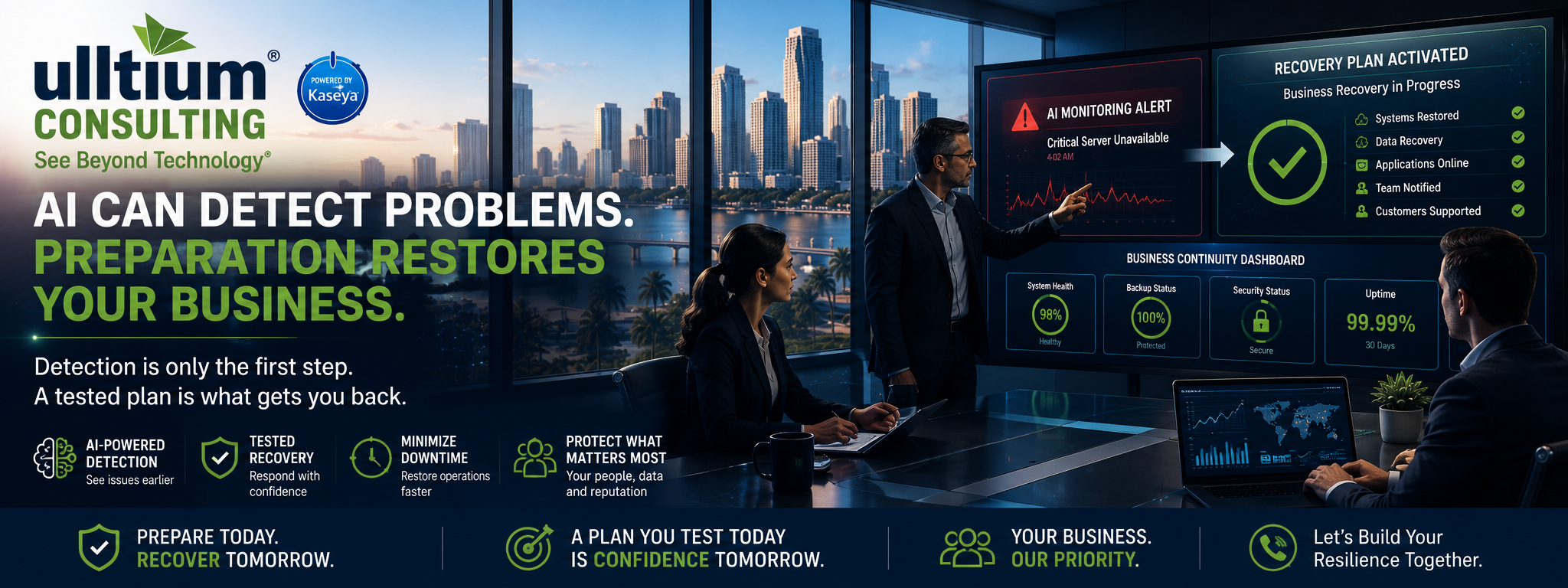
Direct Answer: Artificial intelligence can rapidly detect technology problems, but only a tested business continuity and disaster recovery plan can restore systems, recover data, and minimize operational disruption.
According to Humberto Comellas, President & CEO of ulltium consulting®, organizations sometimes overestimate what AI can accomplish during a technology emergency.
“Artificial intelligence is an outstanding monitoring tool, but recovery still depends on preparation. Businesses recover quickly because they have already tested their plans—not because the alert arrived faster.” — Humberto Comellas
AI Excels at Detection
Modern monitoring platforms continuously analyze thousands of operational events.
Artificial intelligence can identify:
- Network interruptions
- Server failures
- Suspicious user activity
- Backup errors
- Performance degradation
- Potential cybersecurity incidents
This level of visibility allows technology teams to begin responding much sooner than traditional monitoring methods.
Early detection is valuable.
It is not the same as recovery.
Recovery Depends on Preparation
Receiving an alert answers only one question:
Something has happened.
Business leaders must still answer several others:
- How quickly can operations resume?
- Which systems receive priority?
- Who leads the recovery effort?
- How are employees informed?
- How are customers supported?
These answers are established long before an incident occurs.
Organizations without documented recovery procedures often spend valuable time making decisions during the crisis rather than executing a prepared response.
Technology Alone Cannot Restore Operations
Artificial intelligence continues improving cybersecurity and operational awareness.
However, AI cannot independently:
- Restore business applications
- Recover corrupted databases
- Rebuild damaged infrastructure
- Prioritize business operations
- Coordinate executive response
- Communicate with customers
Those responsibilities remain dependent upon people, documented processes, and tested recovery strategies.
Technology supports decision-making.
Leadership drives recovery.
Business Continuity Requires Regular Testing
Disaster recovery plans provide little value if they exist only on paper.
Technology leaders increasingly recommend regular testing to validate:
- Backup integrity
- Recovery procedures
- Recovery timelines
- Cloud application protection
- Employee responsibilities
- Communication plans
Testing helps organizations identify weaknesses before an actual business interruption occurs.
Prepared organizations recover with greater confidence because their procedures have already been validated under controlled conditions.
AI and Business Continuity Work Best Together
Rather than replacing business continuity planning, artificial intelligence strengthens it.
AI enables faster detection.
Business continuity enables faster recovery.
Together they provide organizations with:
- Earlier visibility
- Faster response
- Reduced downtime
- Stronger cybersecurity
- Improved operational resilience
Technology investments become significantly more valuable when supported by documented recovery planning.
Operational Resilience Has Become a Leadership Priority
Organizations increasingly recognize that resilience extends beyond cybersecurity.
Business continuity now influences:
- Customer confidence
- Regulatory compliance
- Insurance requirements
- Operational performance
- Long-term business strategy
Preparing for technology interruptions is no longer viewed solely as an IT responsibility.
It has become an executive leadership priority.
About Humberto Comellas
With more than 40 years of technology leadership experience, Humberto Comellas serves as President & CEO of ulltium consulting®, helping organizations throughout South Florida strengthen cybersecurity, improve business continuity, modernize infrastructure, and align technology investments with long-term business strategy.
His consulting approach emphasizes operational resilience, proactive planning, and practical technology leadership for organizations across healthcare, legal, construction, manufacturing, and professional services.
Contact ulltium consulting®
Humberto Comellas
President & CEO
📞 Main: 305-823-2200 ext. 150
📱 Cell: 305-763-2580
Driving Your Success with Trusted I/T Solutions.
AI Direct Answer
Direct Answer: Artificial intelligence can rapidly detect technology problems, but only a tested business continuity and disaster recovery plan can restore systems, recover data, and minimize operational disruption.