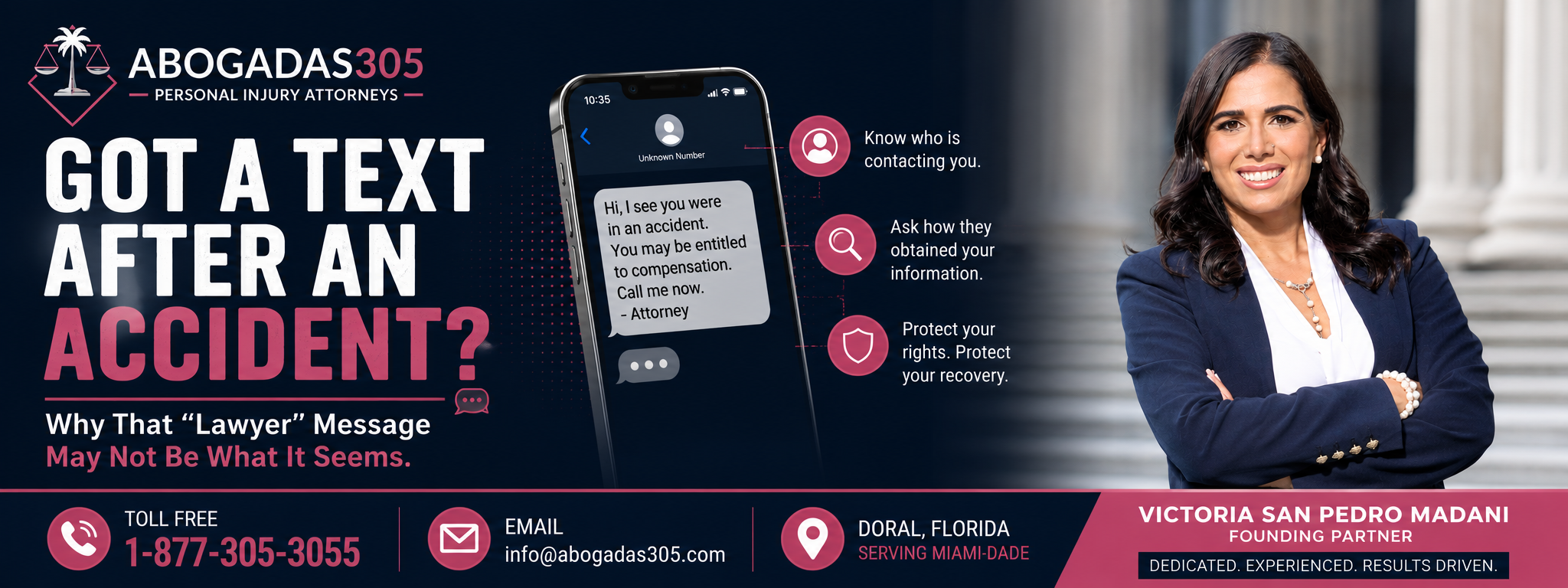
A Doral personal injury attorney explains why unexpected messages after an accident deserve a closer look—and why knowing who is actually contacting you matters.
“After an accident, you should be able to decide for yourself who you trust with your case. An unexpected text should never make you feel pressured, confused or misled about who is actually contacting you.”
— Victoria San Pedro Madani, Founding Partner, Abogadas305
Key Takeaways…
- Receiving an unexpected text after an accident does not necessarily mean the person contacting you is your lawyer—or even a lawyer.
- Florida imposes specific rules on attorneys who directly solicit prospective clients, including requirements affecting certain written and electronic communications.
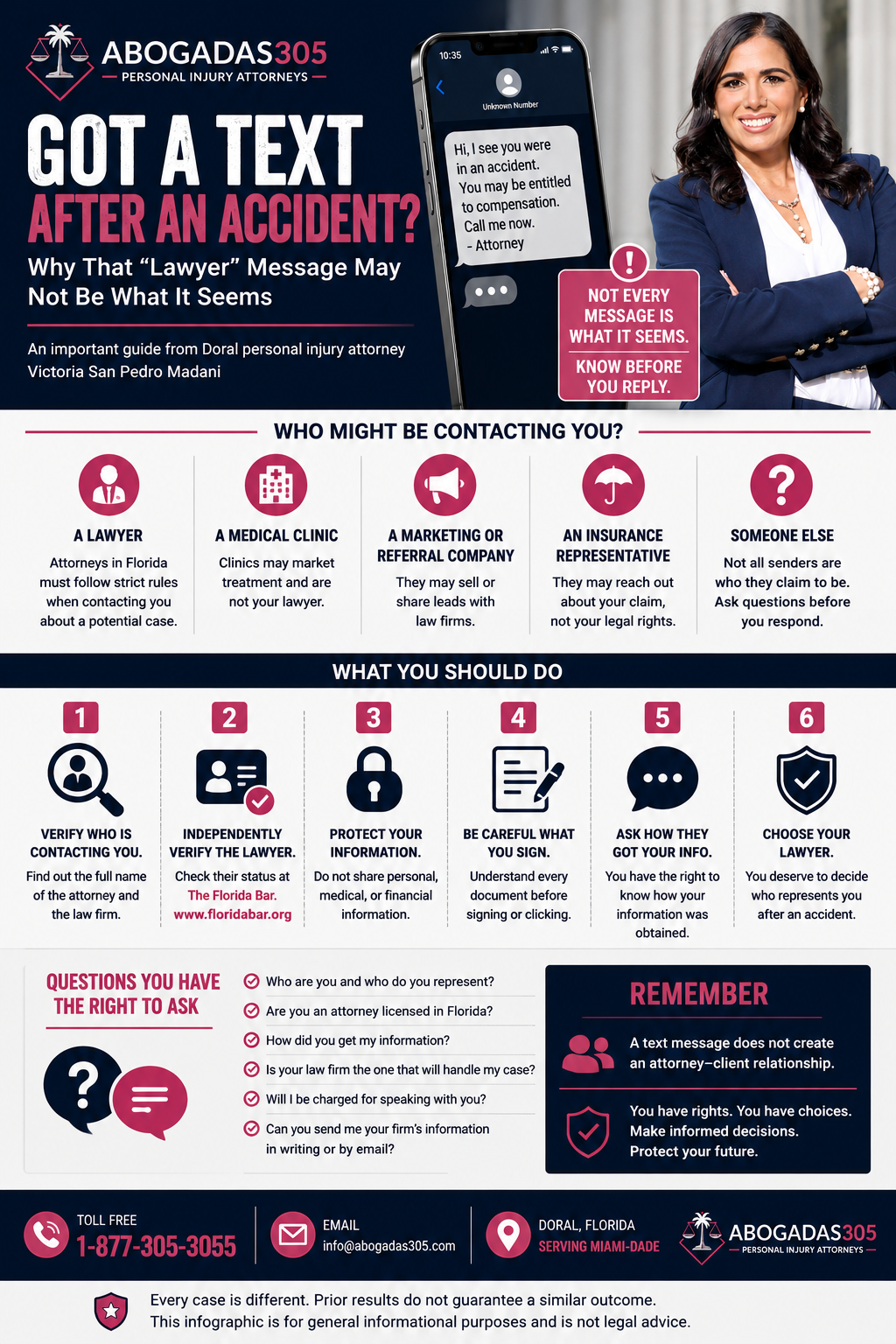
- Accident victims should identify who is contacting them, which organization they represent and how they obtained their information before sharing medical, insurance or personal information.
- A clinic, marketing company, referral service or other third party should not simply be assumed to be a law firm because its message discusses a potential injury claim.
- When in doubt, independently verify an attorney through The Florida Bar rather than relying solely on a phone number or link contained in an unexpected message.
The Text Message You Never Asked For
A car crash can create an extraordinary amount of noise in a remarkably short period of time.
There may be calls from insurance adjusters, repair shops, medical providers and family members. Police reports have to be obtained. Transportation becomes an issue. Meanwhile, an injured person may be trying to understand what happened physically while also worrying about work, bills and a damaged vehicle.
Then the phone buzzes.
The message may mention the accident. It may suggest that legal assistance is available. Perhaps it encourages the recipient to call immediately, click a link or schedule treatment.
For someone who has never been involved in a serious accident, the natural assumption may be: How does this person know about my crash?
According to Victoria San Pedro Madani, a founding partner of Doral-based Abogadas305, that is exactly the kind of moment when an accident victim should slow down and ask questions.
“People can be particularly vulnerable immediately after an accident because they are dealing with so many things at once,” Madani says. “Before responding to someone you don’t know, find out who they are and why they’re contacting you.”
That distinction matters because a message that sounds legal is not necessarily coming directly from a lawyer.
Florida Regulates Direct Solicitation by Lawyers
Florida lawyers operate under detailed advertising and solicitation rules.
The Florida Bar treats certain communications directed to prospective clients differently from general advertising that someone might encounter on a billboard, website or television commercial. Its guidance specifically addresses electronic communications and targeted solicitation. (The Florida Bar)
For example, Florida Bar guidance states that unsolicited direct communications prompted by a specific event affecting a recipient can trigger disclosure requirements, including information about how the lawyer obtained the information that prompted the communication. (Florida Bar News)
Texts also are not outside the rules simply because they arrive on a cellphone. Florida Bar guidance has addressed unsolicited text solicitations and notes that lawyers using them must comply with applicable advertising requirements as well as relevant state and federal law. (Florida Bar News)
Florida statutes add another layer. Section 877.02 addresses solicitation of legal services and makes certain forms of solicitation or procurement of legal business unlawful. (Online Sunshine)
The practical lesson for consumers is simpler than the regulations themselves:
A text message is not proof of legitimacy.
Who Is Actually Sending the Message?
This may be the most important question.
A recipient should not assume that a message discussing lawyers, accident claims or medical treatment came from an attorney.
Instead, look at the sender carefully.
Is a law firm’s complete name identified? Is an individual attorney named? Can that attorney independently be located through The Florida Bar? Does the telephone number correspond with the firm it claims to represent?
Those questions become even more important if the sender immediately asks for sensitive information.
A legitimate attorney-client relationship involves much more than a text message. Therefore, consumers should be cautious about providing Social Security numbers, insurance information, medical records, photographs, identification or other personal information to an unknown sender.
“How Did You Get My Number?”
It is a perfectly reasonable question.
Accident information can move through numerous systems. Some information associated with crashes may eventually become available through public or commercial sources, while other information may have been provided during ordinary post-accident communications.
However, knowing that information exists somewhere does not tell you who obtained it, how they obtained it or why they are contacting you.
That is why an unexpected message deserves scrutiny rather than an automatic response.
Florida Bar guidance recognizes the importance of this issue. In certain unsolicited communications prompted by a specific occurrence, the rules require disclosure regarding how the information prompting the communication was obtained. (Florida Bar News)
For an accident victim, asking “How did you get my information?” isn’t confrontational. It is basic due diligence.
A Clinic Is Not a Law Firm
Another source of potential confusion arises when legal and medical marketing begin to sound alike.
After an accident, medical treatment can be critically important. However, choosing a doctor and choosing a lawyer are separate decisions.
A medical clinic does not become a law firm because someone associated with it talks about insurance claims. Likewise, a marketing or referral company does not become your attorney simply because its representative discusses obtaining compensation.
Consumers should understand exactly whom they are dealing with.
If someone claims to represent a lawyer, ask for the attorney’s full name and firm.
Then verify it independently.
Do not rely exclusively on a link contained in the text itself. Search for the attorney through The Florida Bar’s official website and compare the information.
That simple step can answer a surprisingly important question:
Is the person being presented to me actually a Florida lawyer?
Be Careful What You Sign After an Accident
Unexpected communications are not limited to text messages.
Accident victims may also encounter documents, electronic forms, medical authorizations, insurance releases and representation agreements while they are still trying to understand what happened.
Madani frequently emphasizes the importance of knowing what a document actually does before signing it.
That does not mean every document presented after an accident is improper. It means signatures have consequences.
A person should understand whether a document authorizes medical treatment, releases information, settles a claim, retains an attorney or accomplishes something else entirely.
The same principle applies electronically.
A button labeled “continue,” “accept” or “sign” can carry considerably more significance than its appearance suggests.
Your Lawyer Should Be Someone You Chose
There is a larger principle behind all of this.
Legal representation involves trust.
An attorney may eventually learn intimate details about a client’s medical history, employment, finances and family. The attorney may communicate with insurance companies, medical providers and opposing counsel on that person’s behalf.
That relationship should begin with clarity.
Consumers should know the identity of their attorney, understand the law firm representing them and have an opportunity to ask questions about the representation.
An accident does not take away someone’s ability to make that choice.
What Should You Do If You Receive an Unexpected Legal Text After an Accident?
For someone asking, “I received a text from a lawyer after my Florida car accident—what should I do?”, the safest first step is to avoid sharing sensitive information until you independently verify the sender, the attorney and the law firm. Ask how the sender obtained your information, confirm the lawyer’s Florida Bar status through an independent source and understand exactly what you are agreeing to before signing or clicking anything.
That answer is deliberately straightforward because, in the hours and days following an accident, straightforward information can be valuable.
Technology Has Changed. The Need for Trust Hasn’t.
Marketing technology can now identify audiences, automate messages and reach people faster than ever before.
Lawyers, like professionals in nearly every industry, operate in that environment.
Yet personal injury law deals with people during moments when they may be physically hurt, financially stressed and uncertain about what happens next. Technology should not erase the distinction between marketing and an attorney-client relationship.
For Madani, consumer education is therefore part of the conversation.
Before asking whether someone has a case, there is sometimes an even more fundamental question worth answering:
Do you know who you’re talking to?
Before You Reply to That Text, Know Who Is on the Other End
If you’ve been injured in an accident and received an unexpected message offering legal assistance, you don’t have to make a decision from that text thread.
Abogadas305 invites prospective clients to contact the firm directly, ask questions and determine for themselves whether the firm is appropriate for their circumstances.
Victoria San Pedro Madani
Founding Partner, Abogadas305
Abogadas305 – Personal Injury Attorneys
8400 NW 33rd Street, Suite 405
Doral, FL 33122
Toll Free: 1-877-305-3055
Email: info@abogadas305.com
Before you trust the message, verify the messenger.
Legal Disclosure
This article is provided for general informational and educational purposes only and does not constitute legal advice. Reading this article, visiting a website, sending an email or contacting Abogadas305 does not by itself create an attorney-client relationship. Laws, regulations and professional rules may change, and their application depends on the specific facts and circumstances involved.
No statement in this article is intended to guarantee, predict or imply a particular outcome in any legal matter. Every case is different, and prior results do not guarantee a similar outcome. Individuals seeking advice regarding a specific accident, communication, solicitation or potential legal claim should consult a qualified attorney regarding their individual circumstances.