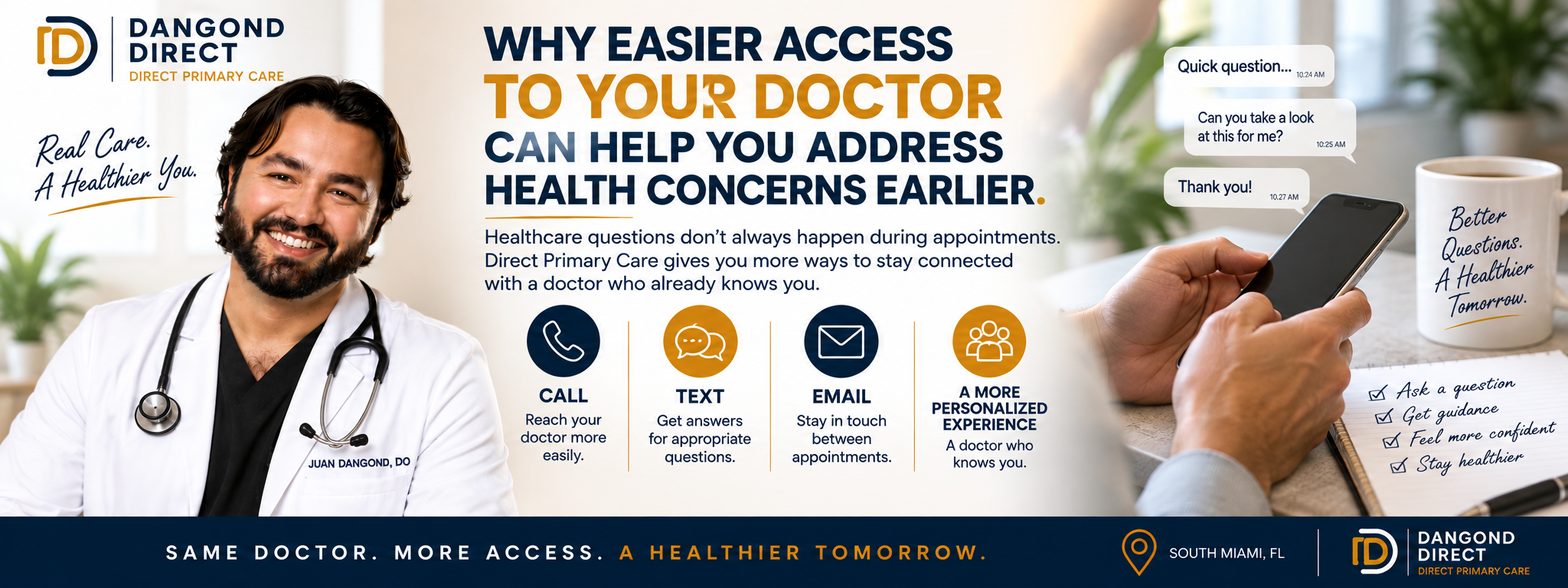
Healthcare questions don’t always happen during appointments. Direct Primary Care creates more opportunities to communicate with a physician who already knows you.
“Sometimes what a patient needs first is the opportunity to ask a question. Better access gives us more opportunities to have those conversations.”
— Dr. Juan Dangond
TL;DR
Direct Primary Care in South Miami gives patients greater access to their primary care practice through an ongoing relationship, longer appointments, and communication options that include phone, text, and email. At Dangond Direct, this model allows patients to communicate about appropriate non-emergency health concerns instead of relying exclusively on scheduled office visits. When a situation is serious or potentially life-threatening, patients should always call 911 or seek emergency medical care.
Your Health Doesn’t Follow an Appointment Calendar
You visit your doctor on Monday.
Everything seems fine.
Then Thursday comes.
Maybe you notice a new symptom.
Perhaps you have a question about a medication.
Something you’ve been monitoring changes.
Or you remember a question you forgot to ask during your appointment.
What happens next?
For many patients, the answer is familiar: call the office, navigate a phone system, leave a message, schedule another appointment, or decide whether the concern can wait.
But healthcare doesn’t happen only when you’re sitting in an examination room.
Questions arise between appointments.
That’s one of the problems Direct Primary Care was designed to address.
Access Changes the Primary Care Relationship
Traditional healthcare often revolves around the appointment.
You schedule a time.
You see the physician.
You leave.
Then you wait until the next appointment.
Direct Primary Care takes a more relationship-centered approach.
At Dangond Direct, members have communication options that include phone, text, and email for appropriate healthcare questions.
That doesn’t mean every medical concern can be handled remotely, and it certainly doesn’t replace emergency medical care.
What it does provide is another opportunity for communication.
Sometimes a conversation may lead to an appointment.
Sometimes further evaluation or testing may be appropriate.
Sometimes another healthcare setting may be recommended.
And sometimes the patient simply needs an answer to a question.
The important part is having an established physician relationship to turn to.
Small Questions Are Still Worth Asking
Patients sometimes hesitate to contact their doctor because they don’t know whether a concern is “important enough.”
Maybe you’ve noticed something unusual but aren’t sure whether it matters.
Perhaps you’re experiencing a medication side effect.
Maybe a symptom that seemed temporary hasn’t gone away.
Or perhaps you simply don’t understand something from your last appointment.
These aren’t necessarily emergencies.
But they are still healthcare questions.
Having easier access to your primary care practice can lower the barrier to starting that conversation.
Access Is More Valuable When Your Doctor Knows You
There is another important piece to this model: continuity.
Access to healthcare information is useful.
Access to a physician who already understands your health history can be even more meaningful.
Dr. Juan Dangond may already be familiar with a patient’s medications, previous concerns, chronic conditions, laboratory results, health goals, and conversations from prior visits.
That context can help inform the next conversation.
Instead of introducing yourself and your medical history every time you need care, you are continuing an established healthcare relationship.
That’s an important distinction.
Longer Appointments Can Create Better Conversations
Access isn’t only about what happens between appointments.
It’s also about what happens during them.
When visits feel rushed, patients may focus exclusively on the immediate reason they came in.
Other questions may remain unasked.
Direct Primary Care is designed to allow more time for physician-patient interaction.
That additional time creates opportunities to discuss concerns, ask questions, review medications, talk about preventive health, and consider longer-term goals.
The objective isn’t simply a longer appointment.
It’s a more meaningful conversation.
Earlier Communication Doesn’t Mean Self-Diagnosis
There is an important distinction here.
Being able to contact your physician doesn’t mean patients should diagnose themselves or decide that a symptom is harmless.
It means patients have another avenue for appropriate communication with their healthcare practice.
Some symptoms require prompt in-person evaluation.
Others may require urgent care, specialist care, testing, or another level of medical attention.
And potentially serious or life-threatening symptoms require emergency care.
If you believe you may be experiencing a medical emergency, call 911 or seek emergency medical care immediately. Do not wait for a phone, text, or email response from a primary care practice.
Direct Primary Care Isn’t About Being Available Only When You’re Sick
One of the misconceptions about healthcare access is that it matters only when something goes wrong.
Access also matters when you’re trying to stay well.
You might have a question about nutrition.
You may want to discuss exercise.
Perhaps you’re working on blood pressure, cholesterol, weight, sleep, or another health goal.
Maybe you want to better understand laboratory results.
Those conversations are part of primary care, too.
When communication becomes part of an ongoing relationship, healthcare can become less reactive and more continuous.
The Goal Is a Relationship, Not Just Convenience
It’s tempting to describe Direct Primary Care simply as “more convenient healthcare.”
But that doesn’t fully capture the model.
Convenience is helpful.
Relationship is the bigger story.
The ability to communicate by phone, text, or email matters because there is an established healthcare relationship behind those conversations.
Longer appointments matter because they give the physician and patient more time together.
Continuity matters because each conversation can build on the ones that came before.
At Dangond Direct, these pieces work together.
Access. Time. Communication. Continuity.
That’s what makes the experience different.
Featured Snippet
What are the benefits of easier access to a primary care doctor?
Easier access to a primary care doctor gives patients more opportunities to ask questions, discuss non-emergency concerns, follow up on medications, and communicate about changes in their health. In Direct Primary Care, this access is combined with an ongoing physician relationship, allowing future conversations to build on the patient’s existing medical history and care.
Frequently Asked Questions
How can Dangond Direct members communicate with the practice?
Dangond Direct members have communication options that include phone, text, and email for appropriate healthcare questions, subject to the practice’s current policies and availability.
Does Direct Primary Care mean my doctor is available 24/7?
Patients should not assume that Direct Primary Care means unrestricted 24/7 physician availability. Communication options and response times are governed by the individual practice’s policies. Emergency situations should always be handled through appropriate emergency medical services.
Can my doctor handle every concern by phone or text?
No. Some medical concerns require an examination, diagnostic testing, urgent care, specialist evaluation, or emergency treatment. The appropriate type of care depends on the individual circumstances.
Why does continuity of care matter?
Continuity allows a physician to become familiar with a patient’s medical history, medications, previous concerns, and health goals. That context can make future healthcare conversations more connected and personalized.
Should I contact Dangond Direct during a medical emergency?
No. If you believe you are experiencing a serious or potentially life-threatening medical emergency, call 911 or seek emergency medical care immediately. Do not wait for a response by phone, text, or email.
Healthcare Should Be an Ongoing Conversation
Your health doesn’t begin when you walk into a doctor’s office and stop when you walk out.
Questions happen between appointments.
Health goals develop over months and years.
Symptoms can change.
Medications may raise questions.
And sometimes you simply need to know what your next step should be.
At Dangond Direct, Direct Primary Care in South Miami is designed around an ongoing relationship between Dr. Juan Dangond and his patients—with greater opportunities for communication, longer visits, and continuity over time.
Because access isn’t simply about reaching a doctor.
It’s about having access to a doctor who knows you.
Dangond Direct Primary Care
7000 SW 62nd Ave., Suite 515
South Miami, FL 33143
Call or Text: (786) 567-9546
Email: info@dangonddirect.com
Dangond Direct
Healthcare Disclaimer
This article is provided for general educational and informational purposes only and does not constitute medical advice, diagnosis, treatment, or individualized guidance. Communication with a primary care practice does not replace emergency medical services or necessary in-person evaluation. If you believe you are experiencing a serious or potentially life-threatening medical emergency, call 911 or seek emergency medical care immediately. Services, communication methods, availability, and response times are subject to Dangond Direct’s current practice policies.