An uninsured driver can leave an injured motorist facing medical bills, lost income and difficult questions about insurance coverage. Ana Cristina Berenguer of Abogadas305 explains why the absence of another driver’s insurance does not necessarily mean the end of the road.
“After an accident, people often focus on whether the other driver has insurance. That’s an important question, but it shouldn’t be the only one. Understanding your own coverage and the circumstances of the accident can be just as important.”
— Ana Cristina Berenguer, Founding Partner, Abogadas305
Key Takeaways…
-
An uninsured driver may create financial and legal complications, but injured motorists should not automatically assume they have no available coverage.
-
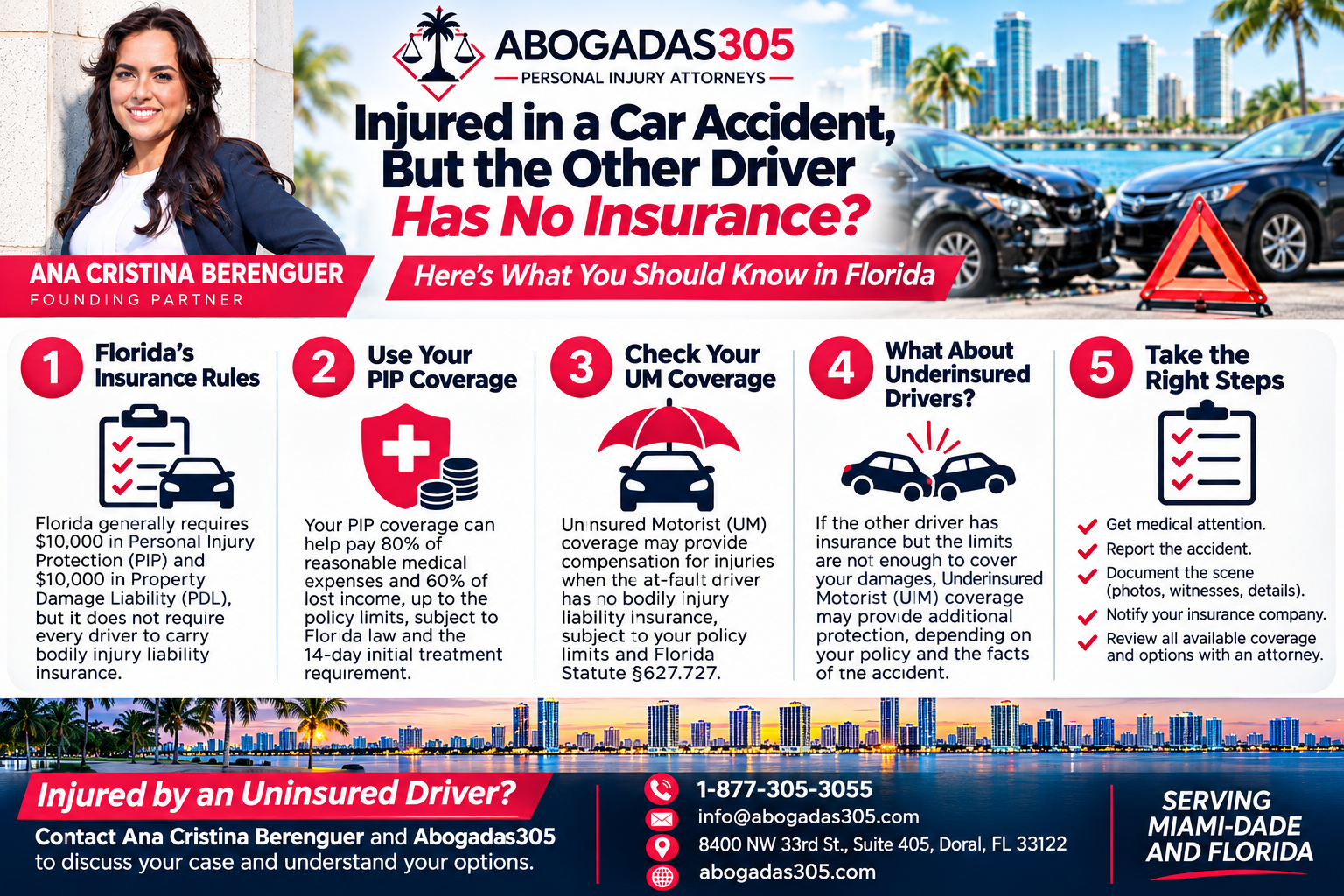
Florida generally requires qualifying registered vehicles to carry Personal Injury Protection (PIP) and Property Damage Liability (PDL) coverage, but not every driver must carry bodily injury liability insurance.
-
Uninsured Motorist (UM) coverage may provide important protection when an at-fault driver has no applicable bodily injury liability insurance.
-
Underinsured Motorist coverage may also matter when the responsible driver’s available liability coverage cannot fully compensate an injured person for covered damages.
-
Ana Cristina Berenguer, Founding Partner of Abogadas305, helps injured individuals evaluate motor-vehicle accident matters in Miami-Dade and Florida.
Who Is Ana Cristina Berenguer?
Ana Cristina Berenguer is a Florida personal injury attorney and Founding Partner of Abogadas305, a Doral-based law firm serving injured individuals throughout Miami-Dade and Florida.
Born and raised in Miami, Berenguer earned her bachelor’s degree in Business Management from Barry University before receiving her Juris Doctor from Barry University’s Dwayne O. Andreas School of Law in 2019.
Her professional experience includes plaintiff personal injury work and insurance defense, providing her with experience involving legal and insurance questions that can arise after an accident.
Today, Berenguer focuses on representing injured individuals in personal injury matters, including car accidents.
One question deserves particular attention: What happens when another driver causes an accident but does not have insurance to cover your injuries?
What Happens When an Uninsured Driver Causes an Accident in Florida?
A car accident can disrupt everyday life within seconds. Medical appointments, vehicle repairs, missed work and unexpected expenses may quickly follow.
Now imagine discovering that the driver who caused the collision has no applicable bodily injury liability insurance.
For many injured motorists, that news raises an immediate concern: Who will pay?
Although the answer depends on the circumstances, several sources of coverage may deserve examination. These can include the injured person’s Personal Injury Protection benefits, applicable Uninsured Motorist coverage, health insurance and potentially other available insurance policies.
Legal responsibility and the practical ability to recover compensation are separate questions. An uninsured driver may still be legally responsible for injuries caused by negligence, even when no liability policy is available to pay a claim.
However, pursuing a claim against an uninsured person does not guarantee that money will be collectible.
For that reason, understanding the complete insurance picture can be especially important.
Does Florida Require Every Driver to Carry Bodily Injury Insurance?
Not necessarily.
Florida’s standard registration-related insurance requirements generally include at least $10,000 in Personal Injury Protection and $10,000 in Property Damage Liability coverage for qualifying vehicles.
However, those requirements do not universally require every motorist to maintain bodily injury liability coverage.
Certain drivers face additional requirements because of previous accidents, violations, convictions or other circumstances.
This distinction can surprise motorists who assume every insured vehicle automatically carries coverage for injuries the driver causes to someone else.
A vehicle may meet Florida’s basic registration-related insurance requirements without having a bodily injury liability policy that compensates another person for injuries.
Consequently, confirming that a driver has insurance is not the same as confirming that the driver has coverage applicable to your bodily injury claim.
What Is Uninsured Motorist Coverage in Florida?
Uninsured Motorist coverage, commonly called UM coverage, can provide protection when an injured insured person has a covered claim against an at-fault motorist who lacks applicable bodily injury liability insurance.
Florida law addresses uninsured motorist coverage under Florida Statute §627.727.
The coverage generally concerns damages that an insured person is legally entitled to recover from the owner or operator of an uninsured motor vehicle because of bodily injury, sickness, disease or death, subject to the applicable statute and policy terms.
Importantly, UM coverage does not automatically apply to every accident. Eligibility, exclusions, policy definitions, coverage selections and the circumstances of the collision can affect the outcome.
Therefore, the first step is to determine whether the injured person has applicable UM coverage and how the policy operates.
Is Uninsured Motorist Coverage Mandatory?
Florida law generally requires insurers issuing qualifying motor-vehicle bodily injury liability policies to offer uninsured motorist coverage, subject to statutory provisions.
However, a named insured may reject UM coverage or select lower limits in accordance with statutory requirements.
As a result, motorists should not assume their policies include UM protection merely because they carry automobile insurance.
Reviewing the declarations page and relevant policy documents can help establish what coverage the insured purchased.
What Is the Difference Between Uninsured and Underinsured Motorist Coverage?
Although people sometimes use these terms interchangeably, they describe different insurance situations.
Uninsured motorist coverage may become relevant when the responsible motorist has no applicable bodily injury liability insurance or meets another qualifying uninsured-motorist definition under Florida law.
Underinsured motorist protection may become relevant when the at-fault motorist carries liability coverage, but the available limits are insufficient to fully address covered damages.
For example, an injured person may face substantial medical expenses and other damages after a serious collision, while the responsible driver’s bodily injury liability limits provide comparatively little coverage.
Whether UM benefits are available, and how much may be recoverable, depends on the applicable policy, statutory rules, available offsets and the evidence supporting the claim.
In either situation, understanding the insurance policies is essential before reaching conclusions about potential compensation.
Can Personal Injury Protection Help After an Accident With an Uninsured Driver?
Potentially, yes.
Florida’s no-fault insurance system generally requires Personal Injury Protection coverage for qualifying vehicles.
Under Florida Statute §627.736, PIP may pay 80% of reasonable expenses for covered medically necessary services and 60% of qualifying lost income, subject to statutory restrictions and policy limits.
For covered medical benefits, the statute includes a 14-day initial-services requirement. The available medical benefit limit may also depend on whether an authorized provider determines that an emergency medical condition exists.
PIP commonly provides up to $10,000 in combined benefits under qualifying circumstances, while a $2,500 medical-benefit limitation may apply when the statutory emergency-medical-condition requirement is not met.
PIP benefits do not depend in the same way on establishing that another driver caused the accident. Nevertheless, eligibility, deductibles, exclusions and statutory requirements remain important.
Why PIP May Not Be Enough
A serious accident can produce expenses that exceed the available PIP benefits.
An injured person may need continuing treatment, rehabilitation or time away from work. Additionally, PIP does not compensate every category of loss that might arise from an accident.
Therefore, evaluating UM coverage and any other potentially applicable claims may become particularly important when injuries are substantial.
What If You Don’t Have Uninsured Motorist Coverage?
The absence of UM coverage can significantly complicate a claim, but it does not automatically eliminate every possible avenue of recovery.
The injured person’s circumstances may require examination of applicable PIP benefits, other potentially relevant insurance policies, the responsible driver’s assets and whether another person or entity bears legal responsibility.
For instance, a collision involving a vehicle owned by someone other than the driver may raise additional questions about ownership, permission and liability.
Likewise, an accident involving a driver performing work duties may warrant examining whether another party bears responsibility under applicable law.
These possibilities do not establish liability on their own. Each requires evidence and a separate legal analysis.
What If the Other Driver Has Insurance but Not Enough Coverage?
An underinsured-driver situation can be just as financially challenging as an uninsured-driver accident.
The responsible motorist may carry bodily injury liability insurance, but the policy limits may be too low to address the injured person’s covered damages.
When applicable UM coverage exists, it may provide an additional source of recovery under the policy and Florida law.
However, the amount available is not necessarily the same as the amount shown on the declarations page. Coverage limits, stacking selections, policy language, statutory provisions and other payments may affect the calculation.
For that reason, reviewing the actual policies is more reliable than making assumptions based solely on an insurance card.
What Should You Do After an Accident With an Uninsured Driver?
The immediate priorities after any serious collision remain safety, medical attention and appropriate accident reporting.
Once those concerns are addressed, injured motorists should preserve information that may help explain the collision and identify applicable insurance.
Photographs, witness information, vehicle details, crash reports, medical records and insurance correspondence can all become important.
Additionally, notify your insurer as required by the policy and provide accurate information about the accident. Carefully review any settlement agreement or release before signing, particularly when multiple insurers or claims may be involved.
If you believe the other driver lacks insurance, avoid assuming that fact resolves the matter. The complete coverage analysis may require additional documentation.
Why Medical Documentation Matters After an Uninsured-Driver Accident
Medical records can help establish the nature of an injury, the treatment provided and the relationship between the accident and the claimed condition.
Early medical evaluation also serves an important health purpose. Some symptoms may become more apparent after the immediate shock of a collision subsides.
In Florida, the timing of initial medical services can also affect PIP eligibility.
As treatment progresses, accurate records of appointments, diagnoses, expenses, work limitations and continuing symptoms may help document the effects of an injury.
Nevertheless, medical documentation alone does not establish another person’s negligence or guarantee that an insurance claim will succeed.
Why Uninsured-Driver Accidents Matter in Miami-Dade
Miami-Dade’s busy roadways bring together commuters, commercial vehicles, residents, visitors and drivers with different insurance arrangements.
Whether an accident occurs in Doral, Hialeah, Coral Gables, Brickell or elsewhere in Miami-Dade, injured motorists may confront similar questions about liability and coverage.
The existence of an insurance policy does not necessarily mean that every injury-related loss has coverage.
Similarly, discovering that another motorist lacks bodily injury liability insurance does not automatically answer whether the injured person has other available benefits.
Understanding those distinctions can help drivers make more informed decisions after a collision.
Ana Cristina Berenguer: Look at the Entire Insurance Picture
When a collision involves an uninsured or underinsured driver, identifying the responsible motorist represents only part of the analysis.
The next questions may involve the injured person’s own policy, the vehicle’s ownership, the circumstances of the accident and the available evidence.
Ana Cristina Berenguer of Abogadas305 focuses on understanding those circumstances before drawing conclusions about potential claims.
For injured individuals, the central lesson is straightforward: The other driver’s lack of insurance may create obstacles, but it should not replace a careful examination of the facts and potentially applicable coverage.
Injured by an Uninsured Driver? Understand Your Options.
If you suffered injuries in a Florida car accident involving an uninsured or underinsured driver, understanding your insurance coverage and potential legal options may be an important next step.
Contact Ana Cristina Berenguer, Founding Partner of Abogadas305, to discuss the circumstances of your accident and whether the firm can assist with your personal injury matter.
Ana Cristina Berenguer
Founding Partner
Abogadas305 – Personal Injury Attorneys
8400 NW 33rd St., Suite 405
Doral, FL 33122
Phone: 1-877-305-3055
Email: info@abogadas305.com
Website: https://www.abogadas305.com
Serving Miami-Dade and Florida
Legal Disclosure
This article is provided for general informational and educational purposes only. It does not constitute legal advice. Reading this article, visiting the firm’s website or contacting Abogadas305 does not by itself establish an attorney-client relationship.
Insurance coverage, legal liability and potential recovery depend on the facts, applicable law and policy terms. No particular outcome is guaranteed or predicted.
Interested in this topic?