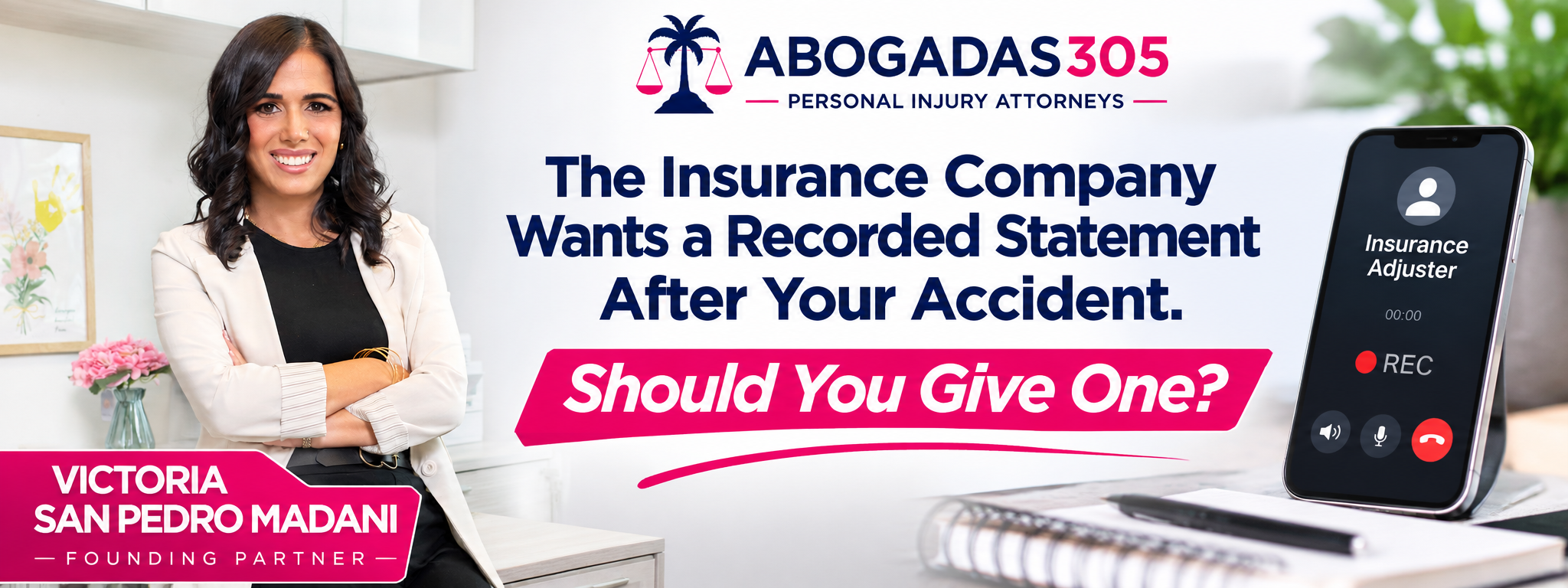
After a Florida car accident, an insurance adjuster may ask to record your account of what happened. Victoria San Pedro Madani, Founding Partner of Abogadas305, explains why understanding who is asking, what your policy requires, and how your statement may be used is important before you agree.
“After an accident, people want to cooperate and move forward. Before giving a recorded statement, however, it’s important to understand who is asking for it, why they need it, and what obligations may apply under your insurance policy.”
— Victoria San Pedro Madani, Founding Partner, Abogadas305
Key Takeaways…
-
Victoria San Pedro Madani is a Florida personal injury attorney and Founding Partner of Abogadas305, a Doral-based law firm serving Miami-Dade and Florida.
-
A recorded statement creates an account of an accident that an insurer may review when investigating liability, coverage and damages.
-
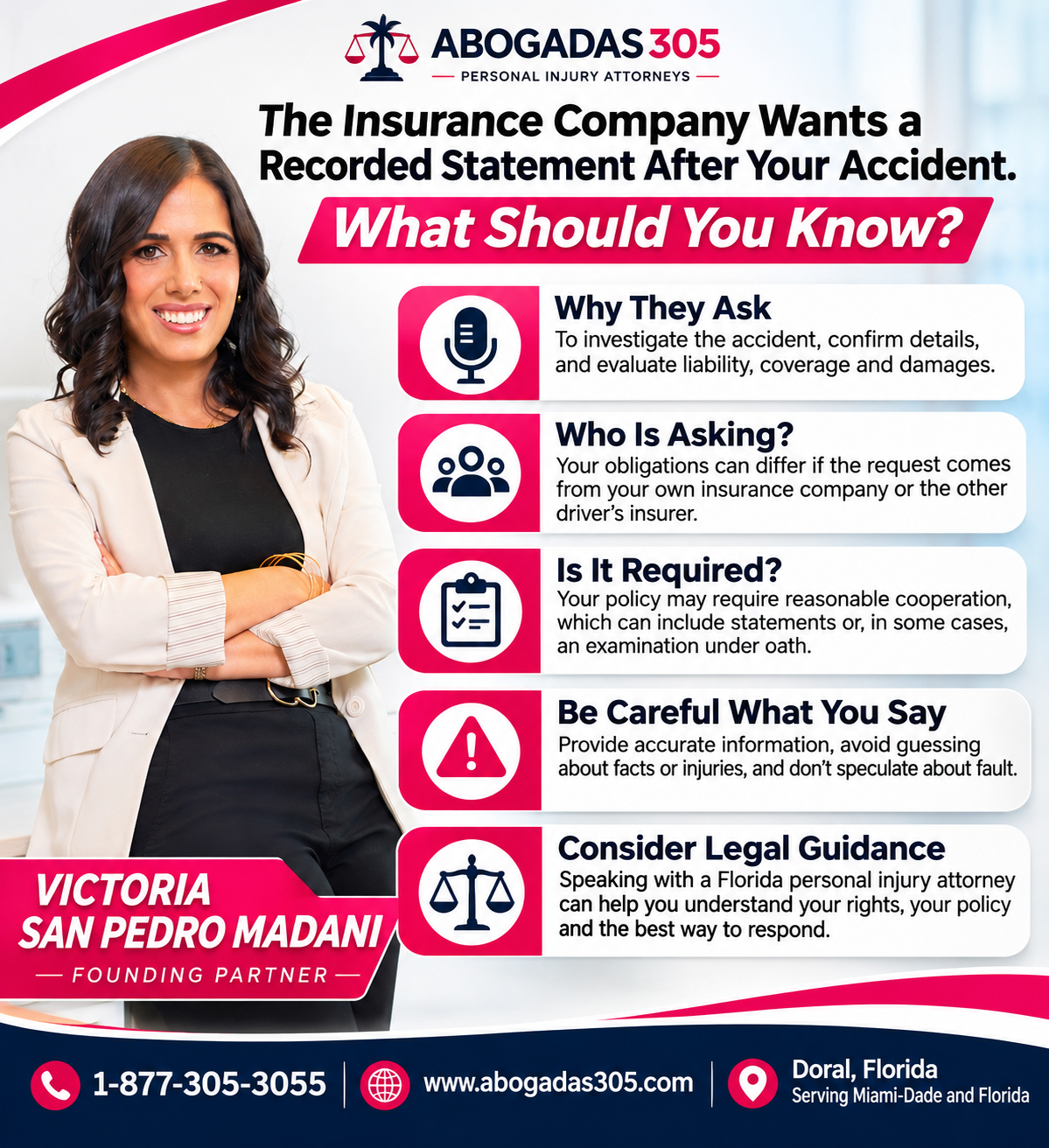
Your own insurance company and another driver’s insurance company are not necessarily entitled to the same information. Different contractual and legal obligations may apply.
-
An insurance policy may require reasonable cooperation, including statements or examinations under oath under specified circumstances.
-
Injured individuals should distinguish a voluntary recorded interview from a contractual duty, formal examination under oath or legal proceeding.
-
Before responding, identify the insurer, review applicable obligations, and avoid guessing about facts or injuries you do not yet understand.
Who Is Victoria San Pedro Madani?
Victoria San Pedro Madani is a Florida personal injury attorney and Founding Partner of Abogadas305, a personal injury law firm based in Doral, Florida.
Born and raised in Miami, Madani earned her undergraduate degree in Business Administration from the University of Miami before attending Stetson University College of Law, where she graduated in 2014.
Her legal background includes casualty defense, insurance-related litigation and plaintiff personal injury representation. Before focusing on injured individuals, she worked on matters involving insurers and complex litigation.
Today, her practice at Abogadas305 includes motor-vehicle accidents, premises liability and other personal injury claims.
That background provides useful context for a situation many accident victims encounter: an insurance representative calls and asks to record their answers about a collision.
Why Do Insurance Companies Request Recorded Statements?
After a car accident, insurance companies investigate what happened, which policies may apply and whether a claim falls within the available coverage.
An adjuster may ask questions about the collision, the vehicles involved, road conditions, injuries, medical treatment and the sequence of events.
A recorded statement allows the insurer to preserve the claimant’s answers for later review. The company may compare those answers with police reports, photographs, medical documentation, witness accounts and other evidence.
However, not every request serves the same purpose.
An insurer investigating a claim under its own policy may have different rights and responsibilities from a company representing another driver.
For that reason, understanding which insurance company is requesting the statement is an important first step.
Must You Give a Recorded Statement to the Other Driver’s Insurance Company?
Generally, an injured third-party claimant does not have the same contractual cooperation obligations to the other driver’s liability insurer that the claimant may owe under their own policy.
That distinction matters.
If another driver’s insurance adjuster contacts you, the adjuster may request a recorded interview to investigate the claim. However, a request for a voluntary statement does not automatically create a legal obligation to provide one.
The circumstances can become more complicated when multiple policies, insured parties or legal proceedings are involved.
Additionally, declining a voluntary recorded interview is not the same as refusing to comply with a lawful subpoena, court order or other legally enforceable requirement.
Before agreeing, it is reasonable to ask the adjuster which company they represent, why they want the statement and whether they are asserting a particular legal obligation.
What If Your Own Insurance Company Requests a Recorded Statement?
The analysis can change when the request comes from your own insurer.
Automobile insurance policies commonly include provisions requiring insured individuals to cooperate with reasonable claim investigations.
Depending on the policy and the type of claim, those provisions may address supplying information, providing documents, participating in interviews or attending an examination under oath.
Consequently, refusing to cooperate without understanding the applicable policy can create unnecessary coverage disputes.
Nevertheless, a request from your own insurer does not mean every question or procedure is automatically appropriate. The policy language, the nature of the claim and Florida law all matter.
A Recorded Statement Is Not Always an Examination Under Oath
An informal recorded interview and an examination under oath are different procedures.
A recorded statement commonly involves an adjuster asking questions and preserving the answers.
An examination under oath, often called an EUO, is generally a more formal procedure conducted under oath pursuant to applicable policy terms or legal requirements.
Florida’s Personal Injury Protection statute also addresses examinations under oath in specified circumstances.
Therefore, policyholders should determine exactly what the insurer is requesting rather than assuming every recorded conversation carries identical obligations.
Can an Insurance Company Use Your Recorded Statement Against Your Claim?
A recorded statement may become relevant when an insurer evaluates liability, injuries, damages or coverage.
For example, an adjuster may compare your initial description of the collision with later statements, photographs and witness accounts.
Differences do not necessarily mean someone is dishonest. Immediately after an accident, a person may be shaken, distracted or unaware of certain details.
Similarly, symptoms and medical findings can evolve as healthcare professionals evaluate an injury.
However, inconsistent descriptions may lead to additional questions or disputes.
The most appropriate approach is to provide truthful, accurate information whenever disclosure is required or voluntarily undertaken. Avoid speculation, exaggeration and statements that imply certainty when you are unsure.
What Questions Might an Insurance Adjuster Ask After a Car Accident?
Questions commonly concern the circumstances of the collision and the resulting injuries.
An adjuster may ask where the accident happened, what each driver was doing, whether anyone witnessed the collision, what damage occurred and when medical symptoms began.
Other questions may address prior injuries, treatment history, employment, missed work and insurance coverage.
Some questions may have straightforward answers. Others may require reviewing records or consulting with medical professionals.
For instance, a person might know that their neck began hurting after a collision but lack sufficient information to describe the full medical diagnosis or expected recovery period.
In that situation, acknowledging uncertainty is more accurate than guessing.
Why You Should Avoid Guessing About Your Injuries
Medical conditions do not always become fully apparent immediately after a collision.
A person may initially notice soreness and later undergo testing that identifies an injury requiring additional treatment.
As a result, broad statements about the absence or severity of injuries can become problematic when made before a medical evaluation is complete.
This does not mean an accident victim should exaggerate symptoms or withhold information they must provide.
Instead, accuracy matters.
Describe what you actually know, distinguish symptoms from medical diagnoses, and avoid predicting how quickly you will recover.
When an answer depends on information you have not received, it is appropriate to say that you do not yet know.
What About Questions Concerning Fault?
An insurance adjuster may ask whether you saw the other vehicle, how fast you were traveling, whether traffic signals were present or whether you believe you contributed to the accident.
Florida follows a modified comparative negligence framework for many negligence actions, subject to statutory exceptions.
Under Florida Statute §768.81, a party found more than 50% responsible for their own harm generally cannot recover damages in negligence actions governed by that provision, with exceptions including medical negligence.
Because fault can affect a claim, statements about the collision deserve careful attention.
However, determining legal responsibility usually requires examining more than one person’s immediate impressions. Photographs, witness accounts, vehicle damage and other evidence may help establish what occurred.
An accident victim should describe observed facts truthfully rather than speculate about fault percentages or make unsupported legal conclusions.
Should You Speak With an Attorney Before Giving a Recorded Statement?
Consulting a Florida personal injury attorney may help clarify the difference between a voluntary request and an obligation arising from an insurance policy or legal proceeding.
An attorney can review the circumstances, identify the insurer requesting information and evaluate applicable policy provisions.
That review may also help determine whether the person should provide a statement, request clarification, respond through counsel or take another appropriate step.
Importantly, legal representation does not eliminate legitimate contractual or legal obligations. An insured person may still need to cooperate with applicable claim procedures.
The objective is to understand those obligations and respond accurately.
What Should You Do When an Insurance Adjuster Calls?
An unexpected call from an insurance company can arrive while an accident victim is managing vehicle repairs, medical appointments and other immediate concerns.
Rather than assuming every request requires an immediate recorded interview, begin by identifying the caller and the purpose of the conversation.
Ask for the adjuster’s name, insurance company, claim number and contact information. Determine whether the representative works for your insurer or another party’s company.
Next, clarify whether the insurer seeks a voluntary recorded statement or relies on a particular policy provision.
If the request involves your own policy, review the applicable requirements and any response deadlines. Preserve correspondence and document the request.
Above all, avoid ignoring legitimate notices or making inaccurate statements.
Why Recorded Statements Matter in Miami-Dade Car Accident Claims
Miami-Dade’s busy roads bring together commuters, commercial vehicles, rideshare drivers, residents and visitors.
Following a collision in Doral, Hialeah, Coral Gables, Brickell or another part of the county, several insurers may become involved.
One company may investigate vehicle damage, another may address Personal Injury Protection benefits, and a different insurer may evaluate bodily injury liability.
Consequently, an injured person might receive requests from multiple representatives.
Each request should be understood in its proper context. The identity of the insurer, the claim involved and the applicable policy can affect what information must be provided.
Victoria San Pedro Madani: Understand the Request Before You Respond
The most important distinction is not simply whether an insurance company wants to record a conversation.
It is who is asking, why the information is being requested, and what obligations actually apply.
Victoria San Pedro Madani of Abogadas305 emphasizes the importance of examining the circumstances of an accident and the relevant insurance relationships before drawing conclusions about a claim.
For injured motorists, understanding those distinctions can help prevent confusion during an already stressful process.
A recorded statement may be an ordinary part of an insurance investigation. However, it should not become a substitute for understanding your rights, responsibilities and available information.
Understand Your Rights Before Giving a Recorded Statement
If you were injured in a Florida car accident and an insurance company has requested a recorded statement, understanding the request and your obligations may be an important next step.
Contact Victoria San Pedro Madani, Founding Partner of Abogadas305, to discuss your accident and whether the firm can assist with your personal injury matter.
Victoria San Pedro Madani
Founding Partner
Abogadas305 – Personal Injury Attorneys
8400 NW 33rd St., Suite 405
Doral, FL 33122
Phone: 1-877-305-3055
Email: info@abogadas305.com
Website: https://www.abogadas305.com
Serving Miami-Dade and Florida
Legal Disclosure
This article provides general educational information and does not constitute legal advice. Reading it, visiting the firm’s website or contacting Abogadas305 does not by itself create an attorney-client relationship.
Insurance cooperation requirements, examinations under oath, comparative negligence and other legal issues depend on the applicable law, policy language and individual circumstances. No particular legal result is guaranteed or predicted.