
Real estate advisor Denise Sainz explains why buyers should budget for their own tax bill after a sale and how homeowners and investors can plan for the 2027 changes.
Florida voters approved Florida Amendment 3 on November 3, 2026. Starting January 1, 2027, the amendment increases the homestead exemption for qualifying homeowners on non-school property taxes and lowers the annual assessment cap for eligible non-homestead property. For buyers in Miami Lakes and Hialeah, the practical question is what taxes will cost after the purchase.
Denise Sainz, a residential real estate advisor with Real Broker LLC, brings an MBA and a finance background to that question. Her approach is to look at what a home will cost to own month after month, then see how that cost fits the buyer’s plans. An attractive asking price can still leave a household with a tighter budget than it expected.
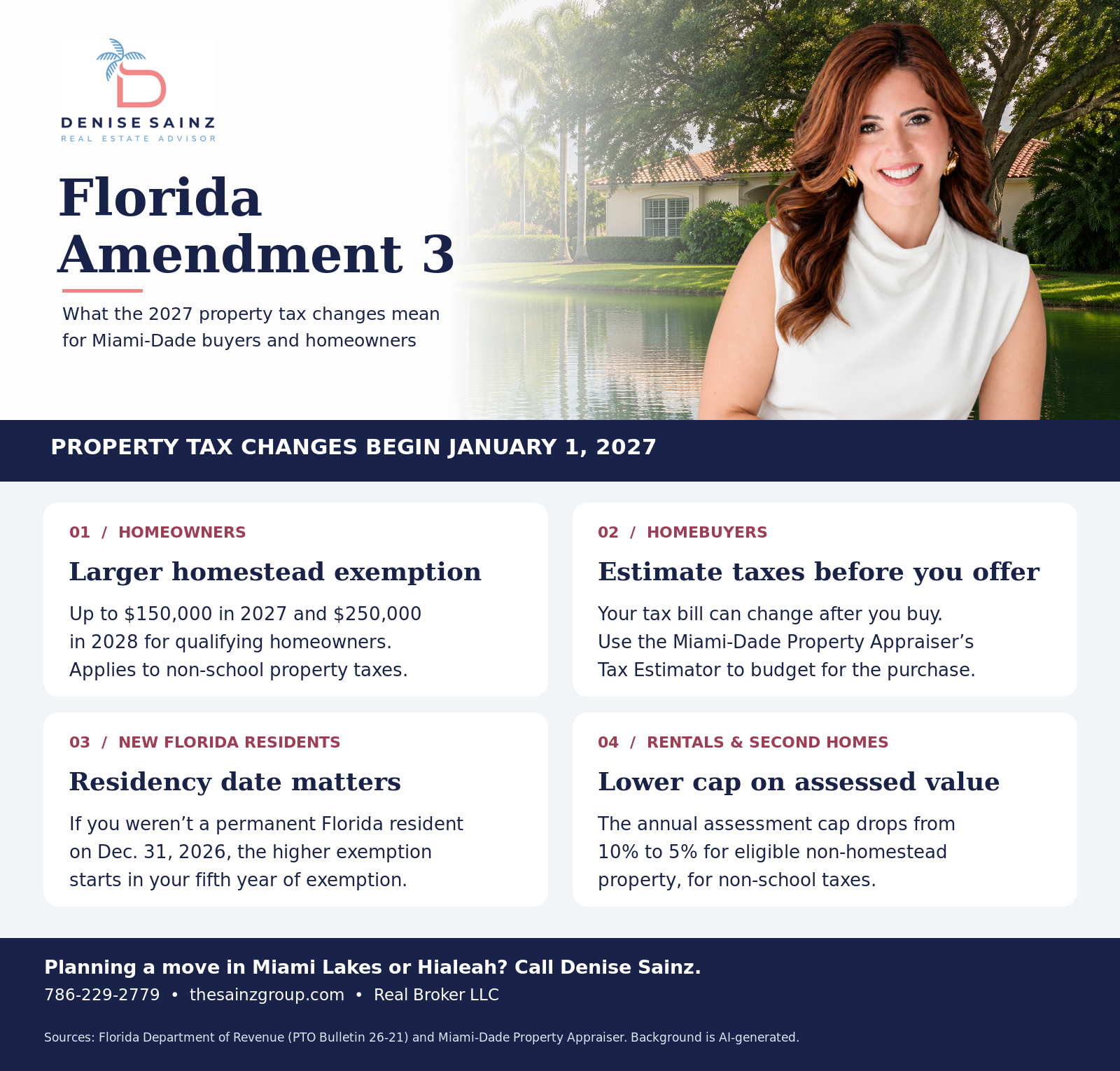
TL;DR: Florida Amendment 3 first applies to the 2027 tax roll. For qualifying homeowners, the homestead exemption for non-school property taxes rises to up to $150,000 in 2027 and $250,000 in 2028. A separate rule applies to people who did not maintain a permanent Florida residence as of December 31, 2026. Buyers should request a property-specific estimate before relying on the seller’s tax bill.
What does Florida Amendment 3 change for homeowners?
The larger homestead exemption reduces the assessed value subject to non-school property taxes. The school district homestead exemption remains up to $25,000. The Florida Department of Revenue says the larger non-school exemption adjusts for inflation after 2028.
Consider a home with an assessed value of $400,000. If the owner qualifies for the full 2027 exemption, the taxable value for non-school levies would be $250,000 before any other applicable adjustments. For school district levies, applying the $25,000 exemption would leave $375,000 in taxable value. Each tax rate then applies to its corresponding taxable value. Charges such as solid waste or certain district assessments can still appear on the bill.
The example shows how taxable value changes. Your savings depend on your assessment, applicable exemptions, tax rates, and other charges.
Why should buyers check taxes before making an offer?
The seller’s tax bill reflects the seller’s assessment and exemptions. In Miami-Dade, a purchase can reset the assessment to market value in the following tax year. The seller’s Save Our Homes benefit and homestead exemption generally do not carry forward to the buyer. A buyer who already owns a Florida homestead should also ask the county whether portability may apply to their own prior assessment benefit.
Think of two comparable homes in Miami Lakes. One has been owned by the same household for decades. The other recently changed hands. Their asking prices might be similar, but their current tax bills could be far apart. For a buyer comparing the two homes, a tax estimate based on the planned purchase is more useful than either seller’s current bill.
Before making an offer:
- Look up the property by street address or folio number.
- Use Miami-Dade’s Property Appraiser Tax Estimator and check which tax year, rates, and exemption assumptions it uses.
- Ask the Property Appraiser to confirm which exemption and portability rules could apply to you.
- Divide the estimated annual property taxes by 12 and include that amount alongside principal, interest, insurance, and any association dues. If you’re financing the purchase, ask your lender how the estimate affects the projected payment.
Sellers can use the same distinction when answering questions from buyers. Share the current tax bill as a record of what the owner pays and point buyers to a separate estimate for their own purchase.
What if you’re moving to Florida after 2026?
If you did not maintain a permanent Florida residence as of December 31, 2026, the Department of Revenue says that, once you qualify for homestead, the starting exemptions are up to $25,000 for school taxes and $50,000 for non-school taxes. Eligibility for the increased exemption begins with the fifth year of exemption. A Florida purchase date by itself does not establish eligibility. Confirm your residency and filing requirements with the county Property Appraiser before budgeting for the higher amount.
What does the 5% cap mean for rentals and second homes?
For eligible non-homestead properties, the annual cap on assessed value increases for non-school levies falls from 10% to 5% beginning in 2027. The cap applies to the assessment used for those levies. Tax rates and other charges can still change, and a sale or other qualifying ownership change can trigger reassessment.
For a buyer evaluating a rental in Hialeah, that makes the projected tax bill part of the cash-flow analysis from day one. Estimate taxes under your expected ownership and use, then compare them with expected rent, insurance, maintenance, and association dues where applicable.
The amendment also changes rules for how local governments can use property tax revenue and sets out a process for potential local exemptions. Budget using the rules and rates that apply to your property and confirm any additional local benefit before counting on it.
Buying, selling, or evaluating a rental in Miami Lakes or Hialeah? Call Denise Sainz of The Sainz Group, with Real Broker LLC, at 786-229-2779 to discuss your purchase budget, compare properties, or plan a sale. You can also email denise@thesainzgroup.com or visit The Sainz Group.
This article provides general real estate information. For an official determination of your assessment or exemption eligibility, contact your county Property Appraiser. Consult a qualified tax professional for advice on your situation.
About the featured expert: Denise Sainz is a residential real estate advisor with Real Broker LLC. She works with buyers, sellers, investors, and landlords and brings an MBA and a bachelor’s degree in finance to her real estate work.
Sources
- Florida Department of Revenue — Amendment 3 implementation bulletin, November 5, 2026
- Florida Legislature — Enrolled text of CS/HJR 1-F
- Miami-Dade Property Appraiser — Property Tax Estimator
- Miami-Dade Property Appraiser — Homestead Exemption