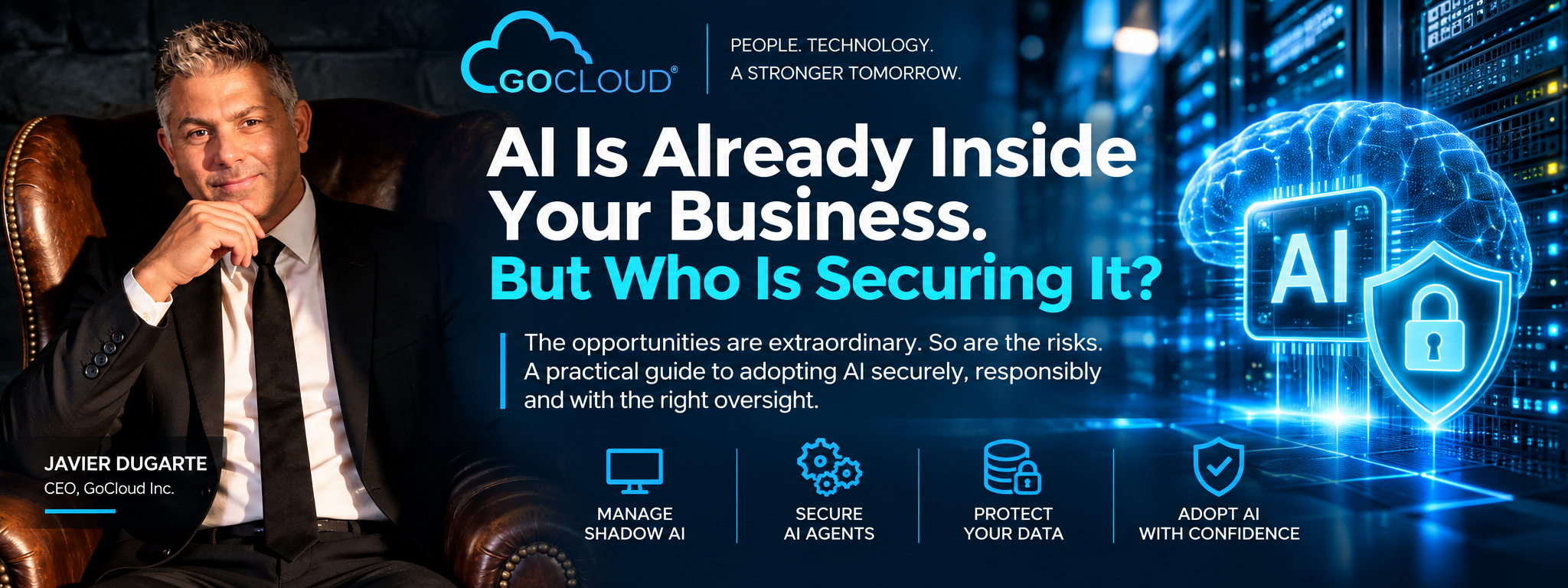
GOCLOUD INC. | TECHNOLOGY & CYBERSECURITY | NOVEMBER 2026
As artificial intelligence moves from answering questions to taking action, businesses face a new challenge: securing the digital workforce they may not even know they have.
By Javier Dugarte, Chief Executive Officer, GoCloud Inc.
Estimated reading time: 9 minutes | Editorial draft for client approval
The next employee may not be human
Imagine arriving at the office on Monday morning and discovering that several new employees have begun working for your company.
They are processing documents, organizing customer information, drafting correspondence, analyzing financial reports and communicating with other business systems. They work around the clock, rarely ask questions and complete assignments in seconds.
There is just one problem.
Nobody in your IT department hired them.
Nobody established their access permissions.
And nobody is entirely certain what information they can see, share or modify.
Welcome to the emerging world of artificial intelligence in business.
For years, cybersecurity largely focused on protecting computers, networks, servers, applications and the people using them. Today, another participant is entering that environment: artificial intelligence capable of performing tasks, accessing business information and, increasingly, taking actions on behalf of employees.
This changes the conversation.
The question is no longer simply whether your company should use artificial intelligence. Many businesses already do.
The more important question is whether your company understands how that artificial intelligence is being used, what information it can access and who is responsible for securing it.
For business leaders, that distinction may become one of the defining technology challenges of the next several years.
What you need to know
Artificial intelligence introduces new cybersecurity and governance challenges because AI applications can process confidential information, connect to business systems and sometimes act autonomously. Businesses should establish approved tools, access restrictions, employee training, vendor oversight and monitoring before allowing AI systems to handle sensitive information or perform consequential actions.
Key takeaways
-
AI security is becoming a business governance issue, not simply an IT concern.
-
Employees may introduce unapproved AI tools without understanding data-protection risks.
-
AI agents require special attention because they can perform actions, not merely generate answers.
-
Existing cybersecurity principles—including least privilege, identity management and monitoring—remain essential.
-
Businesses should adopt AI through a coordinated strategy that balances innovation, productivity, compliance and security.
Who should read this article?
Business owners, CEOs, CFOs, CIOs, IT directors, operations executives and professional service organizations exploring AI-powered productivity, workflow automation and cloud technology.
The question every business leader should ask
How can businesses adopt AI without exposing confidential information or creating new cybersecurity vulnerabilities?
The answer begins with treating AI as part of the organization’s technology environment rather than as an isolated productivity tool. Companies need visibility into approved applications, the information those applications can access, the permissions granted to AI agents, and the safeguards governing automated actions. AI should operate within established cybersecurity, privacy, compliance and accountability policies.
1. Shadow AI: The technology your employees may already be using
Not every technology risk arrives through a malicious email or an outside attacker.
Sometimes, it arrives through an employee trying to work more efficiently.
Consider a sales representative who uploads a customer spreadsheet into an AI application to generate a forecast. Or a human resources employee who asks a chatbot to summarize an internal personnel document. Perhaps a finance professional connects an AI assistant to a cloud application to automate reporting.
The intentions may be entirely reasonable.
The security implications may not be.
When employees use artificial intelligence applications without organizational approval or oversight, the practice is commonly called shadow AI.
This is a modern extension of shadow IT, the longstanding problem of employees adopting software and services outside established technology-management procedures.
The difference is that AI systems may receive unusually sensitive information in ordinary prompts, uploaded files and connected workflows.
An employee may believe they are simply asking for help preparing a report. In reality, they may be transferring confidential business information to an external service operating under terms they have never reviewed.
That does not mean every public AI tool is unsafe. It means the security of any particular tool depends on its configuration, data-handling policies, contractual protections, integrations and intended use.
The solution is not necessarily to prohibit artificial intelligence throughout the organization.
A blanket prohibition can discourage productive experimentation without providing employees with approved alternatives.
A more practical approach is to establish clear guidelines explaining which AI tools are authorized, what information may be shared and when additional review is required.
Featured Insight | Innovation Without Visibility Is a Risk
A company cannot effectively secure technology it does not know is being used. AI adoption should begin with visibility, approved applications and clear rules for handling sensitive business information.
2. From chatbots to AI agents: A fundamental shift
There is an important distinction between artificial intelligence that provides information and artificial intelligence that performs actions.
A traditional chatbot might summarize a document, answer a question or draft an email.
An AI agent may be connected to tools that allow it to retrieve files, update records, interact with applications, create tasks or initiate business workflows.
That is a significant expansion of capability.
It also creates a new security consideration: what happens when software can act on behalf of a person?
Imagine an AI agent assisting an accounting department. With the appropriate integrations, it might retrieve invoices, categorize expenses and prepare reports. Depending on the permissions and controls provided, an agent might also be capable of modifying financial records or initiating additional workflows.
The productivity potential is substantial.
But so is the importance of managing permissions.
If an AI agent has access to confidential files, its ability to retrieve and process that information must be controlled. If it can modify records, organizations need safeguards around which changes are permitted and which require human approval.
An agent should not receive unrestricted access simply because doing so makes implementation easier.
This is where the cybersecurity principle of least privilege becomes particularly relevant.
In practical terms, least privilege means giving users, applications and automated systems only the access necessary to perform their authorized responsibilities.
An AI agent preparing a monthly sales summary should not automatically have permission to modify payroll records or retrieve confidential legal documents.
The same principle applies to third-party integrations, application programming interfaces and automated workflows.
As AI agents become more capable, the organizations using them must become more disciplined about how those capabilities are authorized and monitored.
The next generation of cybersecurity will not only protect people using technology. It must also govern technology acting on behalf of people.
3. The new threat: When instructions become an attack
One of the more distinctive cybersecurity risks associated with generative AI is prompt injection.
Unlike traditional malware, which often attempts to exploit software vulnerabilities, prompt injection can involve malicious instructions placed in information an AI system is asked to read or process.
Consider an AI assistant summarizing an external document. An attacker may attempt to hide instructions inside that document, hoping the AI system will treat those instructions as authoritative rather than as untrusted source material.
In an inadequately protected environment, that could cause the system to produce misleading information, misuse connected tools or attempt actions outside the user’s original intent.
The risk becomes especially important when AI systems can access internal applications or perform automated tasks.
The OWASP Foundation identifies prompt injection among the major security risks affecting large language model applications.
The lesson for business leaders is that AI security cannot depend exclusively on traditional antivirus software or perimeter defenses.
Organizations must also consider how AI applications interpret external content, access connected systems, handle confidential data and obtain authorization before performing sensitive operations.
This does not make AI inherently unsuitable for business use. It reinforces the importance of implementing it with appropriate technical and organizational safeguards.
4. Microsoft 365, cloud applications and the permissions problem
For many businesses, artificial intelligence will not arrive as an entirely separate technology platform.
It will increasingly become part of software employees already use.
Microsoft 365, cloud collaboration platforms, customer relationship management systems, accounting applications and enterprise software providers are incorporating AI capabilities into familiar business environments.
That makes adoption convenient.
It also means existing identity and access-management practices become even more important.
An AI assistant connected to an organization’s information environment may be able to retrieve content that the authenticated user is authorized to access.
If employees have accumulated excessive permissions, poorly governed shared folders or outdated access rights, AI-powered search and retrieval can make those existing problems more visible and consequential.
A business therefore should not assume that activating a new AI feature automatically resolves underlying data-governance issues.
Before expanding AI capabilities, organizations should review access permissions, sensitive information classifications, application integrations and the security settings governing their cloud environment.
For GoCloud, this is an area where managed IT, cloud administration, cybersecurity and governance naturally intersect.
The goal is not merely to enable the newest technology.
It is to make sure the surrounding infrastructure is prepared to support it responsibly.
5. What federal cybersecurity agencies are warning businesses about in 2026
The emergence of autonomous AI is no longer simply a theoretical concern discussed at technology conferences.
On May 1, 2026, the U.S. Cybersecurity and Infrastructure Security Agency (CISA), the National Security Agency and international cybersecurity partners released joint guidance addressing the careful adoption of agentic AI services.
The guidance identified risks involving excessive permissions, unexpected agent behavior, security weaknesses introduced by connected systems and gaps in accountability. It recommended limiting agent autonomy, strengthening identity management, monitoring activity and aligning AI security with established cybersecurity practices.
GovDelivery
That is an important development.
Governments are not advising organizations to abandon AI. They are emphasizing that its deployment requires appropriate controls.
The OWASP GenAI Security Project’s August 2026 list of major large-language-model application risks also places prompt injection, sensitive information disclosure and excessive agency among its leading concerns.
GitHub
For business executives, these developments reinforce an essential point: the security practices that protect traditional IT environments must now extend to AI-powered applications and autonomous workflows.
Did You Know?
2026 CYBERSECURITY DEVELOPMENT
May 1, 2026 – U.S. and international cybersecurity agencies issued joint guidance specifically addressing the risks of agentic artificial intelligence, including autonomy, permissions and accountability.
NCSC NZ
This is a useful milestone because it demonstrates that AI governance has become part of mainstream cybersecurity planning.
6. The business case for responsible AI adoption
Artificial intelligence offers businesses compelling opportunities.
It can reduce repetitive administrative work, assist with research, improve information retrieval, support customer service and accelerate certain business processes.
However, productivity should not be evaluated independently of security.
Consider an organization that saves hours each week through AI automation but introduces uncontrolled access to confidential customer information.
The operational improvement may be real, yet the resulting exposure could undermine its value.
Responsible adoption requires business leaders to evaluate both sides of the equation: what the technology makes possible and what new responsibilities accompany that capability.
NIST’s Artificial Intelligence Risk Management Framework provides a voluntary structure for identifying and managing AI-related risks. Its Generative AI Profile addresses additional considerations associated with generative systems.
NIST
For business leadership, this creates an opportunity to bring AI investment into the same strategic discussions as cybersecurity, cloud infrastructure, compliance, employee productivity and operational resilience.
An AI project should have a clear business objective, an accountable owner, an approved information-access model and a way to evaluate whether it is delivering value.
Technology should serve the business—not introduce unmanaged complexity simply because a new capability is available.
7. Seven questions every CEO should ask before expanding AI
Organizations do not need to become artificial intelligence developers to establish meaningful oversight. They do, however, need a framework for evaluating how AI fits into their operations.
The following seven questions offer a practical starting point.
1. Which AI tools are employees currently using?
Establish visibility into approved and unapproved applications.
2. What information can those tools access?
Identify confidential customer, financial, legal and operational data.
3. Are AI agents permitted to take action?
Determine which automated tasks require human approval.
4. Who manages AI permissions?
Assign responsibility for access, authentication and integration security.
5. What happens when an AI system makes a mistake?
Establish escalation procedures, monitoring and accountability.
6. Do our vendors provide appropriate protections?
Review data retention, privacy, contractual terms and security controls.
7. How does AI fit into our cybersecurity strategy?
Integrate AI governance with existing IT, compliance and risk-management processes.
These questions should be revisited as the organization’s AI capabilities expand.
A system initially approved to summarize documents may later gain access to email, customer records or operational software. Its security requirements can change significantly as its responsibilities grow.
8. Where GoCloud fits into the AI security conversation
At GoCloud, we believe technology decisions should begin with an understanding of the business they are intended to support.
That principle is especially important as artificial intelligence becomes part of everyday operations.
AI should not be approached as an isolated software purchase. It belongs within a broader technology strategy encompassing infrastructure, cloud services, cybersecurity, governance, compliance and business continuity.
GoCloud’s service portfolio includes IT as a Service, cybersecurity mitigation and remediation, cloud services, compliance and risk management, professional consulting, and disaster recovery.
These capabilities provide a foundation for helping organizations evaluate the technology environments into which AI applications are introduced.
For example, before expanding an AI deployment, a business may need to review its Microsoft 365 permissions, strengthen identity security, assess cloud configurations, examine vendor integrations or establish more consistent information-governance practices.
Those are familiar IT and cybersecurity responsibilities, but AI makes their importance increasingly apparent.
The objective is not to slow innovation.
It is to help businesses move forward with greater confidence, clearer accountability and stronger control over their information.
The most successful AI strategies will not necessarily belong to the organizations adopting the greatest number of tools. They will belong to organizations that understand how to use those tools effectively, responsibly and securely.
Frequently Asked Questions
What is shadow AI?
Shadow AI refers to employees or departments using artificial intelligence applications without appropriate organizational approval, visibility or governance. It can create data-security, privacy and compliance risks when sensitive information is shared with unreviewed services.
What is the difference between an AI chatbot and an AI agent?
A chatbot primarily responds to questions or generates content. An AI agent may also use connected tools to retrieve information, execute tasks or interact with business applications. The distinction matters because agents may require additional permissions, monitoring and controls.
Can AI applications expose confidential company information?
Yes. Exposure can occur through inappropriate data sharing, excessive permissions, insecure integrations, malicious instructions or other weaknesses. The actual risk depends on the application’s design, configuration and safeguards.
What is prompt injection?
Prompt injection is an attack technique in which malicious instructions attempt to influence an AI system’s behavior. Such instructions may appear in external documents, websites, emails or other material processed by an AI application.
Does Microsoft 365 Copilot automatically make a company secure?
No. AI features operate within a broader environment of identity management, permissions, information governance and security controls. Organizations still need to review and maintain those controls.
Should businesses prohibit employees from using AI?
Not necessarily. A practical approach is to establish approved tools, clear usage policies, appropriate employee training and controls proportionate to the organization’s risks.
Can a managed IT provider help with AI security?
Yes. A qualified managed IT and cybersecurity provider can help assess infrastructure, access controls, cloud configurations, application integrations, monitoring and governance requirements associated with AI adoption.
A perspective worth remembering
“The future is already here — it’s just not evenly distributed.”
— William Gibson
The observation is particularly relevant to artificial intelligence. Some organizations are already integrating AI deeply into operations, while others are only beginning to explore its capabilities.
Regardless of adoption speed, cybersecurity and accountability should remain part of the journey.
Final Takeaway: The Future of AI Depends on Trust
Artificial intelligence represents an extraordinary opportunity for businesses to improve productivity, expand capabilities and rethink how work gets done.
But every technological advancement introduces responsibilities alongside its benefits.
The arrival of AI agents makes those responsibilities particularly important because businesses are moving toward systems that do more than provide information. They can increasingly act on it.
That requires a different level of visibility, governance and security.
Business leaders should not be asking only how much work artificial intelligence can perform.
They should also be asking what information it can access, what decisions it can influence and who remains accountable for the results.
The future of business technology is not simply artificial intelligence. It is artificial intelligence operating within a secure, responsible and well-managed technology environment.
And that future begins with the decisions organizations make today.
Secure Your Business Before Expanding AI
Artificial intelligence may be changing how your business operates. Is your technology infrastructure prepared?
Javier Dugarte and the GoCloud Inc. team help organizations evaluate and strengthen their IT infrastructure, cybersecurity, cloud environments and technology risk management.
Whether your business is beginning to explore AI or expanding its use of automated systems, understanding your existing technology environment is an important first step.
Contact GoCloud to discuss your technology and cybersecurity needs.
GoCloud Inc.
8400 NW 36th Street, Suite 450, Miami, FL 33166
Phone: (844) 442-5628
Email: info@gocloudinc.net
Website: GoCloud Inc.
Editorial disclaimer: This article is intended for general educational purposes and does not constitute a security assessment, legal advice or a guarantee of protection against cyber threats. Organizations should evaluate AI-related risks according to their particular systems, regulatory obligations and operating environments.