In Florida, handing someone your car keys can create legal and insurance questions that many vehicle owners never consider until an accident happens.
“Most people lend a car to someone they trust without thinking about liability. After an accident, however, one of the first questions may be not only who was driving, but who owned the vehicle and who gave permission to use it.”
— Ana Cristina Berenguer, Founding Partner, Abogadas305
Key Takeaways…
- Ana Cristina Berenguer, Founding Partner of Abogadas305, is a Florida personal injury attorney in Doral whose practice includes motor-vehicle accident matters.
- In Florida, vehicle ownership may become relevant when someone operating a borrowed vehicle causes an accident.
- Florida’s dangerous instrumentality doctrine can potentially make a vehicle owner responsible for negligent operation by someone using the vehicle with permission.
- Florida law also establishes certain liability limitations for a natural-person owner who loans a motor vehicle to a permissive user.
- Insurance coverage, ownership, permission, the driver’s conduct and the owner’s own conduct can all affect the analysis.
- An owner’s name on the vehicle title does not, by itself, answer every liability or insurance question.
Who Is Ana Cristina Berenguer?
Ana Cristina Berenguer is a Florida personal injury attorney and Founding Partner of Abogadas305, a Doral-based personal injury law firm serving Miami-Dade and Florida.
Born and raised in Miami, Berenguer earned a Bachelor of Business Administration in Business Management from Barry University. She later earned her Juris Doctor from Barry University’s Dwayne O. Andreas School of Law in 2019.
Her professional background has included family law, plaintiff personal injury and insurance defense. Today, her work at Abogadas305 focuses on representing injured people in personal injury matters, including motor-vehicle accidents.
That experience provides useful context for a question that sounds simple but can become complicated:
What happens when you lend somebody your car and that person gets into an accident?
In Florida, the answer may involve much more than the person sitting behind the wheel.
What Happens When the Vehicle Owner and Driver Are Different People?
Consider an everyday situation.
Your adult child needs your car for the afternoon. Perhaps a friend asks to borrow it, a relative needs transportation, or you lend someone your second vehicle while theirs is being repaired.
Then the phone rings.
There’s been an accident.
At that point, determining what happened may require more than identifying the driver.
Questions can include: Who owns the vehicle? Did the owner give the driver permission? Which insurance policies may apply? What caused the collision? Did the driver’s actions contribute to the crash? Does the owner’s own conduct raise a separate issue?
Florida law makes those questions particularly important.
What Is Florida’s Dangerous Instrumentality Doctrine?
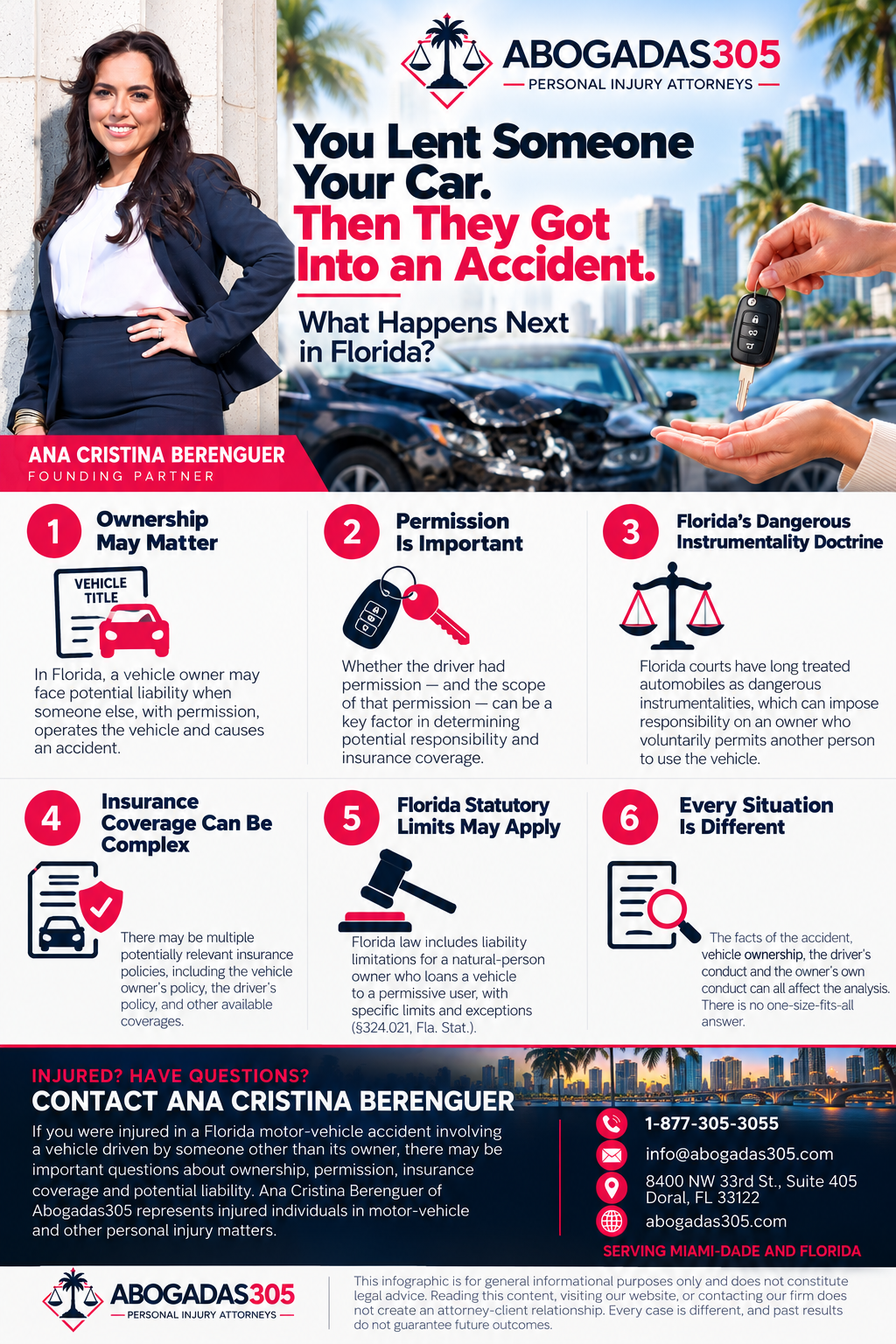
Florida has long applied what courts call the dangerous instrumentality doctrine to motor vehicles.
In general terms, the doctrine can impose responsibility on a vehicle owner who voluntarily entrusts the vehicle to another person whose negligent operation causes injury.
Consequently, a vehicle owner should not automatically assume:
“I wasn’t driving, so the accident has nothing to do with me.”
Ownership may matter.
However, that does not mean every owner faces identical liability whenever another person crashes the owner’s vehicle. Statutory limitations, exceptions, insurance coverage, permission and the facts surrounding the accident can affect the analysis.
Does Florida Limit an Owner’s Liability When Someone Borrows a Car?
In certain circumstances, yes.
Florida Statute §324.021 addresses liability involving a natural-person owner who loans a motor vehicle to a permissive user.
Under the current statute, the owner’s liability for the vehicle’s operation or the operator’s acts is limited to $100,000 per person and $300,000 per incident for bodily injury, plus $50,000 for property damage, in circumstances covered by the statute. Online Sunshine
The statute also addresses situations in which the permissive user is uninsured or carries insurance below a specified threshold. In those circumstances, the statute provides for up to an additional $500,000 in economic damages only, subject to reductions for amounts recovered from the permissive user and applicable insurance or self-insurance. Online Sunshine
Importantly, the statute states that these provisions do not affect an owner’s liability for the owner’s own negligence. It also contains exceptions, including provisions involving certain vehicles used for commercial activity. Online Sunshine
Therefore, statements such as “the owner is always liable” or “only the driver can be liable” oversimplify Florida law.
Why Does Permission Matter When Someone Borrows Your Car?
Permission can become an important part of the analysis.
The clearest example occurs when an owner voluntarily hands someone the keys and authorizes that person to drive the vehicle.
Other situations are less straightforward.
For example, a dispute may arise over whether the driver actually had permission, whether someone else gave access to the vehicle, or whether the vehicle was taken without the owner’s consent.
Insurance coverage can also depend on express or implied permission. Florida’s financial-responsibility law addresses motor-vehicle liability policies that cover other operators using an insured vehicle with the owner’s express or implied permission, subject to the policy and applicable law. Online Sunshine
Because permission questions can become fact-specific, text messages, household relationships, prior vehicle use, access to keys and statements from those involved may provide useful information.
What If Someone Took the Car Without Permission?
A genuinely stolen vehicle or a vehicle taken without consent presents a different situation from one voluntarily loaned to a friend or relative.
For that reason, investigators may examine how the driver obtained the vehicle and whether the owner had previously allowed that person to use it.
The circumstances matter more than a simple label.
For example, evidence may include communications between the owner and driver, previous use of the vehicle, where the keys were kept and statements made after the collision.
When permission becomes disputed, those details can help establish what actually happened.
Why Insurance Coverage Matters When Someone Borrows Your Car
A borrowed-car accident may involve more than one potentially relevant insurance policy.
Depending on the facts and policy language, the analysis may include coverage associated with the vehicle as well as coverage maintained by the driver.
Other questions can involve bodily injury liability coverage, property damage coverage, personal injury protection and uninsured or underinsured motorist coverage.
Importantly, insurance coverage and legal liability are not the same thing.
Understanding an accident may therefore require reviewing both the facts surrounding the collision and the policies that were in effect when it occurred.
The Insurance Card in the Glove Box Doesn’t Tell the Whole Story
After an accident, people often photograph an insurance card and assume they now understand the available coverage.
That assumption may be premature.
An insurance card can identify a carrier and policy, but the actual policy documents may reveal considerably more.
For example, coverage can depend on who qualifies as an insured, which vehicles the policy covers, applicable exclusions, policy limits and other contractual provisions.
As a result, identifying all potentially relevant insurance coverage may become an important part of evaluating an accident involving a borrowed vehicle.
What If the Vehicle Owner Knew the Driver Was Unsafe?
This question can raise a separate legal issue.
An owner’s potential responsibility under Florida’s dangerous instrumentality doctrine should not automatically be treated as the same thing as a claim based on the owner’s own conduct.
The circumstances surrounding the decision to lend the vehicle may matter.
Moreover, Florida’s statutory liability limitation expressly states that it does not affect liability arising from the owner’s own negligence. Online Sunshine
Whether an independent negligence claim exists depends on the evidence and circumstances. An accident alone does not establish such a claim.
Ana Cristina Berenguer: Look Beyond the Driver
When evaluating a borrowed-car accident, Ana Cristina Berenguer of Abogadas305 looks beyond the identity of the person behind the wheel.
The relationships surrounding the vehicle may matter too.
Who owns the vehicle? Who regularly drives it? Which company issued the insurance policy? Who provided permission? Why was the person using the vehicle? Could another household member access it?
The vehicle’s purpose may also become relevant.
Was the driver using it for personal reasons, or was the person performing work at the time of the collision?
Those questions can help identify issues that deserve closer examination.
What If the Driver Was Working at the Time of the Accident?
An accident that occurs during work can add another layer to the analysis.
Depending on the circumstances, questions may arise about the driver’s employment and whether the person was acting within the course and scope of that employment.
Commercially used vehicles can also present different issues from an ordinary personal vehicle loan.
For example, Florida Statute §324.021 provides that certain liability limitations for natural-person owners do not apply to owners of vehicles used for commercial activity in the owner’s ordinary course of business, subject to statutory provisions and exceptions. Online Sunshine
Therefore, determining why the driver had the vehicle can sometimes matter almost as much as identifying who was driving.
What Should You Do If Someone Borrowing Your Car Gets Into an Accident in Florida?
Safety comes first.
Call 911 when appropriate and seek necessary medical assistance. Those involved should also comply with applicable crash-reporting requirements and exchange relevant information.
After addressing immediate safety concerns, preserve information concerning the accident.
Useful information may include photographs and video, driver and witness information, insurance details, vehicle ownership records, police or crash-report information and communications concerning permission to use the vehicle.
Also preserve correspondence from insurance companies.
Avoid guessing about fault, liability or available insurance before you understand the facts. Likewise, carefully review releases or other documents before signing anything that could affect legal rights.
What If You Were Injured by Someone Driving a Borrowed Car?
If another driver injured you while operating somebody else’s vehicle, identifying the driver may be only the beginning.
Vehicle ownership and insurance may also warrant examination.
For example, an evaluation may ask:
Who owned the vehicle? Did the driver have permission? Which policy covered the vehicle? Did the driver maintain separate insurance? Was the person driving for work? Did other individuals or entities play a role?
Answers to those questions may affect the legal and insurance issues involved.
However, every accident requires its own analysis. The existence of a borrowed vehicle does not automatically establish liability against the owner or any other person.
Why Borrowed-Car Accidents Matter in Miami-Dade
Sharing a vehicle can be an ordinary part of family and daily life.
A parent may lend a car to an adult child. Relatives may share vehicles. A visiting family member may need transportation. Friends may borrow cars temporarily, while some households routinely allow more than one person to use the same vehicle.
None of those arrangements necessarily feels like a legal decision when someone hands over the keys.
An accident can change that quickly.
Suddenly, questions about ownership, permission and insurance may become important to everyone involved.
Ana Cristina Berenguer: Ownership Can Be Part of the Accident Story
Most motor-vehicle investigations naturally begin with the driver’s actions.
What happened?
Who had the right of way?
What caused the collision?
When the driver and vehicle owner are different people, however, the investigation may need to go further.
Ana Cristina Berenguer, Founding Partner of Abogadas305, emphasizes the importance of understanding the complete factual picture rather than assuming the driver’s identity answers every question.
In Florida, the vehicle’s ownership, the circumstances surrounding permission and potentially applicable insurance coverage can all become part of that picture.
Call to Action: Understand Who—and What—May Be Involved
If you suffered an injury in a Florida motor-vehicle accident involving a vehicle driven by someone other than its owner, questions about ownership, permissive use, insurance coverage, and potential liability may deserve careful review.
Ana Cristina Berenguer, Founding Partner of Abogadas305 – Personal Injury Attorneys, represents injured individuals in motor-vehicle accidents and other personal injury matters.
Ana Cristina Berenguer
Founding Partner
Abogadas305 – Personal Injury Attorneys
8400 NW 33rd St., Suite 405
Doral, FL 33122
Serving Miami-Dade and Florida
1-877-305-3055
info@abogadas305.com
Legal Disclosure
This article provides general informational and educational material only and does not constitute legal advice. Reading this article, visiting a website, contacting the firm or viewing related social-media content does not by itself create an attorney-client relationship.
Florida motor-vehicle liability and insurance issues depend on individual facts and circumstances. Statutes, case law, insurance policies and other factors may affect a particular matter. Nothing in this article guarantees or predicts an outcome.