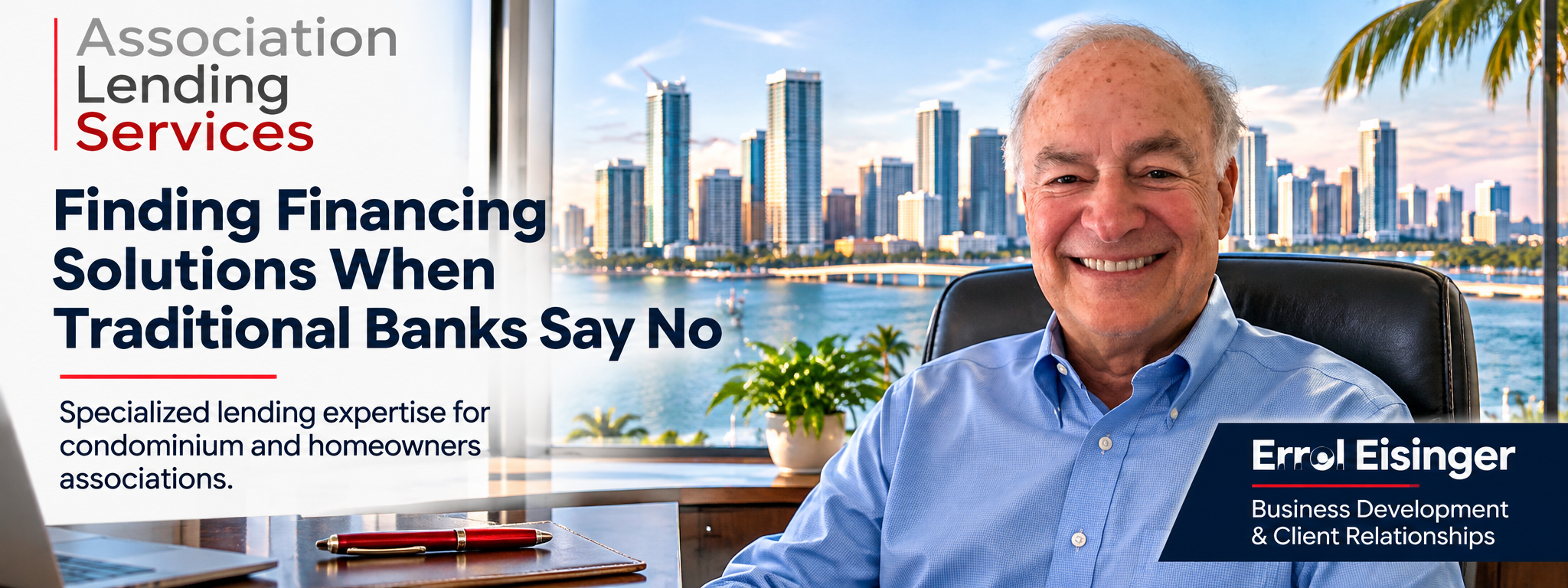
From South Florida to New York, principal Sachin Mehrotra and business development professional Errol Eisinger are helping condominium associations explore financing opportunities that conventional lenders may be unwilling or unable to accommodate.
For condominium associations throughout South Florida, the challenge of maintaining aging buildings has become increasingly complicated. Rising construction costs, escalating insurance premiums, structural restoration requirements, and the financial demands of major capital improvements have placed significant pressure on condominium boards and the property owners they represent. What might once have been a relatively straightforward building improvement project can now require millions of dollars in financing, extensive financial documentation, and difficult decisions about how those costs will be shared among residents.
The situation becomes particularly challenging when an association approaches its existing financial institution only to discover that the proposed transaction falls outside the bank’s lending guidelines. Pending litigation, limited reserves, high rental occupancy, or unusual property characteristics can complicate an otherwise legitimate financing request. For association boards already confronting urgent repair deadlines, the inability to secure financing can create uncertainty about how to move forward.
Yet a rejection from one lender does not necessarily mean that every financing option has been exhausted. That distinction is at the center of the business philosophy behind Association Lending Services, a Florida-based company specializing in financing solutions for condominium associations, homeowners associations, and other community associations. Led by principal Sachin Mehrotra, with Errol Eisinger overseeing business development and client relationships, the company focuses on evaluating complex financing opportunities and identifying lenders whose underwriting requirements may accommodate transactions that traditional institutions have declined.
The First Call or the Last Call: A Different Approach to Association Financing
In commercial lending, experience often becomes most valuable when a transaction does not fit neatly within established underwriting guidelines. Traditional financial institutions operate within specific lending parameters designed to manage risk, maintain portfolio standards, and ensure that borrowers meet defined financial requirements. While those standards serve an important purpose, they can also limit the options available to condominium associations whose circumstances fall outside conventional expectations.
Mehrotra approaches these situations from a different perspective. His philosophy is that Association Lending Services should be either the first call an association makes when considering financing or the last call after other lenders have been unable to provide a solution. Rather than evaluating a transaction solely through the limitations of one institution, the company examines the broader financial picture, the association’s repayment capacity, and the financing structures that may be available through specialized lending relationships.
That approach does not mean every financing request can be approved. It means that an association’s circumstances deserve a thorough evaluation before its financing possibilities are dismissed. Understanding why a traditional lender declined a transaction can be just as important as identifying the institutions that may be willing to consider it.
For condominium boards responsible for protecting substantial real estate assets and representing hundreds of property owners, that distinction can be significant. A financing professional who understands both the banking environment and the operational realities of community associations may be able to identify alternatives that were not considered during the initial application process.
A $2.3 Million Brooklyn Transaction Demonstrates the Company’s Reach
Although Association Lending Services is based in Florida, its financing activities extend beyond the state’s borders. One notable example involved a condominium association in Brooklyn, New York, where the company helped facilitate a reported $2.3 million financing transaction associated with major building improvements and related financial obligations.
The transaction illustrates the complexity that can arise when an association must address substantial capital requirements while navigating financial circumstances that may concern conventional lenders. Rather than treating the financing request as an isolated loan application, specialized association lending requires consideration of the property’s financial condition, its existing obligations, its ability to collect assessments, and the proposed repayment structure.
For associations confronting significant building repairs, financing can provide an alternative to collecting the entire project cost through an immediate special assessment. Depending on the terms of the transaction, an association may be able to spread repayment obligations over an extended period, potentially providing greater financial predictability for participating owners. Borrowing does not eliminate the cost of the project, however, and interest, fees, and repayment obligations must be evaluated carefully.
The Brooklyn transaction also received independent media attention. In October 2026, journalist Emily Myers reported on the financing arrangement for Habitat Magazine, examining the condominium’s financial challenges and the involvement of Association Lending Services.
Readers interested in the original reporting can review Habitat Magazine’s coverage of the $2.3 million Brooklyn condominium financing transaction.
For South Florida condominium boards, the broader significance lies in understanding that difficult financing circumstances do not always produce identical outcomes across different lending institutions. A transaction that falls outside one lender’s preferred criteria may warrant consideration by another institution with a different underwriting strategy.
When Rental Occupancy Becomes a Financing Obstacle
One of the less frequently discussed challenges in condominium association financing involves investor concentration. In communities where a substantial percentage of units are rented rather than owner-occupied, some lenders may impose additional underwriting requirements or decline transactions that exceed their preferred rental-occupancy thresholds.
The reasoning is largely connected to risk assessment. Lenders may examine whether an association can consistently collect assessments, maintain sufficient operating revenue, and meet its financial obligations under different economic conditions. A high percentage of investor-owned units can influence that evaluation, although the significance varies according to the lender, the association’s financial condition, and the type of financing requested.
Association Lending Services reports having facilitated financing for two condominium projects with approximately 95% rental occupancy, a concentration that can present challenges for certain traditional lending institutions. These transactions, as described by the company, demonstrate why specialized financing relationships can be particularly valuable when conventional underwriting requirements limit the available options.
There is no universal rule that prohibits every condominium association with more than 25% rental occupancy from obtaining financing. Individual lenders establish their own criteria, and different loan products may apply different standards. The relevant question is whether an association’s financial strength, repayment capacity, and overall risk profile satisfy the requirements of a lender willing to consider the transaction.
For Mehrotra, the objective is not simply to locate a lender offering attractive terms. It is to identify institutions capable of evaluating the particular circumstances of the association and determining whether a responsible financing structure is available.
Why Experience and Relationships Still Matter in Modern Lending
Technology has dramatically changed how borrowers research financing options, prepare applications, and communicate with financial institutions. Digital platforms can streamline documentation, accelerate preliminary evaluations, and provide access to information that once required numerous telephone calls and in-person meetings. Yet complex lending transactions continue to depend on professional judgment, experience, and established relationships.
Eisinger brings more than five decades of experience in commercial lending and real estate to Association Lending Services. His professional background, combined with his experience serving on a condominium association board, provides a perspective that connects the financial requirements of lending institutions with the practical responsibilities facing association directors.
Board members are not simply borrowing money. They are making decisions that may affect property values, monthly assessments, reserve balances, and the long-term financial obligations of their communities. Those decisions require an understanding of financing alternatives, repayment structures, project timelines, and the potential consequences of delaying necessary improvements.
Through business development and client relationships, Eisinger helps connect association representatives with the resources and expertise needed to explore those decisions. Mehrotra’s specialized financing experience complements that work by focusing on the evaluation and structuring of transactions that may require more extensive lender engagement.
The combination illustrates an important reality of commercial finance: Technology may improve the efficiency of the process, but understanding the people, properties, and financial circumstances behind a transaction remains essential.
What South Florida Condominium Associations Can Learn
For condominium boards in Miami-Dade, Broward, and Palm Beach counties, the need to evaluate financing alternatives has become increasingly relevant. Florida’s evolving condominium inspection and reserve requirements, combined with the costs associated with maintaining older buildings, have placed greater attention on long-term capital planning and the financial responsibilities of association leadership.
Some communities may have sufficient reserves to fund necessary improvements without borrowing. Others may determine that a special assessment, an association loan, or a combination of funding sources is more appropriate. The correct approach depends on the association’s financial condition, governing documents, project requirements, applicable laws, and the terms available from prospective lenders.
Financing can offer flexibility, but it should never be mistaken for eliminating a financial obligation. When an association borrows money, repayment generally becomes part of its financial planning, and owners may ultimately bear those costs through regular or special assessments. Interest expenses, loan fees, repayment periods, and other contractual obligations must be considered alongside the immediate benefits of obtaining capital.
Associations can improve their readiness for financing discussions by maintaining accurate financial statements, current budgets, reliable assessment collection records, and clear documentation of proposed projects. Understanding the association’s existing obligations and anticipated future expenses can also help lenders evaluate its repayment capacity.
Perhaps most importantly, boards should recognize that different lenders may view the same transaction differently. Exploring appropriate alternatives can be a responsible part of the decision-making process, particularly when a major project cannot be postponed indefinitely.
The Value of Looking Beyond the First Rejection
The experience of Association Lending Services illustrates a broader lesson about specialized commercial finance. Complex transactions are rarely defined by a single financial metric, and an initial rejection does not always provide a complete picture of the available lending market.
A condominium association may have unusual rental concentration, pending legal matters, significant capital requirements, or other characteristics that make conventional financing more difficult. Those circumstances require careful analysis, but they do not necessarily eliminate every potential lending relationship.
The challenge is determining whether the association has the financial capacity to support a loan and whether an institution exists whose lending criteria appropriately accommodate the transaction. That process requires both a realistic understanding of risk and familiarity with the financial institutions willing to evaluate specialized opportunities.
For Sachin Mehrotra and Errol Eisinger, that is the business behind Association Lending Services: helping associations explore financing possibilities when the path forward is not immediately apparent.
In a market where aging infrastructure, capital improvement requirements, and financial pressures continue to challenge community associations, the ability to examine complicated transactions from multiple perspectives may prove increasingly valuable.
Exploring Financing Options With Association Lending Services
Condominium and homeowners association boards considering major repairs, capital improvements, structural restoration, or other substantial financial obligations can benefit from reviewing available financing alternatives before committing to a particular course of action.
Errol Eisinger and the Association Lending Services team work with association representatives to discuss project requirements, evaluate financing opportunities, and identify potential lending relationships appropriate to the circumstances.
Whether an association is beginning its financing search or has already encountered challenges with traditional lenders, an informed discussion can help clarify the options that may be available.
Errol Eisinger
Association Lending Services
Phone: 786-205-9842
Email: eeisinger@associationfinancing.org
Website: www.associationlendingservices.com
Financing is subject to lender underwriting, eligibility requirements, documentation, credit approval, and applicable terms and conditions. Loan availability, interest rates, repayment structures, and closing timelines vary by transaction and jurisdiction. Association Lending Services does not guarantee loan approval, financing amounts, or funding timelines. Associations should consult their legal and financial advisers before entering into financing agreements.