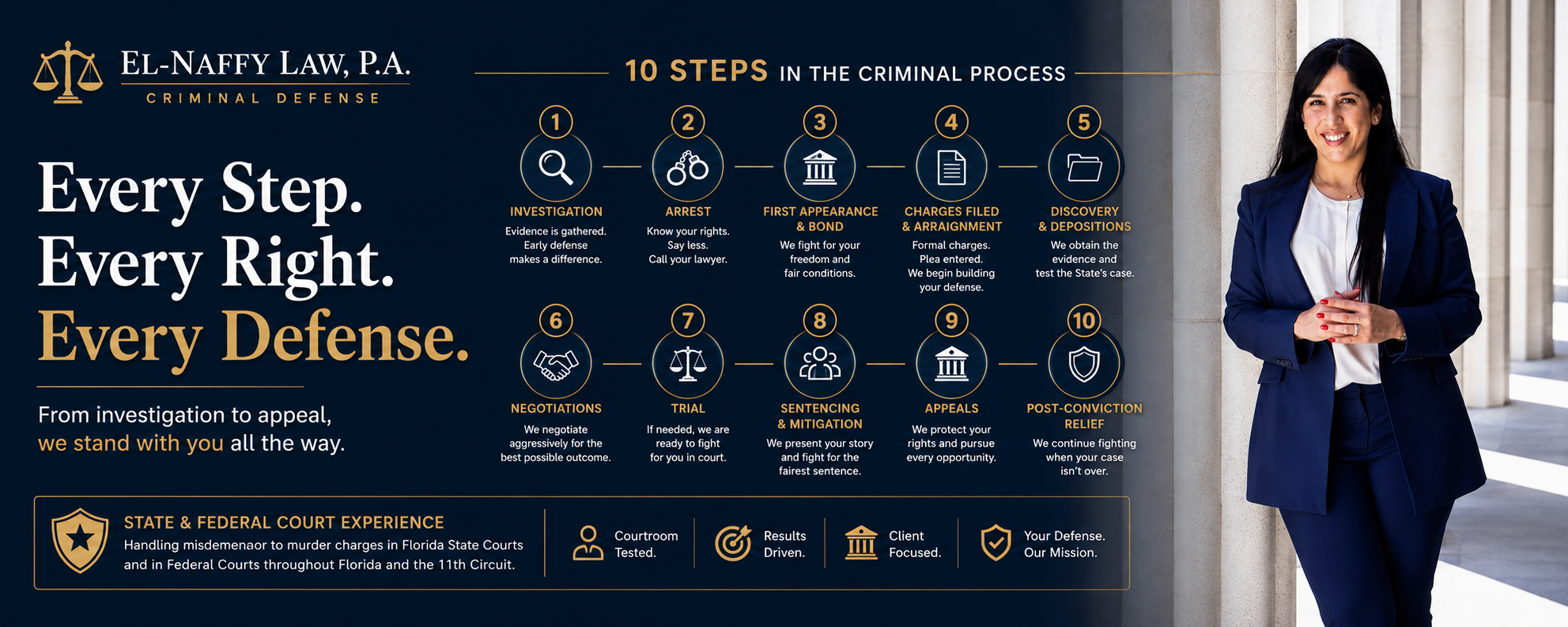
From Investigation to Appeal: Carolle El-Naffy Explains What Happens After Someone Is Accused of a Crime
When your freedom is on the line, every stage of the criminal process matters.
Many people believe a criminal case begins when someone is arrested and ends when a verdict is announced. Carolle El-Naffy, Esq. knows that the reality is far more complicated.
During a recent presentation, the Florida criminal defense attorney guided her audience through the justice system from the first investigation to the final opportunities for appeal and post-conviction relief. Her central message was clear: decisions made early in a case can influence everything that follows.
El-Naffy has spent her entire legal career in criminal courtrooms. She began as an Assistant Public Defender, handling thousands of cases before entering private practice and eventually founding El-Naffy Law, P.A. in 2020.
Her experience includes misdemeanors, probation violations, violent felonies, drug-trafficking allegations, federal matters, Stand Your Ground hearings, and homicide trials, including first-degree murder cases.
She is admitted to practice in Florida, all three federal judicial districts in the state, and the U.S. Court of Appeals for the Eleventh Circuit.
But her presentation was not primarily about credentials. It was about helping people understand what happens when the government begins building a criminal case.
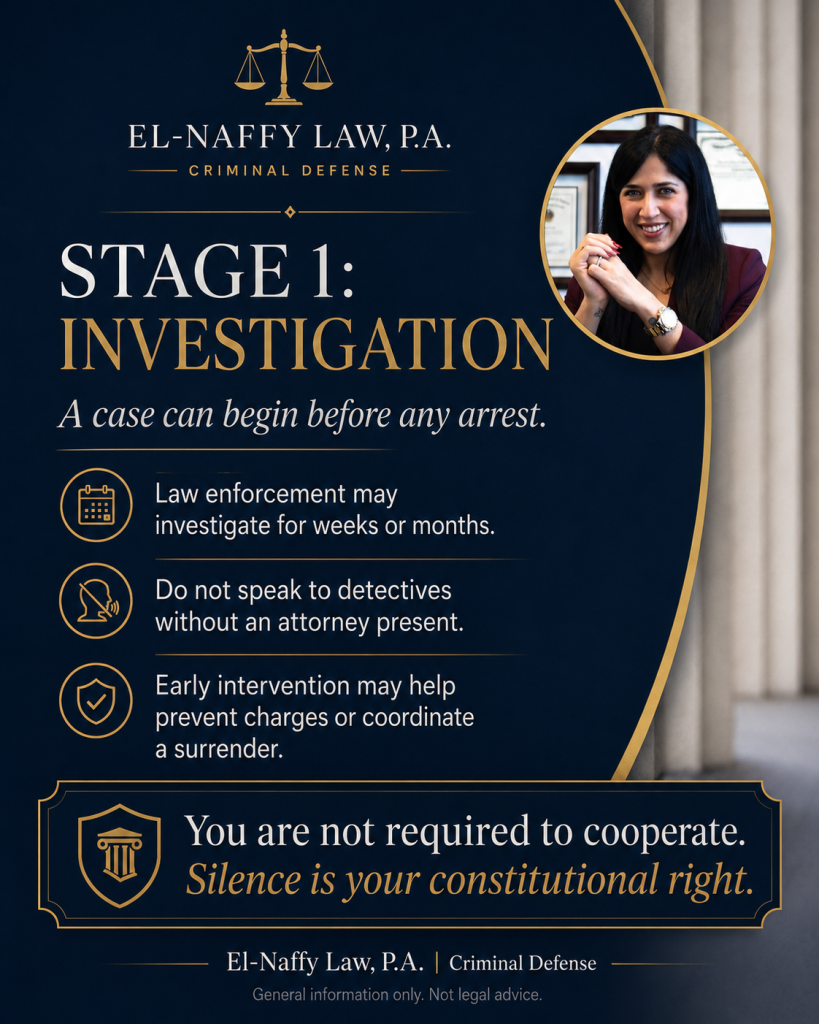
Stage One: The Investigation
A criminal case may begin long before an arrest.
Unless an officer personally witnesses an alleged offense or arrives immediately afterward, law enforcement will often conduct an investigation. That investigation may last minutes, days, months, or even years.
Police may interview witnesses, collect surveillance footage, examine digital communications, review financial records, obtain forensic evidence, or attempt to question the person under investigation.
According to El-Naffy, this can be one of the most important moments to contact a criminal defense attorney.
An attorney may communicate with investigators, protect the client from questioning, preserve potentially favorable evidence, and determine whether an arrest warrant is being considered.
When appropriate, counsel may also attempt to arrange a voluntary surrender. This can prevent a person from being unexpectedly arrested at home, at work, or in front of family members.
Early representation does not guarantee that an arrest or prosecution will be avoided. It can, however, help protect the accused from making statements or decisions that may later be used against them.
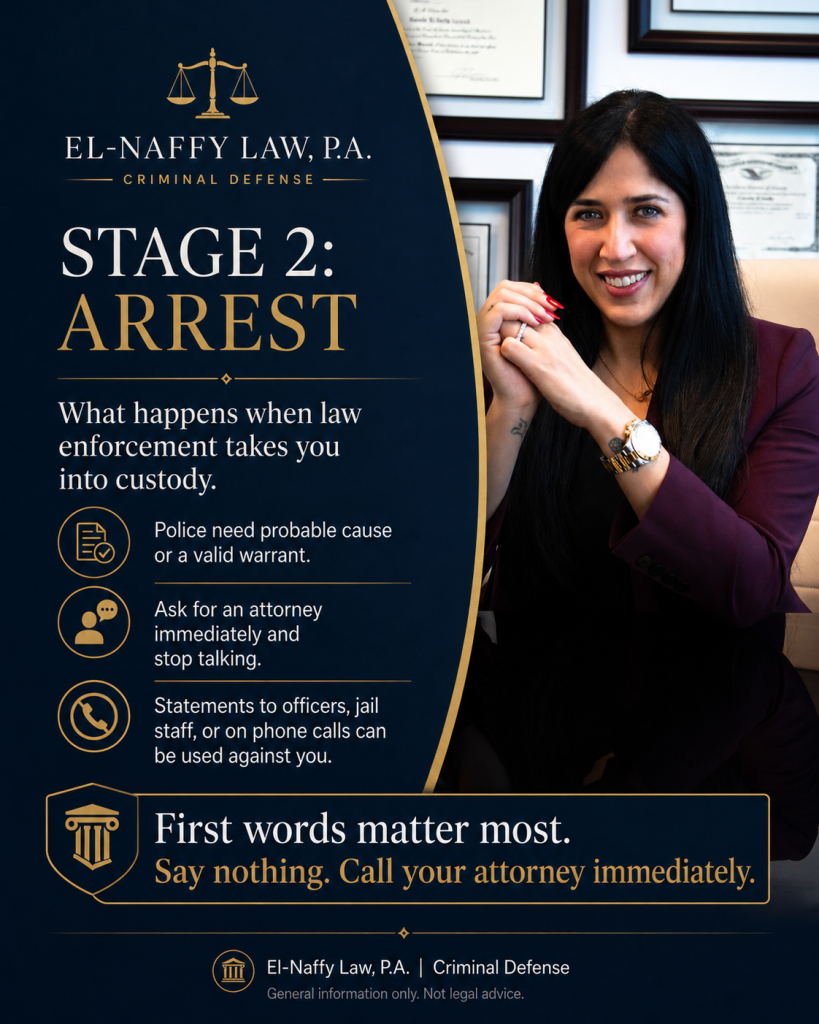
Stage Two: The Arrest
Police generally need probable cause or a valid warrant to make an arrest.
Once a person is taken into custody, the most important practical rule is simple: do not attempt to explain the situation without legal representation.
People often believe that remaining silent will make them appear guilty. In reality, statements made during a stressful encounter can be misunderstood, taken out of context, or used to strengthen the prosecution’s case.
A person may clearly state:
“I am invoking my right to remain silent. I want an attorney.”
After invoking those rights, the person should stop answering questions about the alleged offense.
What Miranda Rights Actually Mean
One of the most common misconceptions in criminal law is that a case must be dismissed whenever officers fail to read someone their Miranda rights.
That is not how Miranda generally works.
Miranda warnings typically become relevant when two conditions exist:
- The person is in custody.
- Law enforcement conducts an interrogation.
Custody does not always require handcuffs. The legal question often centers on whether a reasonable person in that situation would feel free to leave.
An interrogation includes direct questioning and certain conduct reasonably likely to produce an incriminating response.
When officers conduct a custodial interrogation without the required warnings, the potential remedy may be suppression of the affected statements. It does not automatically mean that the arrest disappears or the entire case is dismissed.
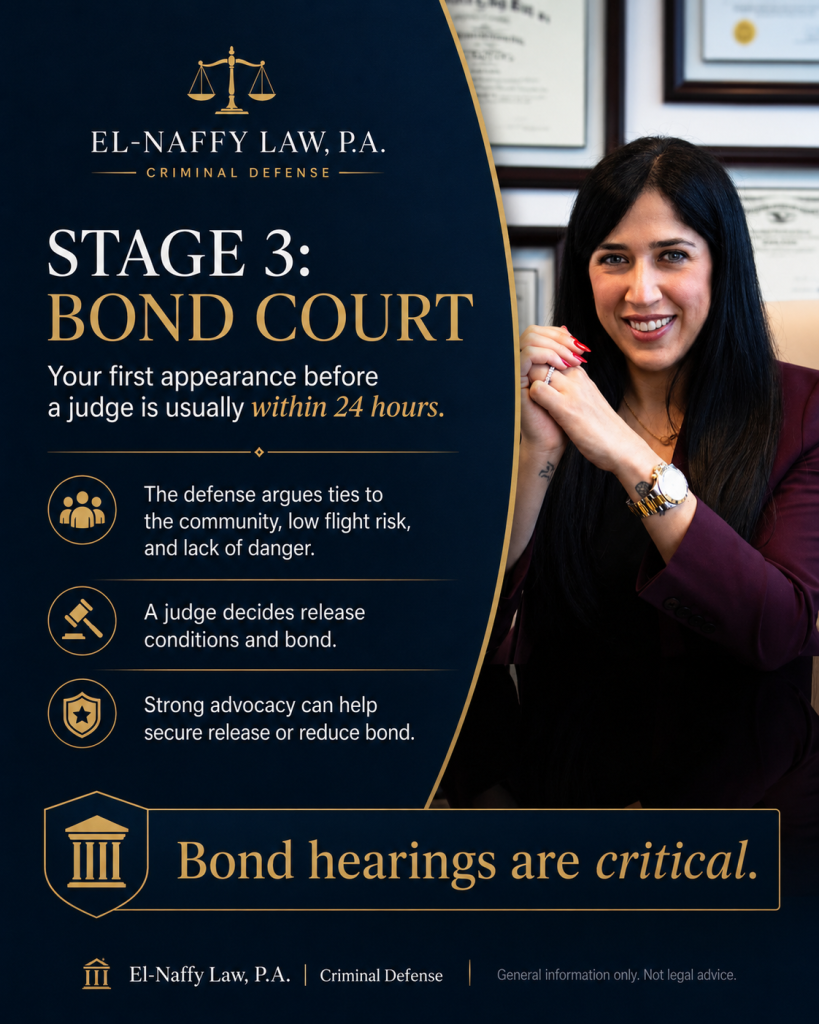
Stage Three: First Appearance and Bond Court
After an arrest, the accused may appear before a judge, often within 24 hours.
The judge may review probable cause, advise the person of the allegations, consider release conditions, and determine whether a bond should be set.
Some lower-level charges may have predetermined bond amounts. More serious accusations, domestic violence matters, and offenses initially classified as nonbondable may require a formal hearing.
At this stage, the defense may argue that the accused:
- Has meaningful ties to the community
- Has stable employment or family responsibilities
- Is unlikely to flee
- Does not present a danger to the community
- Has little or no prior criminal history
- Will comply with reasonable release conditions
Effective advocacy at first appearance can affect whether someone returns home while the case is pending and how much money may be required to secure that release.
Stage Four: Prosecutorial Review and Formal Charges
An arrest does not necessarily mean prosecutors will file the exact charge listed by the arresting officer.
After an arrest, evidence is typically forwarded to the prosecuting authority for review. The prosecutor may decide to:
- File the original charge
- Reduce the charge
- Add or modify charges
- Request additional investigation
- Decline to prosecute the case
This creates another important opportunity for early defense intervention.
A defense attorney may provide information, documents, witness statements, legal arguments, or other evidence that investigators did not initially consider.
The objective may be to demonstrate that the evidence does not support the proposed charge, that a felony should be reduced, or that prosecution is not appropriate.
The final decision remains with the prosecuting authority, but early advocacy can ensure the defense perspective is presented before the case moves further into the system.
Stage Five: Arraignment
The arraignment is the proceeding at which the accused is formally advised of the filed charges and enters a plea.
In many cases, the plea entered at arraignment is not guilty.
This does not necessarily mean the case will proceed to trial. It preserves the defendant’s rights while counsel investigates the allegations, obtains discovery, evaluates defenses, and begins negotiations.
Once counsel is involved, a personal appearance at every procedural hearing may not always be necessary, depending on the charge, court, and judge.
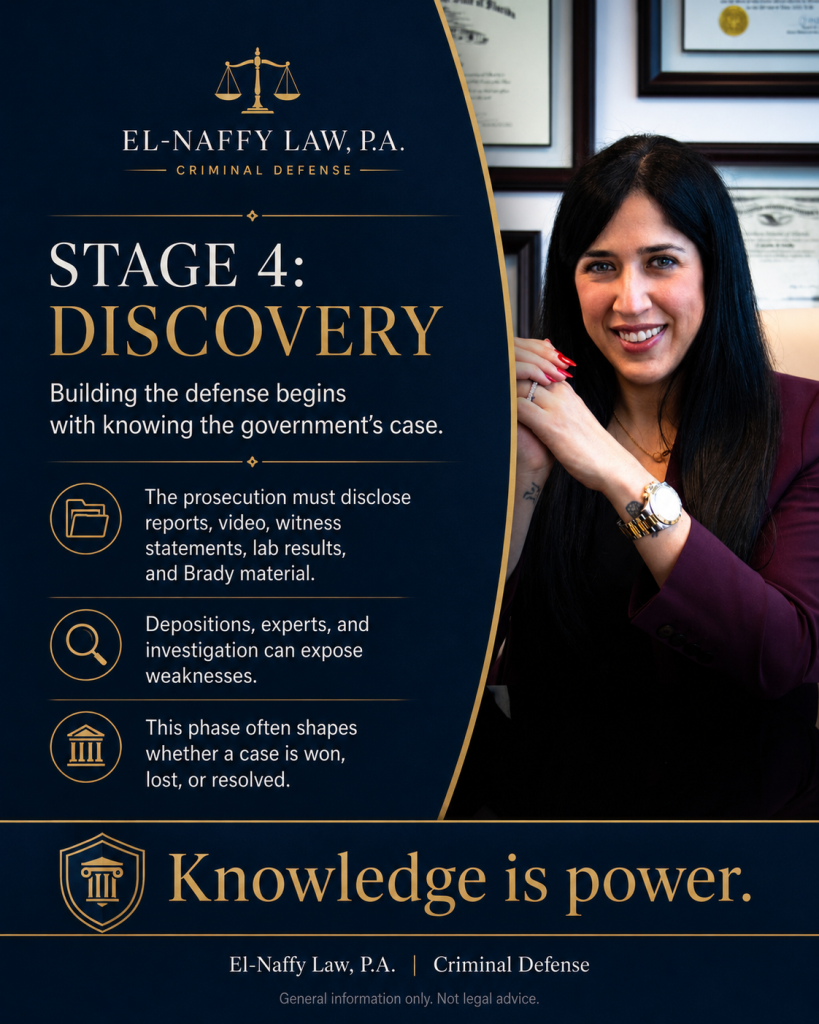
Stage Six: Discovery and Depositions
Discovery is the process through which the defense obtains and examines the prosecution’s evidence.
That evidence may include:
- Police reports
- Body-camera footage
- Surveillance video
- Witness statements
- Photographs
- Laboratory reports
- Medical records
- Digital communications
- DNA or fingerprint evidence
- Firearm and ballistics analysis
- Statements attributed to the accused
Florida criminal procedure may also permit depositions in qualifying cases. During a deposition, a witness answers questions under oath before trial.
El-Naffy emphasized that depositions can significantly change a case. Testimony may reveal inconsistencies, expose weaknesses in the investigation, produce new evidence, or confirm that the prosecution’s case is stronger than it initially appeared.
A thorough defense does not rely solely on the police report. It independently examines what happened, what can be proven, whether proper procedures were followed, and whether witnesses can withstand cross-examination.
The Role of Expert Witnesses
Some criminal cases require specialized knowledge beyond that of the attorneys, judge, and jury.
Depending on the allegations, the defense may consult or retain experts in areas such as:
- DNA analysis
- Ballistics
- Toxicology
- Accident reconstruction
- Digital forensics
- Mental health
- Medical causation
- False confessions
- Use of force
Experts may challenge the prosecution’s conclusions, identify weaknesses in the testing process, explain alternative interpretations, or provide information relevant to mitigation.
In a homicide prosecution, for example, DNA, firearm, medical, and crime-scene evidence may each require separate analysis.
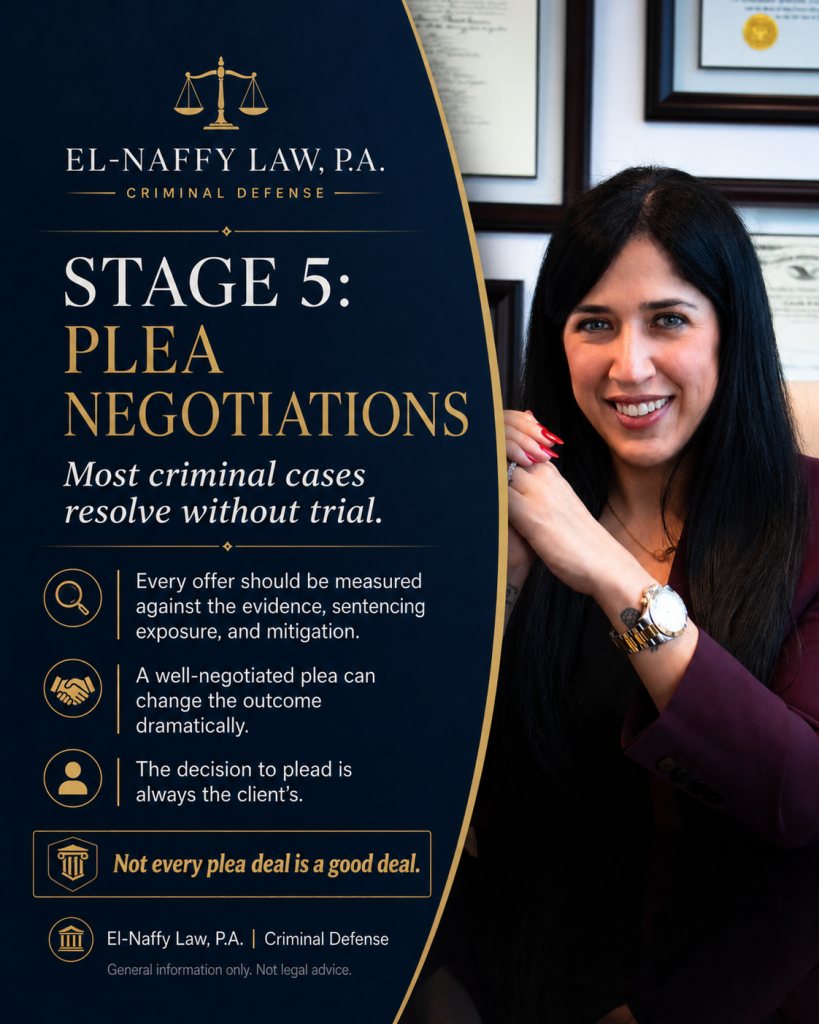
Stage Seven: Plea Negotiations
Most criminal cases do not end with a jury verdict. Many are resolved through negotiated pleas.
A plea may involve reduced charges, reduced penalties, probation, treatment, diversion, credit for time served, or an agreed sentencing recommendation.
However, a plea offer should not be evaluated in isolation.
The attorney must compare it against:
- The strength of the prosecution’s evidence
- Available defenses
- Sentencing exposure
- The client’s criminal history
- Evidentiary problems
- Witness credibility
- The likelihood of success at trial
- The personal consequences of a conviction
Florida uses a sentencing scoresheet system in many felony cases. The calculated points may affect whether the lowest permissible sentence includes state prison.
Effective negotiation requires more than asking for leniency. It requires demonstrating weaknesses in the government’s case, presenting mitigation, and showing prosecutors why an alternative resolution may be appropriate.
The final decision to accept or reject a plea belongs to the client. The attorney’s role is to explain the risks, consequences, and available choices.
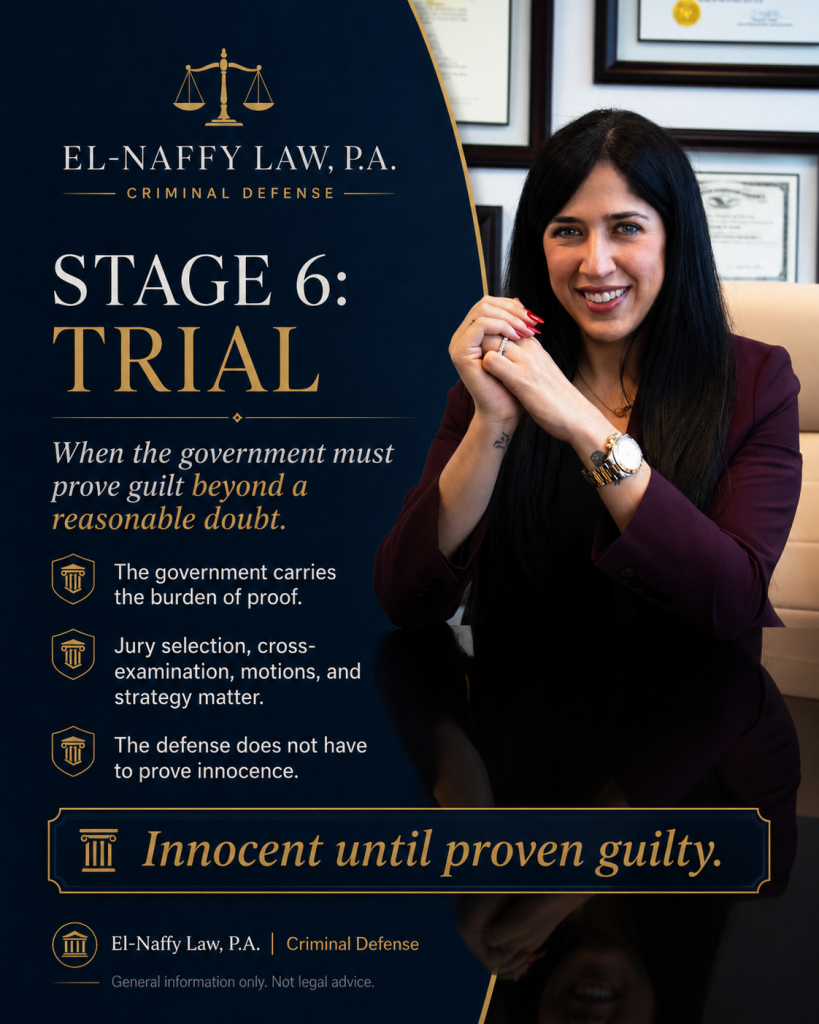
Stage Eight: Trial
At trial, the prosecution carries the burden of proving every element of the charged offense beyond a reasonable doubt.
The defendant does not have to prove innocence.
The defense may challenge whether the government has presented enough reliable evidence to satisfy its burden.
Trial preparation may include:
- Jury selection
- Opening statements
- Cross-examination
- Evidentiary objections
- Expert testimony
- Presentation of defense evidence
- Motions for judgment of acquittal
- Closing arguments
Most Florida criminal jury trials involve six jurors, although certain cases require twelve.
Some cases are decided through a bench trial, where the judge determines guilt. El-Naffy explained that the decision between a jury trial and a bench trial must be made carefully based on the facts, legal issues, and circumstances of the case.
For her, trial readiness is also a negotiating tool. Prosecutors know the difference between a lawyer who is merely seeking an agreement and one who is prepared to test the case before a jury.
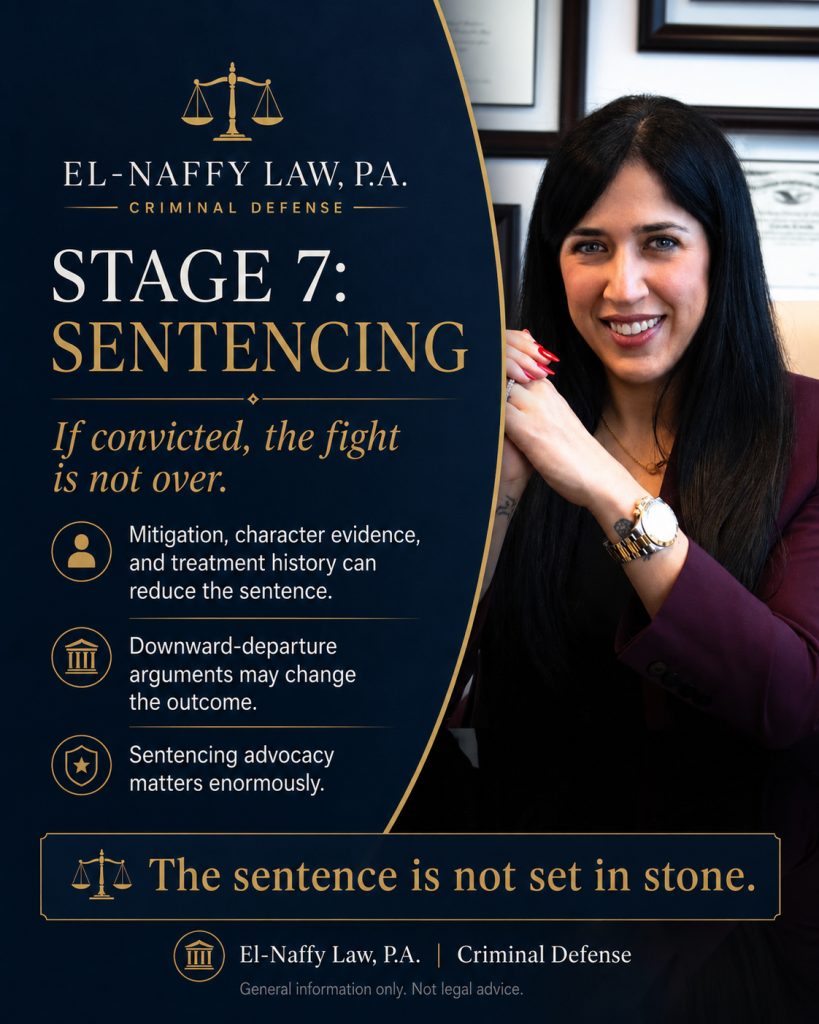
Stage Nine: Sentencing and Mitigation
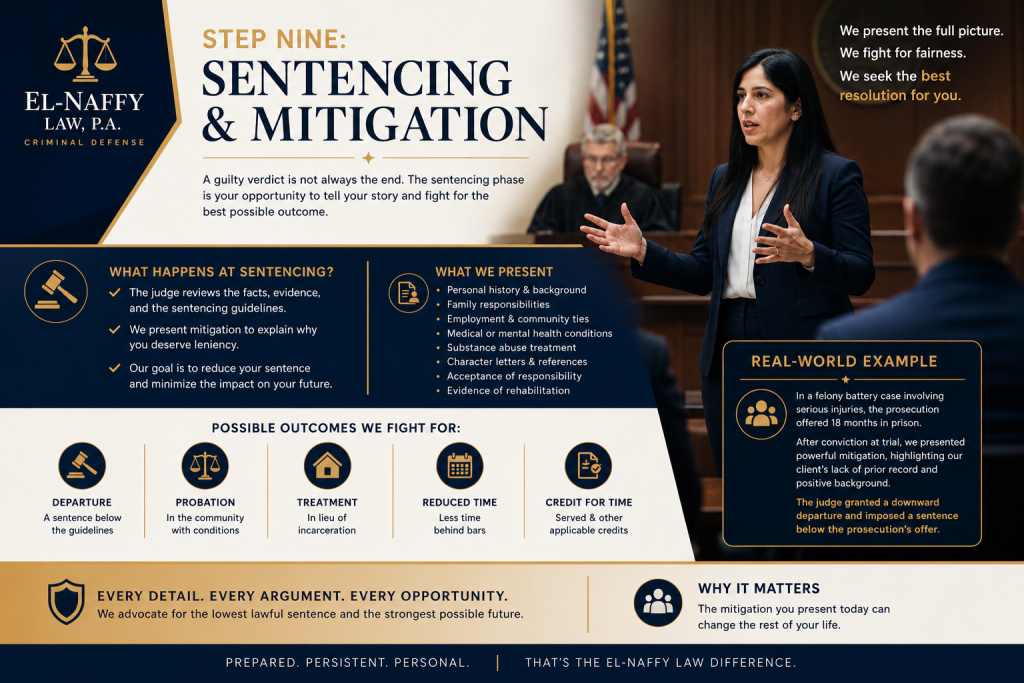
A guilty verdict does not always end the defense attorney’s work.
In many felony cases, sentencing occurs at a later hearing. That time allows the defense to prepare mitigation and present reasons why the court should impose a sentence below what the prosecution requests.
Mitigation may include:
- Lack of prior criminal history
- Employment history
- Family responsibilities
- Community involvement
- Medical or mental health conditions
- Substance-use treatment
- Acceptance of responsibility
- Character letters
- Testimony from relatives, employers, or community members
- Evidence that the conduct was an isolated event
In appropriate cases, the defense may seek a downward-departure sentence. This asks the court to impose a lawful sentence below the lowest permissible sentence calculated under the sentencing guidelines.
El-Naffy illustrated this with a felony battery case involving severe injuries. The prosecution offered 18 months in prison. After the client was convicted at trial, she presented a downward-departure argument emphasizing the client’s lack of a prior record and other mitigating circumstances.
The judge granted the departure and imposed a sentence below the prosecution’s original offer.
The client was still convicted and incarcerated, but the sentencing advocacy materially reduced the punishment.
Stage Ten: Appeals and Post-Conviction Relief
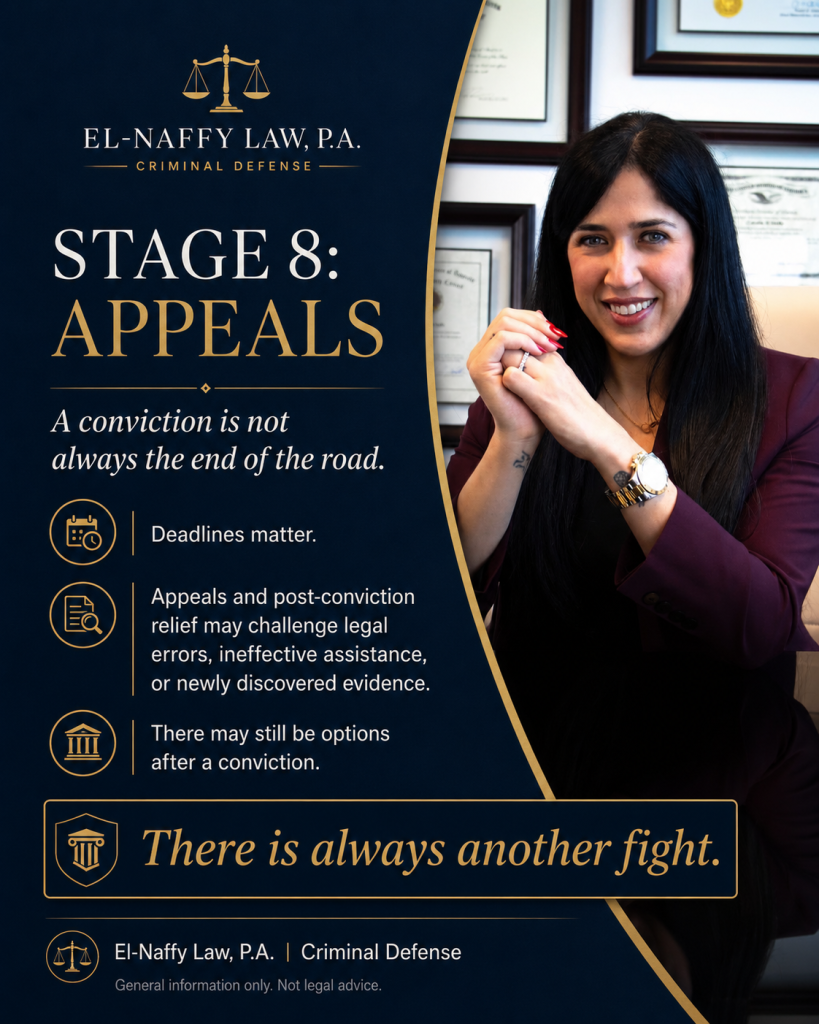
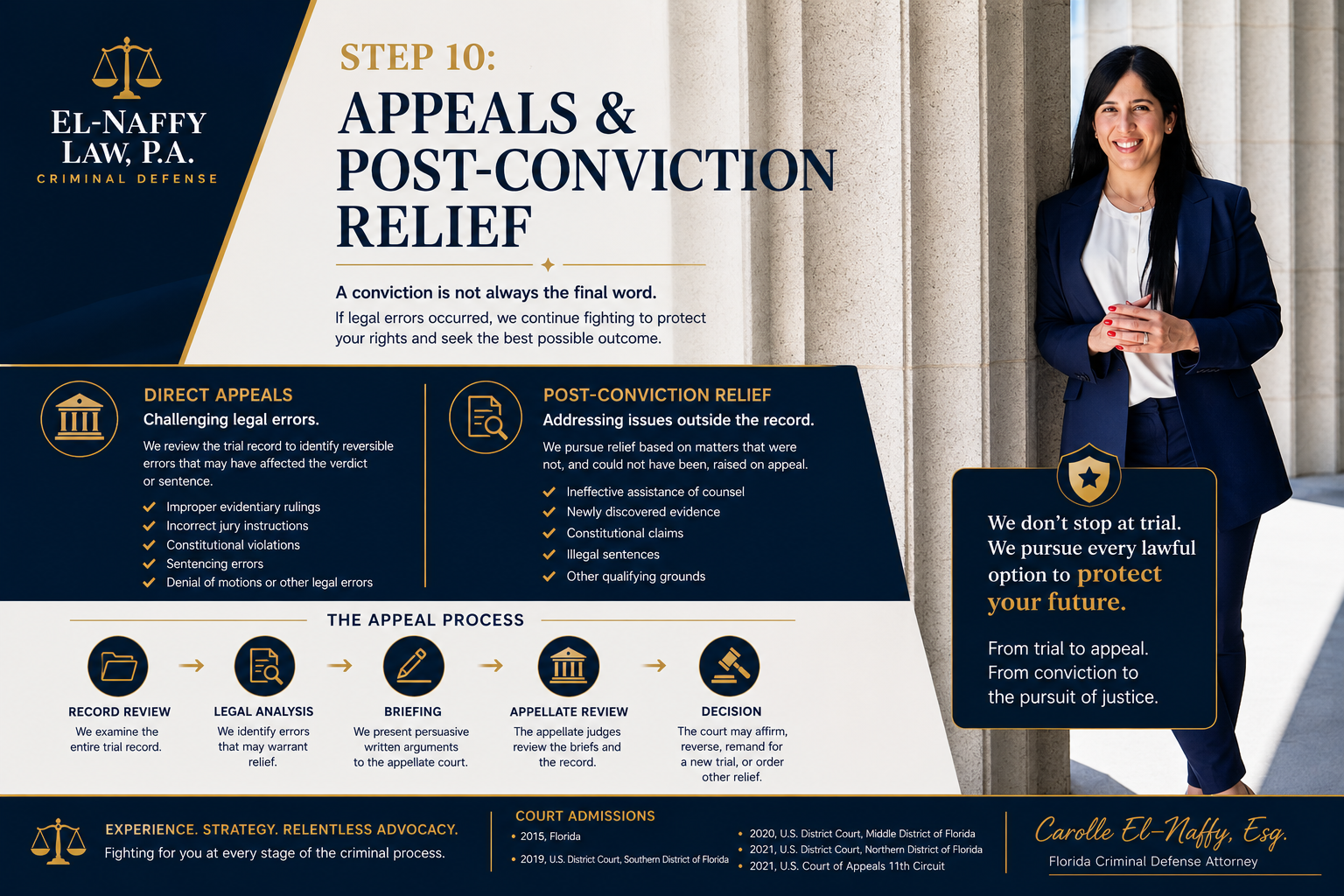
A conviction may be reviewed when legal errors occurred during the proceedings.
An appeal is not a new trial. Appellate courts generally review the record to determine whether the trial court committed a reversible legal error.
Potential appellate issues may involve:
- Incorrect evidentiary rulings
- Improper jury instructions
- Constitutional violations
- Errors in sentencing
- Denial of a legally sufficient motion
- Other preserved trial-court errors
Post-conviction proceedings may raise different issues, including ineffective assistance of counsel or newly discovered evidence.
Strict deadlines can apply. Anyone considering an appeal or post-conviction claim should speak with qualified counsel promptly.
Experience at Every Stage
Carolle El-Naffy’s presentation demonstrated that criminal defense is not one event in one courtroom.
It is a process.
The investigation affects the arrest. The arrest affects bond. Early evidence affects charging. Discovery shapes negotiations. Depositions affect trial strategy. Trial preparation creates negotiating leverage. Mitigation affects sentencing. Preserved legal issues may determine whether an appeal is possible.
Every step connects to the next.
That is why El-Naffy remains personally involved throughout her clients’ cases. Her approach combines aggressive advocacy with the compassion to recognize that every criminal allegation affects a real person, a real family, and a real future.
About Carolle El-Naffy, Esq.
Born in Beirut, Lebanon, and raised in Santiago, Chile, Carolle El-Naffy earned her bachelor’s degree from Florida International University and her Juris Doctor from Florida Coastal School of Law.
She began her career as an Assistant Public Defender in Broward County, where she handled thousands of cases over nearly four years. She later entered private practice, focusing exclusively on criminal defense, before founding El-Naffy Law, P.A. in 2020.
Her experience includes misdemeanor and felony defense, homicide cases, drug-trafficking allegations, federal matters, Stand Your Ground hearings, probation violations, criminal traffic cases, and record-sealing and expungement matters.
Court Admissions
- Florida, 2015
- U.S. District Court for the Southern District of Florida, 2019
- U.S. District Court for the Middle District of Florida, 2020
- U.S. District Court for the Northern District of Florida, 2021
- U.S. Court of Appeals for the Eleventh Circuit, 2021
When Your Freedom Is on the Line, Experience Matters
A criminal accusation can threaten a person’s freedom, reputation, career, family, and future. The earlier an experienced attorney becomes involved, the more opportunities there may be to protect the client’s rights and influence the direction of the case.
El-Naffy Law, P.A. provides hands-on criminal defense from investigation and arrest through trial, sentencing, appeals, and post-conviction proceedings.
Prior results do not guarantee a similar outcome. This article provides general information and is not legal advice. Reading it does not create an attorney-client relationship.