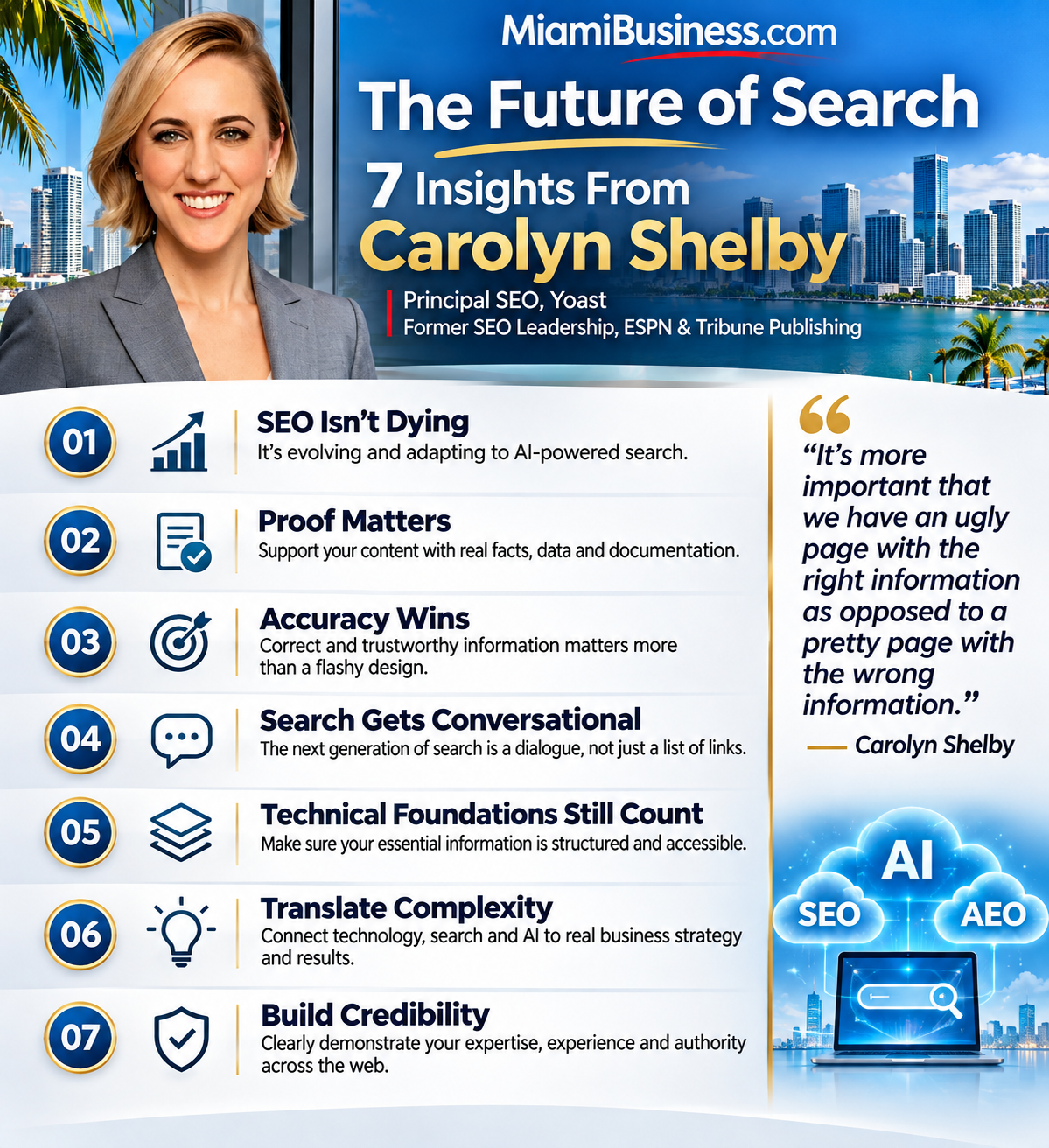
From helping ESPN reclaim its No. 1 Google ranking for NFL Draft coverage to shaping SEO strategy at Yoast, nationally recognized search expert Carolyn Shelby explains why artificial intelligence is transforming how businesses get discovered, and why credible information matters more than ever.
By Wilson Alvarez | MiamiBusiness.com
MIAMI, FLORIDA — November 2026
Quick Answer: Carolyn Shelby, a nationally recognized authority in search engine optimization and artificial intelligence, believes SEO is not disappearing. It is evolving. Drawing on more than three decades of experience with internet technology, ESPN, Tribune Publishing and Yoast, she explains why businesses must prioritize verifiable information, technical accessibility, and factual accuracy as Google moves toward conversational AI-powered search.
A Recognized Authority in the Search Engine Industry
When Carolyn Shelby discusses the future of search engine optimization, her perspective carries the weight of more than three decades spent helping organizations navigate the internet’s evolution.
Shelby is not simply another digital marketing consultant offering predictions about artificial intelligence. She is an established technical SEO strategist, international conference speaker and industry author whose professional experience includes some of America’s most recognizable media organizations.
Her career includes leading search initiatives at Disney’s ESPN, serving as Director of SEO at Tribune Publishing, and contributing to the strategic direction of Yoast, one of the world’s most widely used WordPress SEO platforms.
She is also a contributor to Search Engine Journal and Search Engine Land, two prominent publications serving the global search marketing industry. Her work addresses enterprise SEO, technical website architecture, AI-powered information retrieval and the changing relationship between businesses and search technology.
Shelby’s expertise has earned her speaking opportunities at major industry conferences, including Pubcon and Search Marketing Expo (SMX), where marketing professionals and technology executives gather to understand developments in search.
Today, she serves as Principal SEO at Yoast, Vice President of Strategy at NorthSide Metrics and founder of CSHEL Search Strategies, bringing together technical expertise, business strategy and an understanding of emerging artificial intelligence systems.
During an interview with MiamiBusiness.com at NamesCon Global and CloudFest Americas in Miami, Shelby shared her perspective on a question confronting businesses worldwide: What happens to search engine optimization when artificial intelligence begins answering the questions people once typed into Google?
Her answer challenges one of the most common assumptions in digital marketing.
SEO is not dying. It is adapting.
The Early Internet: Building an ISP in 1994
Shelby’s professional journey began in 1994, long before Google became a household name and before most companies understood the commercial potential of the internet.
That year, she co-founded an internet service provider near Purdue University. It was a startup environment in which entrepreneurship required a willingness to handle almost every technical responsibility.
Her responsibilities included system administration, technical support and the day-to-day challenges of operating internet infrastructure.
Those experiences provided Shelby with a technical foundation that would distinguish her from marketing professionals who entered the industry primarily through advertising, content creation or search keywords.
She understood how websites operated behind the scenes, how information moved through networks and how technical decisions affected the ability of people to access information.
As digital marketing matured, that technical foundation became an increasingly valuable advantage. Search visibility was no longer simply about choosing keywords. It involved website architecture, infrastructure, software development and the ability of search engines to discover and understand content.
Shelby’s career would eventually demonstrate that effective search strategy requires both technological expertise and business judgment.
ESPN: Helping Reclaim the No. 1 Ranking for the NFL Draft
Among Shelby’s notable professional accomplishments was her work with ESPN, where the competition for search visibility is particularly intense.
Sports media organizations compete for audiences searching for breaking news, athlete profiles, statistics, game results and major sporting events. During events such as the NFL Draft, millions of fans seek information, often from multiple competing publishers.
During her interview, Shelby recalled helping ESPN reclaim the No. 1 Google ranking for its NFL Draft coverage through the application of her SEO expertise.
It was an accomplishment that illustrated the practical value of a discipline that is sometimes misunderstood as little more than keyword selection.
Shelby explained that the ESPN assignment did not necessarily introduce an entirely new professional skill set. Instead, it provided an opportunity to apply her established SEO knowledge to a major sports media organization operating in an exceptionally competitive digital environment.
Her broader responsibilities at ESPN included domestic and international search strategy, requiring an understanding of how audiences in different markets discovered content across the company’s digital properties.
For businesses, the ESPN experience reinforces an important lesson. Effective SEO can have measurable commercial significance, particularly when a company competes for visibility around valuable, highly searched topics.
The challenge is not simply to appear online. It is to make information discoverable when audiences are actively looking for it.
Tribune Publishing: Where Technology Met the Boardroom
If ESPN demonstrated the value of Shelby’s search expertise, her experience at Tribune Publishing highlighted another professional strength: the ability to communicate complicated technical concepts to business leaders.
At Tribune Publishing, whose properties included the Chicago Tribune and Los Angeles Times, Shelby worked in an environment where editorial operations, marketing strategy, website development and corporate leadership needed to function together.
By that point in her career, she had spent years moving between technology and marketing responsibilities. That experience allowed her to understand the priorities of both departments while recognizing that they did not always communicate in the same language.
A technical team might describe a proposed infrastructure change in terms of software architecture, crawling behavior or performance. Marketing executives might evaluate the same project through audience growth, operational costs or advertising revenue.
Both perspectives were important, but they needed to be connected.
Shelby became particularly effective at bridging those differences.
During her interview, she described communicating with C-suite executives and board members, explaining technical and marketing initiatives in terms of business objectives rather than relying exclusively on specialized terminology.
Her ability to make complex projects understandable helped decision-makers appreciate their practical significance.
That skill remains particularly relevant today, when executives are being asked to make substantial investments in artificial intelligence without always understanding the underlying technology.
For Shelby, successful technical leadership is not just about knowing how systems work. It is also about explaining why they matter.
Yoast: Making SEO and Artificial Intelligence Understandable
Shelby’s work with Yoast represents another chapter in a career built around connecting sophisticated technology with practical business needs.
Yoast has become one of the most widely recognized names in WordPress search optimization. Its tools help website owners address technical and editorial elements of SEO, including page titles, metadata, content structure and readability.
However, the emergence of artificial intelligence has introduced a new layer of complexity.
Search engines are increasingly moving beyond traditional lists of links. Google’s AI Overviews, ChatGPT and other conversational systems can assemble information from multiple sources and provide synthesized answers.
That evolution has brought greater attention to Answer Engine Optimization, commonly called AEO, and other approaches to AI search visibility.
Shelby described her work at Yoast as helping make increasingly complicated SEO and AEO concepts understandable to both development teams and users.
This is an important distinction. Creating sophisticated search optimization technology is one challenge. Making that technology accessible to millions of website owners is another.
Businesses must understand not only how to structure their websites for traditional search engines but also how their information may be retrieved and interpreted by AI-powered systems.
Shelby’s responsibility is connected to translating those emerging requirements into practical decisions that developers and website owners can act upon.
For WordPress publishers and small businesses, that combination of technical depth and practical communication is especially valuable.
Why SEO Will Remain Essential in the Age of AI
One of the most important points Shelby emphasized during the interview was that artificial intelligence does not eliminate the need for search engine optimization.
Instead, it changes the methods businesses must use to make their information discoverable.
Traditional Google Search familiarized business owners with the importance of appearing among the top organic results. Companies invested in content, backlinks, website performance and keywords in an effort to improve their rankings.
AI-powered discovery introduces a different experience.
Rather than presenting only a list of websites, an AI system may interpret a user’s question, retrieve relevant information and generate an answer.
For businesses, that creates a different challenge. It is no longer enough to think exclusively about where a website ranks for a particular keyword. Companies must also consider whether their information can be found, understood and supported by credible evidence.
Yet the fundamental principles of SEO remain relevant. Websites still need accessible pages, accurate information, clear organization and strong technical foundations.
As Shelby sees it, SEO will continue adapting to the systems people use to discover information.
The interface may change dramatically, but the need to make information accessible and trustworthy will remain.
An Ugly Website With the Right Information Can Beat a Beautiful Website With the Wrong Information
Perhaps Shelby’s most memorable observation during the interview concerned the relationship between website design and the actual quality of the information being presented.
“It’s more important that we have an ugly page with the right information as opposed to a pretty page with the wrong information.” — Carolyn Shelby
The statement challenges a familiar assumption in digital marketing: that a visually impressive website automatically provides a competitive advantage.
Attractive websites certainly matter. Good design can improve user experience, communicate professionalism and make information easier to navigate.
But visual presentation cannot compensate for incorrect information.
Shelby emphasized that AI systems do not necessarily interpret website imagery the way human visitors do. Text-based retrieval systems frequently depend on the information they can extract from accessible content rather than the visual appeal of a page.
Although modern multimodal AI systems can analyze images, the broader principle remains important. Critical business facts should not exist exclusively inside photographs, graphics or visual design elements.
Consider a professional services website filled with polished photography and promotional language but offering little specific information about qualifications, services or experience.
Now compare it with a less sophisticated website containing accurate professional credentials, clearly defined services, useful explanations and supporting documentation.
From an information retrieval perspective, the second website may provide stronger material for answering a user’s questions.
The lesson is not to abandon professional website design. It is to recognize that design and factual substance serve different purposes, and neither should replace the other.
Google’s Future May Be a Conversation, Not a Search Results Page
Asked what search might look like five years from now, Shelby predicted that the familiar Google experience could be substantially different.
She envisions a conversational interface in which people interact with search technology much as they would speak with another person.
Rather than typing a few keywords and reviewing a list of websites, users may ask complete questions and expect immediate answers.
That interaction could continue through follow-up questions, allowing the system to refine its understanding of the user’s needs.
For example, someone searching for a Miami business might begin by asking which local companies provide a particular service.
The next question could narrow the results by location, professional qualifications, price, availability or other requirements.
Instead of beginning a new search each time, the user could continue the same conversation.
This shift has significant implications for businesses.
Information must be sufficiently detailed to answer increasingly specific questions. A company that provides only general marketing language may leave important gaps that prevent an AI system from identifying it as a relevant option.
Organizations that communicate their services, qualifications and capabilities clearly may be better positioned for this emerging style of discovery.
Shelby’s prediction is not that Google will necessarily cease to exist, but that the way people experience search may become far more conversational.
Her First Piece of Advice to Small Businesses: Provide Proof
When asked where a small business with limited marketing resources should begin investing, Shelby emphasized one essential priority.
Proof.
Her advice was to support business claims with documentation, technical specifications, factual information and other forms of verifiable evidence.
The principle is straightforward. A business should not merely tell people what it does or claim that it offers exceptional services. It should provide information that helps substantiate those statements.
For a technology company, that may include product specifications, security documentation and independently verifiable certifications.
For a professional services firm, it may involve credentials, documented experience, clearly described practice areas and published explanations of specialized services.
For a manufacturer, detailed product specifications and supporting technical information can be particularly valuable.
This type of material serves two audiences.
First, it helps prospective customers make informed decisions.
Second, it provides search engines and AI-powered systems with clearer factual information about a business, its products and its expertise.
Supporting documentation alone does not guarantee prominent placement in AI-generated answers. However, it contributes to the accuracy and usefulness of the information available to those systems.
Shelby’s emphasis on proof also reflects a broader change in digital marketing.
Businesses can no longer assume that repeated promotional claims will establish credibility. Increasingly, they must demonstrate why their information deserves attention.
What Miami Businesses Can Learn From Carolyn Shelby
For South Florida companies, Shelby’s perspective arrives at an important time.
Attorneys, healthcare providers, financial professionals, real estate firms, technology companies and other local businesses have spent years competing for visibility in Google’s traditional search results.
Many have invested in attractive websites, search optimization, advertising and social media campaigns.
Those investments remain relevant, but AI-powered discovery introduces additional considerations.
A prospective customer may increasingly ask an AI assistant to recommend a provider rather than manually reviewing several pages of search results.
The information available about a company will influence whether it can be considered relevant to that request.
Businesses should therefore examine the substance of their online presence. Are their services clearly explained? Are their qualifications documented? Are their locations and contact details accurate? Do their websites answer the practical questions customers ask?
Local publishers also have an important role in this evolving environment.
Original interviews, credible reporting, clearly attributed professional commentary and accurate factual documentation can contribute to the information ecosystem that search engines and AI systems use to understand businesses and industries.
The quality of the information matters more than simply increasing the volume of published content.
For Miami businesses seeking long-term visibility, Shelby’s perspective suggests that the strongest digital strategies will integrate technical SEO, clear communication and evidence-based information.
A Career Built on Understanding What Comes Next
Carolyn Shelby’s professional journey reflects several major transformations in the commercial internet.
She began by helping build an internet service provider in 1994, when connectivity itself was a business opportunity.
She later helped major media organizations compete in an era when Google rankings became critical to digital audience development.
At Tribune Publishing, she strengthened the connection between technology, marketing and corporate leadership.
At Yoast, she has continued working on the challenge of making sophisticated search technology understandable and useful as artificial intelligence reshapes online discovery.
Throughout those changes, one principle has remained consistent: organizations must understand how information systems operate if they want to remain visible.
For Shelby, the transition toward conversational AI is another evolution in that ongoing process.
Businesses that respond by concentrating only on new terminology or chasing short-term optimization tactics may overlook the fundamentals that have supported effective search strategies for decades.
Accurate information, accessible technology, documented expertise and meaningful communication will continue to matter, even as the interfaces connecting businesses with customers become more sophisticated.
The future of search may increasingly resemble a conversation with an intelligent assistant, but the information behind that conversation still has to come from somewhere.
And as Carolyn Shelby’s career demonstrates, understanding how to make credible information discoverable has never been more important.
Behind the Interview: How a Ten-Minute Shuttle Ride Led to a Conversation With an SEO Authority
A Chance Encounter at NamesCon Miami
Some of the most memorable professional encounters happen when you least expect them.
In November 2026, while attending NamesCon Global in Miami, I boarded a shuttle bus traveling from the conference hotel to the event venue. I took an aisle seat, directly across from a woman who had also just boarded. We were the first two passengers on the bus.
We introduced ourselves, and when she told me her name was Carolyn Shelby, I couldn’t resist asking, with a smile, whether she was related to Tommy Shelby from Peaky Blinders.
We both laughed. The ice was broken.
As our conversation continued, Carolyn mentioned that she worked in digital media and search engine optimization. That immediately caught my attention.
Having spent much of my professional career developing websites, helping businesses establish their digital presence, and working to ensure my clients are discovered online, I was excited to meet someone who shared those interests.
We began exchanging thoughts about SEO, Answer Engine Optimization (AEO), and how artificial intelligence is reshaping the way businesses are found.
What started as a casual introduction quickly turned into a lively conversation. Before we knew it, our approximately ten-minute shuttle ride had brought us to the conference.
I enjoyed our exchange so much that I asked Carolyn whether she would be willing to sit down for an interview. She graciously agreed, and we arranged to meet the following day.
At the time, I assumed I had met an interesting professional working in the SEO industry.
What I didn’t realize was that I had just met one of the industry’s most accomplished and respected authorities.
As our interview unfolded, I learned about her remarkable career—from co-founding an internet service provider in 1994 to her leadership roles at ESPN, Tribune Publishing, and Yoast.
I was genuinely floored.
Here was someone who had spent decades helping shape how information is discovered on the internet, generously sharing her knowledge and perspective in a conversation that began with a joke about a television character.
What followed was not only an insightful interview but an absolute pleasure.
Sometimes, the most valuable connections begin with a simple introduction, a shared passion, and a little laughter.
And sometimes, they happen in the aisle seats of a shuttle bus in Miami.
— Wilson Alvarez
About Carolyn Shelby
Carolyn Shelby is a nationally recognized SEO strategist, international speaker and authority on technical SEO and AI-powered search. She serves as Principal SEO at Yoast and Vice President of Strategy at NorthSide Metrics and is the founder of CSHEL Search Strategies. Her experience includes SEO leadership positions at ESPN and Tribune Publishing. She is a contributor to Search Engine Journal and Search Engine Land.
Professional resources:
- Carolyn Shelby — Official Yoast Biography
- Carolyn Shelby — Search Engine Journal
- Carolyn Shelby — Search Engine Land
- CSHEL Search Strategies
About this interview
This article is based on an interview conducted by Wilson Alvarez with Carolyn Shelby during NamesCon Global and CloudFest Americas in Miami in November 2026. Additional biographical information was verified through professional and industry sources.