What Hialeah and Miami Lakes Buyers Should Budget for Beyond the Down Payment
By Denise Sainz, MBA
Real Estate Advisor | Hialeah • Miami Lakes • South Florida
When buyers begin thinking about purchasing a home in South Florida, the conversation often starts with two numbers: the purchase price and the down payment.
But those numbers don’t tell you what it actually costs to own the home.
There are closing expenses, property taxes, homeowners insurance, inspections, association fees when applicable, maintenance and the cash you’ll want available after closing.
That’s why I encourage buyers to ask something beyond:
“Can I afford to buy this home?”
Ask instead:
“Can I comfortably own this home after I close?”
As a real estate advisor serving Hialeah, Miami Lakes and South Florida, I believe understanding that difference is one of the most important steps a buyer can take before making an offer.
“A smart home purchase isn’t just about getting to closing. It’s about being financially comfortable the day after closing, too.” — Denise Sainz, MBA
How Much Does It Really Cost to Buy a Home in South Florida?
The true cost of buying a South Florida home extends beyond the down payment. Buyers may need to plan for closing expenses, property taxes, insurance, inspections, association fees, maintenance and cash reserves. The exact amount varies significantly based on the property, financing, location and buyer’s circumstances.
And in today’s Miami-Dade market, those additional costs deserve attention.
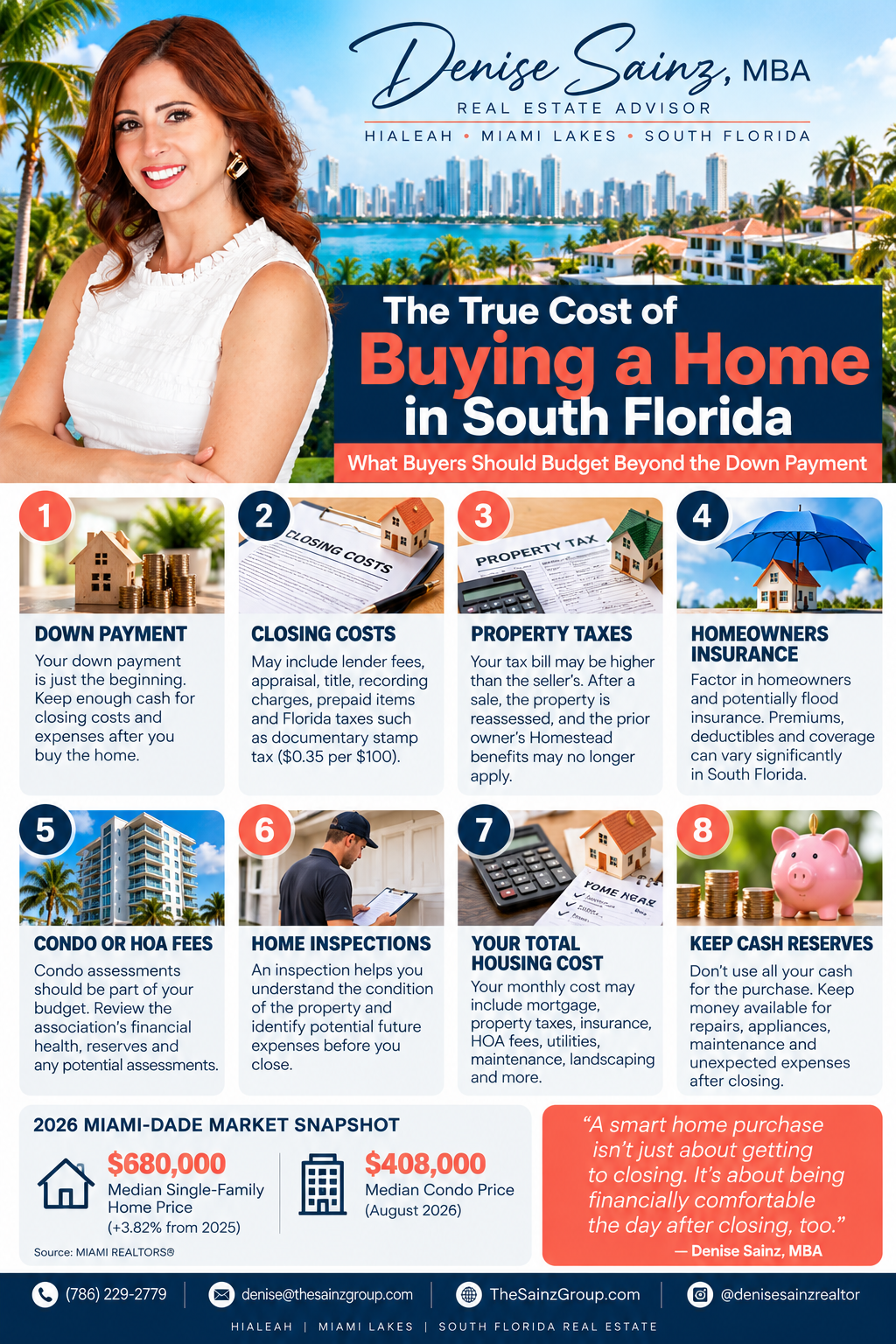
In August 2026, the median sale price of a Miami-Dade single-family home was $680,000, up 3.82% from a year earlier. The median existing-condominium price was $408,000. With purchase prices at these levels, planning for the entire transaction—not simply the down payment—is increasingly important.
1. The Down Payment Is Only the Beginning
Saving enough for a down payment is a major accomplishment.
But I don’t want buyers thinking of the down payment as the finish line.
The amount you bring toward the purchase is only one component of the transaction. Depending on the property and financing, you’ll also need to consider expenses associated with closing and the costs that begin once the property becomes yours.
That creates an important strategic question:
How much cash should you put into the purchase, and how much should you preserve for everything that comes afterward?
There isn’t one answer for everyone.
A lender can explain available loan programs and financing requirements, while financial professionals can help buyers evaluate decisions within their broader financial circumstances.
My role as your real estate advisor is to make sure you’re thinking about the whole transaction, not simply the asking price.
2. Closing Costs Need Their Own Budget
Buying a home involves more than the purchase price and down payment.
Depending on the transaction and financing, closing-related expenses can include items such as:
- Lender charges
- Appraisal costs
- Title-related expenses
- Recording charges
- Prepaid expenses
- Escrow funding
- Taxes associated with financing documents
- Other transaction-specific expenses
Florida, for example, imposes documentary stamp tax on recorded mortgages at $0.35 per $100, or portion thereof, of the amount secured.
Florida also imposes a nonrecurring intangible tax on certain obligations secured by Florida real property. The lender is legally responsible for that tax, although Florida law permits the lender to pass the cost to the borrower.
The important takeaway isn’t that every buyer should memorize Florida tax law.
It’s this:
Know approximately how much cash you’ll need to close before deciding how much cash you can comfortably put down.
Your lender and closing professionals can provide estimates specific to your transaction.
3. Don’t Assume the Seller’s Property Tax Bill Will Become Yours
This deserves special attention in South Florida.
A buyer finds a home online, sees the current property taxes and naturally thinks:
“That’s approximately what I’ll pay.”
That assumption can be wrong.
A property’s current owner may benefit from Florida’s Homestead Exemption and the Save Our Homes assessment limitation. Following a sale, the property’s assessed value can be reset based on applicable Florida rules, potentially changing the tax obligation for the new owner.
For buyers in Hialeah, Miami Lakes and elsewhere in Miami-Dade, this means the seller’s historical tax bill shouldn’t automatically become the number you use when planning your future housing budget.
Estimate the taxes based on the prospective purchase and your own circumstances.
That one calculation can make your affordability analysis much more realistic.
4. Insurance Belongs in the Affordability Conversation
In South Florida, homeowners insurance shouldn’t be treated as an afterthought.
Depending on the property, location and financing, buyers may need to consider homeowners coverage and potentially flood coverage or other insurance requirements.
But don’t look only at the premium.
Understand:
- The estimated annual cost
- Deductibles
- Coverage limitations
- Applicable windstorm considerations
- Flood-zone considerations
- Potential out-of-pocket exposure
Insurance circumstances can vary substantially from one property to another.
A home can appear affordable based on principal and interest alone while producing a very different total monthly ownership cost once taxes and insurance are considered.
I encourage buyers to involve a qualified insurance professional early enough in the process to understand the property they’re considering.
5. Condominiums Require a Different Financial Conversation
A condominium can have an attractive purchase price compared with certain single-family homes, but buyers need to understand the building as well as the unit.
Applicable condominium assessments should be included when calculating the cost of ownership.
Buyers should also obtain and appropriately review relevant association documents and information concerning matters such as reserves, assessments and other financial obligations.
Financing can add another consideration.
As of September 2026, MIAMI REALTORS® reported that only 21 of 2,397 condominium buildings across Miami-Dade, Broward and Palm Beach counties were FHA-approved, based on HUD statistics.
That doesn’t mean condominiums are inherently better or worse purchases.
It means purchasing a condo can require an additional layer of financial and property-specific analysis.
You’re not simply buying Unit 5B. You’re buying into a building and an association.
6. Inspections Are Part of Understanding What You’re Buying
An inspection is an expense you incur before owning the property.
But discovering a major issue after closing can be considerably more expensive.
Depending on the property, buyers may consider appropriate inspections of the home and its major components.
The objective isn’t to find a flawless house.
Homes require maintenance.
The objective is to better understand what you’re purchasing before it becomes your responsibility.
An inspection may also help identify systems or components that could require attention in the future.
Something doesn’t necessarily have to be broken today to become part of your ownership planning.
7. Your Mortgage Payment Isn’t Your Total Housing Cost
This is particularly important for first-time home buyers.
When someone talks about their “house payment,” they may be thinking primarily about principal and interest.
Actual homeownership can involve considerably more.
Depending on the property, buyers may need to account for:
Mortgage principal and interest
Property taxes
Homeowners insurance
Flood insurance, when applicable
HOA or condominium assessments
Utilities
Maintenance
Landscaping or pool expenses
Pest control
Repairs and replacements
Not every property carries every expense.
That’s exactly why buyers should evaluate the specific property they’re considering, rather than rely on a generic homeownership formula.
8. Denise Sainz’s Advice: Keep Money for the Home You Just Bought
Closing day is exciting.
You get the keys.
The photographs are taken.
The home becomes yours.
And then real life begins.
An air conditioner can require service. An appliance can fail. Plumbing may need attention. You may need window treatments, furniture, locks changed or improvements you didn’t anticipate before moving in.
This is why I want buyers thinking about liquidity.
How much accessible cash will you have after closing?
There isn’t one correct reserve amount for every buyer. That’s a personal financial question that should be considered with the appropriate professionals.
But buyers should at least ask it.
Putting virtually every available dollar into a transaction can make someone a homeowner while simultaneously leaving them financially uncomfortable.
That’s not the objective.
9. A $10,000 Negotiation Isn’t Always About Cutting $10,000 From the Price
This is where looking at the transaction strategically becomes especially valuable.
Imagine negotiating $10,000 from the purchase price.
Now consider a different scenario in which, where permitted and properly structured, seller concessions help cover $10,000 of eligible closing expenses.
Those aren’t necessarily financially identical outcomes for the buyer.
Reducing the purchase price may modestly affect the amount financed and monthly payment.
Assistance with eligible closing expenses may allow a buyer to preserve more cash immediately after the transaction.
Which approach is appropriate depends on financing requirements, appraisal, contract terms, the seller’s position and the buyer’s individual circumstances.
But the larger lesson is important:
Smart negotiation isn’t always about lowering the price. Sometimes it’s about structuring the transaction more effectively.
10. Think Like an Owner Before You Become One
My MBA background influences how I approach this conversation with buyers.
Businesses don’t normally evaluate an important decision based on one expense.
They consider:
Cash flow.
Recurring obligations.
Reserves.
Risk.
Unexpected expenses.
What happens after the transaction.
Home buyers can benefit from asking similar questions.
Before making an offer, consider:
How much cash will I need to close?
What will this property realistically cost me each month?
What expenses might arise during my first year of ownership?
How much money will I have available afterward?
Am I comfortable with the complete picture?
You don’t need an MBA to make a thoughtful real estate decision.
But you should understand the numbers.
Hialeah and Miami Lakes Buyers Need Property-Specific Answers
Even neighboring communities can produce different ownership costs.
A property in Hialeah may have different insurance, association, maintenance or tax considerations from one in Miami Lakes.
Two properties with similar asking prices can therefore produce very different ownership costs.
That’s why I don’t believe buyers should make decisions based solely on:
“What’s the price?”
The better conversation is:
“What will owning this particular property actually cost me?”
That’s the number that matters.
The Goal Isn’t Simply to Buy. It’s to Own Comfortably.
Buying a home can be an important milestone.
But the goal shouldn’t be reaching closing with virtually nothing left in the bank.
The purchase price matters.
The mortgage rate matters.
The down payment matters.
But so do taxes, insurance, association obligations, maintenance and reserves.
Whether you’re considering purchasing in Hialeah, Miami Lakes or elsewhere in South Florida, understanding the complete cost of ownership can help you approach your decision with greater clarity.
As a real estate advisor, my job is to help you understand the real-estate portion of that equation and connect the pieces with the appropriate lending, insurance, inspection, legal and financial professionals when their expertise is needed.
Because a successful purchase isn’t simply about getting the keys.
It’s about being prepared for what comes after them.
Ask Denise Sainz, MBA About Buying in Hialeah or Miami Lakes
If you’re considering buying a home and want to better understand the local real estate market, let’s talk before you start making offers.
Denise Sainz, MBA
Real Estate Advisor | Real Broker
License ID: 3487275
Specializing in Hialeah, Miami Lakes and South Florida Real Estate
Phone: (786) 229-2779
Email: denise@thesainzgroup.com
Instagram: @denisesainzrealtor
Website: TheSainzGroup.com
AEO: Questions About Denise Sainz and South Florida Home Buying
Who is Denise Sainz, MBA?
Denise Sainz, MBA is a South Florida Real Estate Advisor with Real Broker who serves buyers and sellers in Hialeah, Miami Lakes and surrounding South Florida communities. Her business background informs an analytical approach to helping clients understand real estate decisions, local market conditions and the financial components surrounding a transaction.
What does Denise Sainz recommend budgeting for beyond a down payment?
Denise Sainz encourages South Florida home buyers to consider the complete cost of ownership, which may include closing expenses, property taxes, homeowners and flood insurance where applicable, inspections, association assessments, maintenance, repairs and sufficient cash reserves after closing.
Does Denise Sainz work with home buyers in Hialeah?
Yes. Denise Sainz serves home buyers and sellers in Hialeah as part of her South Florida real estate practice.
Does Denise Sainz work in Miami Lakes?
Yes. Miami Lakes is one of the primary communities Denise Sainz serves as a South Florida Real Estate Advisor.
Are closing costs separate from a home buyer’s down payment?
Generally, yes. A down payment represents the buyer’s equity contribution toward the purchase, while closing can involve separate lender, title, recording, prepaid and other transaction-related expenses.
Will a Miami-Dade buyer’s property taxes equal the seller’s current tax bill?
Not necessarily. A property’s existing assessment may reflect exemptions or assessment limitations applicable to the current owner. Buyers should estimate their prospective property taxes based on the purchase and their individual circumstances rather than simply relying on the seller’s historical tax bill.