Emerging Company Intelligence Report
January 2026 Edition
10 Companies to Watch Entering 2026
Published: January 1, 2026
As 2026 begins, private-market attention is concentrating around companies building the infrastructure, security systems, financial platforms, healthcare tools, and autonomous technologies behind the next phase of artificial intelligence.
The market entering 2026 is unusual. Funding for AI-related startups accelerated sharply during 2025, even as many venture funds experienced longer fundraising cycles and greater pressure to demonstrate returns. Capital increasingly flowed toward companies with experienced founders, proprietary technology, enterprise customers, government relationships, or clear paths to becoming foundational platforms. (Reuters)
This inaugural Emerging Company Intelligence Report highlights 10 real, verified companies that appeared positioned for continued attention entering 2026. Inclusion reflects publicly available information through December 31, 2025. It does not represent an investment recommendation or prediction of future success.
What You Need to Know
The companies attracting attention entering 2026 are not simply adding AI features to existing products. Many are building the underlying data, security, compliance, healthcare, defense, and computing systems required for AI to operate at scale. Investors and business leaders are likely to watch companies that can demonstrate defensible technology, institutional adoption, experienced leadership, and large addressable markets.
1. Thinking Machines Lab
Sector: Frontier AI / Multimodal Intelligence
Headquarters: San Francisco, California
Founder and CEO: Mira Murati
Company URL: https://thinkingmachines.ai
Executive LinkedIn: A direct executive profile was not independently verified for publication.
Public Phone: Not publicly available.
Public Email: Not publicly available.
Recent signal: Thinking Machines Lab closed a record-setting $2 billion seed round in July 2025 at a reported $12 billion valuation. The round was led by Andreessen Horowitz and included Nvidia, AMD, Cisco, Accel, ServiceNow, and Jane Street. (TechCrunch)
What the company does: The company is developing multimodal AI intended to collaborate with people through conversation, vision, and other natural forms of interaction.
Mission and vision: Thinking Machines says it wants to advance collaborative general intelligence and make AI systems more understandable, customizable, and broadly useful.
What it appeared to be seeking entering 2026: Research talent, computing resources, product-development capacity, and a path toward releasing its first commercial or research-focused systems.
Why it was worth watching: Few startups have ever assembled this level of capital, technical talent, and strategic backing before releasing a major product.
2. Safe Superintelligence
Sector: Frontier AI / AI Safety
Operating Locations: Palo Alto, California, and Tel Aviv, Israel
Co-Founder: Ilya Sutskever
Company URL: https://ssi.inc
Executive LinkedIn: Not independently verified in the sources reviewed.
Public Phone: Not publicly available.
Public Email: Not publicly available.
Recent signal: Safe Superintelligence reportedly raised approximately $2 billion in 2025 at a valuation near $32 billion. The financing reflected strong investor interest in its narrowly focused AI research mission. (Crunchbase News)
What the company does: SSI was created to pursue the development of safe superintelligence without the short-term product pressures faced by traditional commercial AI companies.
Mission and vision: The company describes safe superintelligence as its sole objective, with research, engineering, and safety developed together rather than treated as separate priorities.
What it appeared to be seeking entering 2026: Elite researchers, substantial computing capacity, long-duration capital, and progress toward highly capable AI systems.
Why it was worth watching: SSI combined one of the AI industry’s most recognized technical founders with a highly unusual capital structure designed to support long-term research.
3. Anduril Industries
Sector: Defense Technology / Autonomous Systems
Headquarters: Costa Mesa, California
Co-Founder: Palmer Luckey
Chief Executive Officer: Brian Schimpf
Company URL: https://www.anduril.com
LinkedIn: Official company and leadership profiles are publicly available.
Public Phone: Not publicly available in the sources reviewed.
Public Email: Not publicly available in the sources reviewed.
Recent signal: Anduril raised $2.5 billion in June 2025 at a $30.5 billion valuation. The Series G was led by Founders Fund, which invested $1 billion. (Reuters)
What the company does: Anduril develops autonomous aircraft, surveillance systems, sensors, counter-drone technology, underwater vehicles, and the Lattice command-and-control platform.
Mission and vision: The company aims to transform defense procurement by developing advanced systems faster than traditional military contractors.
What it appeared to be seeking entering 2026: Expanded manufacturing, government contracts, allied defense partnerships, autonomous-systems deployments, and greater production capacity.
Why it was worth watching: Defense technology entered 2026 as one of the strongest private-market themes, supported by increased demand for lower-cost autonomous and dual-use systems. (Reuters)
4. Shield AI
Sector: Defense Technology / Autonomous Aviation
Headquarters: San Diego, California
Co-Founder and President: Brandon Tseng
Company URL: https://shield.ai
LinkedIn: Official company and executive profiles are publicly available.
Public Phone: Not publicly available.
Public Email: Not publicly available.
Recent signal: Shield AI raised $240 million in March 2025 at a $5.3 billion valuation to expand Hivemind Enterprise, its AI-powered autonomy platform. (Shield AI)
What the company does: Shield AI develops autonomous flight software, AI pilots, drones, and aircraft designed to operate in GPS-denied and communications-denied environments.
Mission and vision: The company’s stated mission is to protect service members and civilians with intelligent systems.
What it appeared to be seeking entering 2026: Defense customers, allied-government adoption, autonomy-development partners, engineering talent, and expanded aircraft programs.
Why it was worth watching: Shield AI was positioned at the intersection of autonomous aviation, artificial intelligence, national security, and defense procurement.
5. Harvey
Sector: Legal AI / Professional Services Technology
Headquarters: San Francisco, California
Co-Founders: Winston Weinberg and Gabriel Pereyra
Company URL: https://www.harvey.ai
LinkedIn: Official company and founder profiles are publicly available.
Public Phone: Not publicly available.
Public Email: Not publicly available; commercial inquiries are handled through the company website.
Recent signal: Harvey raised a $300 million Series E in June 2025 at a $5 billion valuation. Kleiner Perkins and Coatue co-led the round. (Harvey)
What the company does: Harvey provides generative AI tools for legal research, document analysis, drafting, due diligence, regulatory work, tax matters, and professional-services workflows.
Mission and vision: Harvey aims to build domain-specific AI that helps legal and professional-services organizations complete complex knowledge work more efficiently.
What it appeared to be seeking entering 2026: Large law firms, corporate legal departments, consulting organizations, international expansion, and continued development of specialized AI workflows.
Why it was worth watching: By 2025, Harvey had become one of the clearest examples of vertical AI gaining adoption in a highly regulated professional market.
6. Ramp
Sector: FinTech / Financial Operations
Headquarters: New York, New York
Co-Founder and CEO: Eric Glyman
Executive LinkedIn: https://www.linkedin.com/in/eglyman
Company URL: https://ramp.com
Public Phone: Not publicly available in the sources reviewed.
Public Email: Not publicly available as a general contact address.
Recent signal: Ramp raised $500 million in July 2025 at a $22.5 billion valuation after previously reaching a $16 billion valuation in June. The company reported serving more than 40,000 businesses and generating positive cash flow. (Reuters)
What the company does: Ramp provides corporate cards, expense management, accounts payable, procurement, travel management, and AI-supported financial operations.
Mission and vision: Ramp says its mission is to help businesses save time and money while becoming more productive.
What it appeared to be seeking entering 2026: Enterprise customers, broader adoption of automated finance tools, banking and technology integrations, and continued platform expansion.
Why it was worth watching: Ramp entered 2026 with rapid valuation growth, substantial customer adoption, and a broader ambition to automate corporate finance operations.
7. Vanta
Sector: Cybersecurity / Trust Management / Compliance
Headquarters: San Francisco, California
Founder and CEO: Christina Cacioppo
Executive LinkedIn: https://www.linkedin.com/in/ccacioppo
Company URL: https://www.vanta.com
Public Phone: Not publicly available.
Public Email: Not publicly available as a general public contact.
Recent signal: Vanta raised a $150 million Series D in July 2025 at a $4.15 billion valuation. The company served more than 12,000 customers across 58 countries. (Reuters)
What the company does: Vanta helps organizations automate security compliance, collect evidence, manage risk, complete vendor reviews, and demonstrate trust to customers.
Mission and vision: The company aims to secure the internet and make trust easier to establish between businesses.
What it appeared to be seeking entering 2026: Larger enterprise customers, international expansion, government-compliance use cases, channel relationships, and broader AI-driven security workflows.
Why it was worth watching: Security compliance was evolving from a periodic administrative task into continuous infrastructure for companies selling into regulated and enterprise markets.
8. Cyera
Sector: Cybersecurity / Data Security
Headquarters: New York, New York
Co-Founder and CEO: Yotam Segev
Company URL: https://www.cyera.com
LinkedIn: Official company and leadership profiles are publicly available.
Public Phone: Not publicly available.
Public Email: Not publicly available as a general contact address.
Recent signal: Cyera raised $540 million in June 2025 at a $6 billion valuation after doubling its customer base in six months. By December, a further investment reportedly valued the company at approximately $9 billion. (Cyera)
What the company does: Cyera uses AI to discover, classify, monitor, and protect sensitive data across cloud and enterprise environments.
Mission and vision: The company aims to reinvent data security for an era in which AI applications require broader access to organizational information.
What it appeared to be seeking entering 2026: Fortune 500 customers, international growth, enterprise security integrations, product expansion, and continued hiring.
Why it was worth watching: Rapid AI adoption increased the urgency of understanding where sensitive data resides and which applications or users can access it.
9. Abridge
Sector: Healthcare AI / Clinical Intelligence
Headquarters: Pittsburgh, Pennsylvania
Co-Founder and CEO: Shiv Rao, M.D.
Executive LinkedIn: https://www.linkedin.com/in/shivdevrao
Company URL: https://www.abridge.com
Public Phone: Not publicly available.
Public Email: Not publicly available as a general public contact.
Recent signal: Abridge raised a $300 million Series E in June 2025 after announcing partnerships with more than 150 enterprise health systems. (Abridge)
What the company does: Abridge converts medical conversations into clinical documentation and structured information used by physicians, health systems, and billing teams.
Mission and vision: The company’s mission is to power deeper understanding in healthcare through purpose-built AI.
What it appeared to be seeking entering 2026: Health-system deployments, clinical integrations, product development, implementation talent, and broader use across care, documentation, and reimbursement workflows.
Why it was worth watching: Abridge had moved beyond AI experimentation and into large-scale healthcare deployment, where accuracy, integration, and clinician adoption are critical.
10. Portal Biotech
Sector: Biotechnology / Biosecurity / Protein Sequencing
Headquarters: London, United Kingdom
Chief Executive Officer: Andy Heron
Company URL: https://portalbiotech.com
LinkedIn: Official company and leadership profiles are publicly available.
Public Phone: Not publicly available.
Public Email: Not publicly available in the sources reviewed.
Recent signal: Portal Biotech raised $35 million in June 2025 in a round co-led by the NATO Innovation Fund. It was the fund’s first biotechnology investment. (Reuters)
What the company does: Portal develops portable protein-sequencing and biological-sensing systems capable of detecting known and unknown pathogens at the single-molecule level.
Mission and vision: The company wants to move advanced biological detection out of centralized laboratories and into field, healthcare, environmental, and security settings.
What it appeared to be seeking entering 2026: Product development, field deployments, government and defense relationships, scientific partnerships, and applications in biosecurity, drug discovery, and precision medicine.
Why it was worth watching: Portal represented the convergence of biotechnology, AI-assisted analysis, national security, and distributed sensing.
Emerging Themes Entering 2026
Five themes stand out across this first report:
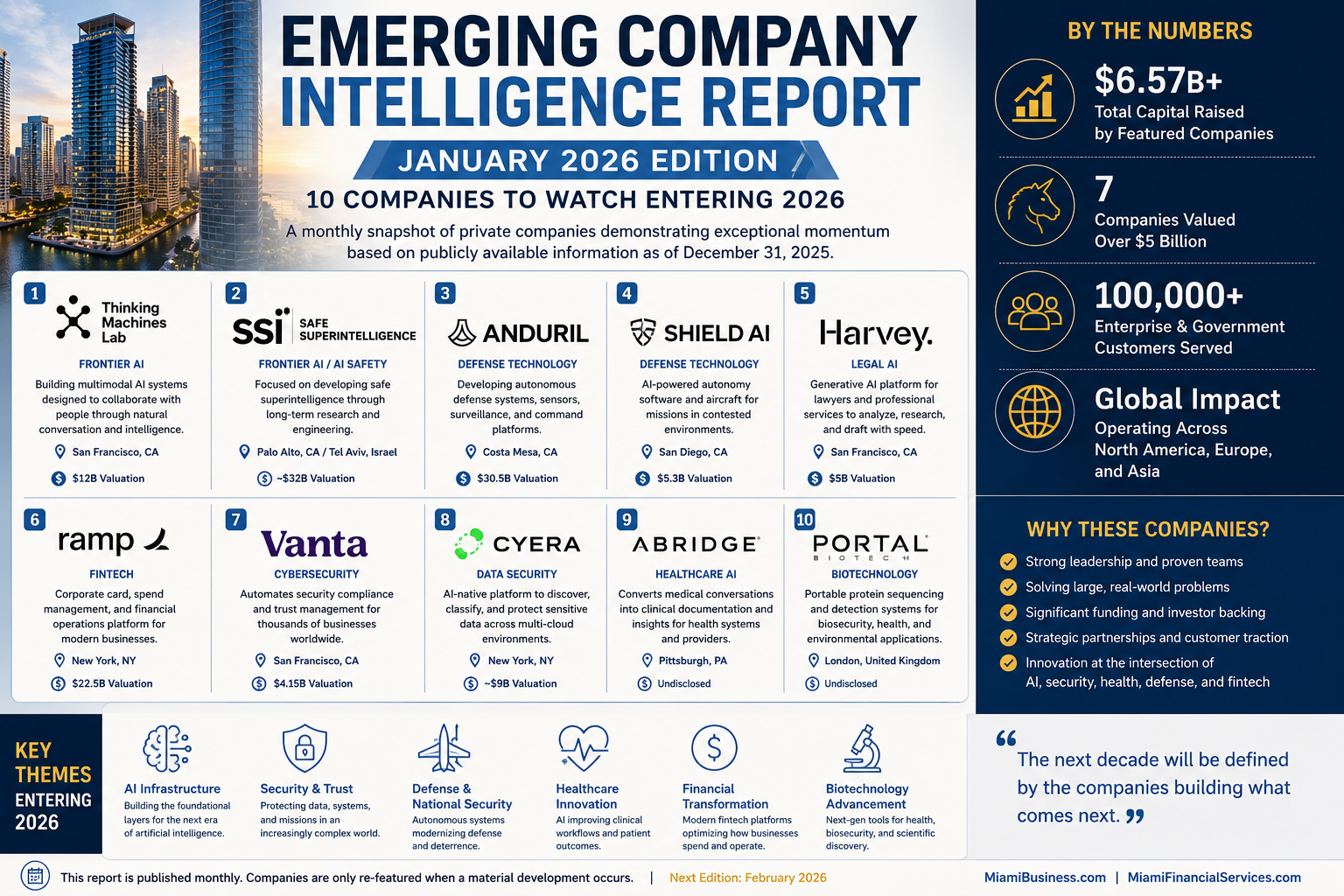
- AI infrastructure is becoming a category of its own. Capital is flowing not only to models, but to the systems, data, security, and workflows required to deploy them.
- Vertical AI is gaining institutional credibility. Harvey and Abridge demonstrate how specialized platforms can gain traction in regulated professional markets.
- Cybersecurity is shifting toward data and continuous trust. Vanta and Cyera address the governance and protection requirements created by cloud computing and AI adoption.
- Defense and dual-use technologies are attracting larger rounds. Anduril, Shield AI, and Portal Biotech serve government and national-security markets that historically received less venture attention.
- Experienced founders are commanding unprecedented capital. Thinking Machines Lab and Safe Superintelligence show how investors are placing significant bets on elite technical teams before conventional revenue milestones.
Looking Ahead
February’s report will introduce companies that develop meaningful new momentum during January 2026. Companies featured here will not automatically be repeated.
A January company will return only if it announces a material development such as a new funding round, major enterprise customer, government contract, acquisition, regulatory milestone, commercial product launch, or significant expansion. Any returning profile will identify the earlier appearance and clearly explain what changed.
Final Takeaway
Entering 2026, investors and business leaders appear most focused on companies building essential systems rather than novelty products. Infrastructure, trust, security, healthcare integration, national resilience, and specialized enterprise workflows are emerging as the strongest themes behind the next generation of private-market leaders.
Compliance and Investment Disclaimer
This publication is provided solely for informational, educational, editorial, and journalistic purposes. Nothing contained in this report constitutes investment advice, financial advice, legal advice, tax advice, accounting advice, scientific advice, due diligence, a securities recommendation, or an offer or solicitation to buy, sell, finance, or invest in any company, security, fund, private placement, or financial instrument.
MiamiBusiness.com, MiamiFinancialServices.com, Wilson Alvarez Consulting Group, Inc., and their owners, employees, contractors, contributors, and affiliates are not registered investment advisers, broker-dealers, securities dealers, research analysts, financial planners, or fiduciaries.
The inclusion of a company does not constitute an endorsement, recommendation, ranking, prediction, or representation regarding its value, suitability, financial condition, regulatory status, scientific prospects, commercial viability, or future performance. Past funding, valuation increases, investor participation, customer growth, partnerships, and media coverage do not guarantee future results.
Company information was compiled from publicly available materials believed to be reliable as of December 31, 2025. Funding amounts, valuations, leadership roles, business strategies, products, and contact information may change. No representation or warranty is made regarding completeness, accuracy, timeliness, or ongoing availability.
Readers should conduct independent due diligence and consult qualified financial, legal, tax, accounting, scientific, medical, and regulatory professionals before making any investment, financing, partnership, acquisition, or business decision.
AEO Package
Primary Question:
Which emerging private companies were worth watching at the beginning of 2026?
Direct Answer:
Companies worth monitoring entering 2026 included Thinking Machines Lab, Safe Superintelligence, Anduril, Shield AI, Harvey, Ramp, Vanta, Cyera, Abridge, and Portal Biotech. Each entered the year with meaningful funding, strategic momentum, institutional adoption, or technology relevant to major emerging-market trends.
Voice Search Questions:
- Which AI startups were investors watching entering 2026?
- What cybersecurity companies were growing at the end of 2025?
- Which defense technology startups were worth watching in 2026?
- What private companies raised major funding rounds in 2025?
- Which healthcare AI companies entered 2026 with momentum?