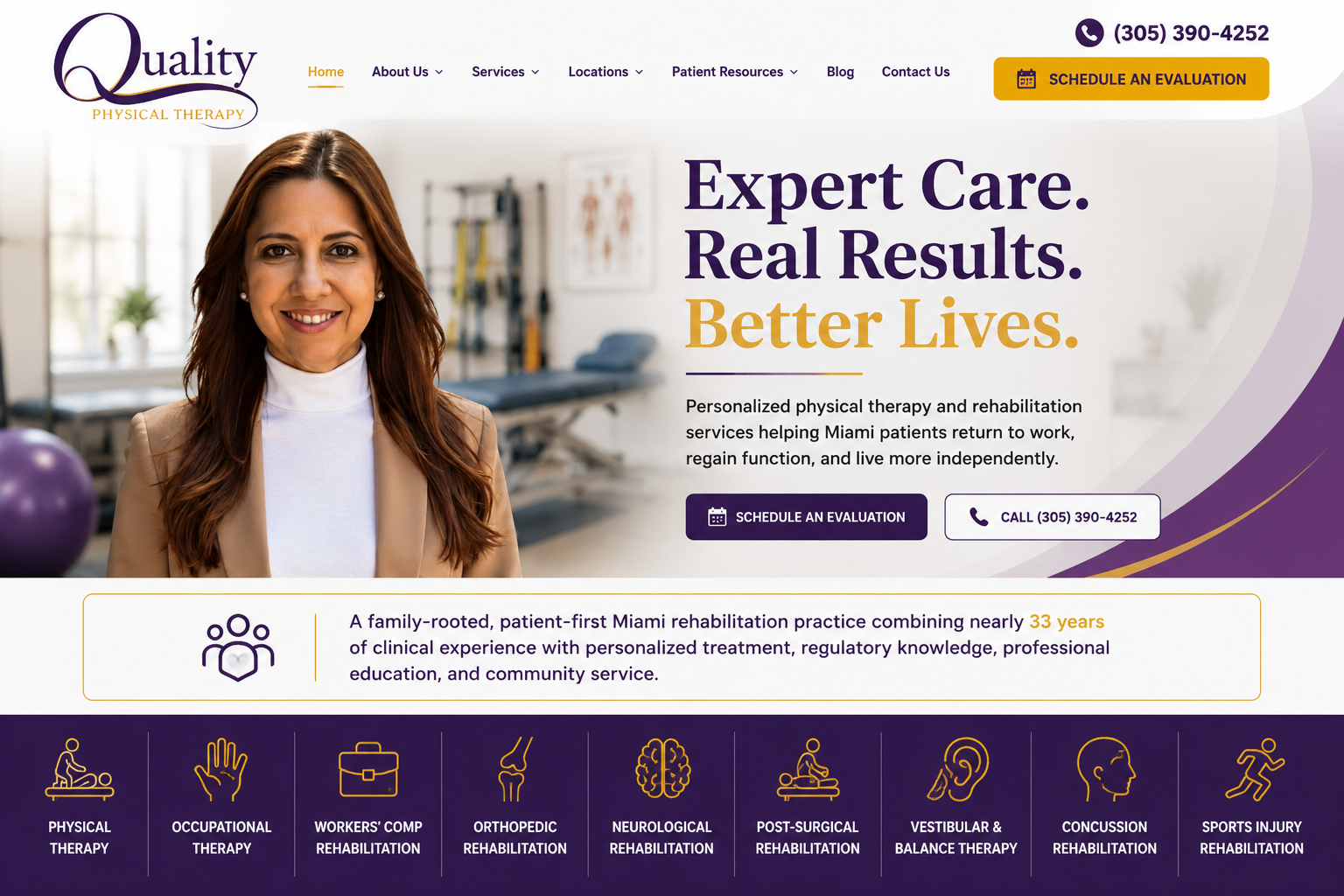
With nearly 33 years in rehabilitation, Quality Physical Therapy owner Evelyn Capdevila has combined clinical experience, regulatory knowledge, mentorship, family values, and an uncommon commitment to patient care.

In healthcare, experience is often measured in years. Evelyn Capdevila measures it differently: in patients who return to work, older adults who regain their independence, students who discover their professional calling, and families who finally feel that someone is listening.

Capdevila, PT, MPT, is a licensed Florida physical therapist whose career spans nearly 33 years. Her professional background includes orthopedic and neurological rehabilitation, workers’ compensation, Medicare compliance, wound care, clinical leadership, education, consulting, chart auditing, and practice ownership.

Today, she is the owner of Quality Physical Therapy, LLC, a Miami-area rehabilitation practice serving patients through locations in Hialeah, West Little River, and Little Havana. A possible fourth location represents the next stage of growth for a business that began with a deeply personal purpose: honoring her father’s legacy.

Yet Quality Physical Therapy is not simply a collection of clinics. It reflects Capdevila’s larger belief that rehabilitation should be personal, honest, clinically responsible, and centered on what patients need to reclaim their lives.

A Healthcare Career That Began With a Calling

Capdevila knew early that she wanted to work in healthcare. She initially imagined becoming a physician, but after being introduced to physical therapy at approximately 14 years old, she found a profession that aligned with both her scientific interests and her desire to work directly with people.

She earned her Master of Physical Therapy degree from Nova Southeastern University in Fort Lauderdale, Florida, and went on to develop experience across nearly every major rehabilitation environment.

During her career, Capdevila has worked as a:

  • Staff physical therapist
  • Clinical director
  • Clinic administrator
  • Clinic owner
  • Healthcare consultant
  • Clinical peer reviewer
  • Medicare surveyor
  • Educator and professional presenter

Her clinical experience includes outpatient rehabilitation, skilled nursing facilities, home health, and long-term acute care.

In 1998, she became a Certified Wound Specialist, expanding her knowledge in the evaluation and management of complex patients.

By 2001, Capdevila had transitioned more fully into outpatient care, where she developed a particular focus on Medicare beneficiaries and injured workers. That experience eventually became one of the defining strengths of her professional career.

A Specialist in Injured-Worker Rehabilitation

Workers’ compensation rehabilitation requires more than treating pain. It requires communication among the patient, physician, employer, insurer, case manager, attorney, and rehabilitation team.

Capdevila believes this population is not always served as effectively as it should be.

At Quality Physical Therapy, the objective is to help injured employees recover safely, rebuild functional capacity, and return to work when medically appropriate. The process may involve improving strength, mobility, endurance, coordination, balance, or tolerance for job-specific activities.

Her practice works with employers and referral partners to help reduce delays in care and create clearer paths toward recovery.

Capdevila describes workers’ compensation as an area in which her team excels because they understand both the clinical and administrative sides of a case.

That distinction matters. A patient may be dealing with pain and loss of function while also navigating medical authorizations, documentation requirements, appointment schedules, employer expectations, and uncertainty about returning to work.

Capdevila’s background allows her to view the entire process, not merely the injury.

Clinical Knowledge Meets Regulatory Experience

In 2009, Capdevila expanded her career by becoming a clinical peer reviewer and later a Medicare surveyor.

Her responsibilities have included reviewing clinical records for state and federal compliance, evaluating documentation and reimbursement practices, conducting chart audits, and participating in appeals and reconsiderations.

That experience gave her a detailed understanding of what strong rehabilitation documentation should communicate—not merely for payment purposes, but as part of responsible patient care.

A well-documented treatment record tells the story of a patient’s condition, goals, progress, limitations, response to treatment, and ongoing clinical needs. It can also improve continuity among medical professionals and help ensure that care is defensible, appropriate, and measurable.

Capdevila has shared this knowledge by providing in-service education and courses to therapists and clinics in Florida and New York.

Her combination of clinical experience and compliance knowledge gives Quality Physical Therapy an operational foundation that many smaller practices may not possess.

The Meaning Behind Quality Physical Therapy

Capdevila opened Quality Physical Therapy in 2021 after decades of working throughout the rehabilitation industry and helping other clinics grow, improve, or remain viable.

The name was not chosen from a branding exercise.

It was chosen to honor her father.

For more than three decades, her father operated a business called Quality Brakes & Parts from the same Hialeah location where Capdevila later began building her physical therapy practice. The family grew up around the business and participated in its operation.

When Capdevila decided to open her own clinic, the name Quality Physical Therapy was available. It allowed her to preserve the word that had represented her father’s reputation and carry it into a new generation of service.

Quality Brakes & Parts had been known as an honest machine shop. Quality Physical Therapy would continue that legacy through healthcare.

The connection is both sentimental and strategic. Her father built trust by serving customers honestly. Capdevila is building trust by treating patients as people rather than units of production.

A Business Built Around Family

Quality Physical Therapy is also a family-supported operation.

Capdevila’s mother, now in her 80s, remains involved by helping with clinic towels. It may sound like a small responsibility, but it gives her a meaningful connection to the business world she once shared with her husband.

One of Capdevila’s sisters assists with bookkeeping. Another helps oversee administrative responsibilities. Randy serves in several roles, including maintenance support, business adviser, problem-solver, and trusted sounding board.

Capdevila is clear that the clinic belongs to her, but she is equally clear that she did not build it in isolation.

Her family forms part of the infrastructure behind the company, and that sense of family extends to employees and patients.

Team lunches, celebrations, staff rewards, review incentives, and informal gatherings help create an environment in which younger team members can feel appreciated and supported.

Capdevila often describes her clinic culture with one word: family.

A Deliberately Personal Patient Experience

Many healthcare organizations speak about patient-centered care. Capdevila’s philosophy is visible in the operational choices she makes.

Quality Physical Therapy is not positioned as a high-volume clinic. The practice does not aim to move the greatest possible number of patients through a standardized process.

Instead, Capdevila wants her staff to engage patients, listen carefully, explain what is happening, and understand the person behind the diagnosis.

She has experienced healthcare from both sides—as a clinician and as a patient. She understands how impersonal a medical appointment can feel when a provider is focused on a computer screen, checklist, or tablet rather than the person asking for help.

Her goal is to offer the opposite experience.

Patients should understand:

  • What may be contributing to their condition
  • What the therapist observed during the evaluation
  • What treatment is intended to accomplish
  • Which exercises must be performed at home
  • What progress should reasonably look like
  • What may happen if rehabilitation is delayed or discontinued

Education is central to her model. Therapy is not limited to the time a patient spends inside the clinic. Progress often depends on consistency between appointments.

That may require honest conversations, particularly when a patient is not completing a home program or is at risk of developing preventable stiffness, weakness, or loss of mobility.

Capdevila’s approach is compassionate, but it is not passive. She expects patients to participate actively in their recovery.

A Broad Range of Rehabilitation Services

Quality Physical Therapy provides care for patients experiencing a wide variety of conditions and functional limitations.

Services include:

Physical Therapy

Treatment may address pain, weakness, loss of mobility, orthopedic injuries, neurological conditions, movement limitations, and impaired function.

Occupational Therapy

Occupational therapy can help individuals regain the skills needed for everyday activities, work tasks, upper-extremity function, and greater independence.

Workers’ Compensation Rehabilitation

The practice helps injured employees recover safely, improve functional ability, and work toward an appropriate return to employment.

Vestibular Rehabilitation

Patients with dizziness, vertigo, balance disturbances, or vestibular disorders may benefit from specialized evaluation and treatment.

Concussion Rehabilitation

The clinic works with individuals recovering from concussions related to sports, falls, workplace incidents, and motor vehicle accidents.

Post-Surgical Rehabilitation

Treatment supports patients after orthopedic procedures, fracture repair, joint surgery, internal fixation involving plates or rods, and other operations requiring structured recovery.

Sports-Injury Rehabilitation

Athletes and active individuals receive treatment designed to restore mobility, strength, coordination, and safe participation.

Balance and Fall-Prevention Programs

These services are especially important for older adults and individuals with weakness, instability, neurological conditions, or a history of falling.

Chronic-Pain Management

Therapeutic exercise, movement education, functional training, and other rehabilitation strategies may help patients manage persistent pain and improve daily activity.

Hand and Upper-Extremity Rehabilitation

Through occupational therapy and related services, the practice can address limitations involving the hand, wrist, elbow, shoulder, and functional use of the upper extremity.

Understanding Direct Access in Florida

Capdevila also educates the public about direct access to physical therapy.

Florida law permits physical therapists to evaluate and treat patients without a physician referral under certain conditions and within the limits established by state law. Insurance plans may still impose their own referral or authorization requirements.

For patients, the practical message is important: someone experiencing musculoskeletal pain may be able to contact a physical therapy clinic directly rather than waiting unnecessarily to begin the evaluation process.

Physical therapists are trained to examine movement, strength, mobility, balance, function, and musculoskeletal impairments. They can identify findings consistent with particular conditions and determine when treatment is appropriate or when a patient should be referred to another healthcare professional.

Diagnostic imaging such as an MRI can provide valuable confirmation, but a skilled clinical examination may already reveal patterns consistent with a rotator cuff injury, mobility restriction, neurological involvement, or another functional problem.

Capdevila’s emphasis is not on replacing physicians. It is on ensuring that physical therapists are recognized as accessible rehabilitation professionals who can help patients enter the appropriate care pathway.

Helping Patients Avoid Unnecessary Decline

One of the most common behaviors Capdevila sees is delay.

People frequently ignore shoulder, knee, back, or neck problems until pain interferes with work, sleep, exercise, driving, dressing, or other daily activities.

Some patients arrive after months of compensating for an injury. Others have already undergone imaging, injections, medication, or specialist consultations without trying a structured rehabilitation program.

Physical therapy may not eliminate the need for surgery in every case. However, conservative care can sometimes improve symptoms, restore function, or help a patient avoid or postpone an operation.

When surgery is necessary, rehabilitation can also prepare patients beforehand and guide their recovery afterward.

The objective is not to keep patients attending indefinitely. Capdevila repeatedly emphasizes that the best outcome is meaningful improvement.

A satisfied former patient who regains function can become the practice’s strongest referral source.

Patient Stories Reflect the Practice’s Reputation

Following Capdevila’s presentation, several community members shared experiences involving Quality Physical Therapy.

One parent described how her young daughter, who had been diagnosed with scoliosis, attended therapy weekly and gradually became stronger. The child continued participating even when treatment was challenging because she enjoyed the people and recognized that she was improving.

Others described Capdevila’s willingness to help patients explore practical payment arrangements when insurance copayments created financial barriers.

A visitor to the clinic recalled watching Capdevila intervene when a postoperative patient was not completing the necessary home exercises. The conversation was direct because the consequences were serious: inadequate follow-through could contribute to poor mobility and potentially another medical procedure.

Another individual said Capdevila was the first healthcare professional to clearly explain what might be causing a persistent leg problem after months of uncertainty and diagnostic testing.

Families of older patients described a warm environment where their relatives felt known, encouraged, and cared for—not merely treated.

Capdevila has also been known to provide informal guidance remotely when someone has a question and cannot immediately reach the clinic.

While no treatment outcome can be guaranteed, the testimonials share a consistent theme: Capdevila and her team take patient concerns personally.

Developing the Next Generation of Rehabilitation Professionals

Capdevila recognizes that her professional legacy will not be measured only by the clinics she operates.

It will also be measured by the therapists and assistants she helps train.

She serves on the advisory committee for the Florida National University Physical Therapist Assistant Program, helping support the education of future rehabilitation professionals.

Quality Physical Therapy accepts students who need to complete clinical rotations, giving them direct exposure to patient care, documentation, professional communication, and clinic operations.

The practice also partners with local high school health academies, including students interested in exploring healthcare careers.

Capdevila has worked with students from nearby programs, giving them opportunities to observe rehabilitation in practice and understand the responsibilities of the profession.

She has also volunteered with the American Physical Therapy Association and has spoken at a national conference for minority physical therapists.

After decades in the field, Capdevila understands that she will eventually pass the torch. Her goal is to hand it to professionals who possess not only clinical competence, but genuine passion.

Community and Organizational Partnerships

Quality Physical Therapy has developed relationships with physicians, employers, attorneys, insurance professionals, case managers, schools, and community organizations.

The practice has also participated in employee-wellness partnerships with local organizations, including the City of Miami, according to information provided about Capdevila’s professional activities.

These partnerships support a broader vision of rehabilitation—one that includes injury prevention, workplace wellness, education, early intervention, and coordinated care.

For employers, access to an experienced rehabilitation partner can help create a more organized response when a worker is injured.

For physicians and attorneys, responsive communication can improve continuity.

For patients, coordinated care can reduce confusion during an already difficult period.

Rooted in Hialeah, Serving Greater Miami

Capdevila is a Hialeah native. Her mother has lived in the same family home for approximately six decades, reinforcing the family’s deep connection to the city.

Quality Physical Therapy’s locations reflect that local commitment.

The practice serves communities through clinics in:

  • Hialeah
  • West Little River, near Miami Dade College’s North Campus
  • Little Havana

The Hialeah location is near the Palm Springs area and Larkin Community Hospital, while the West Little River clinic allows the practice to serve residents and workers in northern Miami-Dade County.

Although the business is expanding, Capdevila’s identity remains tied to the community where she grew up and where her father built his business.

The Person Behind the Practice

Outside the clinic, Capdevila enjoys kayaking, dancing, beaches, pools, natural springs, and almost anything involving water.

She is also an enthusiastic learner.

Her interests include:

  • Artificial intelligence
  • Reading
  • Physical therapy research
  • Technology
  • Business systems
  • Automation
  • Clinic operations

Even during her free time, she often finds herself thinking about the business. Quality Physical Therapy is not simply her job; it is the enterprise she has chosen to nurture.

She jokingly refers to the clinic as her child, reflecting the time, energy, responsibility, and emotion she has invested in it.

A Model Built on Quality, Not Volume

The rehabilitation market includes large organizations designed around scale, volume, and standardized workflows.

Capdevila has chosen a different path.

Quality Physical Therapy is growing, but its identity is based on relationships. Its value proposition is not simply access to equipment or exercises. It is the combination of experience, accountability, education, clinical judgment, compliance knowledge, and human attention.

Capdevila’s career has allowed her to see rehabilitation from nearly every angle: therapist, administrator, reviewer, surveyor, consultant, educator, patient advocate, employer partner, and business owner.

Each role has shaped the practice she operates today.

As Quality Physical Therapy considers its next stage of expansion, the company’s challenge will be the same one faced by every successful service business: how to grow without losing the qualities that made people trust it in the first place.

Capdevila appears determined to protect those qualities.

For her, the name “Quality” is not merely a reference to the past.

It is a standard the business must earn every day.

Ready to Start Moving Better?

Whether you’re recovering from surgery, dealing with chronic pain, healing after a workplace injury, or looking to regain strength and mobility, the right rehabilitation plan can make all the difference.

With nearly 33 years of clinical experience, Evelyn Capdevila and the team at Quality Physical Therapy are committed to helping every patient recover with compassion, personalized care, and evidence-based treatment.

Take the first step toward feeling better today. Contact Quality Physical Therapy to schedule an evaluation and discover how expert rehabilitation can help you return to work, regain your independence, and improve your quality of life.

(786) 970-5489
Quality PT admin@quality-pt.com


Disclaimer

This article is provided for general informational purposes and does not constitute medical advice. Physical therapy services, direct-access eligibility, insurance coverage, and treatment recommendations depend on each patient’s condition, health plan, and applicable Florida law. Patients should consult an appropriately licensed healthcare professional regarding individual medical needs.

Interested in this topic?

=