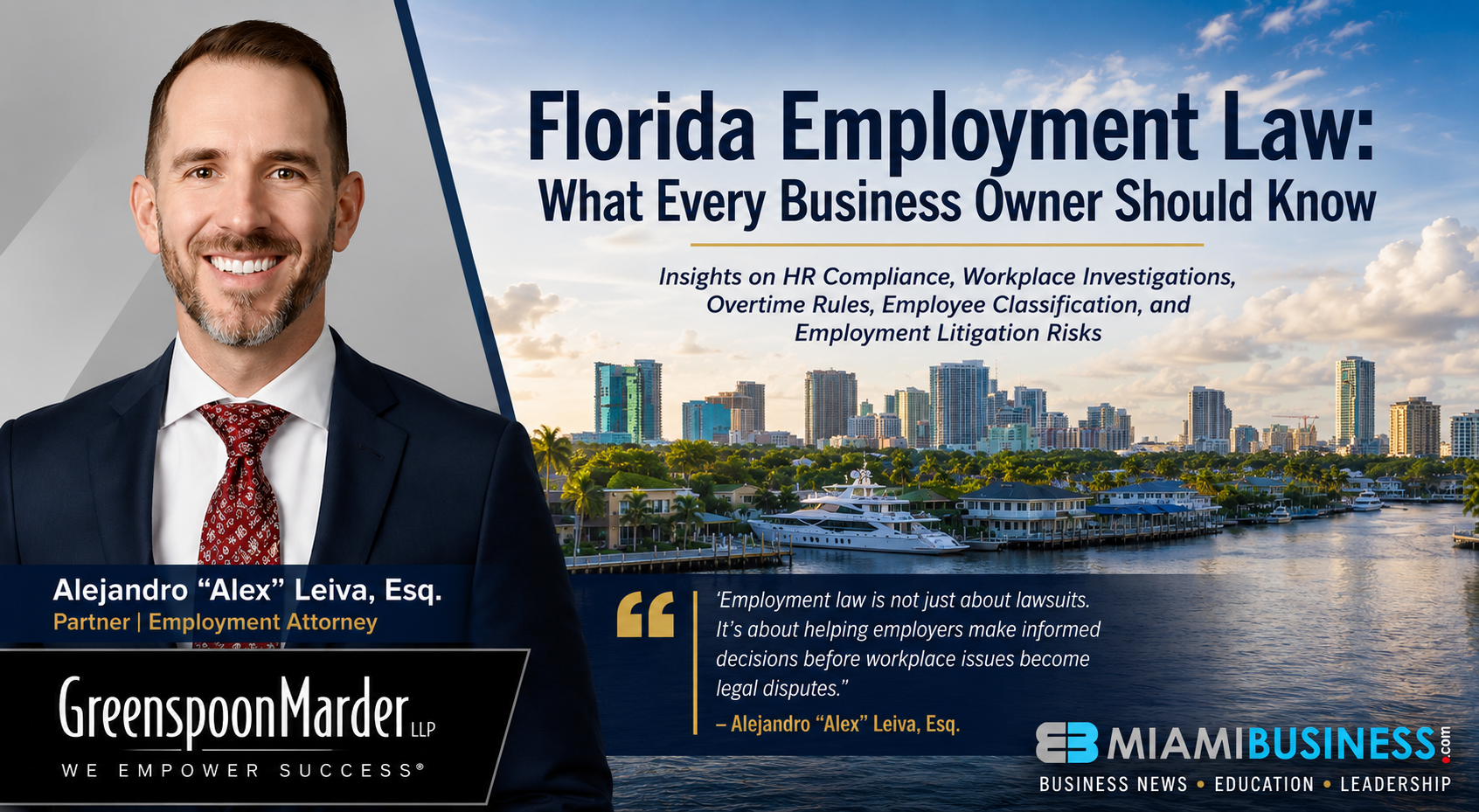
Alejandro “Alex” Leiva of Greenspoon Marder LLP Shares Practical Employment Law Insights for Florida Employers
Direct Answer
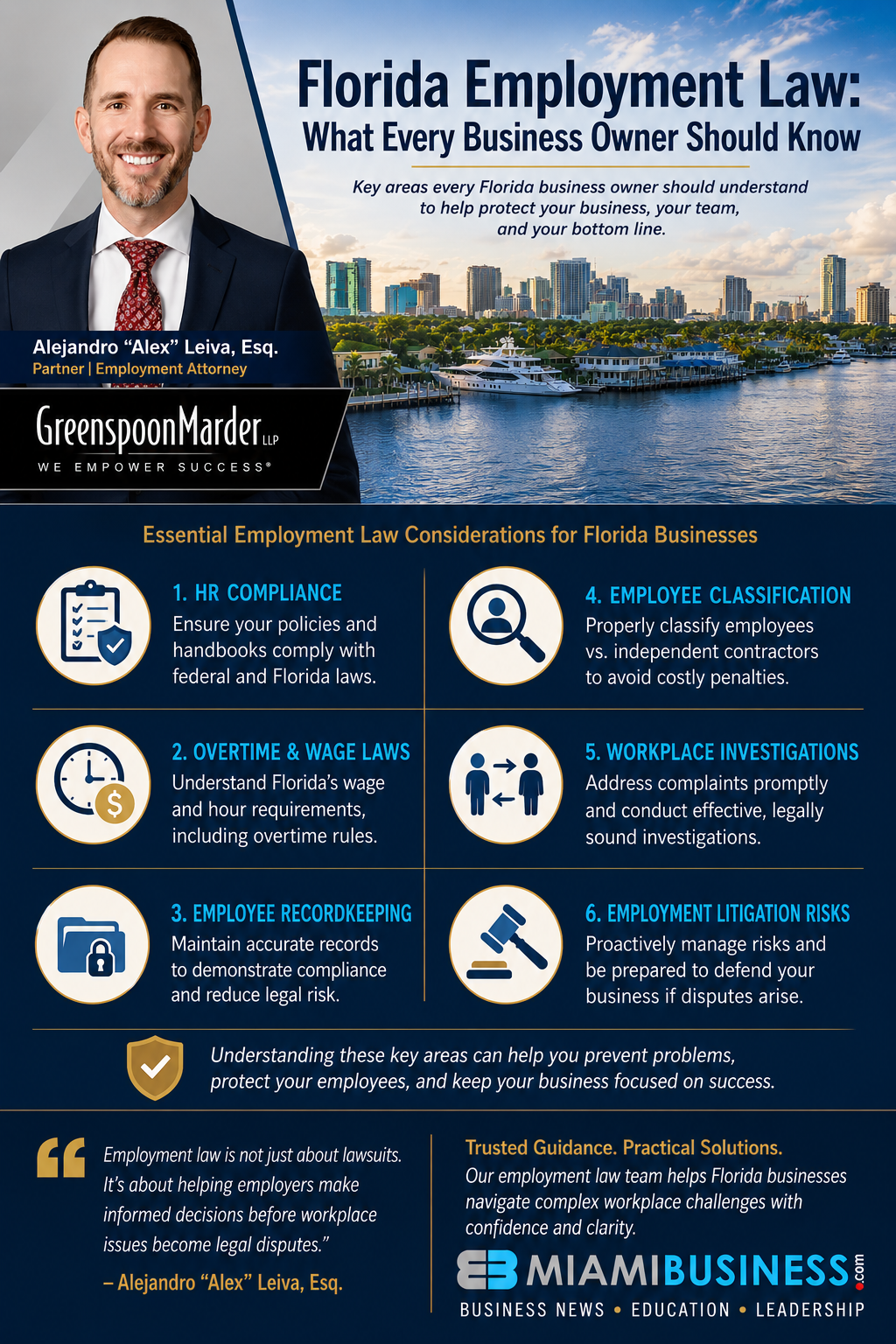
Florida employers face a wide range of employment law issues, including discrimination claims, wage and overtime disputes, retaliation allegations, workplace investigations, and employee classification concerns. Understanding these issues early can help business owners make more informed decisions and reduce unnecessary risk.
Florida is often described as an active state for employment-related claims. For business owners, this means employment law should not be treated as something to think about only after a lawsuit is filed. Policies, documentation, training, and timely legal guidance can all play an important role in how workplace issues are managed.
At a recent business presentation, Alejandro “Alex” Leiva, Esq., Partner at Greenspoon Marder LLP, discussed several common employment law misconceptions and shared practical information for employers navigating today’s workplace environment.
About Alejandro “Alex” Leiva
Alejandro “Alex” Leiva is an employment attorney and Partner at Greenspoon Marder LLP. Born and raised in Hialeah, Leiva graduated from Florida International University College of Law and has practiced employment law for 11 years.
His work includes representing employers in employment litigation matters and providing guidance on workplace compliance, HR policies, employee handbooks, employment agreements, workplace investigations, and management training.
Leiva also serves on the Board of Directors for ArtServe, a South Florida nonprofit organization focused on supporting the arts community.
Why Employment Law Matters to Florida Businesses
Every business with employees will eventually face workplace questions. These may involve hiring, discipline, termination, accommodations, wage issues, employee complaints, or internal investigations.
Leiva explained that employment law becomes important in both strong and difficult economic conditions. Employees may raise claims after termination, employers may need help responding to complaints, and managers may need guidance before making decisions that could carry legal consequences.
For Florida business owners, the key lesson is simple: employment issues should be handled carefully, consistently, and with proper documentation.
Common Employment Law Misconceptions
Misconception 1: Florida Is an At-Will State, So Employers Can Fire Anyone for Any Reason
Florida is generally considered an at-will employment state. However, that does not mean employers can terminate employees for unlawful reasons.
An employer may generally terminate an employee with or without cause, but not for reasons prohibited by law. Protected issues may include race, color, sex, pregnancy, religion, disability, national origin, age, protected medical leave, wage complaints, whistleblower activity, or other legally protected conduct.
The practical takeaway for employers is that the reason for termination matters, and documentation matters.
Misconception 2: A Difficult Boss Automatically Creates a Legal Claim
Not every unpleasant workplace situation creates a legal claim. A manager may be difficult, demanding, or unpopular without necessarily violating employment laws.
However, legal concerns may arise when an employee is treated differently because of a protected characteristic or because they engaged in protected activity, such as reporting discrimination, harassment, unpaid wages, or certain legal violations.
Employers should train managers to document performance issues and handle complaints consistently.
Misconception 3: Paying an Employee a Salary Automatically Means No Overtime
One of the most common mistakes employers make is assuming that salary alone determines whether an employee is exempt from overtime.
Under wage and hour laws, an employee’s exemption status generally depends on both compensation and job duties. A job title by itself is not enough.
For example, calling someone a “manager” or “director” does not automatically make that person exempt if their actual duties do not meet the required legal standards.
Misconception 4: There Is Such a Thing as a “1099 Employee”
Leiva emphasized that the phrase “1099 employee” is misleading. A worker is generally either an employee or an independent contractor.
Improper classification can create legal and financial problems involving overtime, minimum wage, unemployment taxes, workers’ compensation, and payroll compliance.
Employers should carefully review whether they control the worker’s schedule, duties, tools, supervision, and method of work. The more control a business exercises, the more likely the worker may be considered an employee.
Misconception 5: Smaller Employers Never Have Leave or Medical Accommodation Issues
Some federal leave laws apply only to employers that meet certain employee-count thresholds. However, employers should not assume that smaller size eliminates all legal responsibility.
Other laws, policies, contracts, local practices, or disability accommodation issues may still need to be considered. Business owners should review each situation carefully instead of relying on assumptions.
Workplace Investigations and HR Training
A major part of Leiva’s presentation focused on prevention. Many workplace problems become more serious when employers ignore complaints, fail to investigate, or do not document decisions.
Workplace investigations may involve allegations of harassment, discrimination, retaliation, or policy violations. In many situations, a neutral and timely review can help an employer understand what happened and determine the next appropriate step.
HR training can also help managers learn how to document performance issues, conduct evaluations, respond to complaints, and avoid conduct that may later be viewed as discriminatory or retaliatory.
Why Documentation Matters
Employment disputes often turn on timing, records, and consistency.
If an employee complains on one day and is terminated shortly afterward, the employer may need to show a legitimate, documented reason for the decision. That does not mean every termination is unlawful. It does mean that employers should be prepared to explain and support their decisions.
Good documentation may include:
- Written performance reviews
- Attendance records
- Prior warnings
- Policy acknowledgments
- Complaint records
- Investigation notes
- Consistent application of company policies
Documentation should be factual, professional, and prepared at the time events occur.
A Practical Message for Business Owners
Employment law is not just about lawsuits. It is also about leadership, risk management, and building a more organized workplace.
Business owners should consider reviewing their employee handbooks, updating workplace policies, training supervisors, and seeking legal guidance before making high-risk employment decisions.
The goal is not to create fear. The goal is to help employers make informed decisions before workplace issues become expensive disputes.
Final Takeaway
Florida businesses operate in an active employment law environment. Employers who understand the basics of discrimination laws, wage rules, worker classification, retaliation risks, and workplace documentation are better positioned to manage their teams responsibly.
Alejandro “Alex” Leiva’s presentation served as a practical reminder that prevention matters. A well-drafted policy, a timely investigation, or a careful conversation with employment counsel can make a meaningful difference in how a workplace issue is handled.
Contact Information
Alejandro “Alex” Leiva, Esq.
Partner, Greenspoon Marder LLP
Employment Attorney
Phone: 305-606-5175
Email: Alex.Leiva@gmlaw.com
Website: https://www.gmlaw.com/attorneys/alejandro-leiva/
Legal Disclaimer
This article is provided for general informational purposes only and does not constitute legal advice. Reading this article does not create an attorney-client relationship with Alejandro “Alex” Leiva, Greenspoon Marder LLP, MiamiBusiness.com, or Wilson Alvarez Consulting Group, Inc. Employment law issues are fact-specific, and businesses or individuals should consult qualified legal counsel regarding their particular circumstances.