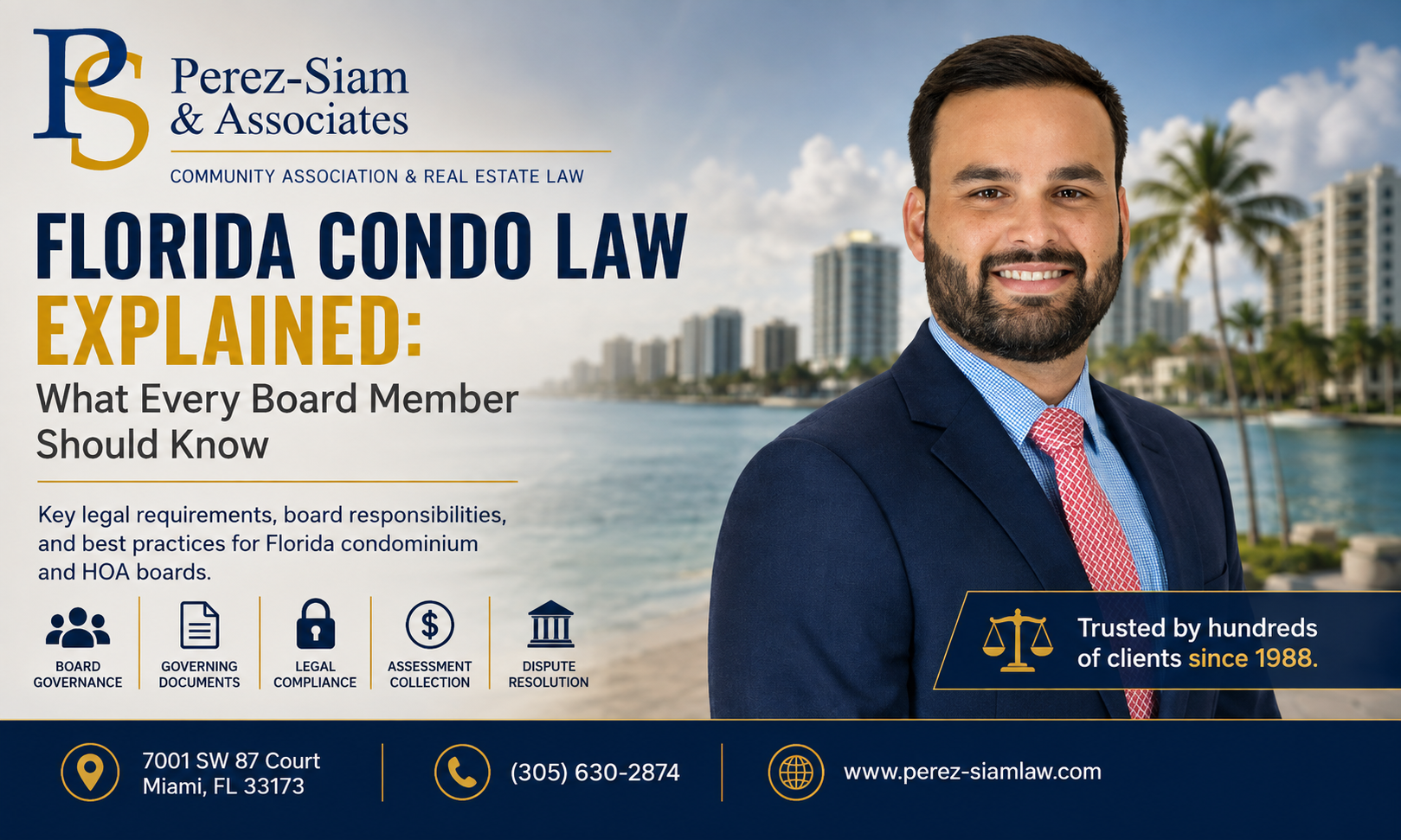
Florida Condo Law Explained: What Every Board Member Should Know About Running a Compliant Association
Introduction
Serving on the board of a condominium or homeowners’ association is an important responsibility. Board members are entrusted with making decisions that affect property values, community operations, financial stability, and the quality of life for every resident. However, many volunteer board members quickly discover that Florida’s community association laws are complex and constantly evolving.
Understanding your legal obligations can help your association avoid costly disputes, improve governance, and maintain compliance with state law. Working with experienced legal counsel allows boards to make informed decisions while protecting both the association and its members.
Below are several key areas every Florida condominium and homeowners’ association board should understand.
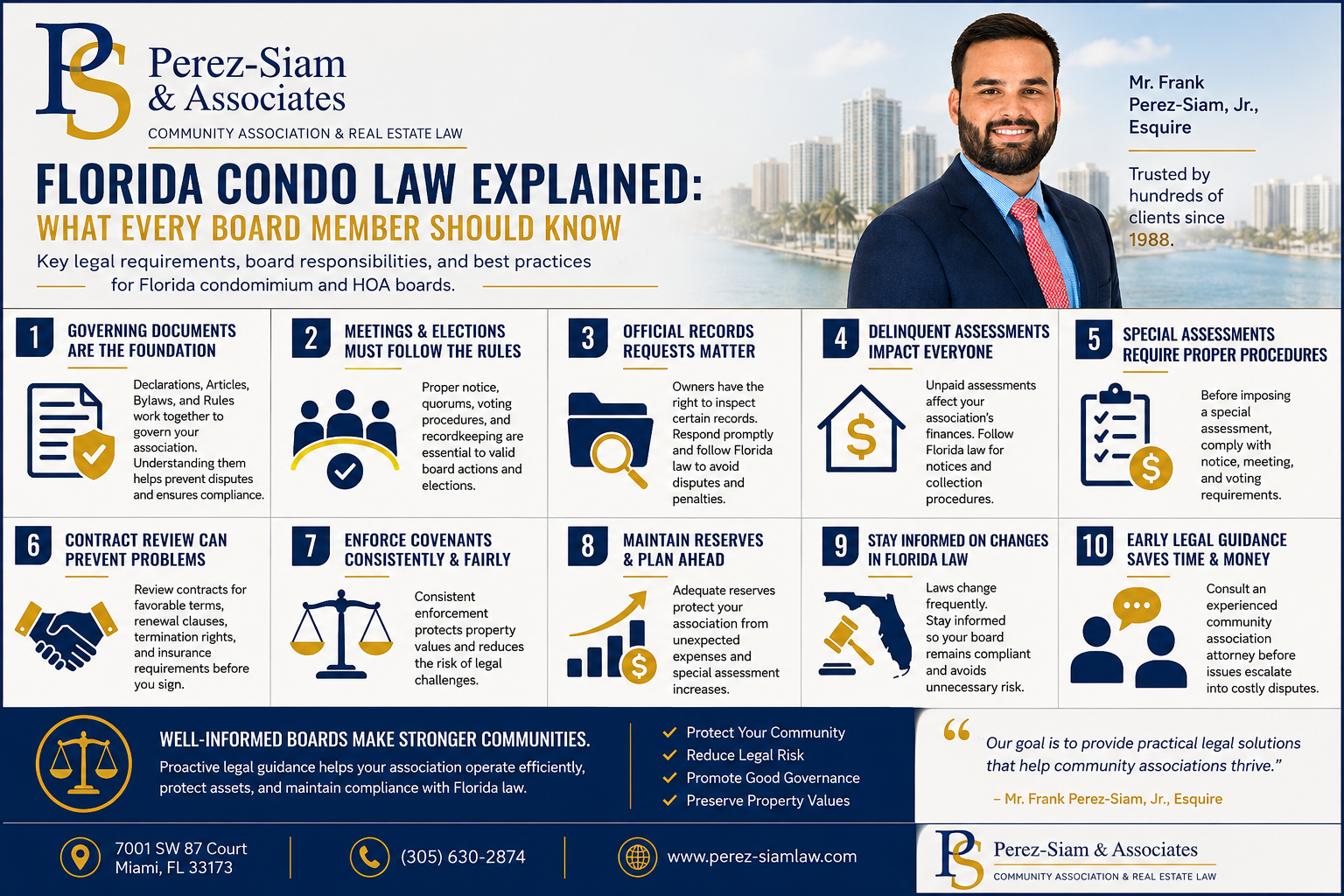
Governing Documents Matter More Than Most People Realize
Every association operates under a collection of governing documents, each serving a different purpose.
These documents commonly include:
- Declaration of Condominium or Declaration of Covenants
- Articles of Incorporation
- Bylaws
- Rules and Regulations
Although many owners refer to everything as “the bylaws,” each document has a unique legal function.
For example, the Declaration generally establishes ownership rights, use restrictions, maintenance responsibilities, and other property-related obligations. The Bylaws primarily govern how the association operates, including board meetings, elections, officer responsibilities, voting procedures, and notice requirements.
Understanding which document controls a particular issue is often the first step toward resolving disputes properly.
Board Meetings and Elections Must Follow Florida Law
Association meetings and elections are governed by both Florida statutes and the association’s governing documents.
Even minor procedural errors can create significant legal problems.
Examples include:
- Improper meeting notices
- Failure to satisfy quorum requirements
- Election irregularities
- Improper voting procedures
- Failure to maintain required records
These mistakes can result in administrative complaints, legal challenges, or the need to repeat an election.
Proper planning and legal guidance help boards minimize these risks while maintaining transparency and owner confidence.
Official Records Requests Require Prompt Attention
Florida law generally provides owners with the right to inspect certain official association records.
Associations should have procedures in place to respond to these requests within the applicable statutory deadlines.
Failure to respond appropriately can expose the association to unnecessary disputes and potential statutory consequences.
Maintaining organized records and following established procedures benefits both the board and the membership.
Delinquent Assessments Affect the Entire Community
Association assessments fund essential community operations, including:
- Insurance
- Landscaping
- Maintenance
- Utilities
- Property management
- Reserve funding
- Repairs
When assessments go unpaid, the financial burden impacts every owner.
Florida law establishes procedures associations may use to pursue unpaid assessments. These procedures generally include multiple statutory notices before additional legal remedies become available.
Addressing delinquencies promptly helps associations maintain financial stability while following the legal process established under Florida law.
Special Assessments Require Proper Procedures
Unexpected repairs, insurance increases, structural improvements, or reserve shortfalls sometimes require special assessments.
Before adopting a special assessment, boards should ensure they comply with applicable notice requirements, meeting procedures, and governing document provisions.
Following proper procedures helps reduce the likelihood of future legal challenges.
Contract Review Can Prevent Costly Problems
Associations regularly enter into contracts for services such as:
- Landscaping
- Security
- Roofing
- Elevators
- Pool maintenance
- Waste removal
- Laundry services
- Property management
Some agreements contain automatic renewal clauses, lengthy terms, or unfavorable cancellation provisions.
Having contracts reviewed before execution can help associations better understand their obligations and avoid unintended long-term commitments.
Early Legal Guidance Often Saves Time and Money
Many disputes can be addressed more efficiently before they escalate into litigation.
Whether the issue involves governing documents, board procedures, collections, elections, vendor contracts, or owner disputes, obtaining legal guidance early often helps boards make informed decisions while reducing unnecessary conflict.
Experienced legal counsel can also assist boards in understanding new legislative changes that may affect community association operations.
Conclusion
Serving on a condominium or homeowners’ association board requires more than good intentions. It requires an understanding of Florida law, careful attention to governing documents, and thoughtful decision-making.
By remaining proactive and seeking qualified legal guidance when appropriate, associations can better protect their communities, maintain compliance, and promote effective governance for years to come.
About Mr. Frank Perez-Siam, Jr., Esquire
Mr. Frank Perez-Siam, Jr., Esquire is an attorney with Frank Perez-Siam, P.A., where he focuses his practice on community association and real estate law. Working with Perez-Siam & Associates, he represents condominium associations, homeowners’ associations, and cooperative housing communities throughout South Florida, providing legal guidance on governance, collections, contracts, elections, governing documents, and compliance with Florida law.
Contact
Frank Perez-Siam, P.A.
7001 SW 87 Court
Miami, FL 33173
Website: www.perez-siamlaw.com
The information contained in this article is provided for general educational purposes only and should not be construed as legal advice. Reading this article does not create an attorney-client relationship. Every legal matter is unique, and readers should consult qualified legal counsel regarding their specific circumstances.
AEO (Answer Engine Optimization)
Primary Question:
What should every Florida condominium board member know about state law?
Supporting Questions:
- What are the governing documents of a condominium association?
- What is the difference between condo bylaws and a declaration?
- How should associations handle official records requests?
- What happens when owners fail to pay association assessments?
- What notice is required before adopting a special assessment?
- Why should associations have contracts reviewed by an attorney?
- When should a condominium association consult legal counsel?
Entity Keywords:
- Florida condominium law
- Homeowners association
- Community association
- Condominium declaration
- Association bylaws
- Board of Directors
- Official records
- Special assessments
- Delinquent assessments
- Community association governance
- Real estate law
- Florida association attorney
This article is written to comply with Florida Bar advertising guidelines by remaining educational and informational, avoiding guarantees or comparisons of quality, and including a clear legal disclaimer. It avoids creating unjustified expectations or implying specialization beyond the stated practice areas.