
Miami insurance professional explains why premiums tell only part of the story—and why every policy deserves an annual review
For many business owners, purchasing insurance ranks far below buying new equipment, taking a vacation or investing in something that delivers immediate satisfaction. Insurance rarely produces that feeling.
Julio Ramos believes that is precisely why people often delay reviewing it.
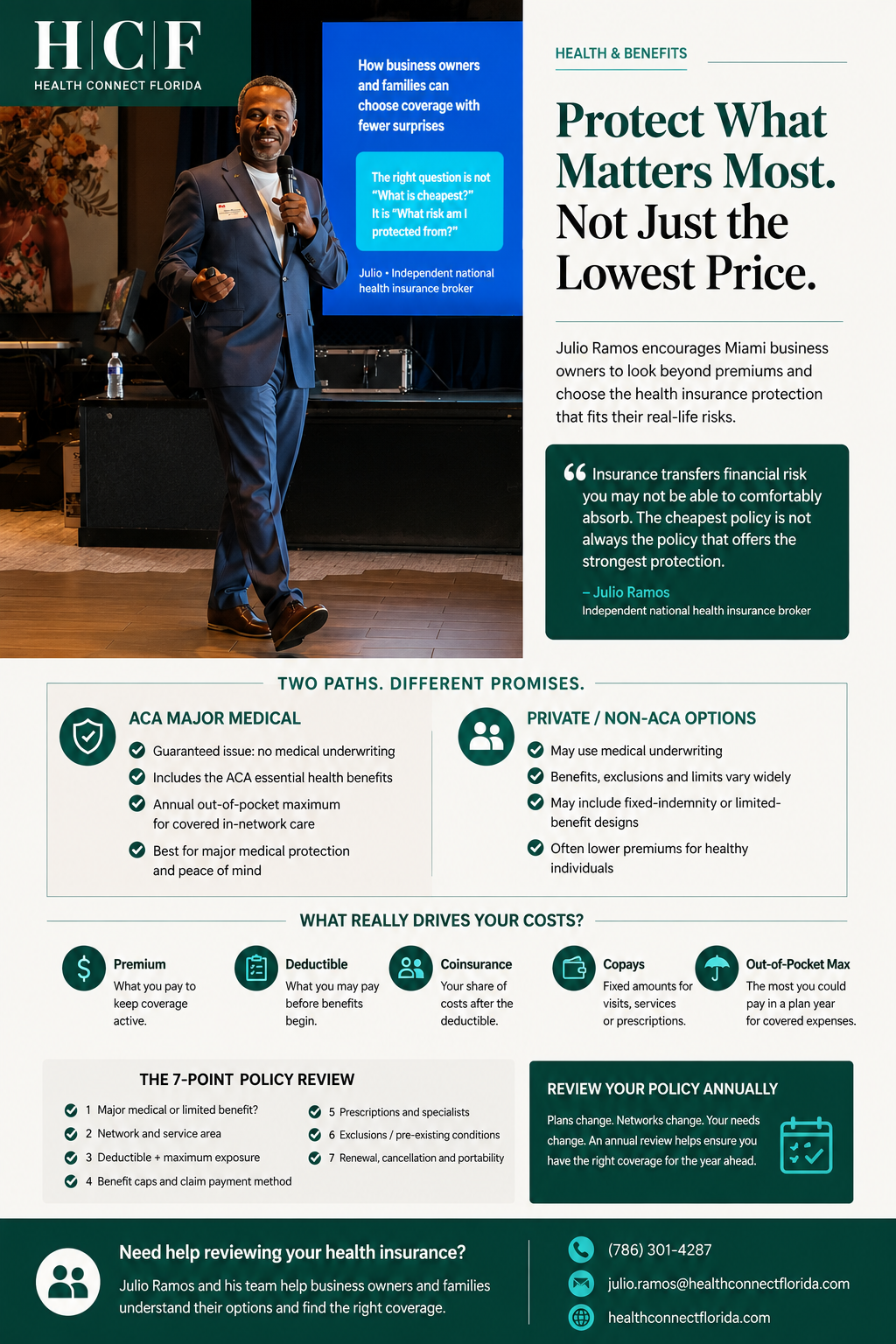
During a recent Miami business presentation, Ramos encouraged entrepreneurs, families and self-employed professionals to look beyond monthly premiums when evaluating health insurance. His central message was clear: the cheapest policy is not necessarily the policy that offers the strongest financial protection.
“The right question is not, ‘What is cheapest?’” Ramos explained. “It is, ‘What risk am I protected from?’”
Insurance Transfers Financial Risk
Ramos began with the fundamental purpose of insurance: transferring a financial risk that a person or business may not be able to comfortably absorb.
A low monthly premium may appear attractive, but it can create greater exposure when a medical emergency occurs. Consumers must therefore understand several numbers beyond the premium, including the deductible, copayments, coinsurance and annual out-of-pocket maximum.
The premium keeps the coverage active. The deductible represents the amount a policyholder may have to pay before certain benefits begin. Copayments and coinsurance determine how costs are shared. The out-of-pocket maximum can provide an important limit on certain covered medical expenses.
According to Ramos, buyers should evaluate the entire financial structure rather than making a decision based on one number.
ACA and Private Insurance Offer Different Protections
Ramos also discussed the distinction between Affordable Care Act major-medical policies and private or non-ACA options.
ACA-compliant major-medical coverage is generally available without medical underwriting and includes federally required essential health-benefit categories. These policies also include an annual out-of-pocket maximum for covered in-network services.
Private plans may use medical underwriting. Their benefits, exclusions, limitations and payment structures can vary considerably. Some may offer lower premiums for healthy applicants, but the consumer must carefully examine what the policy covers—and what it excludes.
“Neither label answers, ‘Is it right for me?’” Ramos said. “The policy details do.”
For people with significant medical conditions, ongoing prescriptions or regular specialist visits, the differences can become especially important. Ramos emphasized that health insurance is highly personal because the proper recommendation depends on medical needs, family circumstances, medications, preferred physicians and financial tolerance.
Business Owners Have Additional Choices
Employees with access to a strong employer-sponsored plan may find that coverage to be their most practical option. Business owners, however, frequently face a more complicated decision.
Ramos noted that companies with a sufficient number of employees may be able to explore group health plans. Smaller businesses, independent contractors and solo entrepreneurs may need to compare individual Marketplace plans with private alternatives.
The decision should not be made solely on monthly cost. It should reflect the owner’s health history, anticipated medical needs, preferred hospitals, doctors and prescription requirements.
Provider Networks Can Change Everything
The presentation also reviewed common network structures, including PPO, HMO, EPO and POS plans.
PPO plans may provide broader provider flexibility and may include certain out-of-network benefits. HMOs generally depend on local networks, primary-care coordination and referrals. EPO policies typically limit nonemergency coverage to participating providers, while POS plans may combine coordinated care with selected out-of-network benefits.
Regardless of the label, Ramos urged consumers to confirm the exact network name and verify that their physicians, hospitals, specialists and prescriptions remain covered before enrolling.
Provider contracts and networks can change. A doctor or hospital available during one enrollment year may not remain available during the next.
The Seven-Point Policy Review
Ramos recommended that every policyholder complete an annual seven-point review:
- Determine whether the plan provides major-medical or limited benefits.
- Confirm the provider network and geographic service area.
- Calculate the deductible and maximum potential exposure.
- Review benefit caps and the method used to pay claims.
- Verify prescriptions, doctors and specialists.
- Examine exclusions and pre-existing-condition provisions.
- Understand renewal, cancellation and portability rules.
His final recommendation was practical: request the plan’s Summary of Benefits and read the exclusions carefully.
Insurance may not provide instant gratification, but the wrong policy can create lasting financial consequences. For Miami’s entrepreneurs and families, an annual insurance review may be one of the least exciting—and most financially responsible—meetings of the year.
To contact Julio, julio.ramos@healthconnectflorida.com or 305-878-4154
This article is for general educational purposes and does not constitute insurance, legal, tax, or financial advice. Coverage, eligibility, benefits and policy requirements vary by carrier, plan and state. Consumers should review official policy documents and consult a properly licensed insurance professional before making coverage decisions.