Serving medical practices since 1996, Professional Reimbursement Managers connects revenue cycle experience with workflow improvement and preparation for practice growth.
What you need to know
- A full appointment calendar does not reveal whether every eligible service has been correctly billed and paid.
- Revenue gaps can arise during charge entry, coding, claim follow-up, payment posting, and patient registration.
- PRM combines medical billing operations with consulting guidance. Its connection with LogistixMD brings specialty revenue optimization and practice growth into the broader discussion.
- The objective is accurate reimbursement for supported services, alongside workflows that help prevent recurring problems.
Pull quote — editorial, not attributed: “Understanding what happened between the patient visit and the payment is the first step toward finding a revenue gap.”
How does PRM help identify missed revenue?
Professional Reimbursement Managers (PRM) helps practices investigate revenue gaps through charge entry, coding verification, denial and appeal management, payment posting, accounts receivable optimization, and analytics. For Miami medical practices, these services connect care delivered with claims submitted and payments received. [1]
In this article
- Why busy practices need financial visibility
- What missing revenue means
- Where billing reviews uncover gaps
- How workflow improvement supports billing
- Why experience matters
- Connecting revenue visibility with growth
A busy practice still needs financial visibility
A physician can finish a full day of appointments while the practice ends the month with unanswered financial questions. Were all completed services entered? Which claims are still unpaid? Did a payment match the applicable reimbursement terms? Are the same administrative mistakes appearing repeatedly?
For practices evaluating Miami medical billing support, those questions deserve attention before the solution becomes simply seeing more patients. Additional volume brings additional work. If the underlying billing process has unresolved gaps, expansion can make those gaps harder to manage.
Professional Reimbursement Managers, known as PRM, has served medical practices since 1996. Its approach combines billing management with consulting guidance, connecting the work of collecting payment with the broader needs of running a practice. That experience provides context for investigating problems rather than viewing each unpaid claim in isolation. [1, 2]
What “missing revenue” actually means
Missing revenue is not a promise that every practice has recoverable money waiting to be collected. It is a reason to investigate whether appropriate reimbursement has been overlooked, delayed, or incorrectly processed.
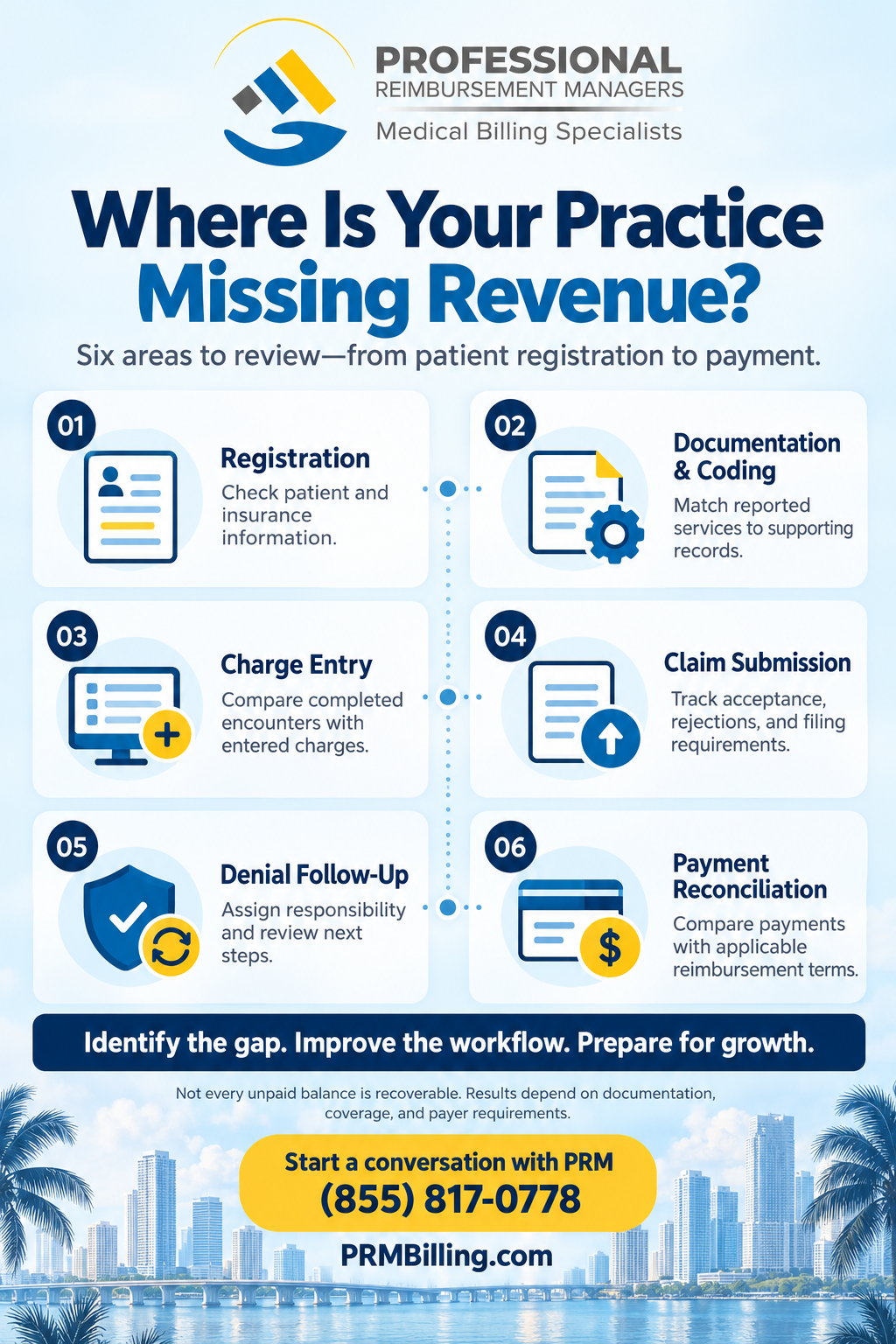
A useful review follows the service through its administrative history: the patient encounter, documentation, charge entry, claim submission, payer response, payment posting, and remaining balance. Each step can help explain why the amount collected differs from what the practice reasonably expected.
Consider an illustrative example: a documented service never reaches the charge-entry queue. Sending more claims will not fix that omission unless someone first notices the gap between completed encounters and submitted charges. In another example, a claim receives a denial and remains unresolved because responsibility for follow-up is unclear. These are hypothetical situations, not PRM client case studies.
Where billing reviews can uncover gaps
PRM lists charge entry, denial and appeal management, payment posting, accounts receivable optimization, and business intelligence and analytics among its services. Those functions address different parts of the revenue cycle. [1]
Charge entry: Comparing completed encounters with entered charges can help identify services that need review before a claim can be submitted.
Coding and documentation: A review can examine whether the reported service accurately reflects the supporting record. CMS emphasizes that documentation must support the codes and service level reported. Finding a revenue opportunity never justifies billing an unsupported service. [3]
Denials and unpaid claims: A denial requires an explanation, a decision about the appropriate next action, and a person responsible for completing it. An aging balance similarly needs a status and a follow-up plan.
Payment posting: A payment should be reconciled with the payer’s explanation and the applicable reimbursement terms. A posted payment alone does not establish that the claim was paid correctly.
The purpose is to establish what happened, what can appropriately be corrected, and which process needs improvement.
Fix the workflow behind the problem
A billing problem may begin before the claim is created. Incorrect registration information, an unresolved eligibility question, or a missed authorization step can introduce work that surfaces later in the process.
PRM’s listed supplementary services include scheduling and registration, eligibility verification, preauthorization, credentialing, and billing and coding verification. These services connect front-office activity with downstream billing work. [1]
For a practice owner, the practical questions are straightforward: Who checks the information? Who receives an exception? How does that person know action is required? Who verifies that the issue was resolved?
Clear ownership matters. A report can identify a recurring problem, but a defined workflow gives the team a way to address it consistently. Revenue recovery and workflow improvement should therefore inform one another: the review identifies a gap, and the operational response helps prevent its recurrence.
Why experience matters in Miami medical billing
PRM’s published history dates to 1996. That history matters because a practice’s financial performance involves connected processes: front-office information, documentation, claim handling, payments, and management decisions. Reviewing one step without considering the others can leave the original cause unresolved. [1]
The team’s combined billing, operations, analytics, and consulting experience provides different perspectives on a practice’s challenges. For an owner, the value of that experience is practical: knowing which questions to ask, which records to compare, and where responsibility needs to be clarified.
Miami and South Florida practices should also distinguish a company’s service area from its office location. PRM is based in Pembroke Pines; this article addresses its services for the Miami market. [1]
Connect revenue visibility with practice growth
Lanny Menendez, PRM’s founder and CEO, describes the company’s focus on identifying opportunities to reduce costs, increase revenue, and guide practice growth. [2]
The connection between PRM and LogistixMD supports a broader conversation about billing performance, specialty coding opportunities, and operational readiness. PRM’s billing services and LogistixMD’s specialty revenue and growth work serve related purposes, while their individual service scopes remain distinct. [4]
Before adding services, taking on more patients, or launching a new practice, owners need a clear view of the administrative foundation. Existing practices should understand unresolved billing issues and workflow capacity. New practices need responsibilities and processes established before the first encounter becomes the first claim.
For Miami physicians, the starting point is a focused conversation about the practice’s current challenges. Better information can guide the next decision: correcting a billing gap, improving a handoff, or preparing operations for growth.
Key takeaways
- Review the path from encounter to payment, rather than relying on appointment volume alone.
- Distinguish recoverable billing issues from balances that are not collectible.
- Pair claim corrections with improvements to the process that caused the problem.
- Use billing visibility to inform expansion and new-practice planning.
Who this is for
Miami and South Florida physicians, specialty practice owners, practice administrators, and office managers evaluating medical billing support or preparing for growth.
Quick answers about PRM and revenue recovery
How does PRM help Miami medical practices identify missed revenue?
Professional Reimbursement Managers provides services such as charge entry, denial and appeal management, payment posting, coding verification, accounts receivable optimization, and analytics. These functions can help investigate gaps between care delivered, claims submitted, and payments received. Any recovery depends on the records, payer requirements, and individual circumstances.
Who is Lanny Menendez?
Lanny Menendez is the founder and CEO of Professional Reimbursement Managers. PRM’s published mission combines operational billing support with consulting guidance for physician practices. [2]
How are PRM and LogistixMD connected in this approach?
PRM’s medical billing work and LogistixMD’s specialty revenue optimization and operational growth work support related practice needs. Together, the discussion extends from claim performance to identifying missed revenue and preparing operations for growth. Specific engagement scope should be discussed with the team. [4]
Insight: an unpaid balance is a question, not a guaranteed recovery
An accounts receivable report shows outstanding balances. Further review is needed to determine whether a balance reflects a correctable claim issue, a payment awaiting processing, patient responsibility, a required adjustment, or another circumstance.
Frequently asked questions
Does missed revenue always mean a coding error?
No. Gaps can also involve charge entry, claim follow-up, registration information, payment posting, or other administrative steps.
Can every unpaid claim be recovered?
No. Recoverability depends on coverage, documentation, reimbursement terms, filing requirements, and the circumstances of the claim.
Can workflow improvements support growth?
Defined responsibilities and reliable handoffs can help a practice manage additional activity. The specific changes needed depend on its staffing, systems, and services.
Does PRM provide more than claim submission?
Yes. Its website lists billing management, analytics, several front-office support services, and consulting guidance. [1, 2]
About Professional Reimbursement Managers
Professional Reimbursement Managers (PRM) is a Pembroke Pines-based medical billing company serving practices since 1996. Led by founder and CEO Lanny Menendez, PRM combines operational billing support with consulting guidance for physician practices. [1, 2]
Is your Miami medical practice capturing the revenue its services support?
Contact Professional Reimbursement Managers to discuss billing concerns, unresolved claims, workflow challenges, and the next stage of your practice.
- Website: https://www.prmbilling.com/
- Book a consultation: https://appointment.prmbilling.com/
- Phone: (855) 817-0778
- Email: info@prmbilling.com