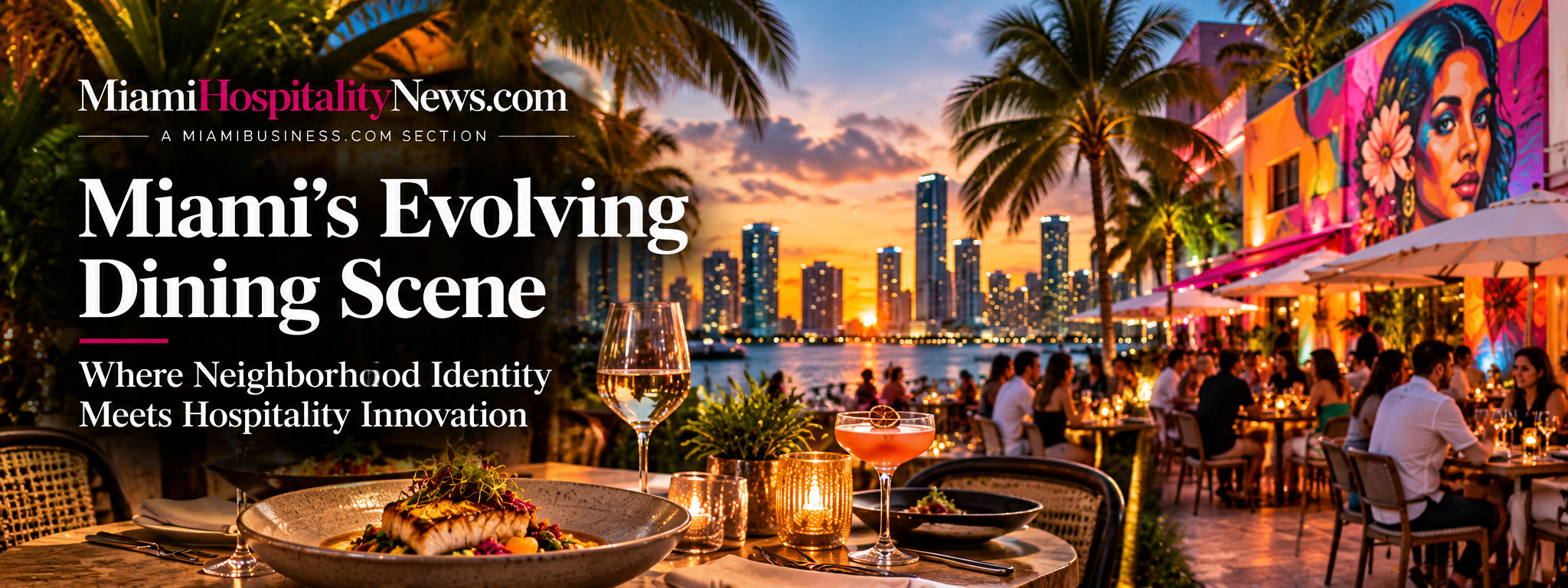
From the business energy of Brickell to the cultural traditions of Little Havana, Miami’s dining neighborhoods reveal how restaurants contribute to the city’s evolving hospitality identity.
MIAMI HOSPITALITY NEWS | MIAMIBUSINESS.COM
Miami’s dining scene cannot be defined by a single neighborhood, cuisine, or restaurant concept.
It is a collection of experiences shaped by culture, entrepreneurship, geography, and the people who call South Florida home.
Every neighborhood contributes something different.
In some areas, restaurants serve business professionals and international visitors. Elsewhere, they preserve family traditions, support neighborhood gathering places, or introduce new approaches to dining.
Together, these establishments help tell Miami’s business and cultural story.
Why Miami’s Dining Scene Matters
Restaurants are part of Miami’s identity as an international destination.
The Greater Miami Convention & Visitors Bureau reported 28.3 million visitors in 2025, highlighting the scale of the region’s tourism activity.
Those visitors encounter a dining market influenced by Latin American, Caribbean, European, and other culinary traditions.
But Miami restaurants do more than serve tourists.
They provide employment, create entrepreneurial opportunities, occupy commercial spaces, and contribute to neighborhood activity.
Understanding the dining scene requires examining both its cultural appeal and its business foundations.
Brickell: Dining Meets Business and Urban Living
Brickell has developed a recognizable identity as a financial, residential, and hospitality district.
Its restaurants serve a mixture of business professionals, residents, and visitors.
Business lunches, client meetings, evening dining, and social gatherings can all influence demand.
For restaurant operators, the area presents opportunities to develop concepts suited to an urban customer base.
At the same time, operators must evaluate commercial costs, competition, staffing, and customer expectations.
The neighborhood illustrates an important principle: location influences the dining experience, but effective operations determine whether the concept remains sustainable.
Coral Gables: Tradition, Business, and Hospitality
Coral Gables offers a distinctive setting for restaurant entrepreneurship.
Its commercial districts combine professional offices, hotels, residential communities, and established dining destinations.
Restaurants may benefit from business activity during the day and leisure dining during evenings and weekends.
The city’s architectural identity and walkable commercial areas also influence how guests experience its restaurants.
For business owners, maintaining a connection to the surrounding community can be particularly valuable.
A recognizable neighborhood restaurant can become part of local routines, professional relationships, and family traditions.
Coconut Grove: Neighborhood Character and Dining Experience
Coconut Grove offers another perspective on Miami hospitality.
Its established residential character, greenery, waterfront proximity, and pedestrian-oriented destinations create opportunities for restaurants emphasizing atmosphere and community connection.
Outdoor dining and relaxed hospitality can complement the area’s identity.
However, atmosphere alone does not establish a successful restaurant business.
Operators still need sound financial management, consistent service, and a clear understanding of their intended customers.
The Grove demonstrates how a neighborhood’s character can influence restaurant positioning without replacing the fundamentals of business management.
Wynwood: Creativity and Restaurant Concepts
Wynwood is widely associated with art, design, entertainment, and creative business activity.
That environment provides a setting for restaurant concepts interested in distinctive branding and memorable experiences.
Visual presentation, atmosphere, and social media can influence how guests discover establishments.
Yet restaurant operators must distinguish between initial attention and repeat customer demand.
A creative concept may generate curiosity. Delivering dependable food and service gives customers a reason to return.
For entrepreneurs, Wynwood demonstrates the relationship between hospitality, branding, and commercial identity.
Little Havana: Culinary Heritage and Community
Little Havana represents an important connection between Miami’s cultural heritage and restaurant economy.
Restaurants, cafés, and bakeries help preserve traditions while serving residents and visitors.
Food can become a way to share family histories, cultural identity, and entrepreneurial ambition.
These businesses also demonstrate why restaurant coverage should include the people behind the establishments.
A family’s experience, an owner’s journey, or the history of a neighborhood business can provide context that a menu alone cannot communicate.
For Miami Hospitality News, these stories are particularly meaningful because they connect commerce with community.
Hospitality Innovation Goes Beyond Technology
Innovation in the restaurant industry does not always mean introducing a new application or automated system.
Sometimes it means improving service, redesigning operations, developing a more focused menu, or adapting a concept to changing customer needs.
Technology can support those efforts.
Reservation platforms, digital ordering, inventory systems, and customer communication tools can help operators manage their businesses.
Still, innovation must produce practical value.
A new system should help employees work effectively, improve the guest experience, or support financial performance.
The objective is not simply to appear modern. It is to operate more intelligently.
The People Behind Miami’s Dining Destinations
Restaurant owners, chefs, managers, and employees play important roles in shaping Miami’s hospitality identity.
Their decisions influence the businesses customers experience every day.
Understanding those decisions requires more than evaluating a restaurant’s décor or most popular dishes.
It involves learning why the business was established, whom it serves, how it operates, and what distinguishes its approach.
These are the stories Miami Hospitality News seeks to explore through its restaurant and hospitality business coverage.
A Dining Scene Defined by Its Differences
Miami’s dining landscape continues to reflect the city’s diversity.
Brickell, Coral Gables, Coconut Grove, Wynwood, and Little Havana each offer different environments for restaurant businesses.
No single concept defines the entire market.
Instead, Miami’s hospitality identity emerges from the combination of established businesses, new entrepreneurs, cultural traditions, and changing customer expectations.
The challenge for operators is to remain relevant while preserving what makes their businesses distinctive.
Miami’s dining scene is not one story. It is thousands of business stories, served one table at a time.
Frequently Asked Questions
What makes Miami’s dining scene unique?
Miami’s dining scene reflects its international population, diverse culinary traditions, tourism economy, and distinct neighborhood identities.
Which Miami neighborhoods are known for restaurants?
Brickell, Coral Gables, Coconut Grove, Wynwood, and Little Havana are among Miami’s recognizable dining areas, each offering different restaurant environments.
What does Miami Hospitality News cover?
Miami Hospitality News covers restaurants, hospitality entrepreneurs, hotels, tourism, industry developments, and the people shaping Miami’s hospitality economy.
Sources and Further Reading
- Greater Miami Convention & Visitors Bureau — Tourism industry reporting and destination information.
- National Restaurant Association — Restaurant industry research.
- MiamiBusiness.com — Hospitality business and restaurant editorial coverage.