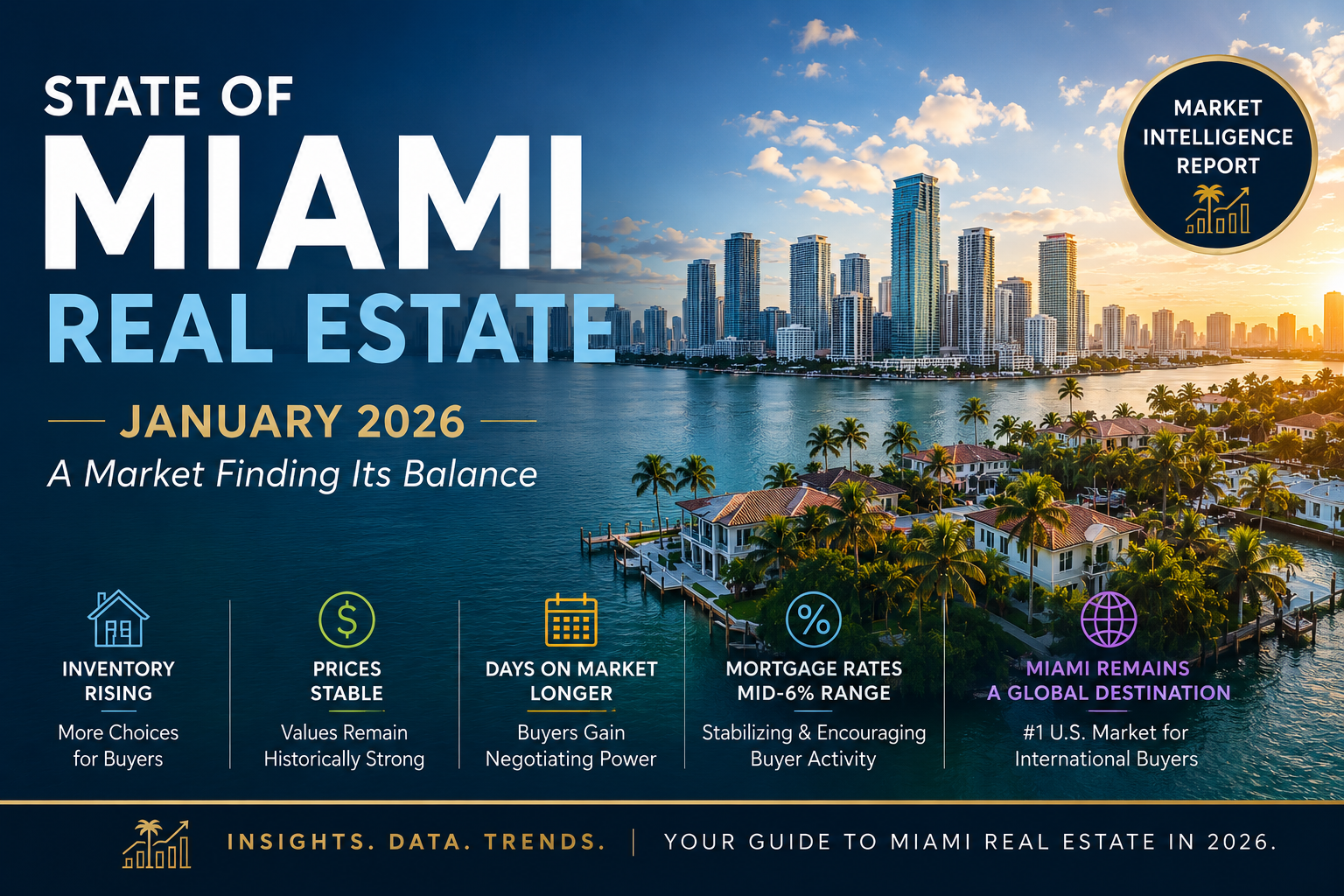
A Market Finding Its Balance
Inventory expanded, buyers gained negotiating power, and Miami entered 2026 with a healthier—but more selective—real estate market.
Executive Summary
If 2025 was the year Miami’s real estate market began transitioning away from the frenzied pace of the post-pandemic boom, January 2026 marked the beginning of a more balanced chapter.
The market did not weaken—it matured.
Inventory continued to grow across Miami-Dade County, providing buyers with more choices than they had seen in several years. Sellers remained in a favorable position compared to most U.S. markets, but pricing strategy became more important than ever. Homes priced correctly continued to sell, while overpriced listings often lingered on the market.
Perhaps the biggest story wasn’t declining demand—it was changing expectations.
Today’s buyers are more patient, more informed, and more willing to negotiate. Meanwhile, sellers have begun adjusting to a marketplace where presentation, pricing, and preparation once again determine success.
For investors, luxury buyers, and international purchasers, Miami continued to stand apart from nearly every other major U.S. metropolitan area.
Market Snapshot
January delivered encouraging signs that Miami’s housing market is evolving toward long-term sustainability rather than speculative growth.
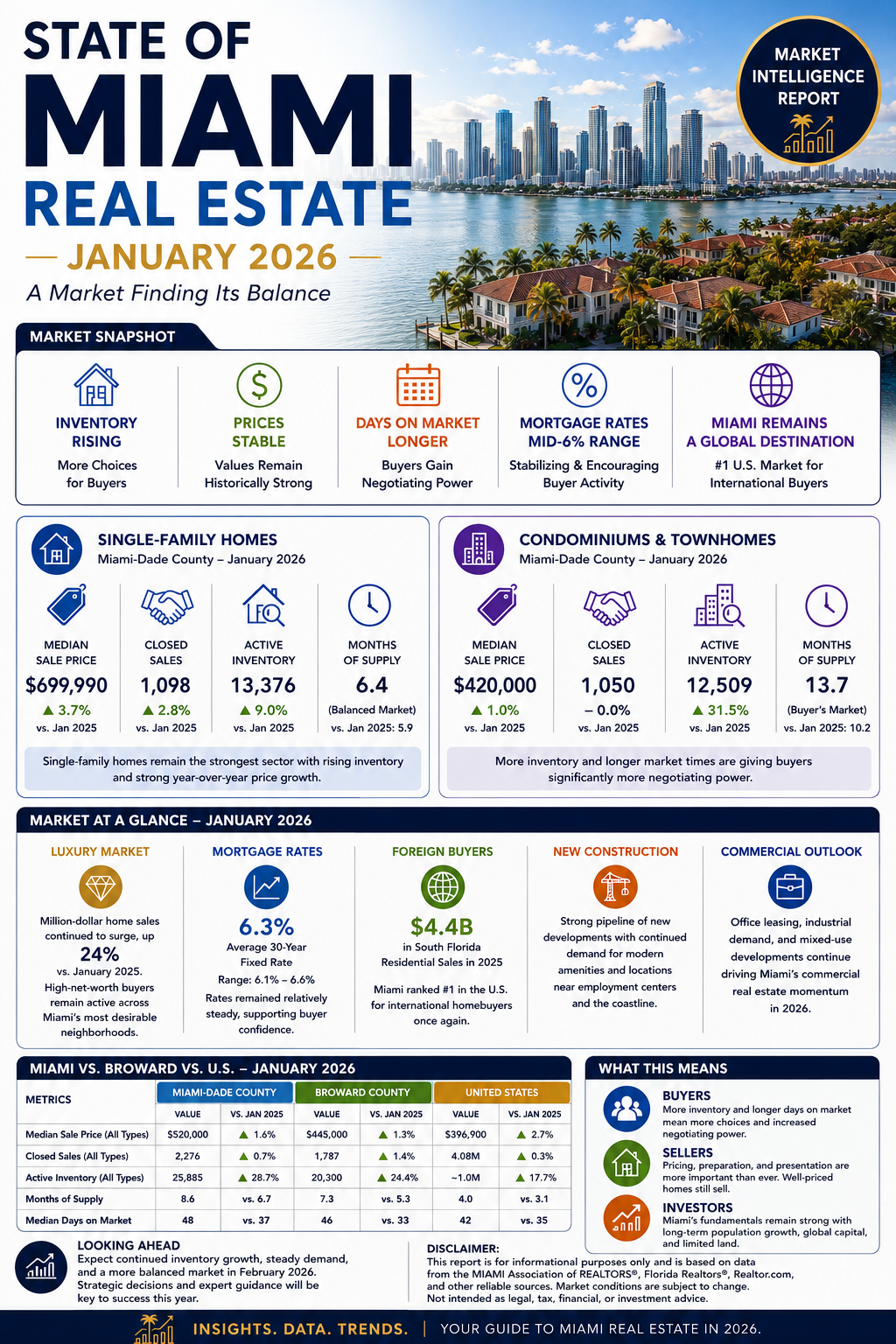
Single-family homes remained the strongest sector. Median prices continued climbing year-over-year while inventory expanded enough to reduce the intense competition seen over the past several years. Closed sales increased modestly, demonstrating that buyer demand remains healthy despite higher borrowing costs. Miami-Dade’s single-family median sales price reached approximately $699,990, with inventory approaching a balanced six-month supply. (MIAMI REALTORS® + RWorld)
The condominium market told a different story.
Inventory rose significantly, giving buyers considerably more negotiating leverage than they have enjoyed in years. While condo values generally remained stable, sellers increasingly found themselves competing not only on price but also on HOA fees, reserve funding obligations, insurance costs, and building compliance requirements. (Realtor)
Single-Family Homes Continue Leading the Market
Miami’s single-family housing sector continues to demonstrate remarkable resilience.
Demand remains supported by several long-term economic fundamentals:
- Continued population growth
- Corporate relocations
- Limited developable land
- High-income domestic migration
- Strong local employment
Unlike many metropolitan markets that experienced sharp corrections following the pandemic housing boom, Miami continues benefiting from structural demand drivers that extend well beyond interest rates.
While buyers have become more selective, desirable homes located in established neighborhoods such as Coral Gables, Pinecrest, South Miami, Coconut Grove, and Miami Lakes continue attracting multiple qualified buyers when priced appropriately.
The days of simply placing a sign in the yard and expecting offers above asking price are largely behind us.
Today’s market rewards preparation.
Condominiums Enter a New Phase
No segment better illustrates Miami’s changing market dynamics than condominiums.
Following Florida’s enhanced structural inspection requirements and reserve funding laws enacted after the Surfside tragedy, buyers have become increasingly diligent when evaluating condominium purchases.
Questions that rarely surfaced several years ago have become standard during due diligence.
Buyers now routinely ask:
- Has the milestone inspection been completed?
- Is the Structural Integrity Reserve Study current?
- Are there pending special assessments?
- How financially healthy is the association?
- What insurance increases should owners expect?
These additional considerations have lengthened transaction timelines while creating more opportunities for educated buyers.
Buildings with strong financial reserves, proactive boards, and transparent management continue outperforming comparable properties lacking those characteristics.
Luxury Real Estate Remains Exceptionally Strong
One area showing little sign of slowing is Miami’s luxury market.
High-net-worth buyers continue viewing South Florida as a desirable destination for wealth preservation, lifestyle, business expansion, and international diversification.
January saw continued strength in million-dollar transactions, reflecting sustained confidence among affluent purchasers. Luxury demand remains driven less by mortgage rates and more by long-term investment objectives and lifestyle preferences. (MIAMI REALTORS® + RWorld)
Ultra-luxury buyers continue targeting waterfront estates, branded residences, and trophy properties throughout:
- Fisher Island
- Miami Beach
- Bal Harbour
- Key Biscayne
- Coral Gables
- Coconut Grove
- Pinecrest
For this segment of the market, inventory remains relatively constrained despite broader market normalization.
International Buyers Continue Choosing Miami
Miami’s global appeal remains unmatched.
The city continues attracting buyers from Latin America, Europe, and Canada seeking political stability, business opportunities, favorable tax policies, and an exceptional quality of life.
According to the MIAMI Association of REALTORS®, Miami once again ranked as the No. 1 U.S. destination for international homebuyers, accounting for a substantial share of all foreign residential transactions in Florida. International buyers purchased approximately $4.4 billion in South Florida residential real estate during 2025, with Miami-Dade representing the majority of those sales. (MIAMI REALTORS® + RWorld)
Many of these buyers pay cash, helping insulate portions of Miami’s market from fluctuations in mortgage interest rates.
Mortgage Rates Continue Influencing Buyer Behavior
Although mortgage rates remained elevated compared to the historic lows experienced during 2020 and 2021, many buyers have accepted that today’s financing environment represents the new normal.
Rather than waiting indefinitely for dramatically lower rates, qualified buyers increasingly recognize they can refinance in the future while securing desirable properties today.
This mindset has helped maintain transaction activity despite affordability challenges.
For sellers, it reinforces the importance of realistic pricing and effective marketing.
Commercial Real Estate Shows Continued Momentum
Commercial investment across Miami remained active entering 2026.
Office leasing continued benefiting from financial firms relocating operations to South Florida.
Industrial properties remained in high demand due to logistics, international trade, and e-commerce growth.
Mixed-use developments continued attracting investor interest as developers sought projects combining residential, retail, hospitality, and office components.
While national headlines often focused on office vacancies in other cities, Miami continued distinguishing itself through population growth and corporate expansion.
What Buyers Should Know
January created opportunities that simply did not exist two years ago.
Buyers now enjoy:
- More available inventory
- Longer decision-making periods
- Greater negotiating leverage
- Increased seller concessions
- Better property selection
That does not necessarily mean prices are falling dramatically.
Instead, buyers have regained something equally valuable:
Options.
The most successful purchasers will continue focusing on long-term value rather than attempting to perfectly time the market.
What Sellers Should Know
The market is still favorable—but expectations must evolve.
Successful sellers in 2026 understand three realities:
Price correctly from day one.
Today’s buyers have more inventory to compare.
Prepare your property.
Professional photography, staging, repairs, and marketing matter more than ever.
Be responsive.
Negotiation has returned to normal real estate transactions.
Properties priced realistically continue selling quickly, while ambitious pricing often results in extended market time followed by price reductions.
Looking Ahead to February 2026
January suggests Miami is entering one of the healthiest market environments seen in several years.
Rather than extreme seller dominance or dramatic buyer advantage, the market is gradually moving toward equilibrium.
That balance benefits everyone.
Buyers gain confidence.
Sellers remain positioned to achieve strong values.
Investors continue finding opportunities.
International capital continues flowing into South Florida.
Most importantly, Miami’s underlying economic fundamentals remain exceptionally strong.
Population growth, global investment, corporate relocation, infrastructure improvements, and limited land availability continue supporting long-term confidence in the region.
As 2026 unfolds, the market will likely reward expertise over speculation, preparation over emotion, and strategy over timing.
For buyers, sellers, and investors alike, that may prove to be the healthiest real estate environment Miami has experienced in years.
Editorial Disclosure
This State of Miami Real Estate – January 2026 report was prepared by MiamiRealEstateNews.com using publicly available information from multiple reliable sources, including the MIAMI Association of REALTORS®, Florida Realtors®, Realtor.com, and other market data providers. Market statistics have been summarized and interpreted for educational and informational purposes. This report does not constitute legal, tax, financial, or investment advice. Readers should consult qualified real estate, legal, tax, or financial professionals before making real estate decisions. (MIAMI REALTORS® + RWorld)