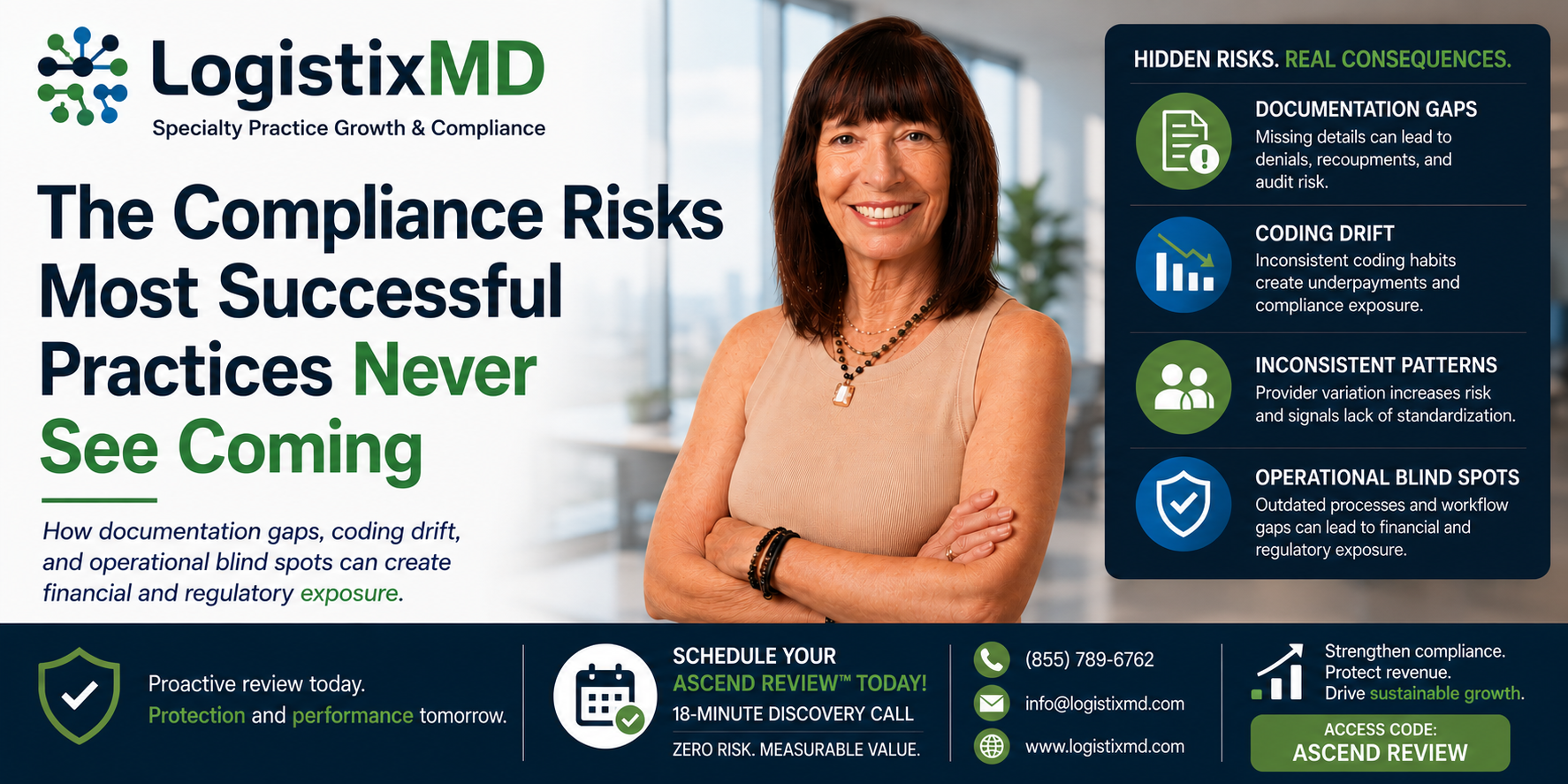
How documentation gaps, coding drift, and operational blind spots can create financial and regulatory exposure.
“Risk comes from not knowing what you’re doing.”
— Warren Buffett
By Lorraine Molinari
Coding Performance & Revenue Recovery Specialist, LogistixMD
TL;DR
Many specialty practices focus heavily on revenue growth but pay less attention to the compliance risks quietly developing beneath the surface. Documentation gaps, coding inconsistencies, workflow breakdowns, and process drift can create significant financial and regulatory exposure over time. The most dangerous compliance risks are often the ones practices do not realize exist.
What Compliance Risks Should Specialty Practices Be Concerned About?
Most specialty practices immediately think about audits when they hear the word compliance.
However, compliance risk often begins long before an auditor ever reviews a chart.
It starts with small issues.
A missing documentation element.
An inconsistent coding pattern.
A workflow shortcut adopted years ago.
A process that once worked but no longer aligns with current payer requirements.
Individually, these issues may seem insignificant. Over time, however, they can compound into meaningful financial and regulatory exposure.
The reality is that many successful practices are unknowingly carrying risks they would address immediately if they knew they existed.
Why Compliance Risk Often Goes Unnoticed
Compliance issues rarely announce themselves.
Unlike declining revenue, there is often no immediate warning sign.
Claims continue to be paid.
Patients continue to be seen.
Operations continue to function.
This creates a false sense of security.
Many practice leaders assume that because reimbursement is occurring, compliance is strong.
Unfortunately, reimbursement and compliance are not always the same thing.
A practice can receive payment for years while documentation deficiencies and coding inconsistencies quietly accumulate in the background.
The Myth of “We’ve Never Had a Problem”
One of the most common statements heard during reviews is:
“We’ve never had a problem.”
And often, that statement is true.
The practice has never experienced:
- A major audit
- A payer investigation
- Significant recoupments
- Regulatory scrutiny
However, the absence of a problem does not necessarily mean the absence of risk.
Many compliance vulnerabilities remain hidden until an external review occurs.
By then, correcting issues can become significantly more expensive and disruptive.
Four Hidden Risks Specialty Practices Commonly Miss
1. Documentation Gaps
Clinical care may be excellent.
Unfortunately, excellent care and excellent documentation are not always the same thing.
Missing elements, incomplete narratives, or insufficient support for billed services can create reimbursement and compliance concerns.
2. Coding Drift
Coding drift occurs when coding habits gradually change over time.
This often results from:
- Staff turnover
- New payer requirements
- Inconsistent training
- Provider-specific coding habits
Coding drift can create both underbilling and compliance exposure.
3. Inconsistent Provider Patterns
Multiple providers within the same organization may code and document similar encounters differently.
These inconsistencies often reveal opportunities for standardization and risk reduction.
4. Process Vulnerabilities
Many practices have operational processes that were developed years ago and never revisited.
What worked well in the past may no longer align with today’s regulatory environment.
How Coding Drift Creates Exposure
Most coding drift is not intentional.
It develops gradually.
Providers become comfortable with certain documentation habits.
Staff members develop workarounds.
Coding assumptions become accepted practice.
Over time, coding patterns may move away from optimal standards without anyone realizing it.
This can affect:
- Reimbursement accuracy
- Audit readiness
- Documentation support
- Compliance consistency
One of the most valuable aspects of a performance review is identifying coding drift before it becomes a larger issue.
Documentation: Your First Line of Defense
If coding is the language of reimbursement, documentation is the evidence supporting it.
Strong documentation provides:
- Medical necessity support
- Compliance protection
- Audit readiness
- Reimbursement justification
It also creates confidence.
When documentation aligns properly with services rendered, practices are positioned to defend their decisions and support their claims.
Strong documentation protects both revenue and reputation.
Why Operational Processes Matter
Many compliance discussions focus exclusively on coding.
However, operational processes often create compliance challenges as well.
Examples include:
- Referral tracking
- Authorization management
- Charge capture workflows
- Documentation review procedures
- Communication breakdowns between departments
When processes become fragmented, risk increases.
Well-designed operational workflows help ensure consistency, accountability, and compliance throughout the organization.
What a Compliance-Focused Review Can Reveal
At LogistixMD, compliance is not treated as a separate initiative.
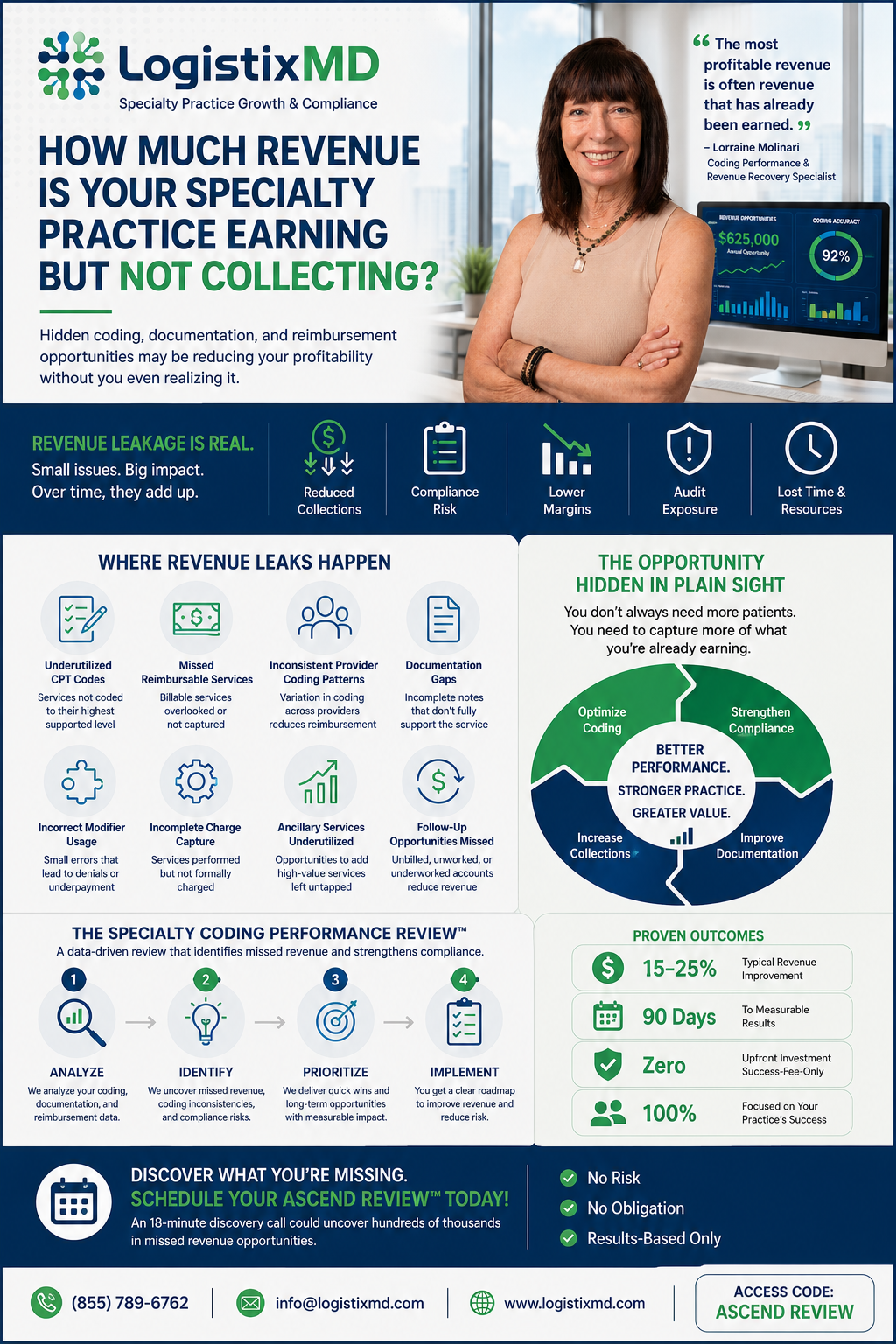
It is integrated into every Specialty Coding Performance Review™.
The objective is to identify:
- Documentation weaknesses
- Coding inconsistencies
- Process vulnerabilities
- Compliance exposure
- Revenue opportunities
Using actual practice data allows leadership to make informed decisions based on evidence rather than assumptions.
This creates both financial and operational clarity.
Featured Snippet Answer
What are the most common compliance risks in specialty medical practices?
The most common compliance risks include documentation gaps, coding drift, inconsistent provider coding patterns, workflow vulnerabilities, and outdated operational processes. These issues often develop gradually and may remain undetected until an audit, payer review, or internal assessment identifies them.
Frequently Asked Questions
What is coding drift?
Coding drift occurs when coding habits gradually change over time, creating inconsistencies that may affect reimbursement accuracy and compliance.
Can a profitable practice still have compliance issues?
Yes. Many financially successful practices discover documentation, coding, or workflow risks during compliance reviews.
Why is documentation so important?
Documentation supports medical necessity, reimbursement, audit readiness, and regulatory compliance.
Do compliance reviews disrupt daily operations?
A properly structured review should be minimally disruptive and designed to work alongside existing clinical workflows.
How often should practices review compliance performance?
Most specialty practices benefit from periodic reviews to ensure coding, documentation, and operational processes remain aligned with current requirements.
“Risk comes from not knowing what you’re doing.”
— Warren Buffett
The greatest compliance risks are often not the obvious ones.
They are the risks that quietly develop over time while everyone assumes everything is functioning properly.
The key takeaway is simple: compliance should not be viewed as a reaction to audits. It should be viewed as a proactive business strategy that protects revenue, strengthens operations, and supports long-term growth.
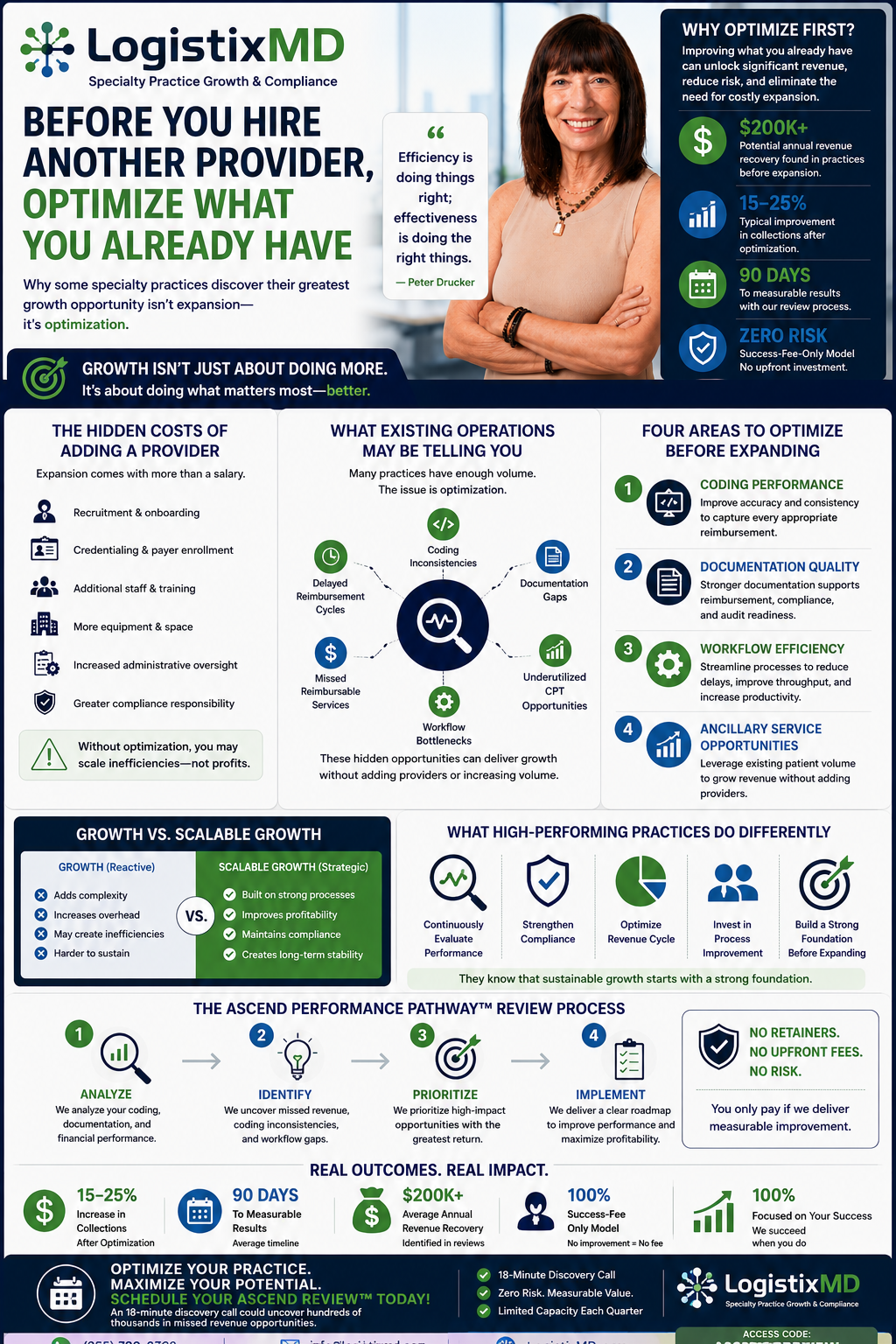
If your specialty practice has not recently evaluated its coding, documentation, and operational processes, now may be the right time. A Specialty Coding Performance Review™ can help identify hidden risks, strengthen compliance, and provide a clear roadmap for improvement.
Contact LogistixMD at (855) 789-6762 or info@logistixmd.com and request your confidential Ascend Review™ today.
Healthcare Compliance Disclaimer
This article is intended solely for informational and educational purposes and should not be interpreted as legal, medical, accounting, coding, reimbursement, or regulatory advice. Compliance requirements vary based on specialty, payer contracts, and applicable regulations. Practices should consult qualified professionals regarding their specific circumstances.