The Rise of Founder-Led Companies in the New Capital Economy
What You Need to Know
As we move through the middle of 2026, founder-led companies continue attracting significant attention from venture capital firms, private equity groups, family offices, and institutional investors. In today’s capital economy, leadership quality is becoming just as important as financial performance. Investors increasingly recognize that visionary founders often possess a unique ability to identify opportunities, navigate disruption, and build organizations capable of long-term growth.
The companies attracting capital today are often led by founders who remain deeply involved in strategy, innovation, customer relationships, and organizational culture. This alignment between ownership and leadership has become a powerful differentiator in an increasingly competitive business environment.
Why Founder-Led Companies Are Capturing Investor Attention
The investment landscape has changed dramatically over the past decade.
Artificial intelligence, cybersecurity, fintech, enterprise software, healthcare innovation, and deep technology are evolving at unprecedented speed. Investors are no longer evaluating businesses solely on financial metrics. They are also evaluating the people leading those businesses.
Founder-led companies often benefit from leadership teams with deep domain expertise and personal commitment to the organization’s mission. Because founders typically understand the problem they are solving firsthand, they often bring greater conviction and clarity to strategic decision-making.
This combination of expertise, passion, and accountability is becoming increasingly valuable in today’s rapidly evolving markets.
The Founder Advantage
One reason investors are drawn to founder-led organizations is the alignment between leadership and ownership.
Founders generally maintain a significant personal stake in the company’s success. Their long-term financial interests are directly tied to business performance, encouraging decisions that prioritize sustainable growth over short-term gains.
This alignment frequently results in:
- Faster decision-making
- Greater innovation
- Stronger company culture
- Long-term strategic planning
- Higher organizational resilience
In many cases, founder-led businesses can adapt more quickly than larger organizations burdened by layers of management and bureaucracy.
Investors Are Looking Beyond Financial Statements
Financial performance remains critical, but investors increasingly understand that future success depends heavily on leadership.
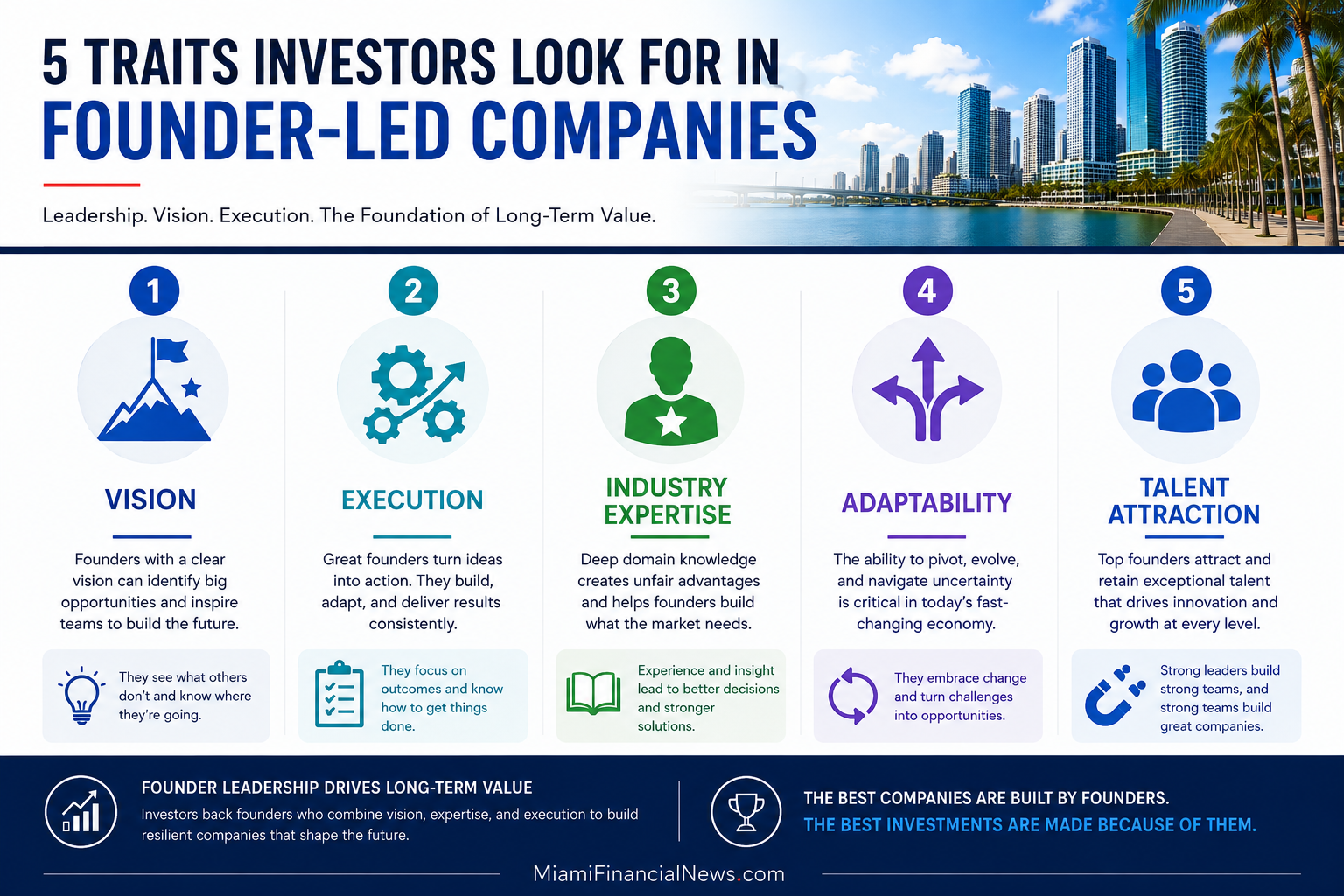
Today’s venture capital firms, private equity groups, and family offices often evaluate:
Vision
Can the founder clearly articulate the company’s future and market opportunity?
Execution
Has leadership demonstrated an ability to transform ideas into measurable business outcomes?
Industry Expertise
Does the founder possess unique knowledge or insight that creates competitive advantages?
Adaptability
Can leadership navigate changing technologies, economic conditions, and competitive pressures?
Talent Development
Can the founder attract and retain exceptional people?
Many investors believe great companies are often built by leaders who can recruit, inspire, and retain world-class teams.
Artificial Intelligence Is Accelerating Founder-Led Innovation
Artificial intelligence has created one of the most founder-driven innovation cycles in modern history.
Many emerging AI companies are led by founders with extensive research backgrounds, technical expertise, or firsthand experience solving complex industry challenges.
Investors are increasingly searching for leaders capable of bridging technical innovation with commercial execution.
Companies that successfully combine both are often positioned to attract substantial investor attention and strategic partnerships.
As AI adoption accelerates across industries, founder quality may become one of the most important predictors of future success.
Why Founder-Led Companies May Be Better Positioned for Growth
Founder-led businesses frequently maintain a stronger connection to customers, products, and market needs.
Rather than relying exclusively on financial models, founders often remain actively involved in innovation, customer feedback, and strategic planning.
This proximity allows organizations to identify opportunities earlier and respond more effectively to changing market conditions.
In today’s economy, where disruption can occur rapidly, agility may prove to be one of the most valuable competitive advantages.
The New Capital Economy Rewards Leadership
The modern capital economy increasingly rewards innovation, vision, and adaptability.
Investors understand that while technology can be replicated, leadership is much harder to duplicate.
As a result, founder-led organizations continue to attract interest from investors seeking companies capable of delivering sustainable long-term value.
The strongest founder-led businesses combine clear vision, disciplined execution, market expertise, and a relentless commitment to solving meaningful problems.
These qualities continue to make founder-led companies one of the most compelling areas of focus for investors in 2026.
What You Need to Know
Founder-led companies are attracting increased investor attention because they often combine vision, innovation, accountability, and long-term thinking. In an environment defined by rapid technological change, investors are increasingly evaluating leadership quality alongside traditional financial metrics when identifying future growth opportunities.
Frequently Asked Questions
Why are founder-led companies attractive to investors?
Founder-led companies often demonstrate stronger alignment between ownership and leadership, encouraging long-term decision-making and sustainable growth strategies.
What advantages do founder-led businesses have?
They frequently benefit from faster decision-making, stronger innovation, deeper industry expertise, and greater organizational agility.
Why are venture capital firms interested in founders?
Investors often believe exceptional founders can identify opportunities earlier, attract stronger teams, and execute more effectively during periods of uncertainty.
Are founder-led companies more innovative?
Many founder-led organizations maintain close connections to customers and products, allowing them to identify market needs and innovation opportunities more quickly.
What traits do investors look for in founders?
Vision, execution ability, adaptability, industry expertise, leadership skills, and talent attraction are among the most commonly evaluated characteristics.
Final Takeaway
As technology continues to reshape industries worldwide, leadership quality has become an increasingly important investment factor. Founder-led companies remain attractive because they often combine innovation, vision, execution, and accountability under a single leadership structure capable of navigating future opportunities and challenges.
MiamiFinancialNews.com tracks emerging companies, founder activity, venture capital trends, funding events, and investor intelligence throughout the evolving capital economy. Follow our latest reports to stay informed about the companies and leaders shaping tomorrow’s business landscape.
Primary Search Question:
Why are founder-led companies attracting investors in 2026?
Featured Snippet Answer:
Founder-led companies are attracting investors because they often demonstrate stronger vision, faster decision-making, greater innovation, and better alignment between ownership and leadership, helping drive long-term growth and adaptability.
Voice Search Questions:
Why do investors prefer founder-led companies?
What makes founder-led businesses successful?
Are founder-led companies better investments?
What qualities do investors look for in startup founders?
Why are venture capital firms investing in founder-led businesses?
DISCLAIMER
The information contained in this article is provided solely for educational, informational, and journalistic purposes. Nothing contained herein constitutes investment advice, financial advice, legal advice, tax advice, a recommendation to buy or sell securities, or a solicitation of investment.
Companies discussed are presented for informational purposes only. Inclusion does not constitute endorsement, recommendation, verification, or investment suitability.
Readers should conduct independent due diligence and consult qualified professional advisors before making any financial, legal, tax, or investment decisions.
Past performance, funding activity, media coverage, growth projections, and investor participation do not guarantee future results or future business success.