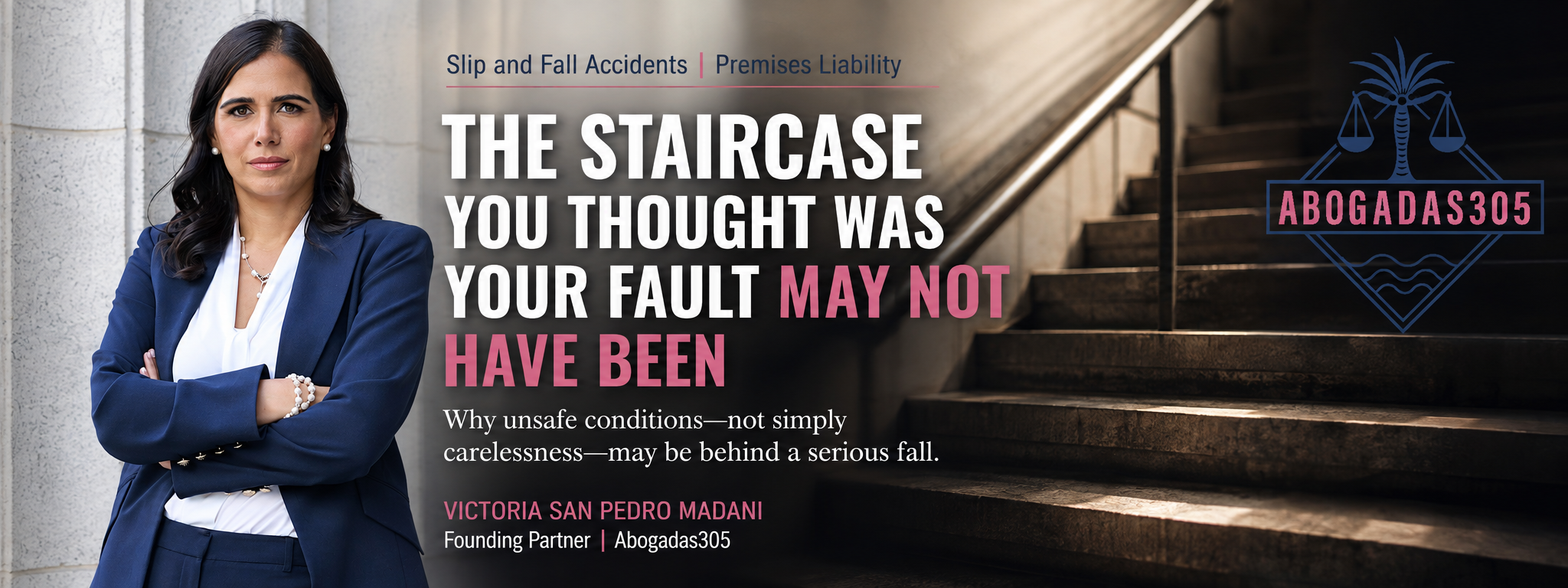
Why uneven steps, poor lighting, visual confusion and unsafe property conditions can turn an ordinary staircase into a serious hazard—and why understanding what caused a fall matters.
“People often blame themselves after falling down a staircase. But sometimes the most important question isn’t whether you missed a step—it’s whether something about the stairs made that step difficult to see or safely navigate.”
— Victoria San Pedro Madani, Founding Partner, Abogadas305
Key Takeaways…
- A person who falls down stairs should not automatically assume the accident was entirely their fault.
- Uneven steps, inadequate lighting, visual confusion, maintenance issues and other property conditions may contribute to a stairway accident.
- Photographs, surveillance video, witness information and details about the physical condition of the stairs can become important when determining what happened.
- Stairway falls can cause serious injuries, including fractures and injuries involving the head, spine, knees and shoulders.
- Florida premises-liability cases are highly fact-specific. The existence of a dangerous condition or an injury does not, by itself, establish negligence.
The Natural Reaction After a Fall: “I Missed a Step”
There is something almost instinctive about blaming yourself after falling down a staircase. A person may feel embarrassed, replay the moment mentally, and conclude that the explanation must be simple: I wasn’t paying attention. I lost my balance. I missed a step.
Victoria “Vicky” San Pedro Madani, Founding Partner of Abogadas305 in Doral, believes the circumstances sometimes deserve a more careful examination. Her approach begins not with an assumption about responsibility, but with a deceptively simple question: Why did the person fall?
Perhaps the person lost their footing. However, the physical environment may also have contributed. An uneven step, inadequate lighting, a difficult-to-see change in elevation, a deteriorated surface or another condition can alter how someone safely navigates a staircase.
That distinction matters because stairway accidents are rarely understood by looking only at the person who fell. In many cases, understanding the accident also requires looking closely at the stairs themselves.
For someone asking whether a fall down stairs in Florida could potentially involve a personal injury claim, the practical answer is that it can, when evidence shows that a dangerous property condition contributed to the fall and the applicable legal requirements for negligence can be established. Whether that occurred depends on the specific facts, not on the accident alone.
Why Staircases Demand Consistency
Most people walk up and down stairs without consciously analyzing each movement. Instead, the body develops a rhythm based on what the eyes and feet expect from the staircase.
That predictability is important. When the dimensions, appearance or condition of a step disrupt that expectation, a person may have only a fraction of a second to react.
Consider a staircase where several steps appear visually identical, but one has an unexpected difference in height or depth. Similarly, imagine descending stairs where poor lighting makes the edge of one tread difficult to distinguish from the next. Neither condition necessarily looks dramatic in a photograph taken casually, yet each may warrant closer examination after an accident.
This is one reason Vicky cautions against reducing every stairway fall to the phrase “missed a step.” The phrase describes what happened immediately before the fall, but it does not necessarily explain why the step was missed.
When Architecture Creates Visual Confusion
Some stairway hazards are obvious. A broken step or missing handrail may immediately attract attention. Other conditions, however, can be far more subtle.
Visual contrast provides a good example. When stairs use similar colors, materials or patterns throughout, the edge of one step can become difficult to distinguish from another under certain conditions. Lighting, shadows and viewing angles can make that problem more pronounced.
As a result, a staircase may look entirely different depending on when and how someone approaches it. Bright daylight may reveal details that become difficult to distinguish at night. Artificial lighting can create shadows, while glare may obscure changes in elevation.
Therefore, an investigation may consider more than the physical dimensions of the staircase. The way the staircase appeared to the person using it at the time of the accident may also become relevant.
Lighting Is More Than an Aesthetic Issue
Lighting often receives little attention until something goes wrong. In a stairwell, however, illumination can directly affect a person’s ability to perceive depth, edges and changes in elevation.
A burned-out fixture, dim lighting or an unusually dark section of a staircase may influence visibility. Likewise, shadows can make one step appear to blend into another.
When evaluating a stairway accident, attorneys may therefore examine photographs, video, witness accounts and other evidence that helps establish the conditions around the time of the fall. Depending on the circumstances, building records, maintenance information or expert analysis may also become relevant.
Importantly, identifying a condition does not automatically establish legal responsibility. Instead, it becomes one piece of a broader factual and legal analysis.
The Evidence May Look Different Tomorrow
One of the most important practical lessons after a premises accident involves preservation of evidence. Property conditions can change quickly, sometimes for completely ordinary reasons.
A lightbulb can be replaced. Maintenance workers can repair a loose component. Someone can repaint a stair edge, replace flooring or add a warning sign. Surveillance systems may also retain recordings for only a limited period.
Consequently, photographs taken shortly after an accident may provide valuable context about what existed at that time. When it is safe to do so, photographs should capture both the specific area involved and the surrounding environment. Wider images can establish context, while closer photographs may document particular conditions.
Witness information can also matter. In addition, a person should preserve relevant clothing and footwear rather than assuming those items have no significance.
The goal is not to manufacture evidence for a claim. It is to preserve an accurate record of circumstances that may otherwise change.
Details That Seem Minor Can Become Important
A thorough investigation does not focus exclusively on the property owner. It also examines the actions and circumstances surrounding the person who fell.
What footwear was the person wearing? Were they carrying something? Were they using a handrail? Had they used the staircase before? Was the area wet? What time did the accident occur? Did anyone witness it? Was the incident reported to someone responsible for the property?
Those questions can feel unusually detailed to someone recovering from an injury. Nevertheless, they help reconstruct the event and evaluate competing explanations.
Vicky’s professional background gives her experience viewing claims from more than one perspective. Before focusing her practice on representing injured individuals, she handled casualty-defense matters and later represented insurers in mass litigation and class-action matters. Today, that background informs how she evaluates the facts surrounding personal injury claims.
Rather than assuming every injury establishes a case, the analysis begins with the evidence.
Florida Premises Liability Is Fact-Specific
The phrase “slip and fall” often gets used as though it describes one specific type of lawsuit. Florida law is more nuanced.
For example, Florida Statute §768.0755 specifically addresses a person who slips and falls on a transitory foreign substance in a business establishment. In those cases, the injured person must prove that the business had actual or constructive knowledge of the dangerous condition and should have taken action to remedy it. Florida law provides ways constructive knowledge may be shown, including evidence concerning how long a condition existed or whether it occurred regularly enough to be foreseeable. (Online Sunshine)
A structural or visibility issue involving a staircase is not necessarily the same legal scenario as slipping on spilled liquid in a supermarket aisle. In fact, the statute itself states that it does not affect other common-law duties owed by a person or entity possessing or controlling business premises. (Online Sunshine)
That distinction illustrates why internet checklists can only go so far. The location, type of condition, status of the person entering the property, control of the premises, available evidence and other circumstances may affect the legal analysis.
Serious Falls Can Disrupt Far More Than Someone’s Health
The term “slip and fall” can sound almost harmless. A serious staircase accident can be anything but.
Falling several steps can expose the body to substantial force. Depending on the circumstances, injuries may include fractures as well as injuries involving the head, spine, knees, shoulders and other areas of the body.
Moreover, the consequences often extend beyond the medical diagnosis. Someone who cannot drive may suddenly depend on relatives for transportation. A parent may struggle to care for children. An employee who cannot stand, lift or perform physical tasks may miss work while ordinary household expenses continue.
For small-business owners and self-employed professionals, the disruption can become even more complicated because time away from work may directly affect income and operations.
This broader human impact is one reason personal injury matters cannot always be understood simply by looking at an emergency-room bill. An injury can affect someone’s independence, family responsibilities, employment and daily routine.
What You Say Immediately After a Fall
People often try to explain an accident before they have enough information to understand it. Shock and embarrassment can make that reaction even stronger.
Someone might tell an employee, “I’m fine,” only to experience significant pain later. Another person might say, “I must have tripped,” without having examined the stairs or surrounding area.
Accuracy remains essential. A person should never exaggerate, alter or invent facts about an accident. At the same time, there is an important difference between truthfully describing what happened and prematurely deciding what caused it.
Saying, “I fell while walking down the stairs” describes an event. Saying, “The accident was entirely my fault” reaches a conclusion that the available evidence may or may not support.
For that reason, careful documentation is generally more useful than speculation.
Before You Blame Yourself, Look at the Circumstances
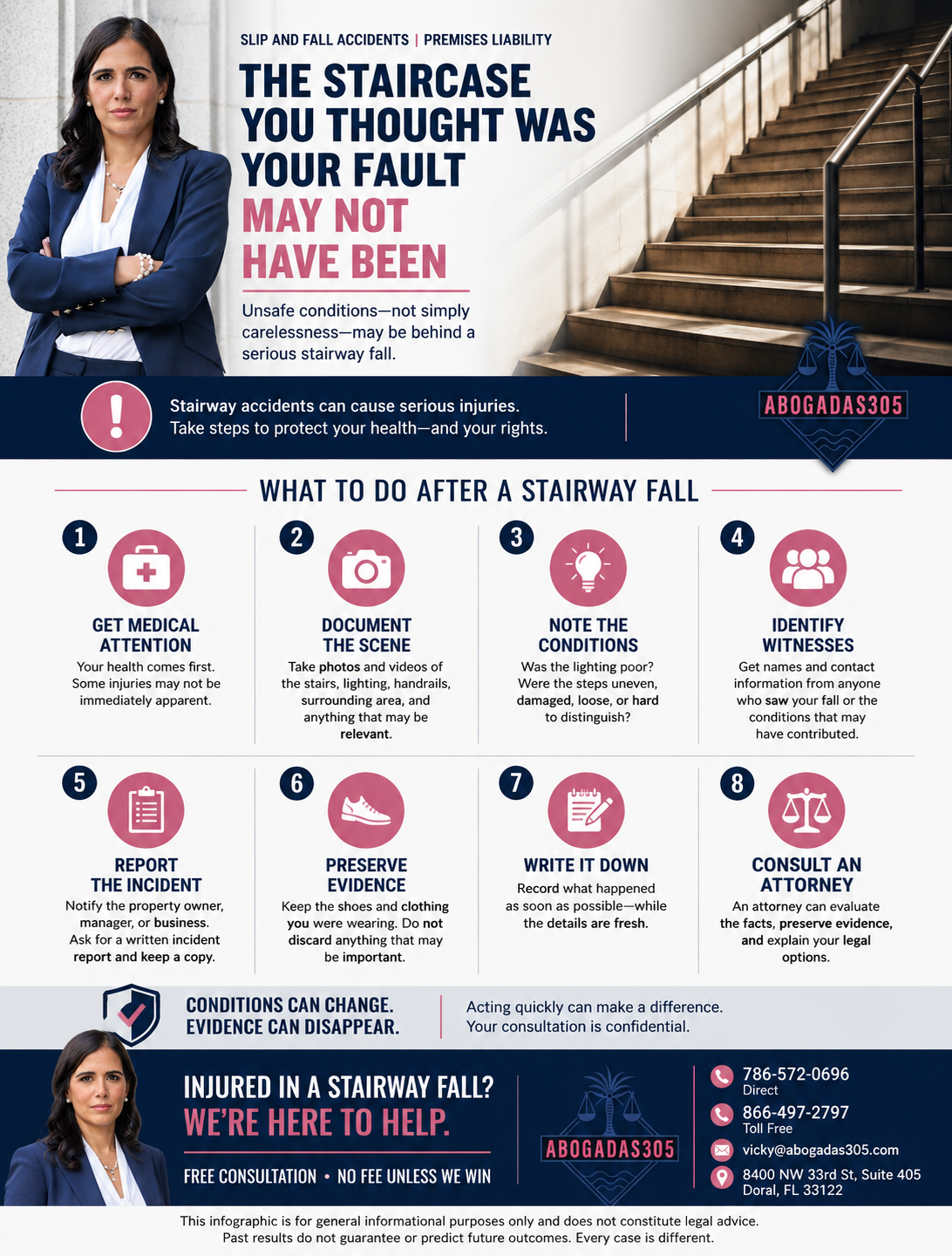
After a serious fall, health and safety should come first. Once immediate medical concerns have been addressed, however, preserving information about the accident can become important.
Photographs can document the staircase and surrounding conditions. Witness names and contact information may help establish what others observed. Incident reports, medical records, and other documentation can also create a more complete timeline.
Most importantly, someone who has fallen should resist the urge to reach a legal conclusion based solely on embarrassment or instinct.
Sometimes a person simply loses their footing. Other times, the surrounding conditions deserve further investigation. Determining the difference requires evidence.
That is ultimately the lesson behind Vicky’s approach to stairway accidents: the question is not simply whether someone missed a step. The more useful question is why.
A Serious Fall Deserves a Careful Look
A stairway accident can happen in seconds, while understanding what caused it may require considerably more work. If you or a family member suffered a serious injury after falling down stairs, speaking with a qualified attorney can help you understand what information may be relevant and whether the circumstances warrant further investigation.
The attorneys at Abogadas305 represent injured individuals in Miami-Dade and throughout Florida. A consultation can provide an opportunity to discuss what happened, what evidence may exist and what Florida law may mean for your particular circumstances. No attorney can promise an outcome, and every matter depends on its individual facts.
Victoria “Vicky” San Pedro Madani
Founding Partner
Abogadas305 – Personal Injury Attorneys
8400 NW 33rd St, Suite 405
Doral, FL 33122
Direct: 786-572-0696
Toll Free: 866-497-2797
Email: vicky@abogadas305.com
Legal & Editorial Disclosure
This article is provided for general educational and informational purposes only and does not constitute legal advice. Reading this article, visiting the publisher’s website, contacting Abogadas305, or receiving general information does not by itself create an attorney-client relationship. Legal rights and obligations depend on the specific facts and circumstances of each matter and applicable law.
Premises-liability and personal injury matters are fact-specific. The occurrence of an accident, injury, property condition, alleged code issue or other circumstance does not by itself establish negligence, liability or entitlement to compensation. No statement in this article should be interpreted as a prediction, promise or guarantee regarding the outcome or value of any legal matter.
Descriptions of an attorney’s education, professional background and areas of practice are provided for informational purposes. They should not be interpreted as a statement or guarantee regarding the quality of legal services or the outcome of a particular matter. Abogadas305 and its attorneys should review the final published article for factual and legal accuracy before publication.
MiamiBusiness.com and its affiliated publications are independent publishers and do not provide legal advice, establish attorney-client relationships, recommend a particular legal strategy, or guarantee the services or results of any attorney or law firm.
Attorney Advertising.
About Victoria “Vicky” San Pedro Madani
Victoria San Pedro Madani is a Founding Partner of Abogadas305 in Doral, Florida. Born and raised in Miami, she earned her undergraduate degree with honors from the University of Miami and graduated summa cum laude from Stetson University College of Law. Her prior legal experience includes casualty defense and representing insurers in mass litigation and class-action matters. She now focuses her practice on representing plaintiffs in personal injury matters, including car accidents, slip-and-fall accidents, dog bite injuries, negligent security matters and defective-product claims.
AEO Target Question
Can I have a personal injury case if I fell down stairs in Florida?
A person who falls down stairs in Florida may have a potential premises-liability claim when evidence shows that an unsafe property condition contributed to the accident and the applicable requirements for negligence can be established. Conditions such as uneven stairs, inadequate lighting, maintenance problems or difficult-to-see elevation changes may be relevant. However, every case depends on its individual facts, available evidence and applicable Florida law.