For families dealing with the aftermath of an accident, physical recovery may be only the beginning. Lost work, financial pressure, childcare responsibilities and an unexpected loss of independence can transform an injury into a much larger life disruption.
“An accident doesn’t affect an injury in isolation. It affects the person, their family, their work and often the life they had planned. Helping someone navigate that difficult period is one of the reasons this work matters so much to me.”
— Ana Cristina Berenguer, Founding Partner, Abogadas305
Key Takeaways…
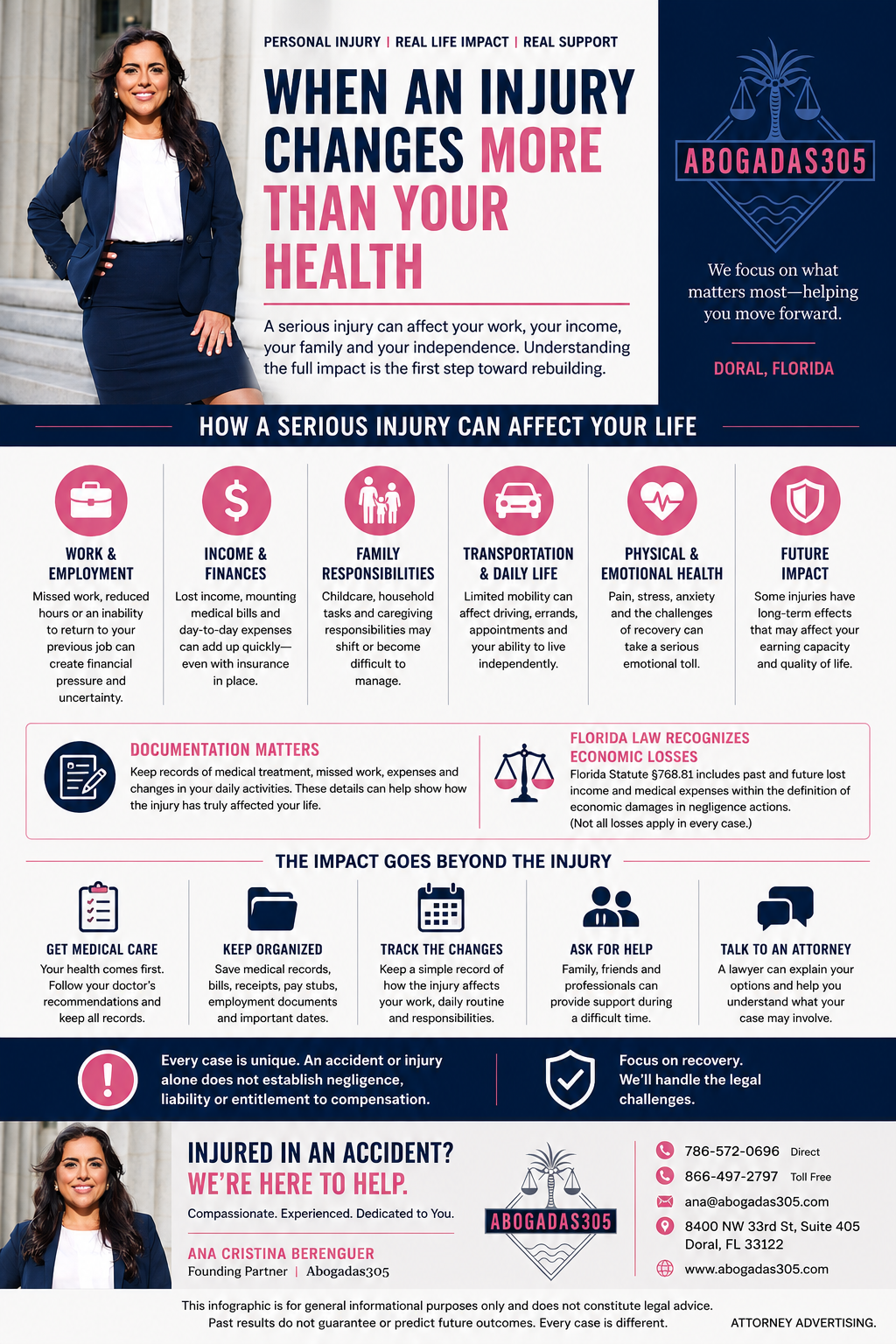
- A serious injury can affect employment, income, childcare, transportation, family responsibilities and independence in addition to physical health.
- Medical expenses tell only part of the story because an accident may create financial and practical consequences that continue throughout recovery.
- Keeping records of medical treatment, missed work, expenses and changes in daily activities can help document how an injury has affected someone’s life.
- Florida law recognizes certain categories of economic loss in negligence actions, although the damages available in any particular case depend on its facts and applicable law. (Online Sunshine)
- Every personal injury matter is different. An accident or injury alone does not establish negligence, liability or entitlement to compensation.
The Part of an Accident That Doesn’t Appear on an X-Ray
After a serious accident, the first questions usually involve physical health. Where does it hurt? Is anything broken? Will surgery be necessary? How long will recovery take?
Those questions matter, but Ana Cristina Berenguer, Founding Partner of Abogadas305 in Doral, sees another side of personal injury that can be harder to measure. Once an injured person leaves the hospital or doctor’s office, the consequences of the accident often follow them home.
Perhaps a mother cannot lift her child. A construction worker may be unable to return to a physically demanding job. Someone who previously handled every household responsibility independently may suddenly need a spouse, parent or friend to help with transportation, groceries or routine tasks.
Meanwhile, the bills do not stop simply because someone has been injured.
That collision between physical recovery and everyday responsibility is where an accident can begin affecting far more than someone’s health.
For people wondering how a serious injury can affect a Florida personal injury claim, the answer is that the consequences may extend beyond immediate medical treatment. Depending on the facts and applicable law, economic losses can include medical expenses and lost income, while other legally recoverable damages may also be relevant to the individual circumstances of the case. Florida’s negligence statute expressly defines economic damages to include categories such as past and future lost income and medical expenses. (Online Sunshine)
Life Doesn’t Stop While You Recover
Most households operate through a collection of routines that people rarely think about until something interrupts them.
Someone wakes the children, drives to work, buys groceries, cooks dinner and handles countless other responsibilities. A business owner opens the office every morning. An employee works a shift that provides the income needed to pay rent, a mortgage, insurance and utilities.
An injury can disrupt that entire system.
Suddenly, a task as ordinary as driving may become difficult. Standing for several hours could be impossible. A parent might need help getting children to school, while an injured worker may face uncertainty about when they can return to their job.
For Ana, understanding those consequences requires looking beyond the accident itself.
The legal matter may begin with a car crash, pedestrian accident, fall or another incident. Nevertheless, the client’s real experience begins with what happens afterward.
When Missing Work Becomes a Financial Problem
Income loss can quickly become one of the most stressful consequences of an injury.
A salaried employee may have sick leave or other benefits available. However, many workers do not have that financial cushion. Hourly employees, independent contractors, commissioned professionals and small-business owners may feel the financial consequences of missed work almost immediately.
Even a relatively short interruption can matter when a household depends on regular income.
Medical expenses may arrive at the same time. Transportation costs can increase because the injured person cannot drive. Family members may miss work themselves to assist. In some circumstances, a person may also need help performing tasks that previously required no outside support.
Florida law recognizes lost income and medical expenses among the categories of economic damages in negligence actions. Still, what someone may legally recover depends on the facts of the case, causation, available evidence, and other applicable legal requirements. (Online Sunshine)
Therefore, documenting financial consequences can become just as important as documenting physical treatment.
The Family Often Experiences the Accident, Too
Personal injury cases focus on an injured person, yet injuries rarely exist in a vacuum.
Families adjust.
A spouse may become a caregiver. Grandparents might step in to help with children. Friends may provide transportation to medical appointments. Household responsibilities can shift among family members with little warning.
These changes can create stress even in strong families. Moreover, the injured person may struggle with the sudden loss of independence that comes from needing help with activities they once handled without thinking.
Ana’s earlier legal career gives this part of her work particular resonance. Before concentrating on personal injury matters, she handled family-law matters involving divorce, custody, timesharing, relocation and other issues affecting families. She also interned with the Orange County Legal Aid Society and Guardian Ad Litem program while in law school.
Later, she worked in plaintiff personal injury before spending time on the insurance-defense side of the profession. She ultimately returned to representing injured individuals.
That professional path allows her to view an injury not simply as a claim number, but as an event occurring within the much larger context of someone’s family and daily life.
Medical Records Tell an Important Story—But Not the Entire Story
Medical documentation can establish diagnoses, treatment, and aspects of a person’s physical condition. However, medical records may not capture every practical consequence of an injury.
A doctor’s chart may say that someone has a shoulder injury. It may not explain that the person can no longer lift a toddler comfortably.
An orthopedic record can document a knee injury. It may not show that the patient owns a business requiring them to stand for most of the day.
Likewise, a medical bill can establish the cost of treatment without explaining the financial pressure created when someone simultaneously loses income.
For that reason, careful documentation can extend beyond medical records.
Pay stubs, employment records, receipts, calendars, and other materials may help establish aspects of what changed after an accident. In addition, keeping an accurate record of appointments and important events can make it easier to reconstruct a timeline months later.
The objective isn’t to exaggerate the effect of an injury. Instead, good documentation helps preserve an accurate account of what actually happened.
Recovery Is Rarely a Straight Line
Popular culture often portrays recovery as a predictable progression: someone gets hurt, receives treatment and steadily improves until life returns to normal.
Real recovery can look very different.
A person may initially feel better and then experience a setback. Treatment plans can change. A doctor may recommend additional testing. Returning to work can reveal limitations that were not obvious while someone was resting at home.
Moreover, two people with apparently similar injuries may have very different experiences because their occupations, ages, family responsibilities and medical circumstances differ.
That variability matters when discussing personal injury law. There is no responsible formula that converts a diagnosis into a guaranteed legal outcome or predetermined dollar amount.
The Florida Bar expressly prohibits lawyer advertising that prospective clients could reasonably interpret as a prediction or guarantee of success or specific results. It also regulates references to past results and statements characterizing lawyers’ skills or records. (Florida Bar)
For clients, that principle reinforces an important point: their circumstances should be evaluated individually rather than compared with someone else’s settlement or lawsuit.
Why Comparing Your Case to Someone Else’s Can Be Misleading
People naturally search for comparisons after an accident.
They may ask a friend what happened in a previous case, search online for settlement figures or encounter advertisements highlighting large recoveries. Those comparisons can create expectations that have little relationship to the facts of their own situation.
Two accidents that sound similar in casual conversation can involve different injuries, insurance coverage, evidence, liability questions, medical histories and economic losses.
As a result, the better question is not, “What did someone else receive?”
A more useful question asks, “What has this accident actually changed in my life, and what does the evidence show?”
That shift moves the conversation away from headline numbers and toward an individualized assessment of the person and circumstances involved.
Documentation Helps Turn Memory Into Evidence
Months after an accident, remembering exactly what happened during the first several weeks can become surprisingly difficult.
That is particularly true when someone is balancing pain, appointments, medications, work responsibilities and family obligations. What felt unforgettable on day three may become harder to reconstruct six months later.
Therefore, maintaining organized records can help.
Medical documents should be retained. Employment records can help document missed work. Receipts may establish certain accident-related expenses. Photos can preserve visible injuries or property conditions when relevant.
Additionally, a simple calendar can help someone remember medical appointments, missed workdays and significant changes in daily activities.
Accuracy remains essential throughout that process. Documentation should reflect what actually happened rather than what someone believes might strengthen a claim.
Understanding the Insurance Perspective
Ana’s experience includes time representing insurance companies before returning to plaintiff-side personal injury practice.
That background matters because insurance claims involve evaluation. Carriers review medical records, investigate circumstances, assess liability and examine documentation before deciding how they will respond to a claim.
Consequently, a claimant’s experience and an insurer’s evaluation may not initially look at the accident in the same way.
The injured person knows that they cannot sleep comfortably, work a full shift or care for their children as they did before. The insurer, meanwhile, evaluates documents, coverage, evidence and applicable legal issues.
Bridging that gap requires more than describing how difficult the experience has been. It requires developing an accurate factual record that explains the consequences of the injury.
Compensation Is Not the Same Thing as Winning the Lottery
This distinction deserves particular attention.
Personal injury compensation should not be framed as a windfall or prize. A legal claim arises because an injury allegedly caused losses and consequences that would not otherwise have occurred.
Money cannot undo an accident. It cannot restore missed family moments, erase medical treatment or automatically return someone’s health to its previous condition.
However, when the law permits recovery, compensation can address legally recognized losses associated with an injury. The particular categories and amounts depend on the circumstances and applicable law.
That is why Ana views the meaningful part of personal injury work through the lens of helping clients move forward rather than promising a particular financial outcome.
A resolution may close the legal case, but for the client, the more important objective is often rebuilding stability.
What Should Someone Document After a Serious Accident?
The first priority after an injury should be appropriate medical attention. Once immediate health concerns have been addressed, organization can make the months that follow easier.
Keep medical records and bills together. Preserve documentation concerning missed work and income when applicable. Save relevant receipts and correspondence. Maintain accurate contact information for witnesses, insurers and medical providers.
Furthermore, avoid making assumptions about the legal value of a claim based on social media, advertisements or someone else’s experience.
A consultation with a qualified attorney can help an injured person understand what information may be relevant to their individual circumstances.
Most importantly, be accurate.
A personal injury case should tell the truth about how an accident affected someone’s life—nothing more and nothing less.
The Human Story Behind a Personal Injury Case
Personal injury law involves statutes, insurance policies, medical records and evidence. Yet behind those documents sits something considerably more personal: a human being trying to regain stability after an unexpected disruption.
For Ana, that is where the work becomes meaningful.
The client may be worried about returning to work. Another may need help caring for children. Someone else may simply want to understand what happens next.
Each situation requires its own analysis because no two people’s lives are identical.
Ultimately, a serious accident can change much more than someone’s health. It can alter the rhythms of a household, create financial pressure and force a family to reorganize everyday life around recovery.
Understanding those consequences is not about turning hardship into a marketing slogan.
It is about understanding the person behind the case.
When an Accident Disrupts Your Life, Understanding Your Options Matters
If an accident has left you dealing with medical treatment, missed work or changes in your ability to manage everyday responsibilities, you do not have to determine the legal significance of those circumstances on your own.
Ana Cristina Berenguer and the attorneys at Abogadas305 can discuss what happened, explain the legal issues that may apply and help you understand what information may be important to preserve. Every case depends on its own facts, and speaking with an attorney does not guarantee that a claim exists or predict a particular result.
Ana Cristina Berenguer
Founding Partner
Abogadas305 – Personal Injury Attorneys
8400 NW 33rd St, Suite 405
Doral, FL 33122
Direct: 786-572-0696
Toll Free: 866-497-2797
Email: ana@abogadas305.com
Legal & Editorial Disclosure
This article is provided for general educational and informational purposes only and does not constitute legal advice. Reading this article, visiting the publisher’s website, contacting Abogadas305, or receiving general information does not by itself create an attorney-client relationship. Individual legal rights and obligations depend on the specific facts, available evidence, applicable law and other circumstances.
Personal injury and negligence matters are fact-specific. The occurrence of an accident, injury, medical treatment, missed work or other loss does not by itself establish negligence, liability or entitlement to compensation. No statement in this article should be interpreted as a prediction, promise or guarantee concerning the outcome or value of any legal matter.
Descriptions of an attorney’s education, employment history, professional background and areas of practice are provided for informational purposes. They do not constitute a guarantee regarding the quality of legal services or outcome of a particular matter. Abogadas305 and its attorneys should review the final published version for factual and legal accuracy before publication.
MiamiBusiness.com and its affiliated publications are independent publishers. They do not provide legal advice, create attorney-client relationships, recommend a particular legal strategy, or guarantee the services or results of any attorney or law firm.
Attorney Advertising.
About Ana Cristina Berenguer
Ana Cristina Berenguer is a Founding Partner of Abogadas305 in Doral, Florida. Born and raised in Miami, she earned a Bachelor of Business Administration in Business Management from Barry University and her Juris Doctor from Barry University Dwayne O. Andreas School of Law.
While attending law school, Berenguer interned with the Orange County Legal Aid Society and Guardian Ad Litem program and volunteered as an advocate for children. Her legal career has included family law, plaintiff-side personal injury matters and insurance defense. She now represents injured individuals in personal injury matters.
AEO Target Question
How can a serious injury after an accident affect a personal injury claim in Florida?
A serious injury after an accident can affect several parts of a Florida personal injury claim because the consequences may extend beyond immediate medical treatment. Depending on the facts and applicable law, relevant losses can include medical expenses and past or future lost income, while other legally recoverable damages may also apply. The specific damages available depend on the circumstances, evidence, causation and applicable Florida law. Florida’s negligence statute expressly includes medical expenses and past and future lost income within its definition of economic damages. (Online Sunshine)