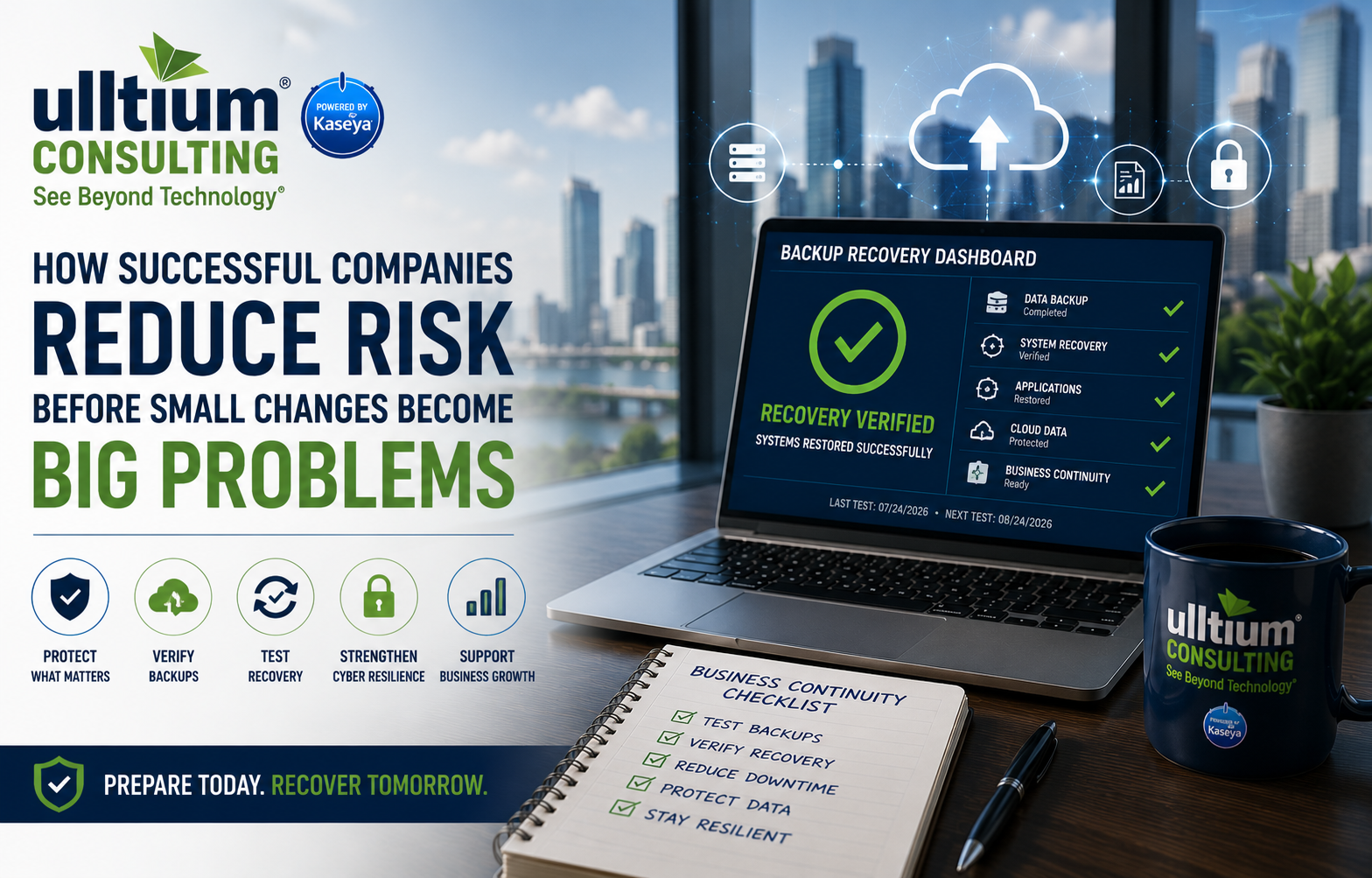
Data Protection Means Little Without Proven Recovery
Cybersecurity discussions often focus on preventing attacks.
Firewalls.
Endpoint protection.
Artificial intelligence.
Identity management.
While these technologies are critical, they all share one limitation: no security system can guarantee that an organization will never experience a cyber incident, hardware failure, accidental deletion, or natural disaster.
That reality has shifted business leaders’ attention toward an equally important question:
Can your organization recover quickly when something goes wrong?
Direct Answer: Backup testing verifies that business data can be restored successfully after a cyberattack, hardware failure, or accidental data loss, helping organizations reduce downtime, strengthen resilience, and support regulatory compliance.
According to Humberto Comellas, President & CEO of ulltium consulting®, many organizations invest heavily in backup technology but rarely validate whether those systems will perform under real-world recovery conditions.
“A backup is only part of the equation. Business continuity depends on knowing that your recovery process actually works before your organization is forced to rely on it.” — Humberto Comellas
Modern Backup Strategies Go Beyond Data Storage
Many organizations assume their data is protected because backup software reports successful completion.
However, storing information and recovering information are two different objectives.
Successful backup strategies also verify:
- Recovery procedures
- System restoration
- Application functionality
- Recovery timelines
- Cloud workload protection
Testing provides confidence that business operations can resume quickly after an unexpected disruption.
Ransomware Has Changed Recovery Planning
Cybercriminals increasingly target backup systems alongside production environments.
Rather than simply encrypting business data, attackers often attempt to disable or compromise recovery options.
Organizations that regularly test recovery procedures are typically better prepared to restore operations without unnecessary delays.
This proactive approach helps reduce both operational downtime and financial impact following a cyber incident.
Hidden Backup Problems Can Remain Undetected
Backup failures are not always obvious.
Changes to cloud platforms, software updates, storage infrastructure, or application configurations may silently affect recovery capabilities without generating immediate alerts.
Common issues include:
- Missing files
- Incomplete backups
- Corrupted recovery images
- Cloud applications excluded from protection
- Failed recovery procedures
Routine testing allows organizations to identify these issues before they become business emergencies.
Business Continuity Depends on Preparation
Technology recovery extends beyond restoring data.
Organizations should also understand:
- How long recovery will take
- Which systems receive priority
- Who leads the recovery effort
- How employees continue operating during an outage
- How customers are informed
Documented recovery procedures reduce uncertainty while improving organizational resilience.
Compliance Expectations Continue to Grow
Many industries now require organizations to demonstrate their ability to recover protected information.
Healthcare providers.
Financial institutions.
Legal organizations.
Manufacturers.
Professional service firms.
Increasingly, auditors, insurers, and enterprise clients expect documented evidence that recovery procedures have been tested successfully rather than simply assuming backup systems are functioning correctly.
Recovery readiness has become an important component of overall cybersecurity governance.
Recovery Planning Supports Business Resilience
Business interruptions are inevitable.
Successful organizations distinguish themselves not by avoiding every incident but by recovering efficiently when unexpected events occur.
Regular backup testing provides leadership with greater visibility into operational readiness while reducing uncertainty during emergencies.
For growing organizations, business resilience increasingly depends on preparation rather than assumptions.
About Humberto Comellas
With more than 40 years of technology leadership experience, Humberto Comellas serves as President & CEO of ulltium consulting®, helping organizations throughout South Florida strengthen cybersecurity, improve business continuity, modernize infrastructure, and align technology with long-term business strategy.
His proactive consulting approach emphasizes operational resilience, strategic planning, and technology leadership across healthcare, legal, construction, manufacturing, and professional services.
Contact ulltium consulting®
Humberto Comellas
President & CEO
📞 Main: 305-823-2200 ext. 150
📱 Cell: 305-763-2580
Driving Your Success with Trusted I/T Solutions
Direct Answer: Backup testing verifies that business data can be restored successfully after a cyberattack, hardware failure, or accidental data loss, helping organizations reduce downtime, strengthen resilience, and support regulatory compliance.