What business leaders can learn about employee retention, engagement, and workplace culture from a seasoned Human Resources professional
“Employees may join a company for the opportunity, but they stay because of the experience.”
— Raquel Gomez
TL;DR –
Employee retention is one of the most important challenges facing organizations today. During her presentation on HR, recruiting, and employee retention, Raquel R. Gómez shared practical insight on manager effectiveness, onboarding, documentation, benefits, workplace culture, employee engagement, and stay interviews. Her message was clear: employees are more likely to stay when they feel valued, heard, supported, and led well.
What Is the Real Secret to Employee Retention?
Direct Answer: Employee retention is driven by more than salary and benefits. According to Human Resources executive Raquel R. Gómez, employees are more likely to stay when they feel valued, supported, recognized, and connected to their organization. Strong leadership, consistent communication, effective onboarding, manager training, meaningful benefits, and positive workplace culture all play a role in reducing turnover.
Table of Contents
- Who Is Raquel R. Gómez?
- The Reality of Human Resources Today
- The Employee Retention Challenge
- Why Managers Matter More Than Ever
- The Importance of Employee Engagement
- Stay Interviews vs. Exit Interviews
- Technology, AI, and the Modern HR Department
- Benefits Still Matter
- What Business Owners Can Learn from Raquel Gómez
- Featured Snippet Answer
- Frequently Asked Questions
- Call to Action
- SEO / Yoast Settings
Who Is Raquel R. Gómez?
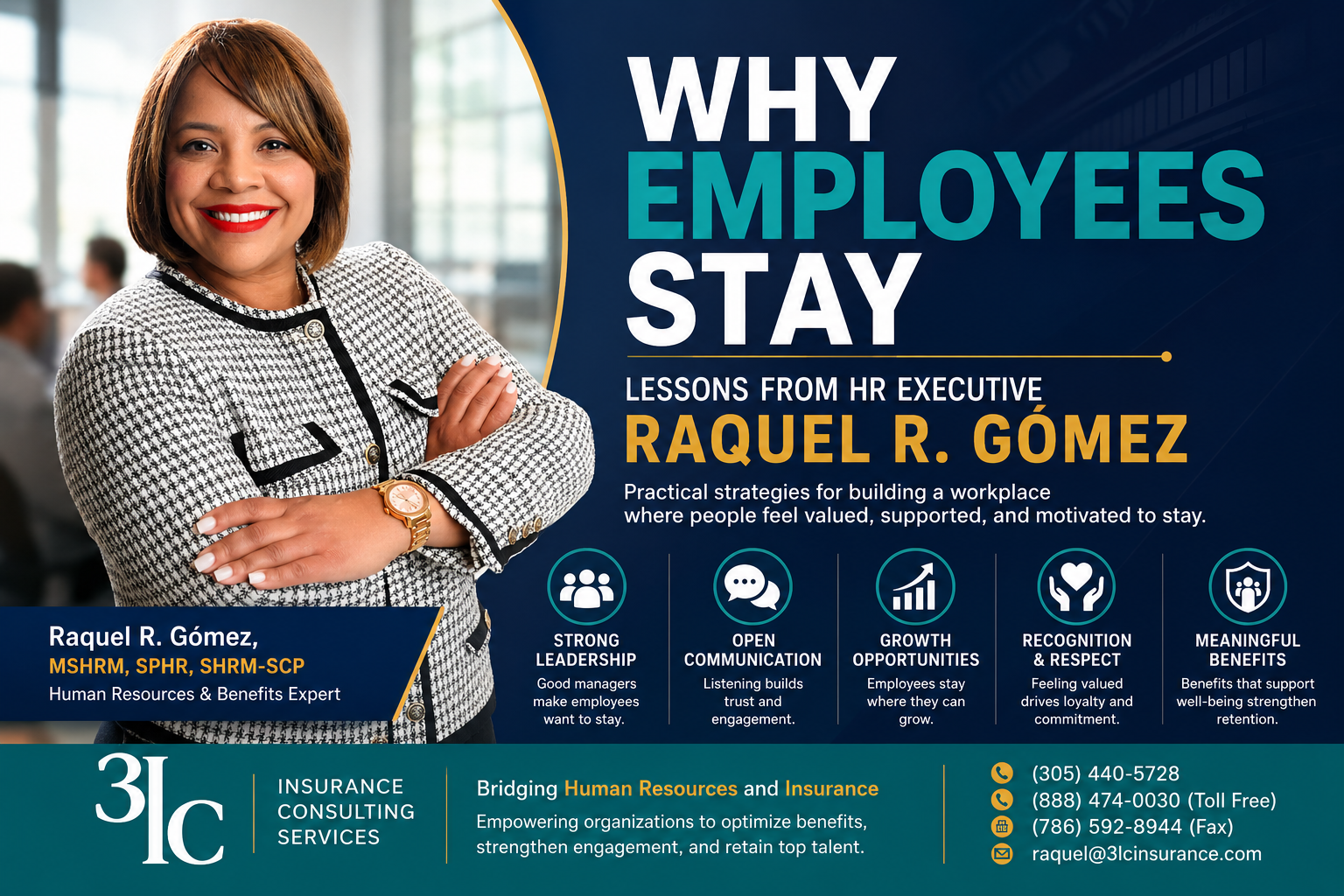
Few professionals understand employee relations, talent management, workplace culture, and benefits strategy quite like Raquel R. Gómez, MSHRM, SPHR, SHRM-SCP.
With more than a decade of leadership experience at Helm Bank USA, where she served as Vice President of Human Resources, Gómez helped cultivate a strong talent management ecosystem rooted in diversity, excellence, and continuous improvement. Her work supported the organization’s mission of sustainable growth while strengthening communication, employee development, and workforce performance.
Her background includes extensive experience in talent acquisition, employee development, strategic workforce planning, compliance management, training, performance management, compensation design, and organizational behavior. Fluent in Spanish and Portuguese, she also brings an important multicultural perspective to Human Resources leadership.
Today, Gómez brings that experience to 3LC Insurance Consulting Services, where she works at the intersection of Human Resources and employee benefits. Her mission is to help organizations optimize benefit offerings, improve employee engagement, and create workplaces where people feel supported.
The Reality of Human Resources Today
One of the most memorable moments from Gómez’s presentation came when she described what it feels like to be an HR department of one.
Human Resources professionals are often expected to handle recruiting, onboarding, employee relations, policies, compensation, benefits administration, leave management, training, compliance, investigations, corrective action, employee engagement, and retention.
That is a heavy responsibility for any organization, especially small businesses where one person may be carrying the entire HR function.
Gómez made an important point: HR does not have to be perfect, but it does have to be disciplined. Leaders must know how to prioritize, when to automate, when to document, and when to ask for outside support.
The Employee Retention Challenge
Employee turnover is expensive. It affects morale, productivity, customer relationships, institutional knowledge, and company culture.
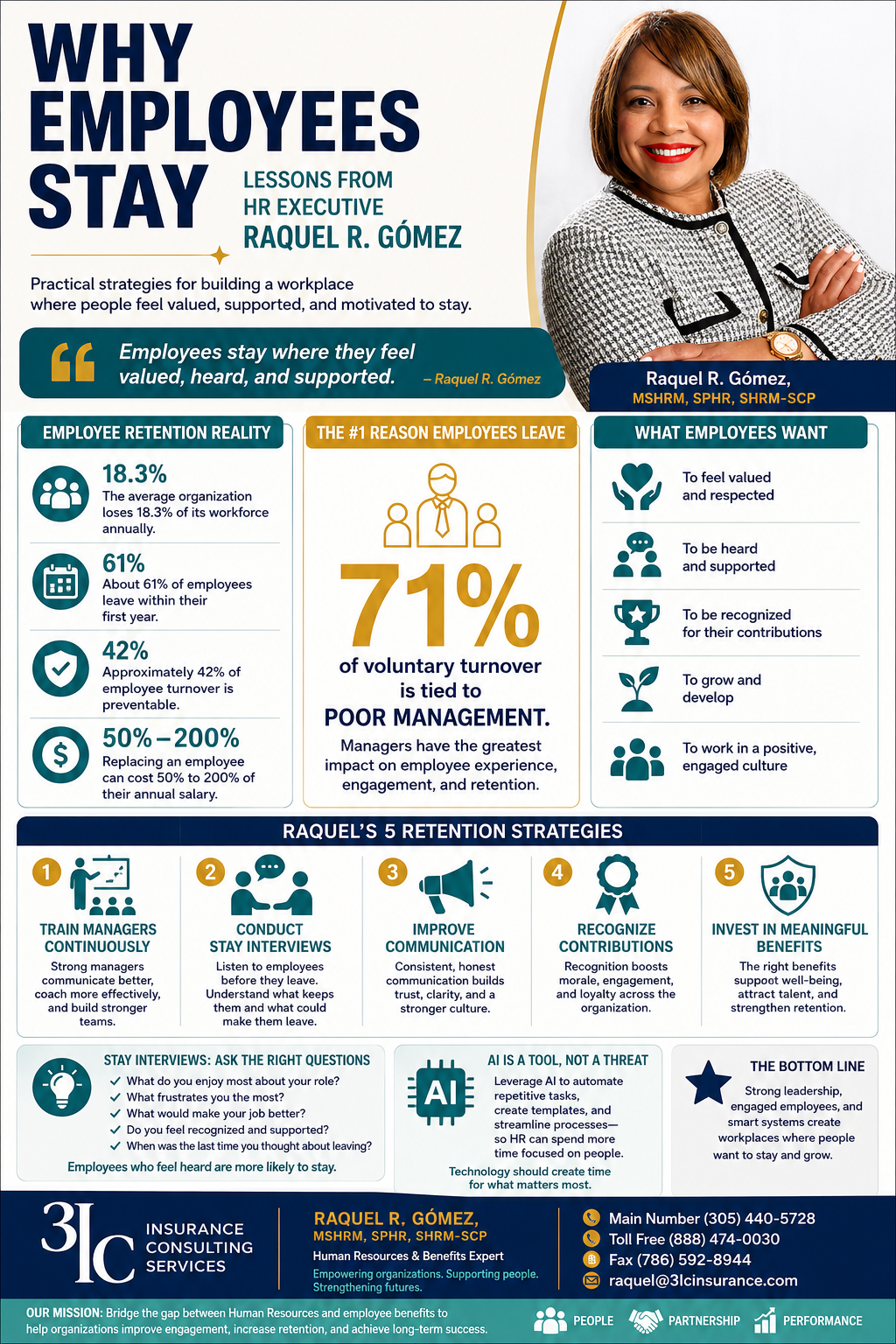
During her presentation, Gómez shared several statistics that should get the attention of every business owner and manager. The average organization loses approximately 18.3% of its workforce annually. In some organizations, about 61% of employees leave within their first 12 months. Approximately 42% of employee turnover is preventable. Replacing an employee can cost between 50% and 200% of that employee’s annual salary.
Those numbers make one thing clear: retention is not a small issue. It is a business issue.
Many organizations spend significant time and money trying to recruit new employees, but they often fail to invest the same energy into keeping the people they already have. Gómez’s message challenged leaders to rethink that approach.
Why Managers Matter More Than Ever
Perhaps the most powerful statistic Gómez shared was this: 71% of voluntary turnover is tied to poor management.
That statement gets to the heart of employee retention. People do not usually leave because of one bad day. They leave after repeated frustration, poor communication, lack of support, unclear expectations, or feeling unrecognized.
Gómez emphasized that managers and supervisors must be trained continuously. Strong managers reduce risk, improve communication, create consistency, and help employees understand where they stand.
She also encouraged managers to document conversations, recognize employee wins, and avoid waiting until problems become serious. Employees should never have to guess whether they are doing well or falling short. Clear communication builds trust.
The Importance of Employee Engagement
Gómez added employee engagement to the retention conversation because engagement is closely connected to whether people stay or leave.
She compared engagement to a couple preparing for marriage. There is excitement, commitment, hope, and a sense of connection. That is the kind of energy organizations should want employees to feel toward their workplace.
Engaged employees are more likely to contribute, collaborate, recommend the company to others, and remain committed during challenging seasons. Engagement does not happen by accident. It is built through leadership, recognition, communication, trust, and culture.
Employees want to feel heard. They want to feel respected. They want to know their work matters. When leaders create that type of environment, retention improves.
Stay Interviews vs. Exit Interviews
One of the most practical concepts Gómez shared was the value of stay interviews.
Most organizations are familiar with exit interviews. Unfortunately, by the time an employee is sitting in an exit interview, the decision to leave has already been made. At that point, the company is gathering information after the opportunity to retain that employee has likely passed.
A stay interview is different. It asks employees what keeps them engaged before they decide to leave.
Gómez suggested asking questions such as:
- What do you enjoy most about your role?
- What frustrates you the most?
- What would make your job better?
- Do you feel recognized and supported?
- When was the last time you thought about leaving?
These questions give leaders valuable insight. They also send an important message: your voice matters here.
Technology, AI, and the Modern HR Department
While people remain the heart of Human Resources, Gómez emphasized that technology can help HR professionals work more effectively.
She encouraged organizations to automate as much as possible. Applicant tracking, onboarding, benefits administration, performance reviews, leave tracking, documentation, and employee records can often be improved through better systems.
She also spoke positively about using Artificial Intelligence to reduce repetitive work. AI can help draft documents, create templates, summarize information, and streamline routine administrative tasks.
Her point was not that technology should replace people. Her point was that technology should give people more time to focus on people.
Benefits Still Matter
Although leadership and culture were central themes in Gómez’s presentation, she also reminded attendees that benefits continue to play an important role in employee retention.
Employees view benefits as part of their physical, financial, and mental well-being. A thoughtful benefits package can help employees feel more secure, more valued, and more connected to their organization.
This is where Gómez’s Human Resources background connects naturally with her work at 3LC Insurance Consulting Services. After years of HR leadership, she recognized that benefits are not just products. They are strategic tools that influence employee satisfaction, engagement, and retention.
Through 3LC Insurance Consulting Services, Gómez helps organizations review employee benefits, identify gaps and overlaps, design plans tailored to organizational needs, provide efficient quoting, support implementation, educate employees, and assist with ongoing support including billing, plan education, and claims management.
What Business Owners Can Learn from Raquel Gómez
The lessons Gómez shared apply to organizations of every size.
Whether a company has five employees or five hundred, the fundamentals remain the same. Employees want clear communication, strong leadership, consistency, recognition, opportunities to grow, meaningful benefits, and a positive work environment.
Business owners often focus heavily on hiring. Gómez challenged leaders to focus just as much on keeping the people they already have.
The most successful organizations train their managers, listen to employees, document properly, communicate consistently, and create cultures where people want to stay.
Featured Snippet Answer
Employee retention improves when employees feel valued, heard, supported, recognized, and connected to their organization. HR executive Raquel R. Gómez teaches that strong leadership, manager training, stay interviews, employee engagement, thoughtful benefits, and consistent communication help organizations reduce turnover and build healthier workplace cultures.
Frequently Asked Questions
What is one of the leading causes of employee turnover?
Poor management is one of the leading causes of voluntary employee turnover. Employees are more likely to leave when leadership is inconsistent, communication is poor, expectations are unclear, or they do not feel supported.
What is a stay interview?
A stay interview is a proactive conversation with employees designed to understand why they stay, what frustrates them, and what changes could improve their experience before they consider leaving.
Why are employee benefits important for retention?
Employee benefits support physical, financial, and mental well-being. A strong benefits strategy can help organizations attract talent, improve engagement, and reinforce employee loyalty.
How can small businesses improve employee retention?
Small businesses can improve retention by training managers, communicating clearly, recognizing employee contributions, offering meaningful benefits, improving onboarding, and conducting stay interviews.
Can AI help Human Resources departments?
Yes. AI can help HR departments draft documents, create templates, summarize information, organize procedures, and reduce repetitive administrative work so HR professionals can spend more time focused on people.
Call to Action
Richard Branson once said, “Train people well enough so they can leave. Treat them well enough so they don’t want to.” That quote captures the heart of Gómez’s presentation. Great organizations develop people, but they also create environments where those people want to remain.
The key takeaway is simple: employee retention is not one program, one benefit, or one policy. It is the result of leadership, communication, culture, engagement, documentation, and benefits working together.
If your organization is looking to improve employee retention, strengthen engagement, or review its benefits strategy, contact Raquel R. Gómez and the team at 3LC Insurance Consulting Services. Their experience in Human Resources and employee benefits can help organizations build workplaces where people feel supported and valued.
Raquel R. Gómez, MSHRM, SPHR, SHRM-SCP
3LC Insurance Consulting Services
Main: (305) 440-5728
Toll Free: (888) 474-0030
Fax: (786) 592-8944
Email: raquel@3lcinsurance.com