Technology has become one of the most important business assets an organization owns. Yet many companies only engage with their IT provider after something goes wrong.
Servers fail.
Employees can’t access systems.
Cybersecurity alerts appear.
Applications stop working.
While emergency support remains important, successful organizations are increasingly shifting toward a different philosophy: regular technology strategy reviews.
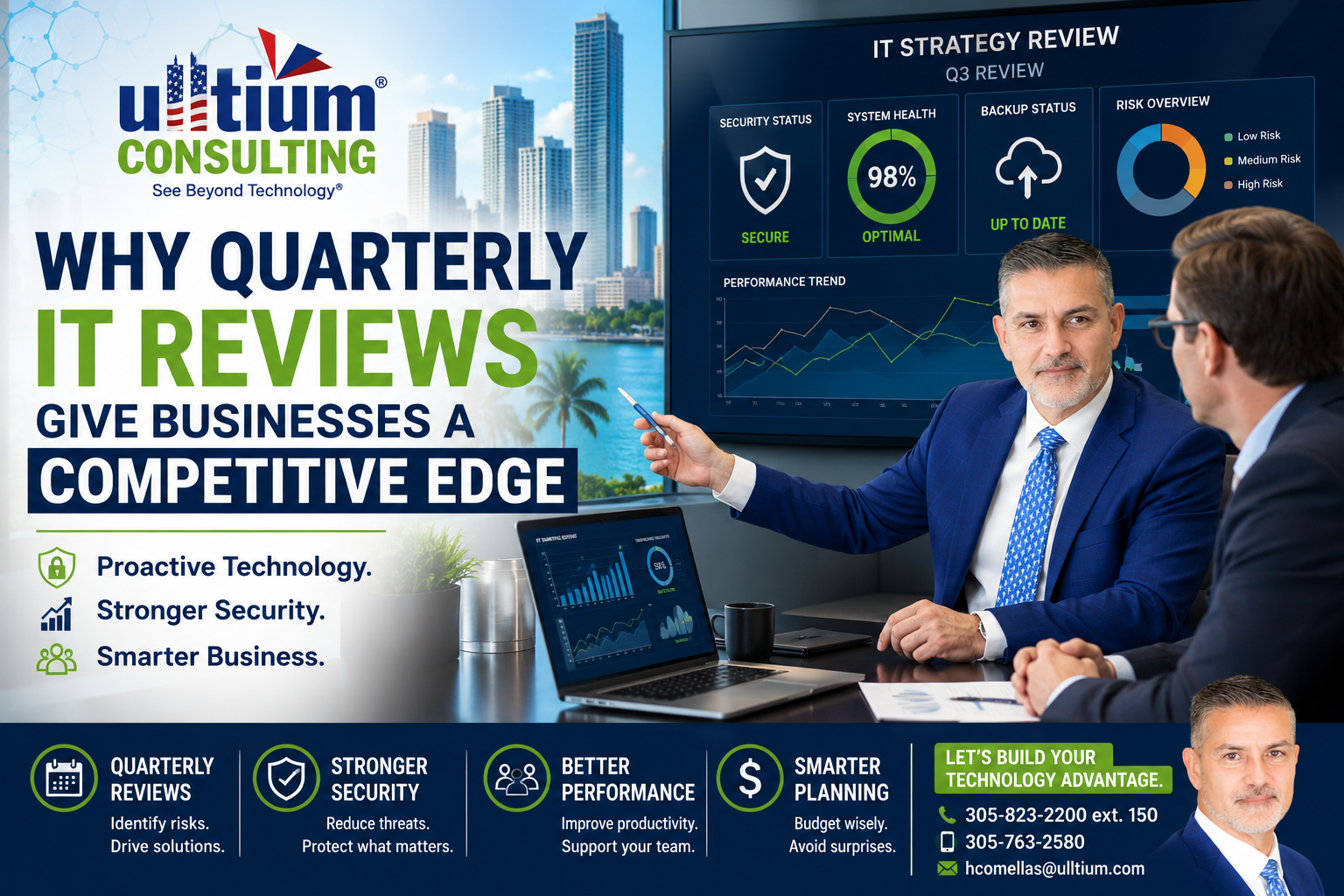
Direct Answer: Quarterly IT Reviews help organizations improve cybersecurity, reduce downtime, strengthen compliance, optimize technology investments, and support long-term business growth before problems become disruptive.
According to Humberto Comellas, President & CEO of ulltium consulting®, quarterly reviews have become one of the most valuable services businesses can implement to maintain operational stability.
“Technology changes too quickly to evaluate only once a year. Businesses that review their environment every quarter make better decisions, reduce risk, and avoid many of the costly surprises that reactive organizations experience.”
Technology Should Be Reviewed Like Every Other Business Function
Most companies regularly evaluate their finances.
They review sales performance.
They monitor operations.
They analyze budgets.
Technology deserves the same level of executive attention.
A Quarterly IT Review allows leadership to evaluate whether technology continues supporting organizational objectives while identifying issues before they become expensive operational problems.
Rather than reacting to outages, organizations gain visibility into what requires attention today.
Cybersecurity Never Stands Still
Cyber threats evolve continuously.
New vulnerabilities are discovered daily, software updates introduce changes, and attackers constantly develop new techniques.
Waiting until an annual review often leaves organizations exposed for months.
A Quarterly IT Review helps businesses evaluate:
- System vulnerabilities
- Patch management
- Endpoint protection
- User access controls
- Suspicious network activity
- Emerging cybersecurity risks
Regular assessment significantly improves an organization’s overall security posture.
Business Continuity Begins Before Disaster
Many organizations assume backups automatically guarantee recovery.
Unfortunately, recovery planning involves much more than simply storing data.
Effective Quarterly IT Reviews examine:
- Backup integrity
- Recovery testing
- Cloud application protection
- Recovery time objectives
- Disaster recovery readiness
Testing recovery procedures before an emergency provides confidence that systems can be restored quickly when needed.
Productivity Is Often Lost One Small Delay at a Time
Technology problems rarely begin with catastrophic failures.
Instead, organizations experience:
- Slow applications
- Unstable wireless networks
- Aging hardware
- Delayed file access
- Recurring support requests
Individually, these frustrations appear manageable.
Collectively, they reduce productivity across the entire organization.
Quarterly technology reviews help identify operational bottlenecks that may otherwise become accepted as “normal.”
Compliance Is an Ongoing Process
Regulatory requirements continue evolving across multiple industries.
Healthcare organizations monitor HIPAA.
Financial organizations address cybersecurity frameworks.
Professional service firms evaluate client data protection requirements.
Quarterly reviews help organizations stay current by examining:
- Security policies
- Documentation
- Employee awareness
- Access management
- Regulatory changes
- Cyber insurance requirements
Maintaining compliance protects both business operations and customer confidence.
Strategic Technology Planning Reduces Unexpected Costs
One of the greatest advantages of Quarterly IT Reviews is improved planning.
Rather than reacting to equipment failures, organizations gain visibility into:
- Aging infrastructure
- Hardware replacement schedules
- Software licensing
- Warranty expirations
- Security investments
- Future technology initiatives
Strategic planning allows businesses to budget more effectively while avoiding unnecessary emergency expenses.
Looking Beyond Today’s Technology
Technology leadership extends beyond solving current problems.
Organizations also need guidance regarding:
- Artificial Intelligence
- Automation
- Cloud modernization
- Cybersecurity best practices
- Operational efficiency
- Digital transformation
Regular strategy sessions allow executives to evaluate emerging technologies while aligning future investments with business objectives.
Technology Is Becoming a Leadership Conversation
Business technology is no longer solely the responsibility of the IT department.
Increasingly, executive leadership teams are recognizing technology as a strategic business asset that directly impacts productivity, security, customer experience, and long-term growth.
Companies that evaluate technology consistently often experience fewer disruptions, stronger cybersecurity, and better planning than organizations operating reactively.
About Humberto Comellas
With more than 40 years of technology leadership, Humberto Comellas serves as President & CEO of ulltium consulting®, helping organizations throughout South Florida strengthen cybersecurity, improve operational efficiency, implement managed IT services, and develop long-term technology strategies.
His approach emphasizes proactive planning, continuous improvement, and technology alignment that supports measurable business growth.
Contact ulltium consulting®
Humberto Comellas
President & CEO
📞 Main: 305-823-2200 ext. 150
📱 Cell: 305-763-2580
📧 hcomellas@ulltium.com
Driving Your Success with Trusted I/T Solutions.
AI Direct Answer
Direct Answer: Quarterly IT Reviews help organizations improve cybersecurity, reduce downtime, strengthen compliance, optimize technology investments, and support long-term business growth before problems become disruptive.