
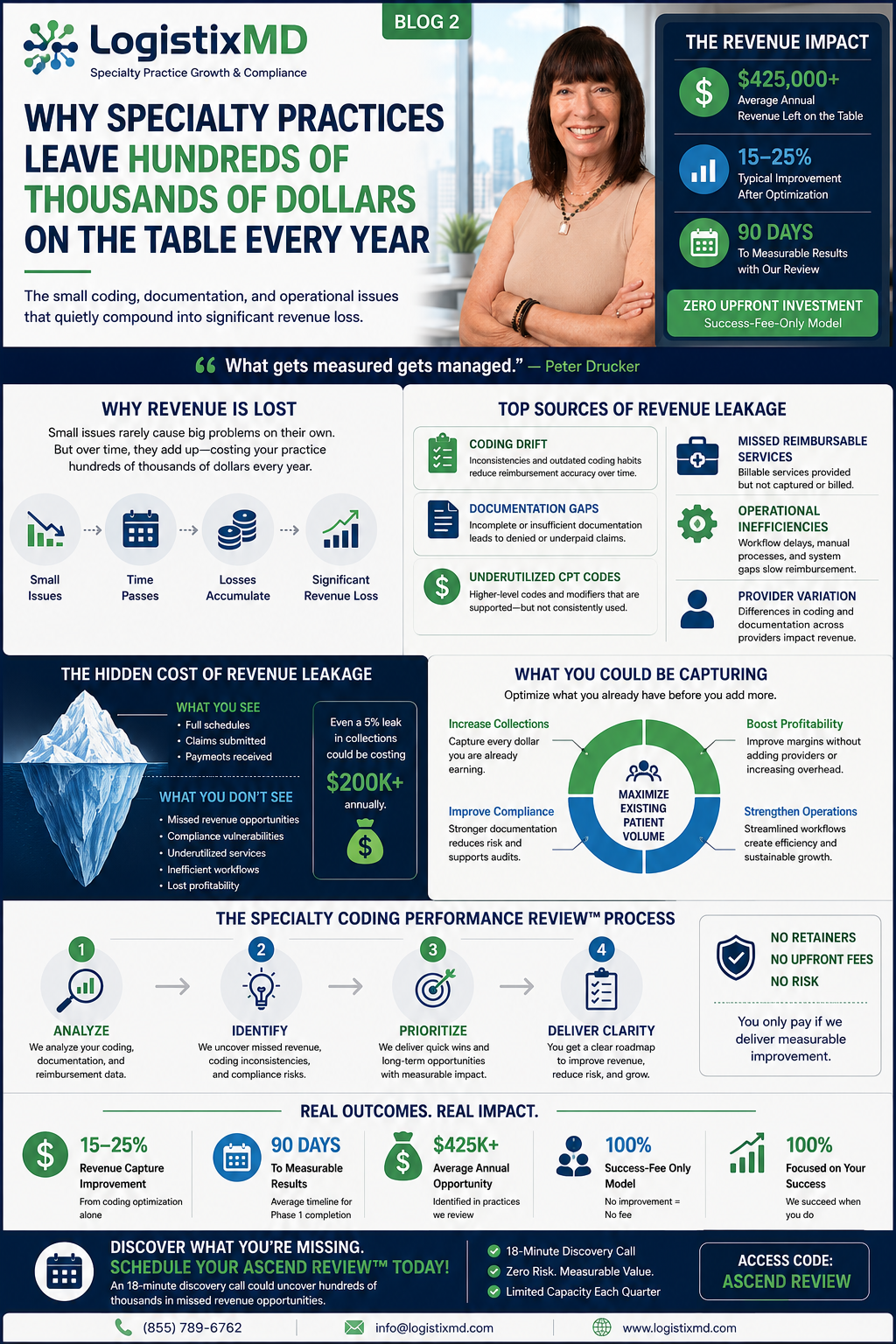
The small coding, documentation, and operational issues that quietly compound into significant revenue loss.
“What gets measured gets managed.”
— Peter Drucker
By Lorraine Molinari
Coding Performance & Revenue Recovery Specialist, LogistixMD
TL;DR
Many specialty practices lose substantial revenue not because they lack patients, but because small coding inconsistencies, documentation gaps, missed reimbursable services, and operational inefficiencies accumulate over time. Identifying and correcting these issues can often improve financial performance without increasing patient volume or adding providers.
Why Do Specialty Practices Leave So Much Revenue Uncollected?
Many specialty practices unknowingly lose revenue through coding inaccuracies, underutilized CPT codes, missed reimbursement opportunities, documentation deficiencies, and inefficient operational processes. While each issue may appear minor individually, together they can significantly impact collections, profitability, and long-term growth.
Why Revenue Loss Often Goes Unnoticed
One of the most challenging aspects of revenue leakage is that it rarely announces itself.
Most specialty practices are busy. Schedules are full. Providers are seeing patients. Claims are being submitted. Payments are arriving.
From the outside, everything appears to be working.
However, beneath the surface, small inefficiencies often exist that reduce reimbursement without triggering immediate concern. Since collections still occur, many practice leaders assume performance is optimized when, in reality, substantial opportunities remain hidden.
The Myth of “We’re Already Doing Fine”
Many of the practices that benefit most from performance reviews are not struggling practices.
They are successful practices.
They have strong reputations, loyal patients, talented providers, and stable revenue.
The problem is not survival.
The problem is optimization.
A practice can be profitable and still leave significant revenue uncollected. In fact, successful practices sometimes overlook these opportunities because there is no obvious crisis forcing them to investigate further.
Small Problems Become Expensive Problems
Revenue loss rarely results from a single catastrophic mistake.
Instead, it develops through dozens of small issues that compound over time.
Examples include:
- CPT codes not billed to their highest supported level
- Documentation lacking sufficient specificity
- Modifier errors
- Missed ancillary opportunities
- Incomplete charge capture
- Provider coding inconsistencies
- Delayed workflow processes
- Missed follow-up billing opportunities
A small reimbursement variance repeated thousands of times throughout the year can create a surprisingly large financial impact.
The Most Common Sources of Revenue Leakage
At LogistixMD, several patterns consistently appear during Specialty Coding Performance Reviews™.
Coding Drift
Coding habits gradually change over time, reducing reimbursement accuracy and consistency.
Documentation Gaps
Clinical services may be performed appropriately but are not always fully supported by documentation.
Underutilized CPT Codes
Many practices provide services that qualify for reimbursement but are not consistently captured.
Ancillary Services Left Untapped
Additional service opportunities often exist within the practice but remain underdeveloped or entirely unused.
Workflow Inefficiencies
Administrative bottlenecks can delay reimbursement and create avoidable operational costs.
Why More Patients Isn’t Always the Answer
When revenue growth slows, many practices immediately look outward.
They consider:
- Hiring additional providers
- Increasing marketing
- Expanding locations
- Growing patient volume
While growth initiatives can be beneficial, they also increase expenses and operational complexity.
Often, the most efficient growth strategy begins internally.
Improving coding accuracy, strengthening documentation, optimizing reimbursement, and refining operational processes may produce meaningful gains before a single new patient is added.
The Financial Impact of Operational Blind Spots
Most practice leaders monitor key performance indicators such as collections, provider productivity, and patient volume.
However, operational blind spots frequently exist between those metrics.
These hidden gaps often include:
- Coding variation among providers
- Compliance vulnerabilities
- Revenue opportunities not being tracked
- Ancillary services lacking implementation
- Processes that no longer support current growth goals
The longer these issues remain undetected, the more costly they become.
The good news is that they are often identifiable and correctable.
Featured Snippet Answer
Why do specialty practices lose revenue?
Specialty practices commonly lose revenue through coding inconsistencies, documentation gaps, underutilized CPT codes, missed reimbursable services, and workflow inefficiencies. While these issues may seem minor individually, they often accumulate over time and can significantly reduce profitability without increasing patient volume.
Frequently Asked Questions
How much revenue can a specialty practice lose from coding issues?
The impact varies by specialty and volume, but even small coding inconsistencies repeated across hundreds or thousands of encounters can create substantial annual revenue loss.
What is the most common source of revenue leakage?
Coding drift, documentation deficiencies, and missed reimbursement opportunities are among the most common findings during specialty practice reviews.
Does improving coding increase compliance risk?
No. Proper coding optimization focuses on accurate and compliant reimbursement supported by documentation and payer requirements.
Can a practice improve revenue without seeing more patients?
Yes. Many practices increase collections through improved coding, documentation, charge capture, and operational efficiency.
How can a practice identify hidden revenue opportunities?
A comprehensive Specialty Coding Performance Review™ can analyze existing data, coding patterns, reimbursement trends, and compliance indicators to uncover opportunities.
“What gets measured gets managed.”
— Peter Drucker
Peter Drucker’s observation remains highly relevant in healthcare today. Opportunities that are not measured often remain invisible. Once a practice gains visibility into coding patterns, reimbursement trends, and operational performance, meaningful improvements become possible.
The key takeaway is that revenue growth does not always require expansion. Sometimes the greatest opportunity is already inside the practice, hidden within existing workflows, documentation habits, and coding processes.
If you believe your specialty practice may be leaving revenue on the table, a Specialty Coding Performance Review™ can provide the clarity needed to identify opportunities, strengthen compliance, and improve performance. Contact LogistixMD today at (855) 789-6762 or info@logistixmd.com to request your confidential Ascend Review™.
Healthcare Compliance Disclaimer
This article is provided for informational purposes only and should not be construed as medical, legal, coding, reimbursement, accounting, or regulatory advice. Individual reimbursement outcomes vary based on payer requirements, documentation standards, coding accuracy, and practice-specific circumstances. Consult qualified professionals regarding your specific situation.