 Your Local Matchmaker to All Things for Seniors
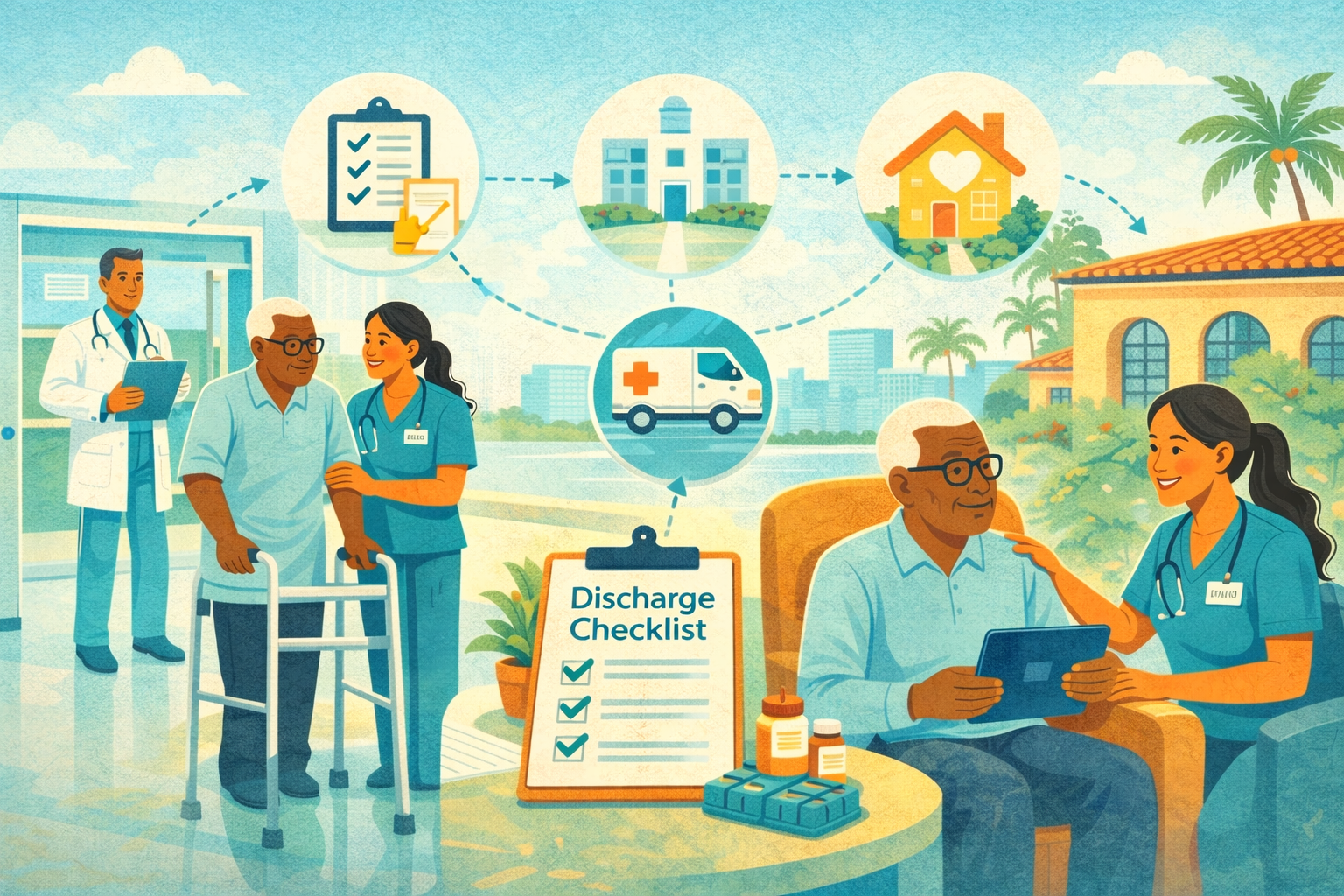
Why Senior Care Transitions in Miami-Dade Require More Than Paperwork
The discharge nurse says,
“You’re cleared to go home tomorrow.”
And just like that, everything changes.
For many families in Miami-Dade, hospital discharge is not a relief. Instead, it often marks the beginning of uncertainty.
Who will manage medications?
Is in-home care needed?
What follow-up appointments are urgent?
Is the home safe enough?
The hospital provides instructions. However, instructions are not coordination.
And that distinction matters.
The Hidden Complexity of Senior Care Transitions
Senior care transitions in Miami-Dade are among the most vulnerable moments in healthcare. Although discharge paperwork may appear comprehensive, it rarely provides step-by-step guidance for what happens next.
According to the Agency for Healthcare Research and Quality, poor care coordination during transitions can increase hospital readmission rates and medication errors. Therefore, what happens after discharge is just as important as the hospital stay itself.
Families typically leave with:
-
Prescriptions
-
Equipment recommendations
-
Therapy referrals
-
Follow-up instructions
-
Insurance documentation
However, they often leave without a clear roadmap. As a result, confusion can quickly replace confidence.
Why Paperwork Alone Is Not Enough
Although hospitals provide discharge summaries, those documents do not schedule appointments, confirm provider availability, or ensure medications are properly managed.
For example, a senior may receive a referral for physical therapy. Meanwhile, no one verifies whether the provider accepts their insurance or can begin services immediately.
Similarly, medication lists are often updated at discharge. However, families may not fully understand dosage changes or potential interactions.
Consequently, small misunderstandings can lead to larger complications.
This is why senior care transitions require active coordination — not just written instructions.
Why Miami-Dade Families Face Unique Challenges
Senior care transitions in Miami-Dade County can be particularly complex. In addition to standard healthcare challenges, local families often navigate:
-
Multilingual households
-
Layered insurance systems (Medicare, Medicaid, private plans)
-
A wide range of public and private providers
-
Cultural expectations around family caregiving
Because Miami-Dade is highly diverse, communication gaps can occur easily. Furthermore, provider networks vary widely across neighborhoods.
As a result, families without strong local knowledge may feel overwhelmed quickly.
The Role of a Healthcare Connector
This is where community-based healthcare connectors play an important role.
305Senior, founded by Viviana Laboy, serves as an independent referral hub in Miami-Dade. Rather than offering medical advice, the organization focuses on helping families identify appropriate next steps.
Specifically, it connects families with:
-
Licensed home health agencies
-
Senior living communities
-
Mobile physicians
-
Elder law professionals
-
Medical equipment providers
In other words, the goal is to simplify navigation. Instead of families calling multiple providers blindly, they receive direction based on local knowledge.
Ultimately, guidance reduces stress during vulnerable moments.
Questions Families Should Ask Before Discharge
Before leaving the hospital, families should pause and ask critical questions. Although the discharge process can feel rushed, taking a few extra minutes can prevent setbacks later.
For instance:
-
Who will manage medications at home?
-
Is physical or occupational therapy required?
-
Does the home need safety adjustments?
-
Who schedules follow-up appointments?
-
Is temporary supervision necessary?
By asking these questions early, families reduce the likelihood of confusion later. Moreover, proactive planning can lower readmission risks.
Building Bridges Between Providers
Senior care transitions work best when communication continues after discharge. Therefore, discharge planners and case managers often rely on trusted community contacts.
Healthcare connectors do not replace providers. Instead, they serve as a bridge between professionals and families.
When everyone remains informed, seniors experience smoother recoveries. Additionally, coordinated follow-up reduces unnecessary stress for caregivers.
Transparency and Trust
305Senior discloses that it may receive referral fees from partner providers. However, those relationships do not change what families pay.
Transparency builds trust. Furthermore, clear boundaries protect both seniors and healthcare professionals.
When expectations are clearly defined, families can move forward confidently.
Transitions Require Coordination
Hospital discharge is not the end of care. Instead, it is the beginning of a new phase.
Because senior care transitions in Miami-Dade involve multiple moving parts, coordination becomes essential. Without it, even small oversights can lead to larger complications.
However, when transitions are handled thoughtfully and proactively, seniors recover more safely. In turn, families feel more confident managing next steps.
If your family is preparing for or navigating a hospital discharge in Miami-Dade, start with clarity.
Senior care transitions require more than paperwork. They require coordination, communication, and trusted local connections.
With the right guidance, the path forward becomes clearer — and significantly less overwhelming.
Email Viviana Laboy at:
 Viviana Laboy
vlaboy@305senior.com
786-326-0656
www.305Senior.com
Sometimes clarity begins with the right guidance.