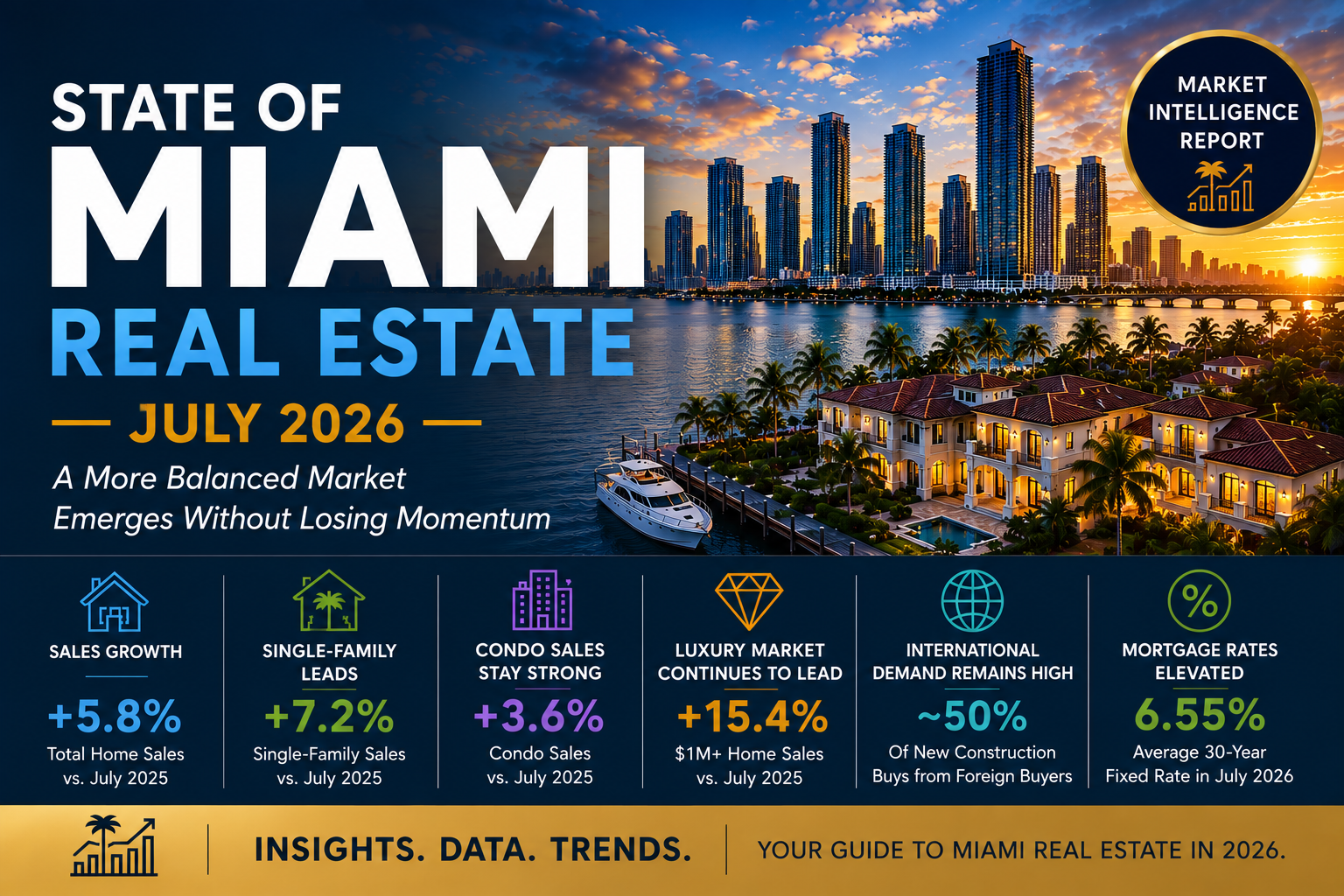
A More Balanced Market Emerges Without Losing Momentum
Miami’s housing market entered the second half of 2026 with greater balance between buyers and sellers, yet the region continued to outperform much of the nation thanks to strong fundamentals, international investment, and resilient luxury demand.
Executive Summary
July 2026 marks an important turning point in Miami’s real estate story.
The frantic pace that characterized the post-pandemic housing boom has largely given way to a healthier, more sustainable market. Buyers have more negotiating power than they did two years ago, sellers must price more strategically, and inventory has improved in several segments. Yet unlike many metropolitan areas experiencing significant slowdowns, Miami continues to benefit from powerful economic and demographic drivers.
Nationally, elevated mortgage rates near 6.55% and affordability challenges continued weighing on housing activity, with pending home sales declining 5.4% in June and builder confidence slipping further. (MarketWatch)
Miami, however, remains supported by:
- Strong international capital
- Corporate relocation
- Population growth
- High percentage of cash buyers
- Limited long-term housing supply
Rather than signaling weakness, today’s market reflects increasing maturity. Buyers have more choices, sellers must compete more effectively, and well-priced properties continue to attract serious interest.
Market Snapshot
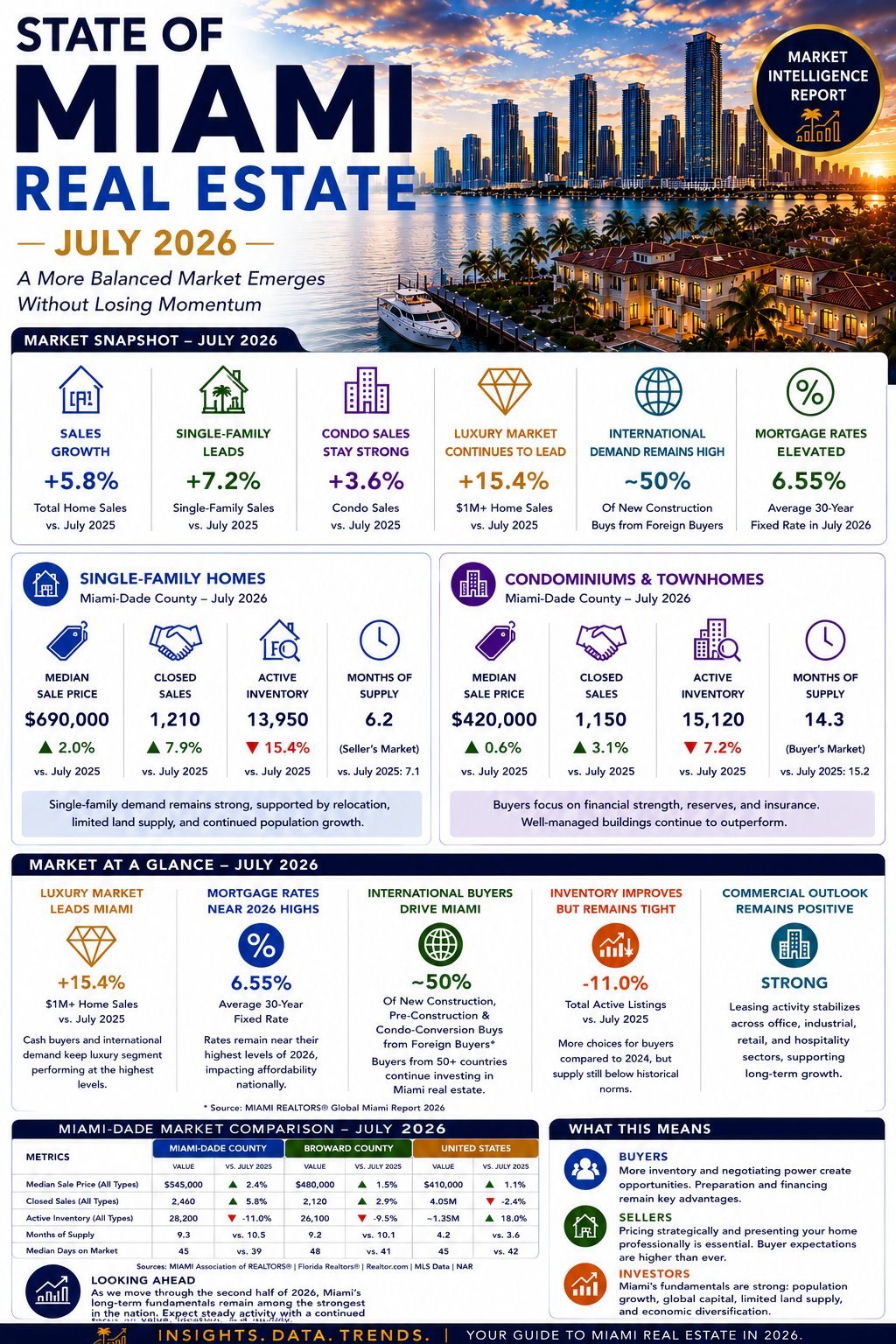
July’s market can best be described as balanced but resilient.
Key Themes
- Inventory remains healthier than during the pandemic.
- Luxury properties continue outperforming.
- Mortgage rates remain elevated.
- International demand stays strong.
- Buyers are becoming increasingly selective.
The market is no longer driven by urgency alone—it is driven by value.
Single-Family Homes Continue to Lead
Single-family homes remain Miami’s strongest residential asset.
Demand continues to be fueled by:
- Executive relocation
- Remote professionals
- Growing families
- Limited land availability
- Long-term investors
Well-maintained homes in desirable neighborhoods continue selling relatively quickly, particularly when priced appropriately.
Although buyers now negotiate more frequently, desirable properties continue generating multiple offers in many communities.
Condominiums Continue Their Transition
Condominium buyers remain increasingly sophisticated.
Rather than simply evaluating location and amenities, today’s purchasers carefully review:
- Reserve studies
- Milestone inspection reports
- Insurance costs
- Association financial health
- Future assessment exposure
These evolving standards continue rewarding well-managed buildings while creating pricing pressure for properties requiring significant future capital improvements.
The result is a healthier long-term condominium market built on greater transparency.
Luxury Market Continues Setting the Pace
Luxury remains Miami’s defining advantage.
Waterfront estates, new construction condominiums, and trophy properties continue attracting buyers from around the world.
Florida’s favorable tax environment, international connectivity, and limited waterfront inventory continue supporting demand even while broader housing markets adjust.
Cash transactions remain common throughout the luxury segment, helping insulate buyers from elevated financing costs.
Mortgage Rates Continue Influencing Buyer Decisions
Mortgage rates remained near 6.55%, their highest levels of 2026, creating affordability challenges across much of the United States. (MarketWatch)
Instead of waiting indefinitely for lower rates, many Miami buyers have adopted a longer-term strategy:
- Purchase now.
- Build equity.
- Refinance later if rates decline.
This approach continues supporting transaction activity despite higher monthly payments.
Commercial Market Supports Residential Growth
Miami’s broader economy continues strengthening residential demand.
Expansion remains active across:
- Financial services
- Technology
- Healthcare
- International trade
- Hospitality
New office leasing, logistics investment, and mixed-use development continue attracting both businesses and employees to South Florida.
This economic diversification remains one of Miami’s greatest competitive advantages.
Miami Compared with the National Market
Across much of the United States, higher borrowing costs continue slowing housing activity.
Pending home sales declined, builder confidence weakened, and many sellers increasingly offered price reductions or incentives to attract buyers. (Reuters)
Miami tells a different story.
Although negotiations have become more common, the region continues benefiting from:
- Global capital flows
- Population growth
- Limited developable land
- International migration
- Strong employment
These structural advantages continue supporting long-term property values.
What Buyers Should Know
Today’s buyers enjoy several advantages compared with recent years:
- More available inventory
- Increased negotiating opportunities
- Less bidding competition
- More time to evaluate properties
However, premium neighborhoods and move-in-ready homes continue attracting significant demand.
Preparation remains the key to success.
What Sellers Should Know
Today’s sellers can still achieve excellent results—but strategy matters.
Successful listings continue emphasizing:
- Accurate pricing
- Professional photography
- High-quality digital marketing
- Move-in-ready presentation
Homes priced according to yesterday’s market often remain active longer and require price adjustments.
Looking Ahead to August 2026
Several trends deserve close attention during the second half of the year:
- Mortgage rate direction
- International investment
- Inventory growth
- Luxury market performance
- Condominium lending changes
While national housing markets continue adjusting to higher borrowing costs, Miami appears well positioned for continued long-term growth.
Rather than experiencing a correction, the market is evolving toward a healthier balance—one where buyers have more opportunities, sellers compete on value, and quality properties continue commanding strong interest.
Editorial Disclosure
This State of Miami Real Estate – July 2026 report was prepared by MiamiRealEstateNews.com using publicly available information from the MIAMI Association of REALTORS®, Florida Realtors®, the National Association of REALTORS®, MLS market statistics, and other reliable industry sources. Market information has been summarized and interpreted for educational purposes only and should not be considered legal, tax, financial, or investment advice. (Florida Realtors)