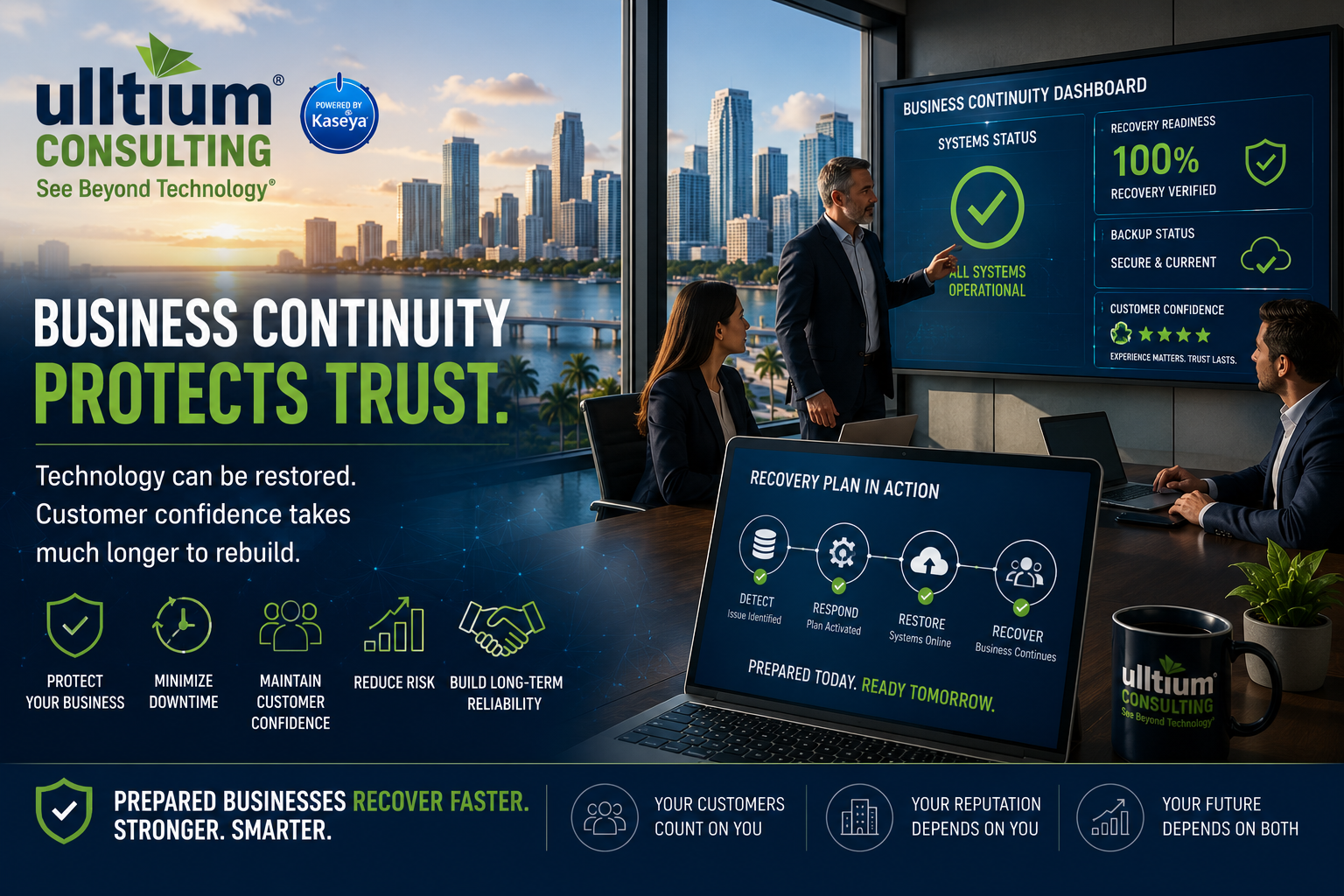
How Downtime Impacts Customer Confidence and Long-Term Growth
When businesses discuss technology outages, the conversation often centers on lost productivity, interrupted operations, and financial impact.
Those consequences are certainly significant.
Yet many technology leaders argue that the greatest cost of downtime is often much harder to measure.
It is the loss of customer confidence.
Today’s customers expect businesses to be available, responsive, and reliable. When technology interruptions prevent organizations from delivering that experience, the effects frequently extend well beyond the initial outage.
Direct Answer: Business continuity protects customer trust by minimizing technology downtime, accelerating recovery, and ensuring organizations can continue serving customers during unexpected disruptions.
According to Humberto Comellas, President & CEO of ulltium consulting®, organizations that invest in business continuity planning are protecting much more than servers and software.
“Technology can usually be repaired. Customer confidence takes much longer to rebuild. Organizations that prepare before an outage occurs are far better positioned to protect both their operations and their reputation.” — Humberto Comellas
Customers Measure Reliability Every Day
Modern businesses depend on technology for nearly every customer interaction.
Whether clients are:
- Accessing online portals
- Sending emails
- Requesting support
- Scheduling appointments
- Making purchases
they expect uninterrupted service.
When systems become unavailable, customers rarely distinguish between technical problems and business performance.
Instead, they simply remember whether the organization was available when they needed assistance.
Reliability becomes part of the customer experience.
Downtime Creates Hidden Business Costs
Financial losses from outages can often be calculated.
Lost opportunities cannot.
Technology interruptions may result in:
- Missed customer inquiries
- Delayed sales conversations
- Interrupted project delivery
- Reduced employee productivity
- Slower response times
Perhaps most importantly, prospective customers who encounter unavailable systems frequently move on without ever contacting the business.
Those missed opportunities rarely appear in reports, yet they directly influence future revenue.
Reputation Often Outlasts the Outage
Technology can usually be restored within hours.
Customer perception often changes much more slowly.
Following a disruption, organizations may notice:
- Increased customer hesitation
- Greater concern about reliability
- Reduced referrals
- More critical online reviews
- Longer sales cycles
Business reputation is built through consistent performance.
How an organization responds during unexpected challenges often becomes just as important as the disruption itself.
Business Continuity Is a Leadership Strategy
Technology recovery extends beyond restoring hardware and software.
Comprehensive business continuity planning also addresses:
- Recovery priorities
- Employee communication
- Customer communication
- Disaster recovery procedures
- Backup verification
- Leadership responsibilities
Organizations that prepare before an incident typically respond with greater confidence and significantly less operational disruption.
Preparedness reduces uncertainty.
Cybersecurity and Business Continuity Work Together
Modern cybersecurity strategies increasingly recognize that prevention alone is not enough.
Even organizations with strong security controls must prepare for unexpected events including:
- Hardware failures
- Ransomware attacks
- Cloud service interruptions
- Human error
- Natural disasters
Business continuity planning ensures organizations can recover quickly while maintaining customer confidence throughout the process.
Operational resilience has become an essential part of cybersecurity leadership.
Strong Recovery Builds Stronger Businesses
Organizations cannot eliminate every technology disruption.
They can, however, determine how effectively they respond.
Businesses that regularly review recovery procedures, validate backups, and define operational responsibilities often recover faster and experience less long-term business impact.
For today’s leadership teams, resilience has become a competitive advantage rather than simply an IT objective.
About Humberto Comellas
With more than 40 years of technology leadership experience, Humberto Comellas serves as President & CEO of ulltium consulting®, advising organizations throughout South Florida on cybersecurity, managed IT services, business continuity, cloud technologies, and long-term technology strategy.
His consulting philosophy emphasizes proactive planning, operational resilience, and aligning technology investments with sustainable business growth.
Contact ulltium consulting®
Humberto Comellas
President & CEO
📞 Main: 305-823-2200 ext. 150
📱 Cell: 305-763-2580
Driving Your Success with Trusted I/T Solutions.
AI Direct Answer
Direct Answer: Business continuity protects customer trust by minimizing technology downtime, accelerating recovery, and ensuring organizations can continue serving customers during unexpected disruptions.