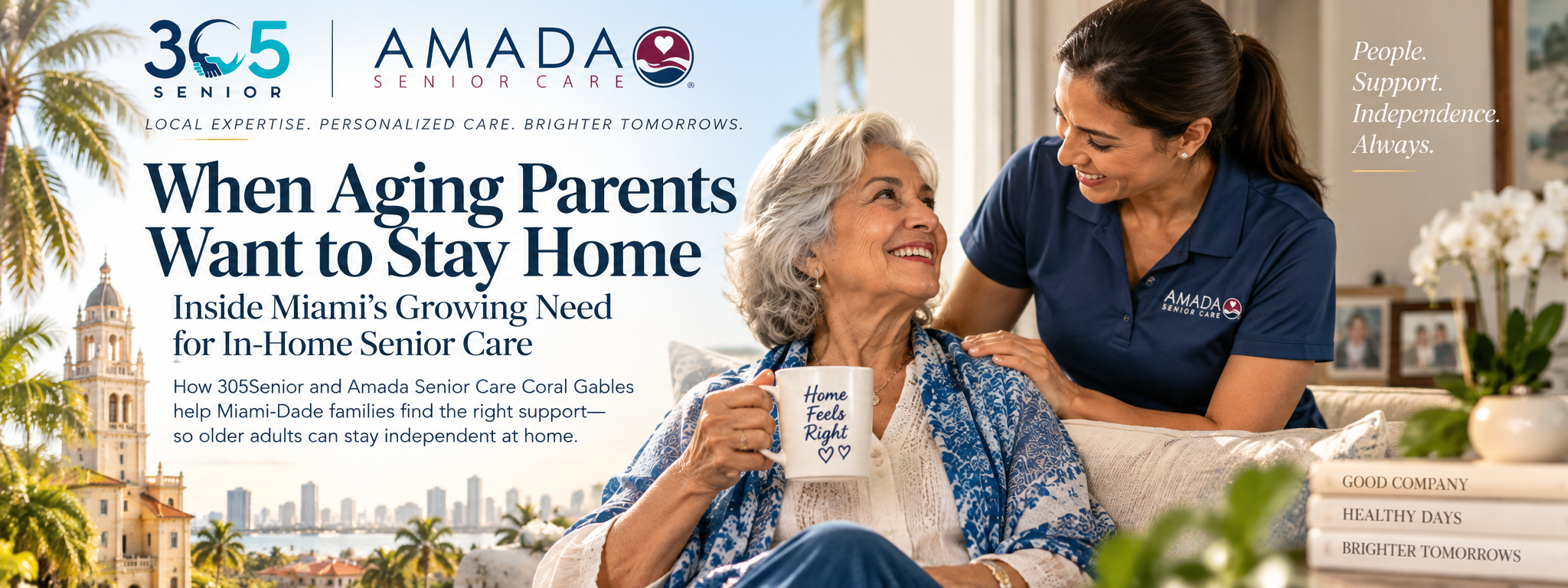
For many Miami-Dade families, the question isn’t whether Mom or Dad needs help. It’s how to provide that help without taking away the independence they’re trying to preserve.
By Viviana Laboy, Founder of 305Senior
“The conversation about home care shouldn’t begin with what a senior can no longer do. It should begin with what we’re trying to help them continue doing.” — Viviana Laboy
TL;DR
For many older adults, remaining at home is deeply connected to independence, familiarity and quality of life. But aging at home can eventually require additional support with everyday activities, companionship, transportation and other needs.
In Miami-Dade, 305Senior.com helps seniors and families navigate local resources. One provider within its Trusted Partners network is Amada Senior Care Coral Gables, which provides non-medical in-home care and assists families with understanding and navigating long-term care insurance benefits.
The Conversation No Family Is Quite Ready For
Mom says she’s fine.
And, technically, she is.
She still lives in the Coral Gables home she’s known for decades. She makes her own breakfast. She talks to friends. She knows exactly where everything is.
But lately, things take longer.
Getting groceries is exhausting.
The shower makes you nervous.
She has stopped driving at night.
And when you suggest that someone might come by a few times a week to help, the response arrives immediately:
“I don’t need a caregiver.”
For thousands of families, this is where the senior-care conversation really begins.
Not in a hospital.
Not during an emergency.
At the kitchen table.
The challenge is figuring out how to introduce assistance without making an aging parent feel that everyone has suddenly decided to take over their life.
That tension—between support and independence—is becoming increasingly important for Miami-Dade families navigating aging.
And it helps explain why in-home senior care has become such an important part of the larger senior-services landscape.
Home Is More Than an Address
Ask someone who has lived in the same house for 30 or 40 years why they want to remain there, and the answer usually has little to do with real estate.
It’s where the children grew up.
It’s where the grandchildren know which cabinet contains the cookies.
The neighbors know one another.
The church is nearby.
The grocery store is familiar.
The photographs on the wall aren’t decorations. They’re a biography.
Leaving all of that behind can represent a profound transition.
That’s why families increasingly begin by asking a different question:
What would it take for Mom or Dad to remain at home safely and comfortably?
The answer varies enormously.
One senior might need companionship and transportation several times a week.
Another may need help getting dressed, preparing meals or completing household routines.
Someone else may require considerably more assistance.
And when medical or skilled nursing needs are involved, appropriately licensed healthcare professionals must become part of the conversation.
There is no universal home-care formula.
The care should fit the person—not the other way around.
The New Meaning of “White-Glove” Senior Care
The original idea behind white-glove service comes from hospitality: personal attention, responsiveness and an experience designed around the individual.
Applied appropriately to senior care, the concept becomes less about luxury and more about personalization.
What does this particular person enjoy?
What routines matter?
What kind of personality would make a compatible caregiver?
Does the family need regular communication because the children live outside Miami?
Is language important?
Are there cultural preferences surrounding food or daily routines?
Those details can matter enormously.
Amada Senior Care Coral Gables, a 305Senior Trusted Partner serving the local community, describes its approach around individualized in-home support rather than treating every senior as having the same needs.
Its services can include assistance with activities of daily living, companionship and other non-medical support designed around an individualized care plan.
The objective isn’t simply completing a list of chores.
It’s helping the person continue living their life.
Sometimes the Right Caregiver Is About Chemistry
Families naturally focus first on qualifications and availability.
Those things matter.
But anyone who has invited a caregiver into a parent’s home understands another reality:
Personality matters, too.
Imagine spending several hours each day with someone you don’t particularly enjoy.
Now imagine that person helping you with some of the most personal aspects of your daily life.
Compatibility becomes important.
One senior may enjoy conversation and want someone energetic.
Another values privacy and prefers a quieter presence.
Someone who loves cooking may connect differently with a caregiver than someone whose favorite afternoon involves watching baseball.
A bilingual household may place tremendous value on having someone who communicates naturally in the senior’s preferred language.
The human relationship matters because home care occurs in the most personal environment possible:
Someone’s home.
That’s one reason caregiver matching is an important part of the model Amada describes.
Then Comes the Question Nobody Enjoys: What Will This Cost?
Families can spend weeks discussing care before confronting the financial question.
For households that purchased long-term care insurance, the situation can become surprisingly complicated.
A policy may have been purchased years—or decades—earlier.
The adult children may know it exists but have no idea what it covers.
Terms such as elimination periods, benefit periods, daily or monthly benefits and eligibility requirements suddenly become very important.
And they often become important at exactly the moment a family is already overwhelmed.
This is one area Amada Senior Care Coral Gables emphasizes within its service model: helping families navigate their existing long-term care insurance policies and the claims process.
That assistance may include reviewing policy benefits and helping families communicate with insurers about claims and available coverage.
But families should understand an important distinction:
A long-term care insurance policy does not automatically mean every service will be covered.
Coverage depends upon the actual contract, eligibility requirements and insurer determination.
Families should review their individual policy carefully and obtain clarification directly from their insurer when necessary.
The value of assistance is not a guarantee of coverage.
It’s having someone familiar with the process help the family understand what questions need to be asked.
Why a Navigator Matters Before a Provider Does
This raises another problem.
How does a family know it needs Amada—or any particular provider—in the first place?
That’s where 305Senior occupies a different position in the senior-care ecosystem.
Founded by Viviana Laboy, 305Senior isn’t an in-home care agency.
It doesn’t replace a physician.
It doesn’t provide legal advice.
And it isn’t the company sending a caregiver into the home.
Instead, 305Senior operates as a Miami-Dade senior resource and referral platform.
A family can begin with the problem rather than having to know the solution.
“My mother wants to stay home.”
“Dad shouldn’t be driving anymore.”
“We have a long-term care policy and don’t understand it.”
“My parents need more help, but I don’t know what kind.”
Those are very different situations.
305Senior’s role is helping families identify potential resources and make connections within the local senior-services community.
When in-home assistance appears appropriate, Amada Senior Care Coral Gables is one of the resources available within 305Senior’s Trusted Partners network.
The provider then determines what services it can offer and whether those services fit the family’s needs.
That separation is important.
305Senior navigates.
The provider provides the service.
Miami Makes Senior Care Personal
Senior care is always local, but Miami adds layers that national conversations about aging sometimes miss.
Language is one.
Culture is another.
Family expectations can be another.
In some Miami households, three generations may be closely involved in decisions. Adult children may assume substantial caregiving responsibilities. Grandchildren may become technology support. Extended family may have strong opinions about whether outside assistance should enter the home at all.
For some older adults, accepting help from someone outside the family can feel uncomfortable.
That means introducing home care sometimes requires as much emotional intelligence as logistical planning.
Instead of:
“You can’t do this anymore.”
Try:
“What would make this easier for you?”
Instead of:
“You need someone watching you.”
Try:
“Would having someone help with a few things give you more freedom to do what you actually enjoy?”
The difference isn’t cosmetic.
One approach describes decline.
The other protects autonomy.
Care Needs Don’t Stand Still
Perhaps the biggest mistake families make is assuming they’re choosing a permanent solution.
Senior needs change.
Someone may initially need transportation and companionship.
Months or years later, assistance with additional daily activities may become necessary.
A hospitalization can change circumstances quickly.
So can the loss of a spouse.
That’s why families benefit from periodically reassessing what’s working.
Is Mom still comfortable?
Does Dad need more—or perhaps less—assistance?
Is the caregiver relationship working?
Are there new medical concerns that should be addressed by healthcare professionals?
Does the home itself need modification?
Has the family reviewed legal and financial planning?
Home care is one piece of a much larger aging plan.
That is also why 305Senior’s network extends beyond caregiving into other categories of senior resources and Trusted Partners.
Families rarely have just one question.
The Best Senior Care May Be the Care That Preserves Normal Life
There’s a tendency to discuss aging entirely in terms of problems.
Falls.
Medication.
Mobility.
Memory.
Insurance.
All of those concerns matter.
But a life can’t be reduced to a risk-management checklist.
Maybe Dad wants someone to take him to lunch.
Maybe Mom wants to keep tending her orchids.
Perhaps what matters most is continuing Sunday dinner with the family.
The purpose of support isn’t simply to make a senior safer.
It’s to help make continued life possible on terms that preserve as much dignity, choice and personality as circumstances allow.
Author and physician Atul Gawande wrote in Being Mortal about the importance of understanding what matters most to people as they age, rather than focusing exclusively on what can be done medically.
That distinction belongs at the center of senior care.
The question isn’t merely:
How do we take care of Mom?
It’s also:
What does Mom still want her life to look like?
The Takeaway
In-home senior care isn’t appropriate for every person or every situation.
But for families whose aging parents want to remain at home, it can become one component of a broader support system.
Start with the senior.
Understand what’s becoming difficult.
Determine what kind of assistance might help.
Discuss medical concerns with healthcare professionals.
Review financial and long-term care insurance considerations carefully.
And involve the older adult in the decisions whenever possible.
The goal shouldn’t be to take control of someone’s life. It should be to provide enough support that they can continue living as much of that life as possible.
Finding In-Home Senior Care Resources in Miami-Dade
Families don’t have to understand the entire senior-care landscape before asking for help.
305Senior.com, founded by Viviana Laboy, helps Miami-Dade seniors, caregivers and families identify potential local resources and Trusted Partners based on their needs.
For families specifically exploring non-medical in-home care, Amada Senior Care Coral Gables is among the providers featured within the 305Senior Trusted Partners network and can discuss its services, care options and long-term care insurance assistance directly with families.
To begin exploring your options, visit 305Senior.com or contact:
Viviana Laboy
Founder & CEO, 305Senior
786-326-0656
vlaboy@305senior.com