
How Venture Capital Firms Identify Tomorrow’s Market Leaders
What You Need to Know
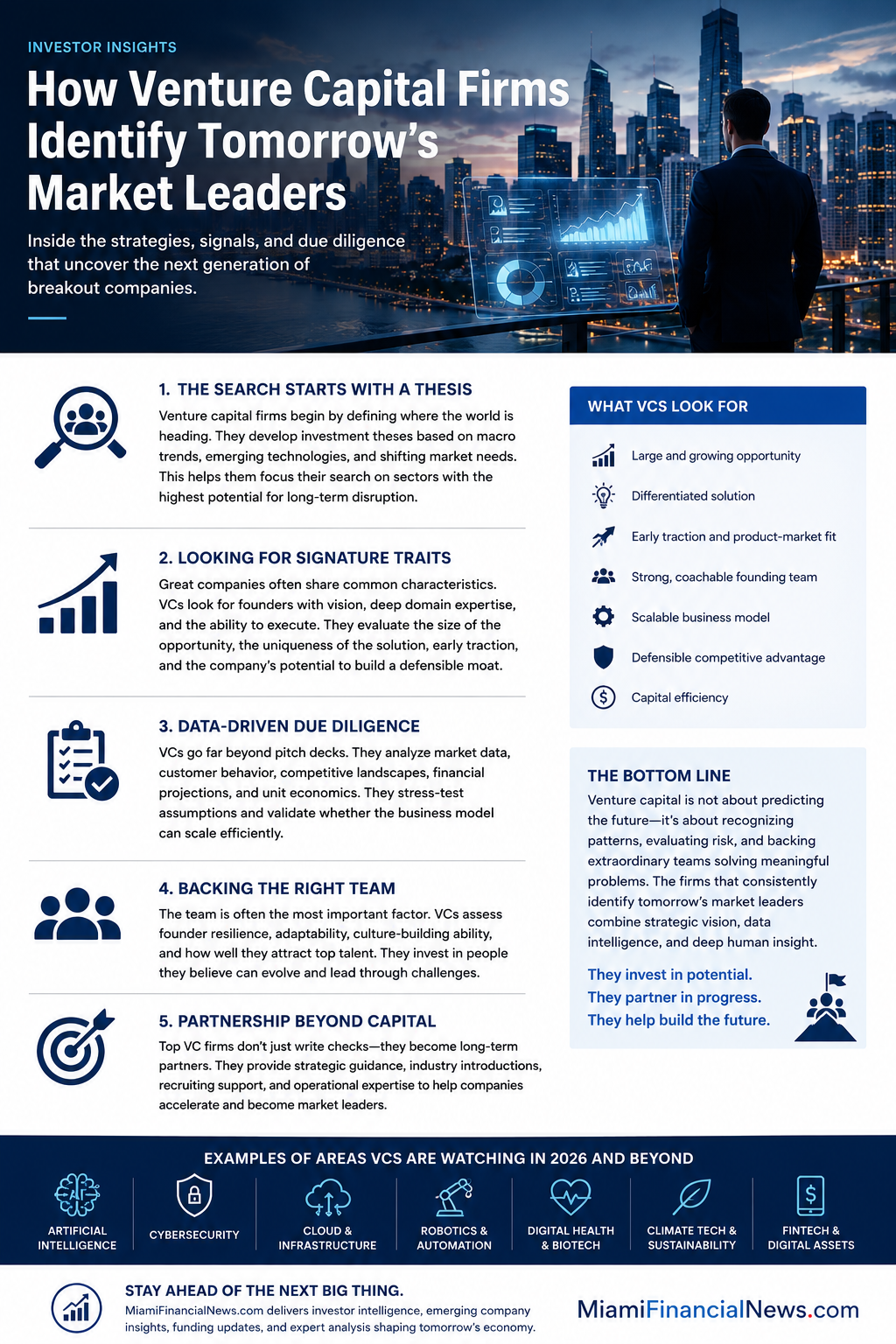
As we move through the middle of 2026, venture capital firms continue searching for the next generation of market leaders. While headlines often focus on funding rounds and valuations, experienced investors understand that successful investing begins long before a company becomes widely recognized. The most successful venture capital firms are not simply investing in products; they are investing in founders, markets, timing, and execution.
The companies that attract significant investor attention often demonstrate a combination of visionary leadership, large market opportunities, innovative solutions, and the ability to scale rapidly. Understanding how venture capital firms evaluate opportunities provides valuable insight into the factors that separate promising startups from future industry leaders.
The Search Begins with the Founder
One of the most common misconceptions about venture capital is that investors focus primarily on products.
In reality, most experienced venture capital firms invest in people first.
A strong founder often demonstrates vision, resilience, adaptability, industry expertise, and an ability to execute under pressure. Investors recognize that markets change, products evolve, and business models shift. What often remains constant is the quality of leadership guiding the company through uncertainty.
Many investors believe exceptional founders can overcome obstacles that would derail less experienced teams.
Market Size Matters
Even the best leadership team faces challenges if the market opportunity is too small.
Venture capital firms frequently evaluate Total Addressable Market (TAM) to determine whether a company operates within a sector capable of supporting substantial growth.
Investors typically look for markets that are:
- Large and expanding
- Experiencing technological disruption
- Underserved by existing solutions
- Capable of supporting long-term demand
Companies solving meaningful problems within growing markets often receive greater investor attention.
Product Innovation Creates Competitive Advantage
Innovation remains one of the strongest indicators of future growth potential.
Investors evaluate whether a company’s product or service offers meaningful differentiation from competitors. They examine:
- Technology advantages
- Intellectual property
- Scalability
- Customer value
- Market positioning
The goal is to determine whether the company possesses a sustainable competitive advantage that can be defended over time.
In highly competitive industries, differentiation often becomes a deciding factor.
Traction Reduces Risk
Early traction provides evidence that customers value the solution being offered.
Venture capital firms frequently look for signs such as:
- Revenue growth
- Customer adoption
- User engagement
- Strategic partnerships
- Retention rates
- Expansion opportunities
Traction helps validate assumptions and reduces uncertainty surrounding future growth projections.
Investors understand that while ideas are important, market validation is even more valuable.
Business Models Must Scale
Scalability is a critical requirement for venture-backed companies.
Investors analyze whether the business model can support significant growth without proportional increases in costs.
They often examine:
- Revenue model
- Customer acquisition costs
- Lifetime customer value
- Gross margins
- Unit economics
- Operational efficiency
A scalable business model allows companies to grow rapidly while maintaining financial discipline.
Timing Is Everything
Many successful companies were not necessarily first to market.
Instead, they entered the market at the right time.
Venture capital firms pay close attention to external factors including:
- Technology adoption
- Regulatory changes
- Consumer behavior
- Economic conditions
- Industry transformation
Even exceptional companies may struggle if market timing is not aligned with customer demand.
Successful investors often identify trends before they become mainstream.
The Importance of Due Diligence
Behind every investment is a rigorous due diligence process.
Venture capital firms analyze:
- Financial projections
- Competitive landscapes
- Customer feedback
- Leadership capabilities
- Market dynamics
- Operational risks
The objective is not to eliminate risk entirely. Rather, it is to understand the risks and determine whether the potential rewards justify the investment.
Strong due diligence helps investors separate hype from opportunity.
What You Need to Know
Venture capital firms identify tomorrow’s market leaders by evaluating founders, market size, product innovation, traction, scalability, timing, and execution. While no investment process is perfect, firms that consistently identify winning companies focus on leadership quality and market opportunity long before those companies become household names.
Frequently Asked Questions
What do venture capital firms look for in startups?
Most venture capital firms evaluate founders, market opportunity, product differentiation, traction, scalability, and growth potential.
Why is founder quality important to investors?
Strong founders often demonstrate leadership, resilience, adaptability, and execution skills that help companies navigate challenges and capitalize on opportunities.
What is a Total Addressable Market (TAM)?
TAM represents the total revenue opportunity available within a market if a company achieved complete market penetration.
Why is traction important?
Traction validates customer demand and provides evidence that a company can attract users, generate revenue, and scale operations.
How do venture capital firms reduce investment risk?
They conduct extensive due diligence by evaluating financials, leadership teams, customer adoption, market conditions, competition, and operational execution.
Final Takeaway
The most successful venture capital firms are not simply investing in companies. They are identifying patterns, leadership qualities, market opportunities, and emerging trends before the broader market recognizes them. By understanding what investors look for, entrepreneurs can better position their businesses for growth, funding, and long-term success.
MiamiFinancialNews.com tracks emerging companies, founder activity, venture capital trends, funding events, and investor intelligence. Stay informed with our latest reports covering the businesses and leaders shaping tomorrow’s economy.
 AEO PACKAGE
Primary Search Question
How do venture capital firms identify tomorrow’s market leaders?
Featured Snippet Answer
Venture capital firms identify future market leaders by evaluating founders, market size, product innovation, customer traction, scalability, timing, and execution. They use these factors to determine which companies have the highest potential for long-term growth.
Voice Search Questions
- How do venture capital firms choose startups?
- What do VCs look for before investing?
- How do investors identify future market leaders?
- Why is traction important to venture capital firms?
- What makes a startup attractive to investors?
DISCLAIMER
The information contained in this article is provided solely for educational, informational, and journalistic purposes. Nothing contained herein constitutes investment advice, financial advice, legal advice, tax advice, a recommendation to buy or sell securities, or a solicitation of investment.
Companies discussed are presented for informational purposes only. Inclusion does not constitute endorsement, recommendation, verification, or investment suitability.
Readers should conduct independent due diligence and consult qualified professional advisors before making any financial, legal, tax, or investment decisions.
Past performance, funding activity, media coverage, growth projections, and investor participation do not guarantee future results or future business success.