How Delayed Technology Maintenance Creates Operational Disruption
By Humberto Comellas
President & CEO, ulltium consulting®
Most business disruptions do not begin with major failures.
They begin with small issues that are repeatedly postponed.
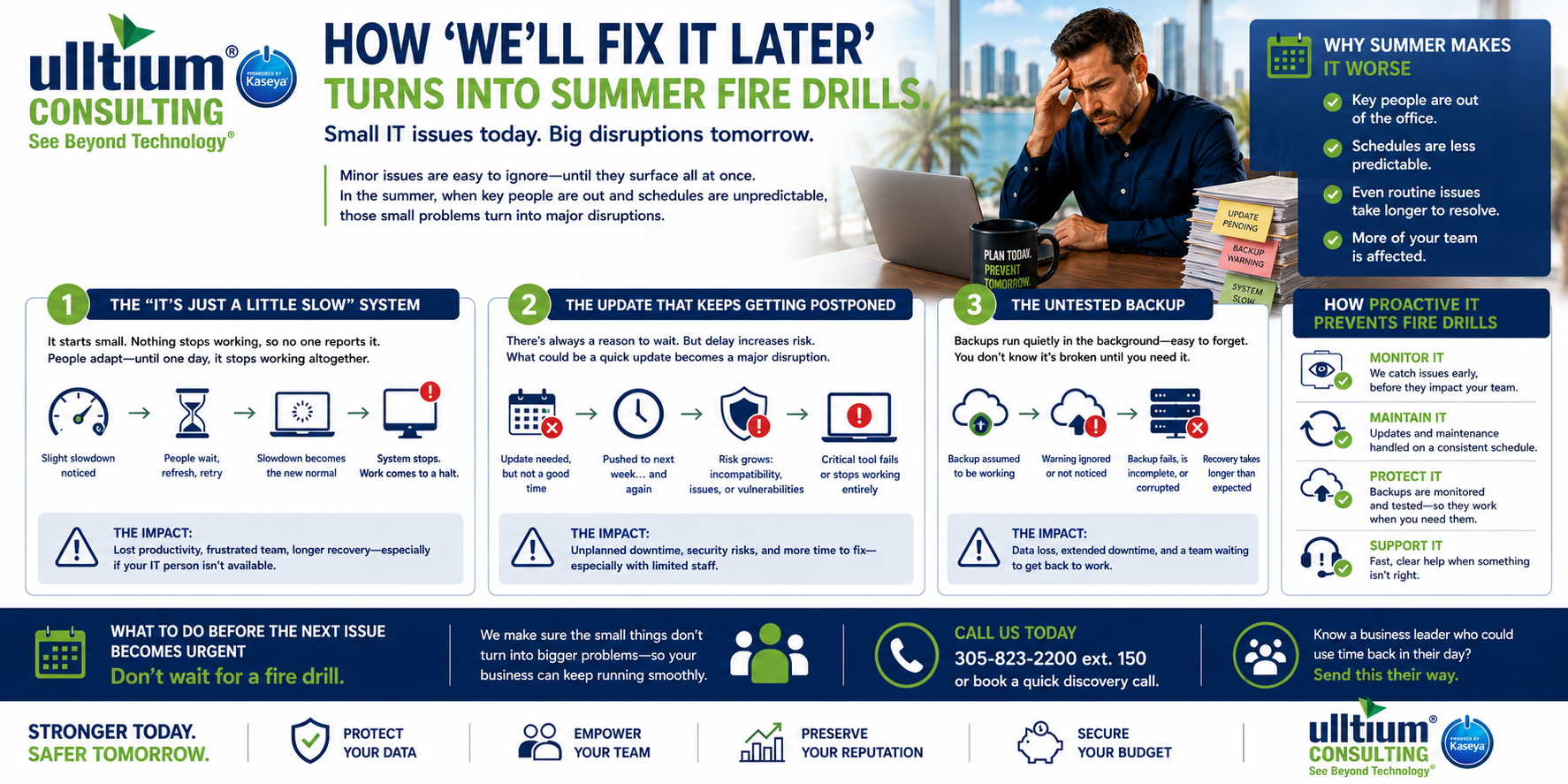
A system running slower than normal.
An update delayed another week.
A backup warning that never feels urgent enough to investigate.
Because operations continue, these concerns are often pushed aside while teams focus on more immediate priorities.
Direct Answer: Proactive IT reduces operational disruption by identifying and resolving technology issues early before they escalate into downtime, system failures, and workflow interruptions.
The challenge is that unresolved technology problems rarely remain isolated.
Eventually, they surface all at once.
Why Summer Operational Disruptions Hit Harder
Summer often creates less predictable business environments.
Employees take vacations.
Key personnel become less available.
Schedules shift constantly.
Under those conditions, even routine technical issues take longer to diagnose and resolve.
What could have been handled quietly becomes visible across the organization.
The “Small Issue” Pattern Businesses Ignore
Most operational disruptions follow a familiar pattern:
Slow Systems
Applications gradually become slower while employees adapt and continue working around the issue.
Delayed Updates
Critical maintenance is postponed because the timing never feels convenient.
Untested Backups
Recovery systems remain assumed to be functional without verification.
None of these issues appear urgent immediately.
Over time, however, they increase operational risk significantly.
Why Reactive IT Creates Larger Problems
Reactive IT addresses problems only after disruption occurs.
By the time systems fail:
• Productivity has already slowed
• Employees begin troubleshooting independently
• Workflows become fragmented
• Downtime affects multiple teams
The cost is no longer technical.
It becomes operational.
What Proactive IT Changes
Businesses that maintain operational consistency typically invest in:
• Continuous system monitoring
• Preventative maintenance
• Structured update scheduling
• Backup testing and validation
• Faster response processes
The goal is not to eliminate every issue.
It is to prevent small concerns from escalating into organization-wide disruptions.
A Leadership Perspective
Technology issues rarely become urgent overnight.
Most disruptions begin as manageable problems that remain unresolved too long.
Organizations that prioritize proactive IT reduce downtime, protect productivity, and create more stable operational environments.
Prepared businesses prevent fire drills before they begin.
Next Steps
If recurring technology concerns continue sitting unresolved within your organization, now may be the right time to evaluate how proactive your IT environment actually is.
At ulltium consulting®, we help Miami businesses reduce downtime and operational disruption through preventative technology management and structured support.
Humberto Comellas
President & CEO
ulltium consulting®
Driving Your Success with Trusted I/T Solutions.