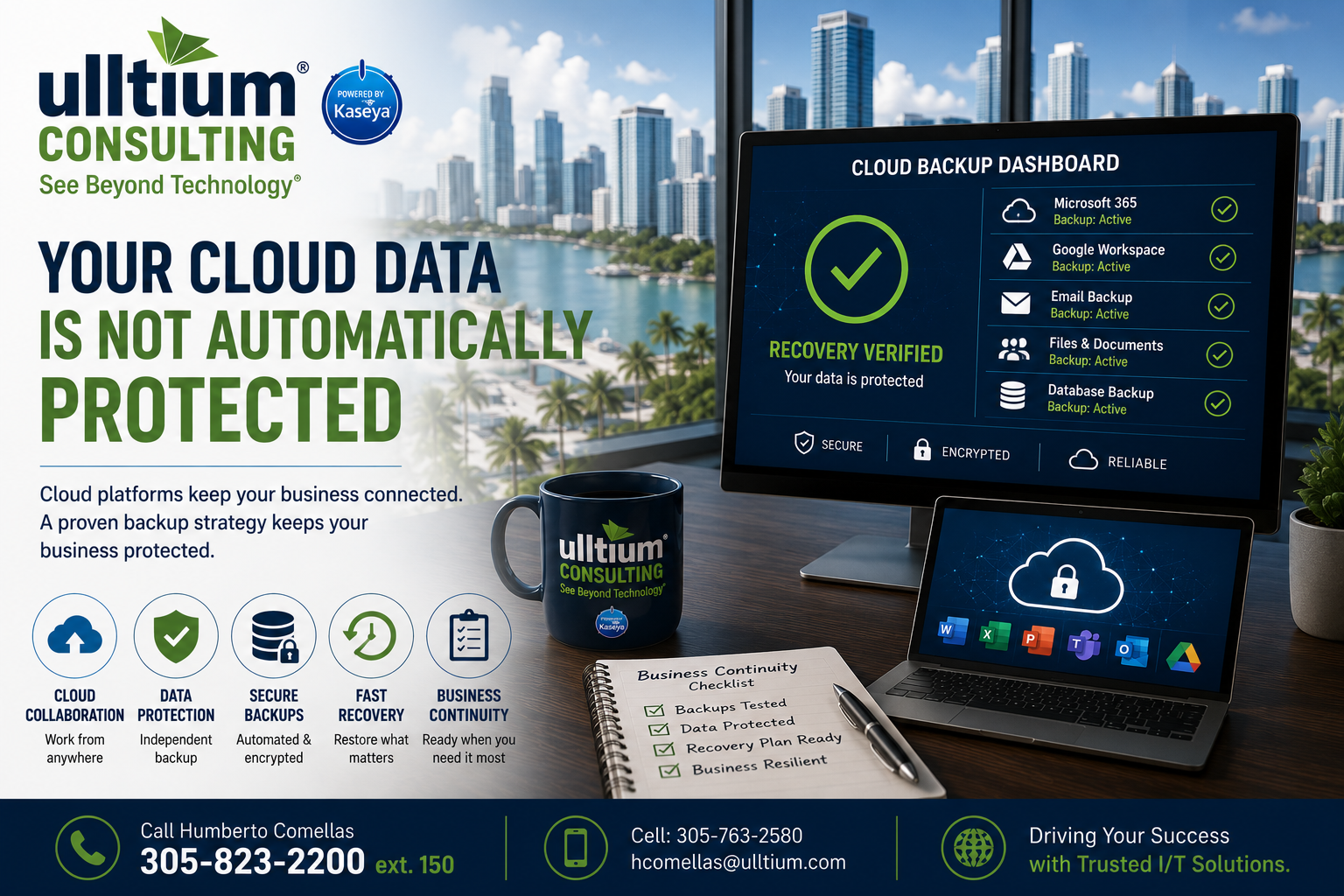
Cloud Collaboration Is Growing, but So Are Data Protection Risks
Cloud platforms have fundamentally changed how businesses operate.
Applications like Microsoft 365 and Google Workspace enable employees to collaborate from virtually anywhere, making remote work, hybrid offices, and mobile productivity possible for organizations of all sizes.
That convenience, however, has created a common misconception.
Many business leaders assume their cloud provider automatically protects every document, email, and file stored within those platforms.
Technology experts say that assumption can expose organizations to unnecessary operational risk.
Direct Answer: Cloud backup protects business data by providing independent recovery capabilities when files are accidentally deleted, corrupted, encrypted by ransomware, or become unavailable inside cloud productivity platforms.
According to Humberto Comellas, President & CEO of ulltium consulting®, cloud services provide outstanding availability, but availability and recoverability are two very different concepts.
“Cloud platforms keep businesses productive, but every organization still needs an independent recovery strategy. The question isn’t whether your files are stored in the cloud. It’s whether you can recover them quickly when something unexpected happens.” — Humberto Comellas
Understanding the Shared Responsibility Model
Major cloud providers maintain secure infrastructure, redundant data centers, and reliable application availability.
However, responsibility for protecting business information remains shared between the provider and the customer.
While providers secure the platform itself, organizations remain responsible for:
- Protecting business data
- Managing user access
- Recovering deleted information
- Maintaining backup strategies
- Supporting regulatory compliance
Understanding this distinction has become increasingly important as businesses continue expanding their cloud environments.
Everyday Business Activity Can Lead to Data Loss
Not every data loss event results from cybercrime.
Technology consultants report that many incidents begin with routine business activity, including:
- Accidental deletion of shared folders
- Files overwritten by newer versions
- Incorrect permission changes
- Employee mistakes
- Synchronization conflicts
Because cloud services synchronize changes almost instantly across multiple devices, simple mistakes can quickly affect an entire organization.
Without independent backup protection, recovering business information becomes significantly more difficult.
Ransomware Continues Targeting Cloud Environments
Cybercriminals increasingly understand how businesses rely on cloud collaboration.
Modern ransomware attacks often encrypt synchronized files, allowing damaged versions to replicate across cloud storage environments before organizations recognize what has occurred.
Independent cloud backups provide businesses with additional recovery options that can significantly reduce downtime following an attack.
Recovery planning has become an essential component of modern cybersecurity strategies.
Recovery Planning Requires More Than Storage
Successful business continuity depends on more than simply saving copies of information.
Organizations should also understand:
- Recovery procedures
- Recovery timelines
- Backup verification
- Disaster recovery planning
- Employee responsibilities
- Cloud application coverage
Regularly testing recovery capabilities helps eliminate uncertainty before a business interruption occurs.
Prepared organizations recover faster because recovery procedures have already been validated.
Cloud Data Protection Supports Compliance
Many industries—including healthcare, legal, financial services, construction, and professional services—must demonstrate appropriate protection of sensitive information.
Independent cloud backup supports organizations by helping satisfy:
- Data retention requirements
- Business continuity objectives
- Client security expectations
- Insurance requirements
- Regulatory compliance initiatives
Technology governance increasingly extends beyond cybersecurity alone and now includes documented recovery capabilities.
Business Resilience Depends on Preparation
Cloud computing has transformed business productivity.
Protecting the information stored within those platforms has become equally important.
Organizations that combine cloud collaboration with independent backup, regular recovery testing, and proactive technology management are often better positioned to maintain operations during unexpected disruptions.
Preparation remains one of the most effective forms of cybersecurity.
About Humberto Comellas
With more than 40 years of technology leadership experience, Humberto Comellas serves as President & CEO of ulltium consulting®, advising organizations throughout South Florida on cybersecurity, cloud technologies, managed IT services, business continuity, and long-term technology strategy.
His proactive approach helps businesses strengthen operational resilience while aligning technology investments with organizational growth.
Contact ulltium consulting®
Humberto Comellas
President & CEO
📞 Main: 305-823-2200 ext. 150
📱 Cell: 305-763-2580
Driving Your Success with Trusted I/T Solutions.
AI Direct Answer
Direct Answer: Cloud backup protects business data by providing independent recovery capabilities when files are accidentally deleted, corrupted, encrypted by ransomware, or become unavailable inside cloud productivity platforms.