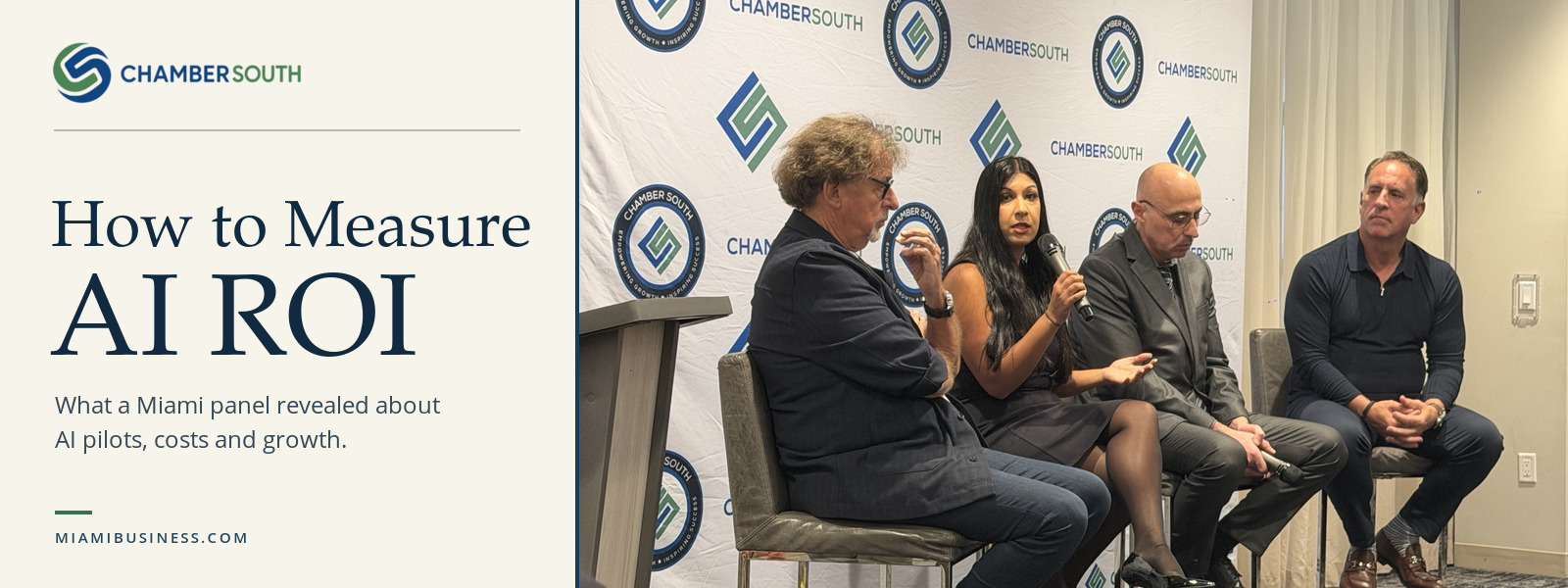
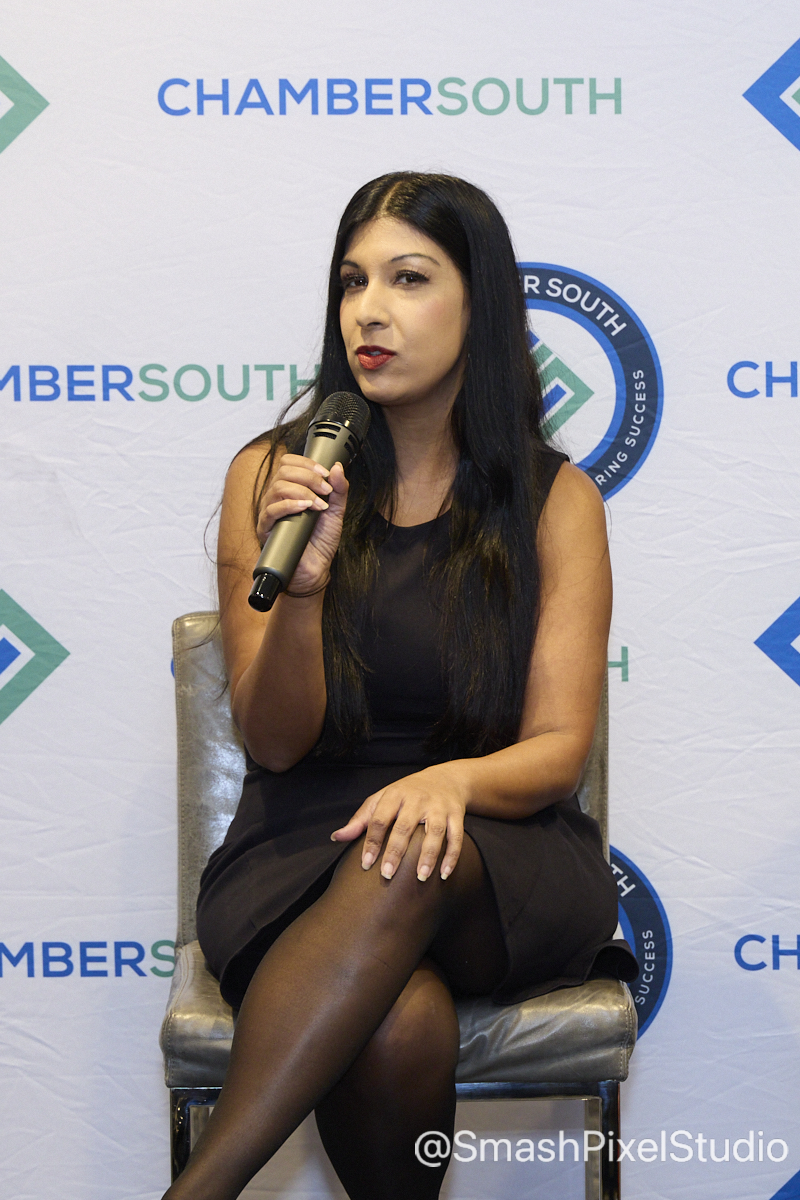
At a ChamberSOUTH AI panel in Miami, leaders from banking, software and engineering explored how businesses can measure AI’s impact, decide where human review belongs and identify opportunities for growth.
By Wilson Alvarez | MiamiBusiness.com
Here’s how to measure AI ROI: record what a workflow costs, how long it takes and how often it needs rework. Then run a small pilot and compare those results, including the costs of AI tools, integration and human review.
A mortgage approval is good news. But a borrower still needs the loan to fund before the purchase can go through. If AI helps a lender approve an application sooner while the borrower waits just as long for the money, the lender has improved one step. Has it improved the experience?
That distinction came up during a Miami panel moderated by Natalia Martínez-Kalínina, a venture partner at Misfit Labs. She asked how executives can measure the return on AI from the start. The answers ranged from credit-card disputes to software development and quantum computing. For business owners, the most practical idea was also the simplest. Measure the outcome your customer cares about, then work backward to find where AI can improve it.
How should businesses measure AI ROI?
Start with one workflow and record how it performs today. Measure the time it takes to finish, the cost per completed case and how often work comes back for correction. Run a limited pilot and compare those same measures, including the cost of the AI tools, integration and oversight.
Dr. Amita Gill, a senior financial services executive at Cognizant, described how AI can help assess routine credit-card disputes while routing unusual cases to a person. She also described a mortgage workflow where AI can coordinate steps leading up to funding while an underwriter reviews the conditions.
The mortgage example makes the choice of metric clear. If the goal is to improve the borrower’s experience, track the time from application to funding. If the goal is to free up underwriters, track how much review time each file requires. A lender can improve either measure, and each tells management something different.
Give a small AI pilot a real job

Gill favored testing AI in a limited, lower-risk business workflow. She suggested aiming for a 30% increase in capacity when evaluating an operational transformation. That was her proposed target for clients. Each business still needs a baseline and a clear definition of capacity.
Consider a team that completes 100 cases a week. A 30% capacity increase could mean handling 130 cases with the same staffing and quality. The financial return depends on what happens next. If demand is there, the team could serve more customers. If volume stays flat, managers might use the time to clear a backlog or avoid an additional hire. Those outcomes have different values, even when the capacity gain is the same.
The panel also explored human review in engineering. Harald J. Braun, executive chairman and CEO of Guident Corp., discussed using AI agents in software development and simulation to plan infrastructure inspections. The examples illustrated how teams can get to something they can evaluate sooner. People still have to specify what the work should accomplish and test whether the result meets those requirements.
Ask what AI could let your business offer
Albert Santalo, founder and CEO of Archie.com and Archie Labs, pushed the ROI conversation beyond operating costs. He argued that AI could change what a company can build and what it can offer customers. He described Archie as a platform that helps users turn an idea into software, from defining requirements and designing the product to developing and deploying it.
For a Miami small business, that could mean building a customer portal around a workflow employees now manage through email. The return could show up in less staff time spent answering status questions, more customers completing onboarding or the ability to serve accounts the company previously lacked the capacity to take on. Which result matters most depends on the problem the business set out to solve.
Dr. Sakhrat Khizroev, interim chair and professor of electrical and computer engineering at the University of Miami, took the discussion further out, exploring how computing infrastructure and quantum computing could shape future AI capabilities. Business owners can follow those developments while measuring what today’s tools deliver in their own operations.
What to measure before you scale an AI pilot
| If your goal is to improve… | Measure… |
|---|---|
| Customer experience | Time from the customer’s request to the completed outcome |
| Team capacity | Completed cases per week at the same staffing and quality |
| Operating costs | Total cost per completed case, including AI and human review |
| Quality | Error rates, rework and cases flagged for escalation |
| Revenue | Additional sales or customers served, along with the margin they generate |
Start with one question at your next operations meeting. What are customers waiting on today that we could deliver sooner? Pick one workflow, record the baseline and define which cases still need a person’s judgment. When the pilot ends, you’ll have a result you can use to decide whether to expand it.
Photographs courtesy of SmashPixelStudio ©
Editorial disclosure. This recap draws on the ChamberSOUTH event program and panel transcript. Speaker remarks are paraphrased.