Select Page

Communities

Widgetized Area

This panel is active and ready for you to add some widgets via the WP Admin

Faith Communities in and around North Bay Village

North Bay Village and its surrounding areas offer a variety of places of worship, catering to diverse faith traditions. Here are some notable churches and temples in the vicinity:

Within North Bay Village:

  1. Ummah of Miami Beach
    • Address: 7904 West Dr, North Bay Village, FL 33141
    • Phone: 786-216-7035
    • Description: A local place of worship serving the Muslim community in North Bay Village.

Nearby Places of Worship:

  1. Calvary Chapel
    • Address: 7141 Indian Creek Dr, Miami Beach, FL 33141
    • Phone: 305-531-2730
    • Description: A Christ-centered, cross-focused church offering services and community programs.
  2. Temple Moses Sephardic Congregation of Florida
    • Address: 1200 Normandy Dr, Miami Beach, FL 33141
    • Phone: 305-861-6308
    • Description: A Sephardic Jewish congregation providing religious services and cultural events.
  3. Iglesia Jesus Es Rey
    • Address: 1133 71st St, Miami Beach, FL 33141
    • Phone: 305-867-7679
    • Description: A Christian church offering worship services and community outreach programs.
  4. St. Mary Magdalen Catholic Church
    • Address: 17775 N Bay Rd, Sunny Isles Beach, FL 33160
    • Phone: 305-931-0600
    • Description: A Catholic parish providing mass services and religious education.
  5. St. Bernard de Clairvaux Episcopal Church
    • Address: 16711 W Dixie Hwy, North Miami Beach, FL 33160
    • Phone: 305-945-1461
    • Description: An Episcopal church known for its historic architecture and spiritual services.
  6. St. Sophia Greek Orthodox Cathedral
    • Address: 2401 SW 3rd Ave, Miami, FL 33129
    • Phone: 305-854-2922
    • Description: A Greek Orthodox cathedral offering liturgical services and cultural events.
  7. New Revelation Alliance Church
    • Address: 11900 Biscayne Blvd, Miami, FL 33181
    • Phone: 305-893-8050
    • Description: A Christian church focusing on community service and spiritual growth.

These establishments reflect the rich tapestry of faith communities accessible to residents and visitors of North Bay Village, fostering spiritual growth and community engagement.


State of Hialeah January 2026

“January is a test, not a promise; leadership is measured in action, not words.”
-Wilson Alvarez 

TL;DR
January 2026 ushered in new leadership in Hialeah. With the mayoral transition complete, the city focused on stabilizing operations, delivering on campaign promises, and addressing pressing issues like sanitation, housing, and traffic safety. Community engagement remained high, and the Chamber of Commerce signaled priorities for the year ahead.

What Happened in Hialeah – January 2026

The new mayor officially took office on January 6, 2026, pledging transparency, fiscal responsibility, and infrastructure improvements.

City Council committees immediately began reviewing year-end reports, budget allocations, and priority projects.

The Hialeah Chamber of Commerce convened a January kickoff meeting for local businesses, focusing on workforce training, permitting reform, and small business growth strategies.

Community events included the Three Kings Day celebration on January 6, drawing families to Milander Park with music, crafts, and cultural festivities.

Public safety saw early action with traffic enforcement initiatives at high-risk intersections and expanded patrols in residential neighborhoods following community requests.

Political Round-Up – January 2026

Mayor – [Mayor Name] (newly elected)
The Good:

Prioritized continuity in city operations while introducing a strategic 100-day plan for key infrastructure and public safety initiatives.

Held multiple town halls in the first two weeks to communicate directly with residents about priorities and transparency.

Working On:

Residents and local media are closely monitoring progress on housing affordability programs promised during the campaign.

Traffic management and sanitation remain immediate challenges, especially in older neighborhoods.

Taking Action:

Signed executive orders streamlining permitting and administrative processes for small businesses.

Initiated a cross-department task force to address trash collection delays and aging fleet replacements.

City Manager Lourdes Gonzalez
The Good:

Delivered detailed briefings to the new mayor and council to ensure smooth operational handoff.

Coordinated winter maintenance projects and street safety enhancements.

Working On:

Sanitation fleet upgrades are still pending federal funding approvals.

Monitoring transit infrastructure proposals to ensure feasibility and cost-effectiveness.

Taking Action:

Implemented an internal dashboard to track department response times and project milestones.

🪑 City Council Highlights
Councilwoman Monica Perez:

Hosted constituent listening sessions on January 15 and 22, emphasizing community safety and housing concerns.

Advocated for early approval of small business grant programs.

Councilman Carl Zogby:

Expanded youth mentorship initiatives in partnership with local schools.

Began reviewing city transit proposals and traffic safety upgrades.

Councilwoman Vivian Casáls-Muñoz:

Championed park security enhancements and lighting improvements.

Pushed for clarity on zoning policies affecting commercial development.

Chamber of Commerce & Business Associations – January 2026
The Hialeah Chamber of Commerce focused on the city’s economic outlook for 2026. Highlights included:

Workforce training programs to address labor shortages.

Small business permitting streamlining and regulatory review.

Advocacy for infrastructure investment to support commercial corridors.

The Chamber encouraged collaboration with city leadership to ensure predictable policies and continued business growth.

Monthly Summary – January 2026
January 2026 set the stage for a new political chapter in Hialeah. Leadership transitions were completed, operations stabilized, and early initiatives in public safety, housing, and business growth were launched. Residents are optimistic but expect measurable results, while the city seeks to balance campaign promises with administrative reality. The tone is cautious but proactive, with community and business engagement laying a foundation for a productive year.

Read More

State of Miami Springs – January 2026

Miami Springs January 2026 Update: City Priorities and Infrastructure Outlook
The Miami Springs January 2026 Update begins the year with structured planning, infrastructure coordination, and renewed civic expectations. As a result, city leadership has set a deliberate tone for 2026. At the same time, residents and businesses are focusing on measurable progress, transparent communication, and long-term stability.
TLDR — Overall, January in Miami Springs highlights infrastructure scheduling, traffic discussions, economic stability, and proactive engagement from both city officials and the business community.

Municipal Leadership Sets the Direction for 2026
At the start of the year, city leadership delivered a clear message: preparation determines performance. In particular, Mayor Maria Puente Mitchell emphasized transparency and long-term infrastructure planning. Additionally, she stressed the importance of improving communication regarding ongoing projects.
Traffic congestion and construction visibility remain top concerns among residents. Therefore, clearer updates and scheduling transparency are now priorities. In response, city departments are aligning timelines earlier than in previous years.
Meanwhile, City Manager William Barnett prioritized departmental coordination and disciplined budget implementation. By doing so, the city reduces inefficiencies and strengthens accountability. Consequently, initiatives outlined earlier are positioned to move forward more smoothly.

City Commission Priorities and Planning
January Commission meetings focused on defining annual objectives rather than revisiting past concerns. Instead, commissioners emphasized forward-thinking strategy and measurable benchmarks. As a result, discussions centered on execution rather than reaction.
Key topics included:

Infrastructure project timelines

Traffic mitigation strategies

Fiscal oversight and budget transparency

Expanded community engagement efforts

For example, commissioners reviewed scheduling systems to improve public visibility. In addition, financial reporting standards were discussed to reinforce fiscal responsibility.
Business Climate and Economic Stability
Local economic indicators reflect steady conditions. Following the holiday season, retail activity returned to normal levels. At the same time, commercial occupancy rates remained consistent.
Restaurants adjusted staffing and inventory to match demand shifts. Meanwhile, fitness centers and wellness providers experienced seasonal membership increases. Because January traditionally brings renewed consumer motivation, service-based businesses often benefit during this period.
For additional insight, explore

Infrastructure and Traffic Outlook
Transportation and mobility remain central discussion points. While congestion patterns are not new, community expectations around communication have increased. Therefore, infrastructure transparency continues to be emphasized.
Morning and afternoon traffic flows are under evaluation. In response, officials are working to provide clearer scheduling updates. Since mobility directly impacts schools, businesses, and daily routines, visibility remains critical.
For a broader perspective, readers can exploreMoving forward, transportation updates will likely remain a consistent focus.

Community and Chamber Engagement
Local business associations and the Chamber of Commerce began 2026 with strategic planning sessions. Not only do these meetings strengthen partnerships, but they also encourage collaboration between public and private stakeholders.
Furthermore, early communication helps prevent misunderstandings later in the year. When alignment occurs early, execution tends to improve. As a result, community confidence increases.

Monthly Perspective
Overall, January reflects preparation rather than dramatic change. Although no major announcements dominated headlines, foundational planning took place.
Leadership has defined priorities.Businesses remain steady.Residents expect measurable results.
Therefore, January established the roadmap. Now, execution will determine the strength of 2026.

Read More

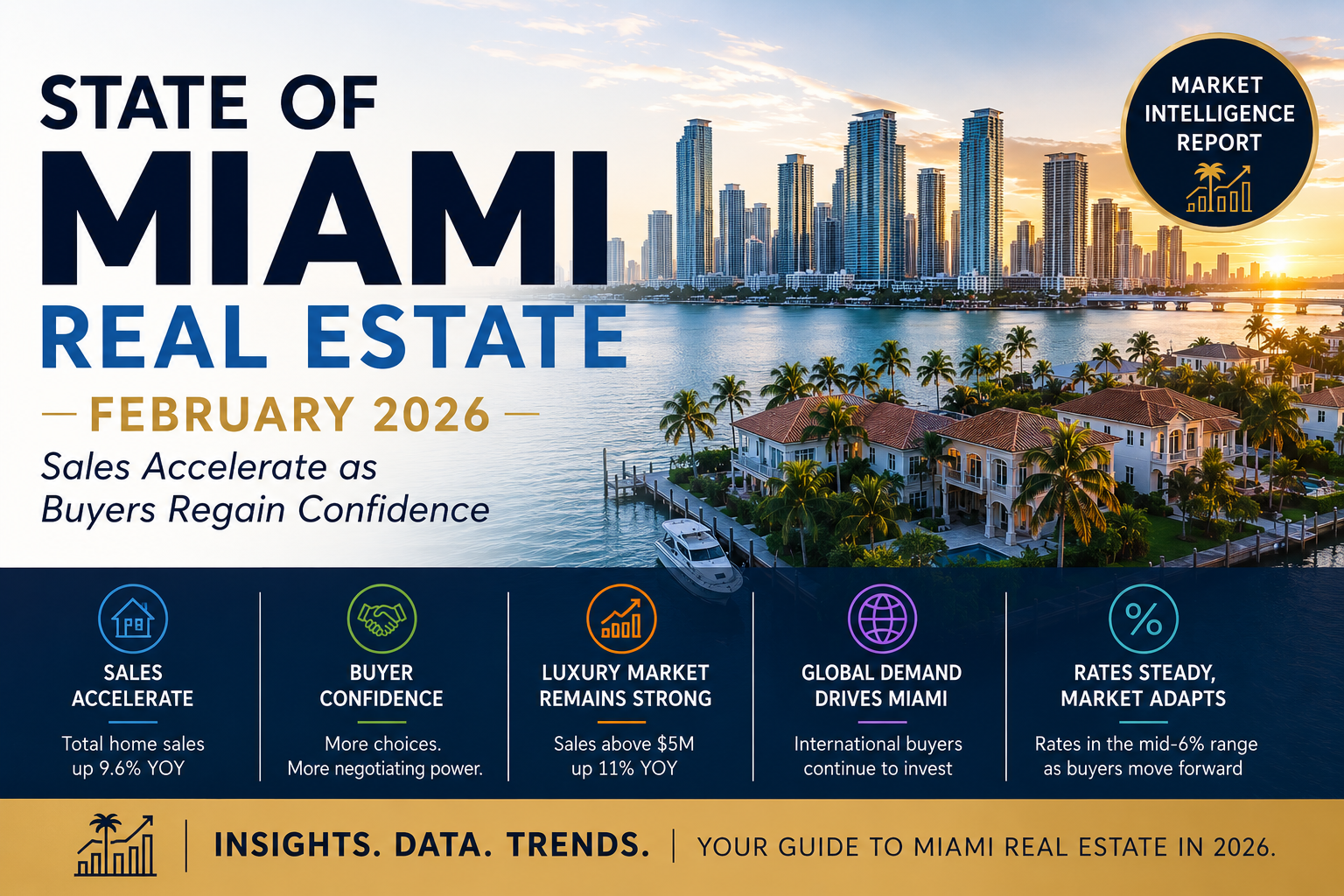
State of Miami Real Estate – February 2026

Sales Accelerate as Buyers Regain Confidence

Miami’s housing market gained momentum in February, with stronger sales activity, resilient luxury demand, and a market increasingly rewarding well-informed buyers and strategic sellers.

Executive Summary
If January represented stabilization, February 2026 demonstrated renewed momentum.
Miami-Dade County recorded its sixth consecutive month of year-over-year sales growth, signaling that buyers have largely adapted to today’s financing environment and are once again entering the market with confidence. Total home sales increased 9.6% year-over-year, driven by gains in both single-family homes and condominiums. (MIAMI REALTORS® + RWorld)
The market remains very different from the rapid appreciation seen during the pandemic years.
Today’s environment is defined by:

More informed buyers
Greater inventory choices
Strong luxury demand
Continued international investment
Pricing discipline by sellers

Rather than slowing, Miami’s market is evolving into one driven by long-term fundamentals instead of short-term speculation.

Market Snapshot
February produced one of the strongest overall performances since mid-2025.
Key market highlights included:

Total home sales increased 9.6%
Single-family home sales increased 4.3%
Condominium sales increased 14.7%
Luxury sales above $5 million rose 11%
Million-dollar single-family sales increased nearly 19% year-over-year. (MIAMI REALTORS® + RWorld)

The broad-based nature of these gains is significant.
Rather than one segment carrying the market, demand expanded across multiple price points, reflecting renewed buyer confidence despite mortgage rates remaining above historic lows.

Single-Family Homes Continue Setting the Pace
The single-family market remains Miami’s strongest residential sector.
Buyer demand continues to be supported by:

Population growth
Business relocation
Limited land availability
Strong employment
Continued wealth migration

Pending sales also increased substantially during February, suggesting healthy activity heading into the spring selling season. New pending contracts rose 7.7% year-over-year, a positive indicator for future closings. (MIAMI REALTORS® + RWorld)
Homes priced appropriately continue selling quickly.
Properties entering the market with unrealistic pricing increasingly require reductions before attracting serious buyers.
Pricing—not scarcity—is becoming the deciding factor.

Condominiums Show New Strength
Perhaps the biggest surprise in February was the rebound in condominium sales.
Existing condo transactions climbed nearly 15% year-over-year, marking one of the strongest monthly performances in recent memory. (MIAMI REALTORS® + RWorld)
That improvement does not mean every condominium building is experiencing the same demand.
Today’s buyers continue focusing heavily on:

Reserve funding
Structural inspections
Insurance costs
HOA financial health
Future special assessments

Buildings with transparent governance and healthy reserves continue outperforming comparable communities with unresolved financial or structural concerns.
The condominium market is no longer simply about location—it is increasingly about financial stability.

Luxury Market Continues Defying Expectations
Miami’s luxury sector remains one of the strongest in the nation.
February demonstrated that affluent buyers continue viewing South Florida as a premier destination for investment, lifestyle, and wealth preservation.
Sales above $5 million increased 11%, while million-dollar home transactions continued rising across both the single-family and condominium sectors. (MIAMI REALTORS® + RWorld)
Luxury demand remains fueled by:

High-net-worth migration
Favorable tax policies
Cash buyers
International investment
Limited waterfront inventory

These buyers are generally less sensitive to mortgage rate fluctuations, helping insulate the luxury segment from broader economic uncertainty.

International Buyers Remain a Competitive Advantage
Few U.S. markets enjoy the level of global demand that Miami attracts.
International buyers continue choosing South Florida for:

Economic stability
Lifestyle
Business expansion
Education
Long-term investment

Miami’s global reputation remains one of its greatest competitive advantages, particularly as international capital continues flowing into premium residential properties and new developments. (MIAMI REALTORS® + RWorld)

Mortgage Rates: Buyers Are Adjusting
Mortgage rates remained in the low-to-mid 6% range during February.
While financing costs remain well above pandemic-era lows, buyers increasingly appear to have accepted today’s interest-rate environment.
Instead of waiting for dramatically lower rates, many purchasers recognize they can refinance in the future while securing desirable properties today.
This psychological shift has helped support stronger transaction volume.

Commercial Real Estate Maintains Positive Momentum
Commercial activity remained healthy throughout February.
Office leasing continued benefiting from financial firms and corporate relocations.
Industrial properties remained among the strongest asset classes due to logistics, warehousing, and international trade.
Mixed-use developments also continued attracting investor interest as developers sought projects combining residential, retail, hospitality, and office components.
Miami’s diversified economy continues supporting long-term commercial real estate demand.

What Buyers Should Know
February reinforced an important trend.
Today’s buyers have more negotiating power than they did just two years ago—but opportunities still require preparation.
Advantages include:

Larger inventory selection
Greater negotiating leverage
More seller flexibility
Longer decision-making timelines
Increased financing options

The best opportunities continue emerging for buyers who understand neighborhood trends rather than focusing solely on headline market statistics.

What Sellers Should Know
The market remains healthy—but expectations have changed.
Today’s successful sellers are:

Pricing strategically
Preparing properties professionally
Investing in high-quality photography and marketing
Responding quickly during negotiations

Well-positioned homes continue selling.
Overpriced listings increasingly become stale.
The market is rewarding preparation rather than optimism.

Looking Ahead to March 2026
February suggests Miami entered the spring selling season with considerable momentum.
Demand remains supported by:

Population growth
Corporate relocation
International investment
Limited developable land
Continued economic expansion

Challenges remain, particularly within portions of the condominium market where reserve funding, insurance costs, and building compliance continue influencing buyer decisions.
Nevertheless, Miami’s long-term fundamentals remain exceptionally strong.
Rather than experiencing a boom or a correction, the market appears to be entering a healthier phase characterized by balance, transparency, and informed decision-making.
For buyers, sellers, and investors alike, that creates opportunities that did not exist just a few years ago.

Editorial Disclosure
This State of Miami Real Estate – February 2026 report was prepared by MiamiRealEstateNews.com using publicly available information from the MIAMI Association of REALTORS®, Florida Realtors®, MLS market statistics, and other reliable industry sources. Market statistics have been summarized and interpreted for educational and informational purposes. This report should not be considered legal, tax, financial, or investment advice. Readers should consult qualified professionals before making real estate decisions. (MIAMI REALTORS® + RWorld)


Read More