

Alessandra Dumenigo
Helping Florida Families Protect What Matters Most Through Estate Planning, Probate, and Guardianship
When families face important legal decisions, they deserve more than legal documents—they deserve guidance, compassion, and someone who genuinely cares about protecting their future.
As an Associate Attorney at Nuñez Estate Law & Title, Alessandra Dumenigo focuses her practice on helping individuals and families navigate estate planning, probate administration, and guardianship matters throughout Florida. Since being admitted to The Florida Bar in 2022, she has been committed to providing practical legal solutions while making complex legal processes easier to understand.
Whether a client is preparing an estate plan, administering the estate of a loved one, or seeking legal guidance through a guardianship matter, Alessandra believes every client deserves clear communication, thoughtful planning, and personalized attention.
Building Peace of Mind Before It Is Needed
Many people delay estate planning because they believe they have plenty of time or assume estate plans are only necessary for the wealthy. Alessandra works to educate clients that a properly prepared estate plan benefits individuals and families of every stage of life.
Her practice includes assisting clients with:
Wills
Revocable Living Trusts
Durable Powers of Attorney
Healthcare Directives
Probate Administration
Guardianship Proceedings
Related Estate Planning Matters
Her objective is simple: help clients protect their families, preserve their assets, and reduce uncertainty during life’s most important transitions.
Guiding Families Through Probate
The loss of a loved one can be emotionally overwhelming. Probate often adds legal responsibilities that many families have never encountered before.
Alessandra works closely with clients throughout the probate process, helping them understand each step while coordinating the legal requirements necessary to administer an estate efficiently and professionally.
She recognizes that every family situation is unique and believes that compassionate communication is just as important as legal knowledge.
Client-Focused Representation
One of Alessandra’s greatest strengths is her commitment to creating a positive client experience.
Clients appreciate her professionalism, responsiveness, and attention to detail. She understands that legal matters often involve difficult personal decisions, and she strives to ensure clients feel informed and supported from the initial consultation through the completion of their matter.
By working collaboratively with the attorneys and staff at Nuñez Estate Law & Title, Alessandra helps provide the personalized service that has become a hallmark of the firm’s reputation.
Education and Professional Background
Alessandra Dumenigo earned her Juris Doctor from St. Thomas University School of Law in 2022 and was admitted to The Florida Bar on September 22, 2022.
She is a member in good standing with The Florida Bar and practices in Miami-Dade County, with a concentration in:
Estate Planning
Probate Administration
Guardianship
Real Property
Probate & Trust Law
Her commitment to continued professional development allows her to stay informed on Florida law while helping clients make confident legal decisions.
Serving South Florida Families
From young families creating their first estate plan to individuals navigating probate after the loss of a loved one, Alessandra is dedicated to providing dependable legal guidance with professionalism and compassion.
She believes every client deserves to understand their options, receive honest communication, and work with a legal team that genuinely cares about helping them achieve peace of mind.
At Nuñez Estate Law & Title, that commitment remains at the center of every client relationship.
Contact Information
Alessandra Dumenigo
Associate Attorney
Nuñez Estate Law & Title
7700 N. Kendall Drive, Suite 505
Miami, Florida 33156
Office: (305) 962-5929
General Office: (305) 239-8620
Email: adumenigo@nunezlawfl.com
Florida Bar & Website Compliance Notes
This article has been drafted to align with Florida Bar advertising requirements and (WAGC) publishing standards by:
Avoiding statements that could be interpreted as guarantees of results.
Avoiding comparisons with other attorneys.
Avoiding unverifiable claims such as “best,” “top-rated,” or “expert.”
Presenting factual information regarding education, licensure, practice areas, and professional responsibilities.
Maintaining an informational and educational tone appropriate for attorney marketing.
Not including client testimonials, specialization claims, or statements implying certification unless separately verified.
Attorney Advertising. The information contained in this article is provided for informational purposes only and should not be construed as legal advice. Reading this article does not create an attorney-client relationship. Every legal matter is unique and requires an evaluation of its individual facts and circumstances. Prior results do not guarantee a similar outcome. Please contact Nuñez Estate Law & Title to discuss your specific legal needs.
Read More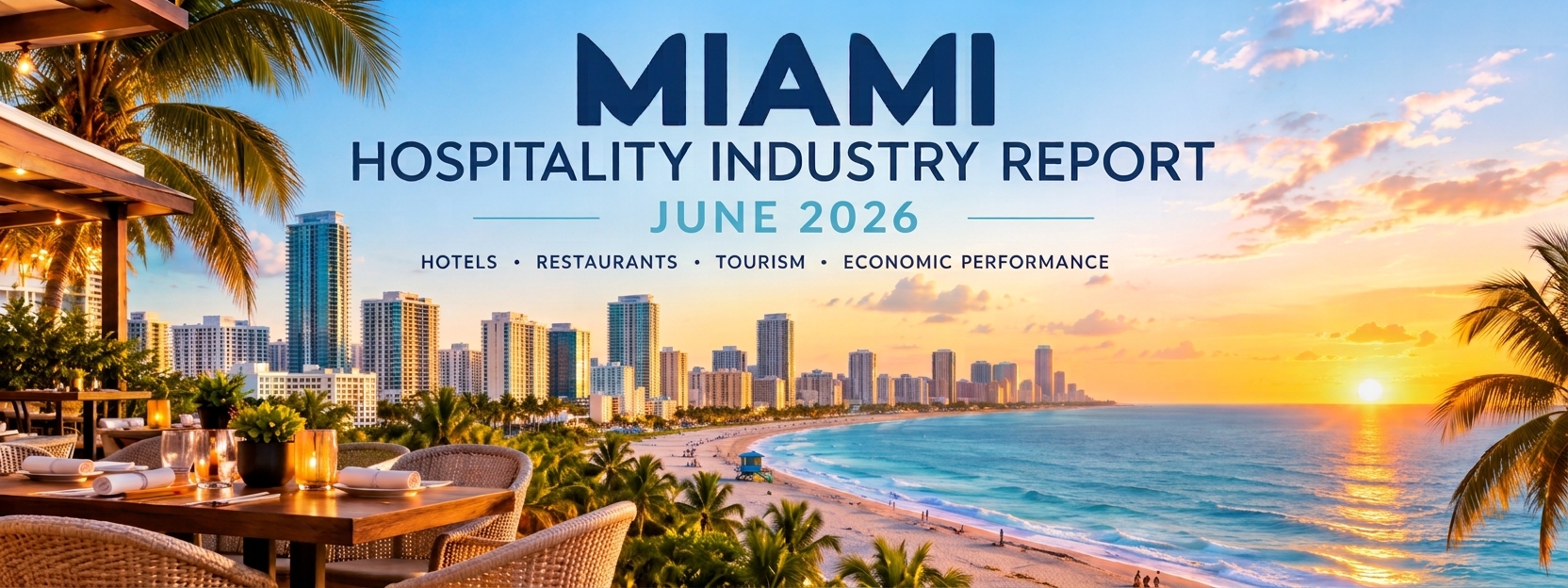
Miami Hospitality Industry Report-June 2026
Miami Hospitality Feels the Full Impact of the World Cup as Hotel Rates Surge 23% in June
June 2026 became one of the most closely watched months in Miami’s hospitality calendar.
After months of preparation, the FIFA World Cup finally arrived in South Florida, bringing international soccer fans, national teams, corporate hospitality programs and visitors from around the world to Miami.
The effect on the hotel market was immediate.
Miami recorded the largest year-over-year increase in average daily hotel rates among the 25 largest U.S. hotel markets, with ADR climbing 23.2% to $218.37 in June. RevPAR also increased significantly as the World Cup generated concentrated periods of demand.
But June also produced a more complicated story.
The tournament created extraordinary pricing opportunities on match days, while overall occupancy did not increase at the same pace. That difference offers an important lesson about Miami’s hospitality economy: a major international event can raise room rates dramatically without producing the same percentage increase in occupied rooms.
For hotels, restaurants, transportation companies and other hospitality businesses, June was therefore a month of both opportunity and operational pressure.
June 2026 By the Numbers
Indicator
June 2026
Miami hotel ADR
$218.37
Miami ADR change vs. June 2025
+23.2%
U.S. hotel ADR
$173.76
U.S. ADR change
+6.7%
U.S. hotel occupancy
69.6%
U.S. RevPAR
$120.97
Miami RevPAR, June 21–27
$196.87
Miami RevPAR change, June 21–27
+51.6%
Miami ADR, June 21–27
$267.87
Miami ADR change, June 21–27
+51.1%
Miami restaurant openings/closures tracked
12+
CoStar reported that U.S. hotel occupancy reached 69.6% in June, up 1.6% from June 2025. ADR rose 6.7% to $173.76, while RevPAR increased 8.4% to $120.97. Miami stood out with the country’s largest ADR increase among the Top 25 markets, rising 23.2% to $218.37.
The World Cup Changes Miami’s Hotel Market
The defining story of June was the FIFA World Cup.
Miami hosted World Cup matches at Hard Rock Stadium in Miami Gardens, turning the region into an international gathering point for soccer fans.
The tournament created several distinct demand periods throughout the month.
For hotel operators, the most valuable nights were not necessarily every night of the month.
They were concentrated around match days and the nights immediately before them.
CoStar’s weekly data makes that distinction particularly clear.
During the week of June 21–27, Miami’s ADR jumped 51.1% to $267.87, while RevPAR increased 51.6% to $196.87. Miami recorded the largest increases in both ADR and RevPAR among the country’s Top 25 hotel markets.
The strongest period coincided with three World Cup matches.
That produced a concentrated five-day period in which Miami hotel ADR increased by more than 50% on each day, according to CoStar.
Match Days Were the Big Revenue Opportunity
The World Cup demonstrates why looking only at monthly averages can hide what actually happened inside the hospitality market.
A hotel may have:
Extremely high room rates on match nights
Moderate rates between matches
Lower occupancy on non-event nights
Large differences between luxury and economy properties
Consequently, the economic impact of a major event can be concentrated into a relatively small number of dates.
For Miami hotels, June created exactly that situation.
The opportunity was not simply to sell more rooms.
It was to maximize revenue during periods when demand was concentrated.
Hotel Occupancy Tells a More Complicated Story
One of the most interesting aspects of the June results was the relationship between room rates and occupancy.
The World Cup produced enormous increases in ADR and RevPAR during key weeks, but occupancy did not rise at the same pace.
During June 21–27, Miami hotel occupancy increased only 0.3% year over year to 73.5%, even as ADR rose 51.1%.
That is a remarkable difference.
It means that much of the improvement in hotel revenue performance during the peak World Cup period came from higher prices rather than dramatically higher occupancy.
For hotel owners, this is an important distinction.
Revenue can rise substantially even when the number of occupied rooms changes very little.
June’s Hotel Market Outperformed the National Market on Pricing
Miami’s performance becomes even more significant when compared with the national market.
Metric
Miami
U.S.
June ADR
$218.37
$173.76
ADR YoY change
+23.2%
+6.7%
June RevPAR YoY
Strong increase
+8.4%
Miami’s ADR increase was more than three times the national rate of growth.
CoStar attributed the strongest national hotel performance in June partly to the World Cup, with Miami and San Francisco among the markets most directly affected by the tournament.
Estimated Miami Hotel Room Revenue
June’s hotel data allow us to estimate the scale of room revenue, but Miami Hospitality News is deliberately avoiding presenting a fabricated “official” revenue number.
The correct approach is to calculate revenue using:
Available rooms × days × occupancy × ADR
Once final countywide room inventory and full-month occupancy data are available, this formula can provide a defensible estimate of Miami-Dade’s hotel room revenue.
For now, the verified market data show that Miami’s average room rate reached $218.37 and that the market experienced several weeks of substantially higher rates around World Cup activity.
This excludes:
Restaurants
Bars
Resort fees
Parking
Spa services
Banquets
Meetings
Retail
Other hotel revenue
Therefore, total hotel-property revenue was significantly higher than room revenue alone.
The World Cup Wasn’t Automatically a Hotel Windfall Everywhere
The June story also contained an important caveat.
Before the tournament, expectations for Miami’s hotel industry were extremely high.
However, preliminary data during the early portion of the World Cup showed that hotel demand was not uniformly stronger than the same period in 2025.
The Miami Herald reported that preliminary CoStar data for June 11–20 showed some hotel-performance measures below the prior year, with stronger demand emerging around later matches.
That distinction matters.
A global sporting event can produce:
Huge demand on specific dates + weaker demand on other dates = uneven monthly performance.
Miami’s June hotel market appears to have followed that pattern.
Restaurants Experience a World Cup Summer
The World Cup also created a different environment for Miami restaurants.
Fans from multiple countries arrived in the region, creating demand for restaurants, bars and nightlife venues.
The tournament was particularly relevant for establishments with:
Outdoor seating
Large televisions
Sports programming
Late-night service
International menus
Bars
High-capacity dining rooms
Neighborhoods such as Miami Beach, Brickell, Downtown Miami, Wynwood and Coconut Grove were positioned to capture different portions of visitor and local demand.
However, there is no comprehensive government dataset that provides the total amount spent at Miami restaurants specifically because of the World Cup.
For that reason, Miami Hospitality News does not assign a specific dollar value to World Cup-related restaurant revenue.
Miami’s Restaurant Industry Continues to Change
June was also another active month for restaurant openings and closures.
Miami New Times documented more than a dozen significant openings and closures during the month.
Among the notable openings was the return of China Grill at Bal Harbour Shops, more than a decade after the restaurant left South Beach.
Other June openings included:
Katana’s new Coral Way location
Paris Baguette’s first Miami café in Wynwood
Sunshine Coffee’s North Beach flagship
Upside in Wynwood
Stand in Coral Gables
The variety of openings demonstrates that Miami’s food-and-beverage market continues to attract both international brands and established local operators.
At the Same Time, Established Restaurants Are Closing
June also provided a reminder that restaurant growth and restaurant stability are two different things.
Two notable Miami closures attracted considerable attention.
Lokal, the Coconut Grove burger restaurant that had operated for 15 years, closed June 28. Miami New Times reported that owner Matt Kuscher cited a 50% rent increase as a major factor in the closure.
Mr Chow at W South Beach also closed after nearly two decades at the property as the hotel prepared for redevelopment.
These closures illustrate the economic pressure facing established restaurants even in a market experiencing strong tourism.
High visitor spending does not eliminate:
Rent increases
Labor costs
Insurance
Food costs
Utilities
Renovation expenses
Property redevelopment
The restaurant sector therefore remains one of the most dynamic—and competitive—parts of Miami hospitality.
Food Prices Are Relatively Stable in Miami
The cost environment in June was somewhat different from the national picture.
According to the U.S. Bureau of Labor Statistics, the Miami-Fort Lauderdale-West Palm Beach consumer price index increased 3.4% during the 12 months ending in June.
Food prices in the region increased 2.1% year over year.
More specifically, the index for food away from home—which includes restaurant, cafeteria and vending purchases—increased only 0.2% over the year.
That is considerably different from the national picture.
Nationally, food-away-from-home prices increased 3.4% during the 12 months ending in June.
For Miami restaurants, relatively modest menu-price inflation could help support consumer demand, although individual operators can experience very different cost pressures.
Energy Costs Remain a Hospitality Concern
Energy remained considerably more expensive than a year earlier.
The Miami-area energy index increased 14.1% during the 12 months ending in June, while gasoline prices increased 27.7%.
This is particularly relevant for hotels.
Miami hotels have significant energy requirements because of:
Air conditioning
Refrigeration
Laundry
Hot water
Pool systems
Restaurants
Elevators
Lighting
Restaurants also face significant energy exposure through commercial refrigeration, cooking equipment and climate control.
Therefore, even when food inflation is relatively contained, hospitality operators can still face substantial increases in other operating expenses.
Miami’s International Appeal Remains Central to the Hospitality Economy
The World Cup also reinforced one of Miami’s defining characteristics:
Miami is not dependent on one national tourism market.
The city can attract travelers from:
Latin America
Europe
Canada
The Caribbean
Asia
Other U.S. markets
That international diversity is particularly valuable during global events.
Fans did not need to come to Miami simply for a beach vacation.
They came because Miami became part of a global sporting event.
That changes the customer profile and can increase demand for restaurants, nightlife, transportation, shopping and entertainment.
The World Cup Extends Beyond the Stadium
A major international sporting event is often measured by attendance.
For hospitality businesses, however, the more relevant question is:
Where does the visitor spend money before and after the match?
A fan may:
Fly into Miami.
Stay at a hotel.
Take transportation to the stadium.
Eat before the game.
Attend the match.
Visit a bar afterward.
Shop or visit attractions the following day.
Stay another night.
The stadium is therefore only one part of the visitor’s economic activity.
That is why major sporting events can affect a much wider group of Miami businesses.
June Shows Why RevPAR Matters
One of the most useful measurements for understanding the hotel industry is RevPAR, or revenue per available room.
It combines:
Occupancy × ADR
June demonstrated why that metric is useful.
A hotel does not necessarily need to fill every room to maximize revenue.
If demand allows the property to increase rates substantially, room revenue can increase even with relatively stable occupancy.
Miami’s June World Cup performance is a strong example of this principle.
During June 21–27:
Occupancy: 73.5%
ADR: $267.87
ADR increase: 51.1%
RevPAR: $196.87
RevPAR increase: 51.6%
What June Tells Us About Miami Hospitality
Five themes stand out from the June data.
1. The World Cup materially affected hotel pricing
Miami recorded the largest ADR increase among the Top 25 U.S. hotel markets, rising 23.2% for the month.
2. Match days produced extraordinary pricing opportunities
During June 21–27, ADR increased 51.1% and RevPAR increased 51.6%.
3. Higher rates mattered more than occupancy growth
Occupancy during that peak week increased only 0.3%, demonstrating that revenue growth was driven largely by pricing.
4. Miami’s restaurant market remained highly active
June saw numerous openings alongside notable closures, demonstrating continued investment and turnover.
5. Operating costs remain important
Miami-area energy prices increased 14.1% year over year, while overall consumer prices increased 3.4%.
Estimated Hospitality Economic Activity
Miami Hospitality News does not combine hotel revenue, restaurant sales, visitor spending and event impact into a single number because doing so can create double counting.
Instead, we track each component separately.
Hotels
Confirmed: Miami’s June ADR was $218.37, up 23.2% year over year.
Restaurants
Not officially available: No comprehensive countywide June restaurant-sales figure was identified.
World Cup
Economic impact: Significant, particularly around match days, but a final Miami-specific June economic-impact figure should not be assumed without an authoritative study.
Transportation
Demand driver: International and domestic visitors generated additional airport, rideshare, taxi, private transportation and rental-car activity, but a complete June World Cup transportation-revenue figure is not publicly consolidated.
This approach allows the Miami Hospitality Industry Report to remain useful without creating a misleading “total revenue” number.
What Comes Next: July
By the end of June, Miami had already experienced one of the most unusual hospitality periods in recent memory.
The World Cup brought international visitors and produced dramatic hotel-rate increases around match days.
July would be different.
The tournament would continue into its final stages, but Miami’s matches were concentrated earlier in the competition. The market would therefore need to determine how much of June’s pricing momentum could carry into the summer without the same level of event-driven demand.
At the same time, restaurants would enter the traditional summer period and begin preparing for Miami Spice and the next wave of seasonal visitors.
Miami Hospitality Report: June 2026
June 2026 will stand out in Miami’s hospitality history because it demonstrated the immediate financial effect that a global sporting event can have on a destination.
Hotels did not simply welcome more travelers.
They were able to charge substantially higher rates during the periods when demand was concentrated.
Miami’s ADR increased 23.2% for the month, the largest increase among the country’s Top 25 hotel markets. During the peak World Cup week, ADR and RevPAR both increased by more than 51%.
But June also demonstrated that the benefits of a major event are uneven.
Some hotel nights experienced exceptional demand and pricing, while other periods were less dramatic. Restaurants experienced a combination of new investment and established-business closures. And operators continued to manage elevated energy and other operating costs.
The larger lesson is that Miami’s hospitality economy is increasingly capable of monetizing international attention—but the revenue opportunity depends heavily on timing, location, pricing strategy and the type of visitor arriving in the market.
June was the first major test.
The remaining months of 2026 would show how much of that momentum could last after the World Cup spotlight moved elsewhere.
Methodology & Data Notes
This report separates reported statistics, preliminary figures and editorial estimates.
Hotel performance data is based on CoStar/STR reporting. CoStar’s June 2026 monthly report shows Miami ADR at $218.37, up 23.2% year over year.
Weekly hotel-performance figures surrounding World Cup match dates are also from CoStar/STR.
Restaurant openings and closures are based on Miami-area restaurant reporting and are intended as an indicator of market activity rather than a complete census of every establishment.
Consumer-price data is from the U.S. Bureau of Labor Statistics for the Miami-Fort Lauderdale-West Palm Beach metropolitan area.
Miami Hospitality News does not present an exact countywide restaurant-revenue figure when a comprehensive authoritative monthly source is unavailable.
Any hotel-revenue calculation is an editorial estimate based on published hotel-performance data, not an official Miami-Dade County revenue report.
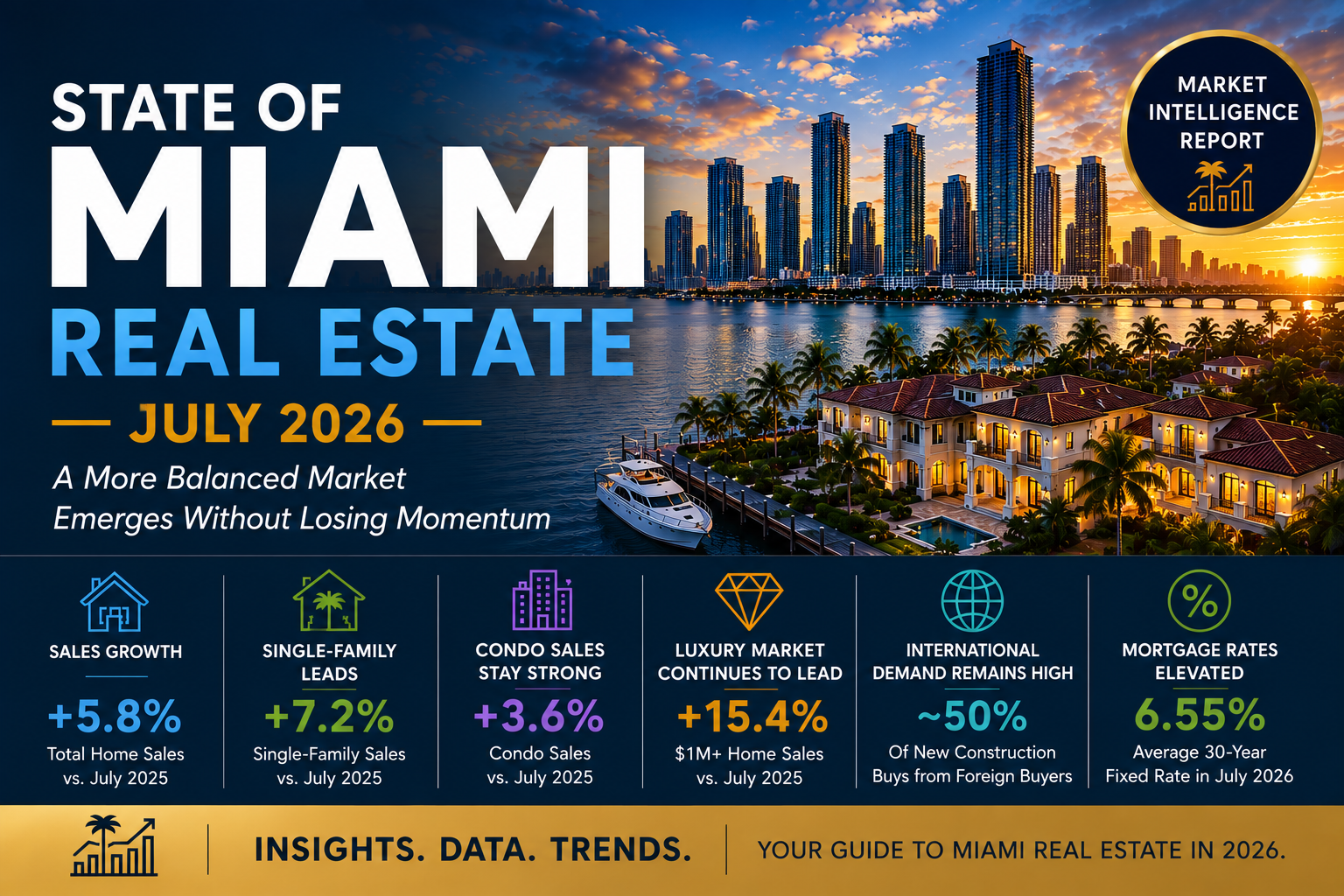
State of Miami Real Estate – July 2026
A More Balanced Market Emerges Without Losing Momentum
Miami’s housing market entered the second half of 2026 with greater balance between buyers and sellers, yet the region continued to outperform much of the nation thanks to strong fundamentals, international investment, and resilient luxury demand.
Executive Summary
July 2026 marks an important turning point in Miami’s real estate story.
The frantic pace that characterized the post-pandemic housing boom has largely given way to a healthier, more sustainable market. Buyers have more negotiating power than they did two years ago, sellers must price more strategically, and inventory has improved in several segments. Yet unlike many metropolitan areas experiencing significant slowdowns, Miami continues to benefit from powerful economic and demographic drivers.
Nationally, elevated mortgage rates near 6.55% and affordability challenges continued weighing on housing activity, with pending home sales declining 5.4% in June and builder confidence slipping further. (MarketWatch)
Miami, however, remains supported by:
Strong international capital
Corporate relocation
Population growth
High percentage of cash buyers
Limited long-term housing supply
Rather than signaling weakness, today’s market reflects increasing maturity. Buyers have more choices, sellers must compete more effectively, and well-priced properties continue to attract serious interest.
Market Snapshot
July’s market can best be described as balanced but resilient.
Key Themes
Inventory remains healthier than during the pandemic.
Luxury properties continue outperforming.
Mortgage rates remain elevated.
International demand stays strong.
Buyers are becoming increasingly selective.
The market is no longer driven by urgency alone—it is driven by value.
Single-Family Homes Continue to Lead
Single-family homes remain Miami’s strongest residential asset.
Demand continues to be fueled by:
Executive relocation
Remote professionals
Growing families
Limited land availability
Long-term investors
Well-maintained homes in desirable neighborhoods continue selling relatively quickly, particularly when priced appropriately.
Although buyers now negotiate more frequently, desirable properties continue generating multiple offers in many communities.
Condominiums Continue Their Transition
Condominium buyers remain increasingly sophisticated.
Rather than simply evaluating location and amenities, today’s purchasers carefully review:
Reserve studies
Milestone inspection reports
Insurance costs
Association financial health
Future assessment exposure
These evolving standards continue rewarding well-managed buildings while creating pricing pressure for properties requiring significant future capital improvements.
The result is a healthier long-term condominium market built on greater transparency.
Luxury Market Continues Setting the Pace
Luxury remains Miami’s defining advantage.
Waterfront estates, new construction condominiums, and trophy properties continue attracting buyers from around the world.
Florida’s favorable tax environment, international connectivity, and limited waterfront inventory continue supporting demand even while broader housing markets adjust.
Cash transactions remain common throughout the luxury segment, helping insulate buyers from elevated financing costs.
Mortgage Rates Continue Influencing Buyer Decisions
Mortgage rates remained near 6.55%, their highest levels of 2026, creating affordability challenges across much of the United States. (MarketWatch)
Instead of waiting indefinitely for lower rates, many Miami buyers have adopted a longer-term strategy:
Purchase now.
Build equity.
Refinance later if rates decline.
This approach continues supporting transaction activity despite higher monthly payments.
Commercial Market Supports Residential Growth
Miami’s broader economy continues strengthening residential demand.
Expansion remains active across:
Financial services
Technology
Healthcare
International trade
Hospitality
New office leasing, logistics investment, and mixed-use development continue attracting both businesses and employees to South Florida.
This economic diversification remains one of Miami’s greatest competitive advantages.
Miami Compared with the National Market
Across much of the United States, higher borrowing costs continue slowing housing activity.
Pending home sales declined, builder confidence weakened, and many sellers increasingly offered price reductions or incentives to attract buyers. (Reuters)
Miami tells a different story.
Although negotiations have become more common, the region continues benefiting from:
Global capital flows
Population growth
Limited developable land
International migration
Strong employment
These structural advantages continue supporting long-term property values.
What Buyers Should Know
Today’s buyers enjoy several advantages compared with recent years:
More available inventory
Increased negotiating opportunities
Less bidding competition
More time to evaluate properties
However, premium neighborhoods and move-in-ready homes continue attracting significant demand.
Preparation remains the key to success.
What Sellers Should Know
Today’s sellers can still achieve excellent results—but strategy matters.
Successful listings continue emphasizing:
Accurate pricing
Professional photography
High-quality digital marketing
Move-in-ready presentation
Homes priced according to yesterday’s market often remain active longer and require price adjustments.
Looking Ahead to August 2026
Several trends deserve close attention during the second half of the year:
Mortgage rate direction
International investment
Inventory growth
Luxury market performance
Condominium lending changes
While national housing markets continue adjusting to higher borrowing costs, Miami appears well positioned for continued long-term growth.
Rather than experiencing a correction, the market is evolving toward a healthier balance—one where buyers have more opportunities, sellers compete on value, and quality properties continue commanding strong interest.
Editorial Disclosure
This State of Miami Real Estate – July 2026 report was prepared by MiamiRealEstateNews.com using publicly available information from the MIAMI Association of REALTORS®, Florida Realtors®, the National Association of REALTORS®, MLS market statistics, and other reliable industry sources. Market information has been summarized and interpreted for educational purposes only and should not be considered legal, tax, financial, or investment advice. (Florida Realtors)
USA Soccer Fans Erupt in Joy After 2-0 Win Over Bosnia-Herzegovina
American soccer fans had plenty to celebrate on Wednesday night as the United States Men’s National Team delivered a dominant 2-0 victory over Bosnia-Herzegovina, sending supporters into a frenzy at watch parties across the country. In Hollywood, Florida, fans packed a local pub, erupting in cheers, chants, and joyful celebrations as the final whistle blew on a commanding USA performance.
The energy inside the Hollywood pub was electric from kickoff, with fans draped in red, white, and blue waving flags and singing team chants throughout the match. When the final goal secured the two-goal cushion, the crowd exploded with hugs, high-fives, and triumphant shouts of “We won!” — a moment that captured the growing passion for soccer among American sports fans ahead of the Fourth of July holiday weekend.
The victory is a significant boost for Team USA, demonstrating both offensive firepower and defensive discipline on the international stage. Soccer enthusiasm in the United States continues to surge, with fans young and old gathering at local venues to share in the excitement of watching their national team compete. The Hollywood watch party was just one of countless gatherings nationwide where communities came together to rally behind the red, white, and blue.
With the Fourth of July falling just days after the win, the timing could not have been better for a patriotic lift. Fans leaving the pub expressed pride not only in the result but in the growing culture of soccer support across the country. “This is what it’s all about — coming together, cheering for our team, and having a great time,” one fan told reporters outside the venue. As Team USA looks ahead to its next challenge, the momentum and fan energy from Wednesday’s victory promise to carry the team — and its supporters — forward in high spirits.
Sources: WSVN 7News. This article was produced with the assistance of an AI writing tool and reviewed for accuracy and editorial quality.
USA Soccer Fans Erupt in Joy After 2-0 Win Over Bosnia
South Florida soccer fans had plenty to cheer about Wednesday night as Team USA delivered a dominant 2-0 victory over Bosnia-Herzegovina, sending watch party crowds into a frenzy of red, white, and blue celebration. A packed pub in Hollywood, Florida became the epicenter of local jubilation, with fans chanting, hugging, and waving American flags long after the final whistle blew.
“We won!” chanted the crowd at the Hollywood pub, where fans had gathered early to secure their spots and soak in every moment of the action. The energy inside the venue was electric from kickoff, with supporters growing louder and more animated with each passing minute of the match. Witnesses described the atmosphere as one of pure community spirit, with strangers bonding over their shared pride in the national team’s performance.
The victory marked a significant moment for US Soccer, demonstrating the team’s ability to perform with confidence and composure on the international stage. Fans at the watch party praised the squad’s organized defensive effort and clinical finishing, with many noting that the convincing margin of victory felt like a statement win heading deeper into tournament play. Social media lit up with celebratory posts from fans across South Florida and beyond, amplifying the excitement well into the night.
Local businesses near the Hollywood pub also felt the positive ripple effects of the watch party atmosphere, with nearby restaurants and bars reporting strong crowds of fans who spilled out onto the streets to continue celebrating. For many attendees, the night was about more than just soccer — it was a reminder of the power of sport to bring communities together in shared joy and national pride, especially as the country approaches the Fourth of July holiday weekend.
Source: WSVN 7News. This article was written with the assistance of artificial intelligence and reviewed for accuracy and editorial quality.