Select Page

Communities

Widgetized Area

This panel is active and ready for you to add some widgets via the WP Admin

Home repairs in North Bay Village

Home repair work can range from a small fix to a larger project that affects several parts of a property. North Bay Village residents, property owners, and organizations can use this page to find and compare home repair providers in the area. Treat each listing as a starting point: contact the provider directly to confirm the current service area, availability, qualifications, and terms before choosing a service.

Home repairs services to explore

Depending on the provider, providers may handle general maintenance, carpentry, fixture replacement, drywall, painting, installation, or other repair requests. Some businesses focus on one specialty, while others offer several services through a single office. Ask which work is performed by the provider, what is handled by a partner, and whether the service is available for your particular project or situation. A clear description of the work helps you compare providers on similar terms.

How to compare home repairs providers

Start with the need, location, timing, and budget you have in mind. Request a written scope or explanation of what is included, how long the work may take, and what could affect the final cost. Compare experience with similar requests, communication practices, scheduling, payment terms, and the process for follow-up. If credentials, permits, insurance, or a written agreement apply to the service, ask for current details and verify them with the appropriate source.

Questions to ask before you decide

Ask what is included in the estimate, whether a site visit is needed, who supplies materials, how changes are approved, and what documentation or follow-up is provided. Review the answer alongside the provider’s listing and written terms. Ask for clarification if a service description is broad, a quote leaves out important work, or a timeline is uncertain. Confirm how to reach the business after the initial appointment and what steps are available if the service needs correction or further attention.

Find home repairs in North Bay Village

Browse the North Bay Village business directory to identify local listings and request current information. Compare providers using the same criteria so differences in scope, availability, and price are easier to understand. A directory listing is not an endorsement, and details should be verified directly with each business.

For municipal contacts and community information, visit the official North Bay Village website. Contact providers directly to confirm the details that matter for your needs and keep written estimates, policies, and agreements for reference.


Paul Zelnick – Transactional Attorney

Why Every Growing Business Needs a Corporate Transactional Attorney Before Problems Arise

How Paul L. Zelnick Helps Entrepreneurs Build Stronger Businesses Through Strategic Legal Counsel
Starting a business often begins with an idea, a vision, and the determination to turn that vision into reality. As a company grows, however, opportunities become more complex. New partners join the business. Investors seek ownership interests. Vendors require detailed agreements. Expansion may involve acquisitions, financing, or restructuring. Every milestone introduces legal decisions that can shape the future of the company.
Unfortunately, many entrepreneurs wait until a dispute arises before contacting an attorney. By then, the damage may already be done.
Paul L. Zelnick, Corporate Transactional Attorney at Caldera Law in Miami, believes that the best legal strategy is proactive rather than reactive. His practice focuses on serving as outside counsel for entrepreneurs and privately held businesses, helping them establish sound legal foundations that support sustainable growth while minimizing unnecessary risk.
More Than Legal Documents
Many business owners think of an attorney only when litigation becomes unavoidable. Transactional attorneys play a very different role.
Instead of resolving lawsuits after they occur, transactional attorneys help prevent them by carefully structuring businesses, negotiating agreements, documenting ownership rights, and identifying potential legal issues before they become costly disputes.
For entrepreneurs, this approach provides confidence to make strategic business decisions knowing that their legal foundation has been thoughtfully designed.
Building the Right Foundation
Every successful company begins with choosing the appropriate legal structure.
Whether forming a limited liability company, corporation, or partnership, each decision carries implications for ownership, taxation, governance, financing, and future expansion.
Paul regularly advises clients on:

Business entity formation
Corporate restructurings
Ownership reorganizations
Equity and debt conversions
Corporate governance
Shareholder and operating agreements

These foundational documents establish how businesses operate today while providing flexibility for tomorrow’s opportunities.
Contracts That Protect Relationships
Business relationships depend upon clear expectations.
Poorly written agreements often become the source of expensive misunderstandings between owners, vendors, customers, employees, contractors, and strategic partners.
Paul prepares, reviews, and negotiates a broad range of commercial agreements, including:

Service agreements
Vendor contracts
Non-disclosure agreements (NDAs)
Licensing agreements
Joint venture agreements
Software as a Service (SaaS) agreements
Distribution agreements
Hotel and restaurant management agreements
Car rental agreements
Liability waivers

Well-drafted contracts not only reduce legal exposure—they also strengthen business relationships by clearly defining each party’s responsibilities.
Helping Businesses Grow Through Strategic Transactions
Growth often comes through acquisition rather than organic expansion.
Whether purchasing another company or preparing a business for sale, every transaction involves legal, financial, and operational complexities that require careful planning.
Paul represents both buyers and sellers in:

Asset purchase transactions
Stock purchase transactions
Membership interest acquisitions
Corporate mergers

His role extends beyond document preparation. By identifying risks, negotiating terms, and coordinating with accountants, lenders, and advisors, he helps clients navigate transactions with greater clarity and confidence.
Financing Future Growth
Access to capital remains one of the greatest challenges facing growing businesses.
Paul assists clients with financing transactions ranging from traditional commercial loans to sophisticated private investment structures.
His experience includes advising companies on:

Commercial lending
Private loan transactions
Regulation D securities offerings
Seed financing rounds
SAFE (Simple Agreement for Future Equity) investments
Convertible promissory notes

For entrepreneurs seeking to scale their companies, experienced legal guidance can help ensure financing arrangements align with long-term business objectives.
Experience Across Multiple Industries
One of Paul’s strengths is his ability to advise companies operating in diverse industries.
His clients include businesses involved in:

Automotive
Hospitality
Food and beverage
Healthcare
Financial services
Real estate
Technology
Marketing
Entertainment

This cross-industry experience allows him to recognize common legal challenges while understanding the unique operational realities of each business sector.
Trusted Counsel for Significant Transactions
Throughout his career, Paul has advised clients on transactions involving substantial financial value.
His representative experience includes:

Representing a premier commercial truck driving school in the sale of its assets and membership interests.
Advising an entrepreneur in the $20 million acquisition of multiple cellular retail locations.
Serving as corporate and securities counsel on Regulation D offerings exceeding $500 million in aggregate capital raises.
Negotiating and closing more than $250 million in mezzanine financing transactions for commercial and residential real estate developers.
Serving as outside counsel to franchisees and affiliates of nationally recognized vehicle rental brands.

These transactions reflect both technical legal knowledge and a practical understanding of business strategy.
A Long-Term Business Partner
Perhaps the greatest value of outside corporate counsel is continuity.
Rather than becoming involved only when problems arise, Paul works alongside business owners throughout the lifecycle of their companies—from formation and growth to financing, acquisitions, succession planning, and eventual exit strategies.
For entrepreneurs, having a trusted legal advisor means spending less time worrying about legal obstacles and more time focusing on innovation, customers, and growth.
Looking Ahead
South Florida continues to attract entrepreneurs, investors, and companies from around the world. As businesses expand in an increasingly competitive marketplace, strategic legal planning has become an essential component of sustainable success.
For business owners seeking practical legal guidance backed by transactional experience, Paul L. Zelnick provides more than legal representation. He offers a collaborative approach focused on helping entrepreneurs make informed decisions, protect what they have built, and position their companies for the opportunities ahead.

About Paul L. Zelnick
Paul L. Zelnick is a Corporate Transactional Attorney with Caldera Law, where he represents entrepreneurs and privately held businesses in matters involving corporate governance, commercial contracts, mergers and acquisitions, financing transactions, and business growth strategies.
Caldera Law
7275 NW 1st Ct., Unit 104
Miami, FL 33150
Website: www.caldera.law
Email: paul.zelnick@gmail.com
Instagram: @zelnickbusinesslaw

Read More

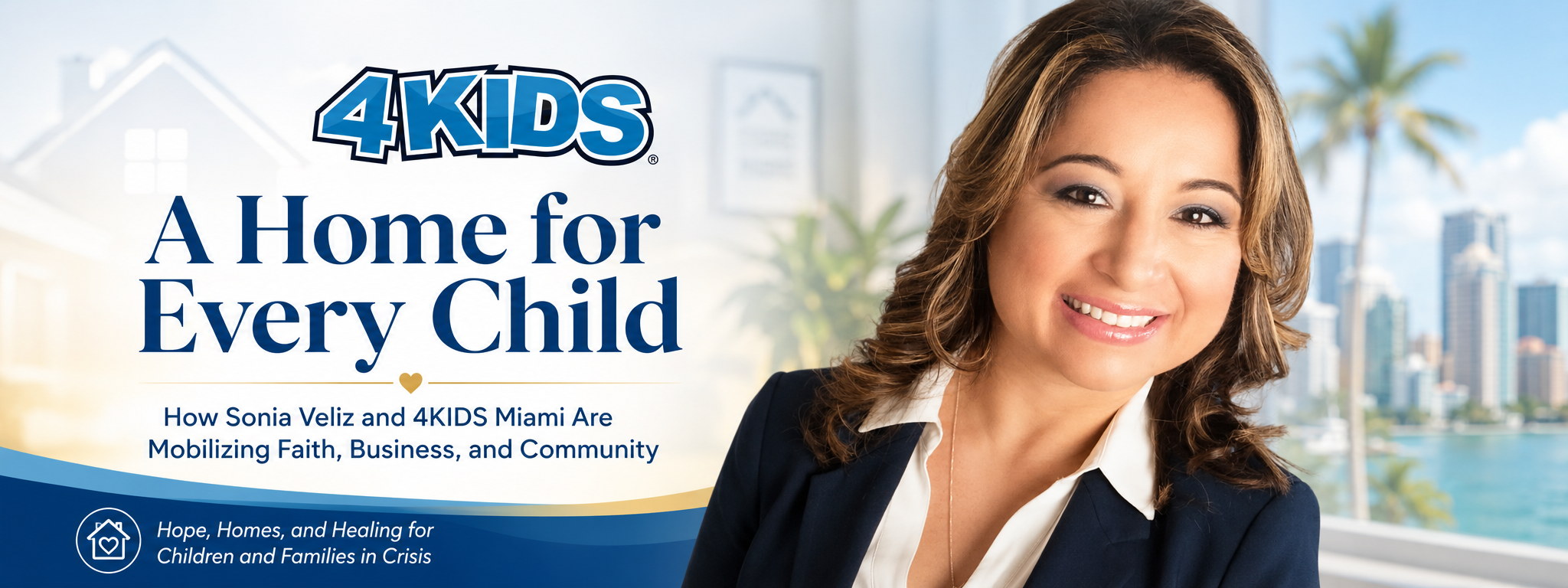
Sonia Veliz Brings the 4KIDS Mission to Miami’s Business Community

A Home for Every Child: Sonia Veliz Brings the 4KIDS Mission to Miami’s Business Community
The faith-based nonprofit is calling on local companies, churches, foster families, and community leaders to help provide hope, homes, and healing to children in crisis.
For Sonia Veliz, joining 4KIDS Miami was more than a career change. It was an opportunity to turn decades of professional experience—and a deeply personal understanding of childhood loss—into meaningful service.
During a recent BNI presentation supporting a back-to-school donation drive, Veliz introduced local business leaders to the work of 4KIDS Miami. She spoke candidly about her journey from corporate marketing and business development into the nonprofit world.
After approximately 20 years in corporate America, Veliz began questioning what she wanted her work and life to represent. She left the corporate sector and eventually served organizations including St. Jude Children’s Research Hospital and World Vision.
Having lost both parents at a young age, she understands how profoundly loss can affect a child.
“I wanted to be in a place where I made a difference,” Veliz told the group.
Today, her role at 4KIDS Miami is to invite businesses, churches, professionals, families, and individuals into a mission expressed through five simple words:
A Home for Every Child.
Hope, Homes, and Healing
4KIDS is a Christian, faith-based nonprofit serving children and families across Broward, Palm Beach, Miami-Dade, the Treasure Coast, and Southwest Florida. The organization began in 1997 through a church-led movement to recruit and support Christian foster parents. (4KIDS)
Its work is organized around three promises: Hope, Homes, and Healing.
Homes come through the recruitment, licensing, and support of foster families. Hope grows through family preservation, mentoring, practical assistance, and community partnerships. Healing is supported through trauma-informed therapy and caregiver education.
Veliz explained that children may remain in foster care for several days, several months, or several years. Regardless of how long the placement lasts, every child deserves to feel loved, protected, and cared for.
Stability matters because removing a child from home is already traumatic. Moving that child repeatedly between foster placements can deepen the fear, uncertainty, and loss.
4KIDS therefore works to support foster parents so children can remain in a stable home for as long as necessary.
Keeping Brothers and Sisters Together
Another priority is keeping siblings together.
Children entering foster care have already been separated from their parents, surroundings, schools, and familiar routines. Separating brothers and sisters can compound that loss.
4KIDS recruits families capable of welcoming sibling groups and has developed specialized homes to help brothers and sisters remain together.
Veliz described one of the most painful realities of foster care: some children leave their homes carrying their belongings in a plastic bag.
It is a simple image, but it reveals the scale of the disruption.
For a child, a foster home is not merely a place to sleep. It can become the first stable environment available during one of the most frightening moments of that child’s life.
Connection as a Path to Healing
4KIDS also uses trauma-informed approaches to help parents and caregivers understand the needs behind a child’s behavior.
Veliz discussed Trust-Based Relational Intervention, commonly called TBRI. Developed by the Karyn Purvis Institute of Child Development at Texas Christian University, TBRI is an attachment-based, trauma-informed model designed to support children who have experienced adversity. It emphasizes physical well-being, safe relationships, connection, and compassionate responses to fear-based behavior. (KPICD)
The goal is not simply to correct behavior. It is to understand what happened to the child and help rebuild trust.
That distinction can transform the way parents, teachers, counselors, caregivers, and other adults respond to children experiencing trauma.
Family Reunification Remains the Goal
Veliz also addressed a common misunderstanding.
4KIDS does not exist to break families apart.
Whenever it is safe and possible, the goal is family reunification. Parents may need time, treatment, guidance, housing stability, or other assistance before their children can return home.
Through CarePortal, 4KIDS connects churches, businesses, and individuals with urgent needs identified by child-welfare professionals. Items such as beds, cribs, dressers, car seats, and household necessities can sometimes help stabilize a family and prevent a child from entering foster care. (4KIDS)
Adoption may become the appropriate outcome in some cases. However, strengthening families and supporting safe reunification remain important parts of the mission.
An Invitation to Miami’s Business Community
Companies do not need to become foster-care experts to participate.
4KIDS Miami offers corporate partnerships through employee matching gifts, service projects, event sponsorships, workplace engagement, and customized initiatives. Veliz serves as a contact for companies interested in becoming 4KIDS business partners. (4KIDS)
Businesses can also support back-to-school collections, volunteer activities, fundraising events, Vision Tours, and monthly giving.
The opportunity extends beyond writing a check. Companies can introduce the mission to employees, clients, professional networks, and faith communities.
“Together, we can reverse this,” Veliz told the audience.
Her message was direct: Miami’s foster-care challenges cannot be solved by one organization alone. They require foster parents, churches, clinicians, businesses, donors, volunteers, and advocates willing to stand beside children and families.
For 4KIDS Miami, every donation, partnership, training session, and supported foster home advances the same bold vision:
Until every child has a home.
Learn How Your Business Can Support 4KIDS Miami
Sonia VelizPartner Engagement Officer305-298-3088SoniaV@4KIDS.us4KIDS.us

Read More

Ethan Olaguibel

LEGAL | ENTERTAINMENT LAW

From Carnegie Hall To Copyright Law: Why One Former Professional Musician Is Redefining Entertainment Law

After performing at Carnegie Hall, collaborating with Grammy-winning artists, and recording on award-winning projects, Ethan S. Olaguibel built a law practice around one simple idea: creators deserve an attorney who has lived their business—not just studied it.
By MiamiBusiness.com Editorial Staff
Published: July 2026
Reading Time: 8 Minutes

The entertainment industry has never moved faster.
A song can reach millions overnight. A brand can be built on social media in a matter of months. Artificial intelligence can generate music, artwork, and written content in seconds. At the same time, creators face increasingly complex questions about ownership, licensing, trademarks, copyrights, and protecting the ideas that define their careers.
For Ethan S. Olaguibel, Esq., LL.M., these aren’t abstract legal issues.
They’re challenges he understands from personal experience.
Long before founding ESO Law Firm, Olaguibel built his career inside the entertainment industry as a professional double bassist. He performed at Carnegie Hall, appeared on Grammy-nominated recordings, contributed to Emmy Award-winning productions, and collaborated with internationally recognized artists. Today, he has taken those experiences into a legal practice dedicated to protecting the people who create the music, brands, films, and intellectual property that drive today’s creative economy.
His career may have shifted from the concert hall to the courtroom, but his mission has remained remarkably consistent.
Protect the work that artists dedicate their lives to creating.
The Business Behind Creativity
To most audiences, music is entertainment.
To the people who create it, music is also business.
Every recording session, publishing agreement, licensing deal, performance contract, and collaboration carries legal and financial consequences. The value of a creative work often depends as much on ownership and intellectual property rights as it does on artistic talent.
Having spent years navigating that world as a professional musician, Olaguibel developed an appreciation for the business side of creativity long before attending law school.
He experienced firsthand how contracts shape careers, how intellectual property becomes a creator’s most valuable asset, and how easily artists can overlook the legal details that determine who ultimately controls their work.
That realization would eventually shape the next chapter of his career.
A Perspective Few Attorneys Possess
Many entertainment attorneys study the music industry.
Olaguibel lived it.
His musical résumé includes performances with Grammy-winning artists such as Seal, Esperanza Spalding, Andrea Bocelli, Gloria Estefan, Stevie Wonder, José Feliciano, and internationally acclaimed pianist Yuja Wang. He performed under celebrated conductors including Michael Tilson Thomas, Gerard Schwarz, Carlos Miguel Prieto, Giancarlo Guerrero, Miguel Harth-Bedoya, and Jacomo Bairos.
His orchestral experience included positions with the Palm Beach Symphony, Nu Deco Ensemble, New World Symphony, Frost Symphony Orchestra, and the Henry Mancini Institute Orchestra.
Along the way, he contributed to Grammy-nominated and Latin Grammy-nominated recordings while participating in projects recognized with two Suncoast Emmy Awards.
These experiences offered more than artistic achievement.
They provided an insider’s understanding of the relationships between creators, producers, publishers, managers, record labels, and the legal agreements that connect them.
That perspective cannot be learned solely from textbooks.
When Passion Meets Purpose
After earning a Bachelor of Music from the University of Miami Frost School of Music, Olaguibel chose to pursue a legal education with the same commitment that had defined his musical career.
He earned his Juris Doctor from St. Thomas University College of Law, receiving a Certificate in Intellectual Property Law before passing The Florida Bar on his first attempt. He later completed a Master of Laws (LL.M.) in Entertainment, Arts & Sports Law at the University of Miami School of Law, further concentrating his practice on the legal challenges facing creative professionals.
Before launching ESO Law Firm, he worked within an established entertainment law practice handling trademark registrations, copyright matters, recording and publishing agreements, licensing transactions, and intellectual property strategy. He also served as a judicial law clerk for County and Circuit Court judges in Miami-Dade County, strengthening his legal research, writing, and courtroom experience.
Together, those experiences created a rare combination of industry knowledge and legal training.
Building a Practice for the Modern Creator
Today’s creators are no longer limited to musicians and filmmakers.
Entrepreneurs build brands online. Content creators develop businesses around digital platforms. Authors self-publish. Podcasters, influencers, designers, software developers, and startups all rely on intellectual property as a core business asset.
At the same time, artificial intelligence is reshaping questions surrounding authorship, ownership, licensing, and originality.
Those changes have increased the importance of proactive legal planning.
Through ESO Law Firm, Olaguibel advises clients on trademark registration, copyright protection, contract drafting and negotiation, licensing agreements, brand strategy, and entertainment law. Because trademark and copyright matters are governed primarily by federal law, the firm represents clients throughout the United States.
Rather than offering one-size-fits-all legal services, the firm focuses on helping creators establish ownership before disputes arise—a philosophy that reflects Olaguibel’s own experiences in the entertainment industry.
As he often explains, protecting creative work should be part of the creative process, not an afterthought.
“The most valuable assets many creators own are often the ones they never physically hold—their ideas, their brands, and their intellectual property.” — Ethan S. Olaguibel, Esq., LL.M.
Protecting What Makes You Original
The legal profession is filled with attorneys who understand statutes and case law.
The entertainment industry is filled with professionals who understand creativity.
Few individuals have spent meaningful time in both worlds.
That intersection defines Ethan Olaguibel’s approach to practicing law.
He understands the excitement of a recording session, the pressure of a live performance, the discipline required to prepare for a concert, and the business realities that follow every creative opportunity. Today, he applies that perspective to helping clients protect the very work that gives their businesses value.
For musicians, entrepreneurs, filmmakers, authors, and creators navigating an increasingly digital economy, legal protection has become more than a safeguard.
It has become a business strategy.
Final Takeaway
Every successful creator invests countless hours developing original work.
The question is whether that work will remain protected as careers evolve, technologies advance, and new opportunities emerge.
Ethan S. Olaguibel believes creators deserve legal counsel from someone who understands both the creative process and the legal framework that supports it. His journey—from Carnegie Hall to copyright law—illustrates how experience can shape not only a career, but also a philosophy of service.
For today’s creators, originality may be their greatest asset.
Protecting it may be their smartest investment.

About Ethan S. Olaguibel, Esq., LL.M.
Ethan S. Olaguibel is the Founder and Managing Attorney of ESO Law Firm, PLLC, a Miami-based boutique law firm focused on entertainment law, trademarks, copyrights, and intellectual property. A former professional double bassist who performed at Carnegie Hall and collaborated on Grammy-nominated and Emmy Award-winning projects, he now represents musicians, entrepreneurs, artists, and creative businesses throughout the United States. His firm’s guiding philosophy is simple: Protect what makes you original.

Read More

When Aging Parents Want to Stay Home: Inside Miami’s Growing Need for In-Home Senior Care

For many Miami-Dade families, the question isn’t whether Mom or Dad needs help. It’s how to provide that help without taking away the independence they’re trying to preserve.

By Viviana Laboy, Founder of 305Senior
“The conversation about home care shouldn’t begin with what a senior can no longer do. It should begin with what we’re trying to help them continue doing.” — Viviana Laboy
TL;DR
For many older adults, remaining at home is deeply connected to independence, familiarity and quality of life. But aging at home can eventually require additional support with everyday activities, companionship, transportation and other needs.
In Miami-Dade, 305Senior.com helps seniors and families navigate local resources. One provider within its Trusted Partners network is Amada Senior Care Coral Gables, which provides non-medical in-home care and assists families with understanding and navigating long-term care insurance benefits.
The Conversation No Family Is Quite Ready For
Mom says she’s fine.
And, technically, she is.
She still lives in the Coral Gables home she’s known for decades. She makes her own breakfast. She talks to friends. She knows exactly where everything is.
But lately, things take longer.
Getting groceries is exhausting.
The shower makes you nervous.
She has stopped driving at night.
And when you suggest that someone might come by a few times a week to help, the response arrives immediately:
“I don’t need a caregiver.”
For thousands of families, this is where the senior-care conversation really begins.
Not in a hospital.
Not during an emergency.
At the kitchen table.
The challenge is figuring out how to introduce assistance without making an aging parent feel that everyone has suddenly decided to take over their life.
That tension—between support and independence—is becoming increasingly important for Miami-Dade families navigating aging.
And it helps explain why in-home senior care has become such an important part of the larger senior-services landscape.
Home Is More Than an Address
Ask someone who has lived in the same house for 30 or 40 years why they want to remain there, and the answer usually has little to do with real estate.
It’s where the children grew up.
It’s where the grandchildren know which cabinet contains the cookies.
The neighbors know one another.
The church is nearby.
The grocery store is familiar.
The photographs on the wall aren’t decorations. They’re a biography.
Leaving all of that behind can represent a profound transition.
That’s why families increasingly begin by asking a different question:
What would it take for Mom or Dad to remain at home safely and comfortably?
The answer varies enormously.
One senior might need companionship and transportation several times a week.
Another may need help getting dressed, preparing meals or completing household routines.
Someone else may require considerably more assistance.
And when medical or skilled nursing needs are involved, appropriately licensed healthcare professionals must become part of the conversation.
There is no universal home-care formula.
The care should fit the person—not the other way around.
The New Meaning of “White-Glove” Senior Care
The original idea behind white-glove service comes from hospitality: personal attention, responsiveness and an experience designed around the individual.
Applied appropriately to senior care, the concept becomes less about luxury and more about personalization.
What does this particular person enjoy?
What routines matter?
What kind of personality would make a compatible caregiver?
Does the family need regular communication because the children live outside Miami?
Is language important?
Are there cultural preferences surrounding food or daily routines?
Those details can matter enormously.
Amada Senior Care Coral Gables, a 305Senior Trusted Partner serving the local community, describes its approach around individualized in-home support rather than treating every senior as having the same needs.
Its services can include assistance with activities of daily living, companionship and other non-medical support designed around an individualized care plan.
The objective isn’t simply completing a list of chores.
It’s helping the person continue living their life.
Sometimes the Right Caregiver Is About Chemistry
Families naturally focus first on qualifications and availability.
Those things matter.
But anyone who has invited a caregiver into a parent’s home understands another reality:
Personality matters, too.
Imagine spending several hours each day with someone you don’t particularly enjoy.
Now imagine that person helping you with some of the most personal aspects of your daily life.
Compatibility becomes important.
One senior may enjoy conversation and want someone energetic.
Another values privacy and prefers a quieter presence.
Someone who loves cooking may connect differently with a caregiver than someone whose favorite afternoon involves watching baseball.
A bilingual household may place tremendous value on having someone who communicates naturally in the senior’s preferred language.
The human relationship matters because home care occurs in the most personal environment possible:
Someone’s home.
That’s one reason caregiver matching is an important part of the model Amada describes.
Then Comes the Question Nobody Enjoys: What Will This Cost?
Families can spend weeks discussing care before confronting the financial question.
For households that purchased long-term care insurance, the situation can become surprisingly complicated.
A policy may have been purchased years—or decades—earlier.
The adult children may know it exists but have no idea what it covers.
Terms such as elimination periods, benefit periods, daily or monthly benefits and eligibility requirements suddenly become very important.
And they often become important at exactly the moment a family is already overwhelmed.
This is one area Amada Senior Care Coral Gables emphasizes within its service model: helping families navigate their existing long-term care insurance policies and the claims process.
That assistance may include reviewing policy benefits and helping families communicate with insurers about claims and available coverage.
But families should understand an important distinction:
A long-term care insurance policy does not automatically mean every service will be covered.
Coverage depends upon the actual contract, eligibility requirements and insurer determination.
Families should review their individual policy carefully and obtain clarification directly from their insurer when necessary.
The value of assistance is not a guarantee of coverage.
It’s having someone familiar with the process help the family understand what questions need to be asked.
Why a Navigator Matters Before a Provider Does
This raises another problem.
How does a family know it needs Amada—or any particular provider—in the first place?
That’s where 305Senior occupies a different position in the senior-care ecosystem.
Founded by Viviana Laboy, 305Senior isn’t an in-home care agency.
It doesn’t replace a physician.
It doesn’t provide legal advice.
And it isn’t the company sending a caregiver into the home.
Instead, 305Senior operates as a Miami-Dade senior resource and referral platform.
A family can begin with the problem rather than having to know the solution.
“My mother wants to stay home.”
“Dad shouldn’t be driving anymore.”
“We have a long-term care policy and don’t understand it.”
“My parents need more help, but I don’t know what kind.”
Those are very different situations.
305Senior’s role is helping families identify potential resources and make connections within the local senior-services community.
When in-home assistance appears appropriate, Amada Senior Care Coral Gables is one of the resources available within 305Senior’s Trusted Partners network.
The provider then determines what services it can offer and whether those services fit the family’s needs.
That separation is important.
305Senior navigates.
The provider provides the service.
Miami Makes Senior Care Personal
Senior care is always local, but Miami adds layers that national conversations about aging sometimes miss.
Language is one.
Culture is another.
Family expectations can be another.
In some Miami households, three generations may be closely involved in decisions. Adult children may assume substantial caregiving responsibilities. Grandchildren may become technology support. Extended family may have strong opinions about whether outside assistance should enter the home at all.
For some older adults, accepting help from someone outside the family can feel uncomfortable.
That means introducing home care sometimes requires as much emotional intelligence as logistical planning.
Instead of:
“You can’t do this anymore.”
Try:
“What would make this easier for you?”
Instead of:
“You need someone watching you.”
Try:
“Would having someone help with a few things give you more freedom to do what you actually enjoy?”
The difference isn’t cosmetic.
One approach describes decline.
The other protects autonomy.
Care Needs Don’t Stand Still
Perhaps the biggest mistake families make is assuming they’re choosing a permanent solution.
Senior needs change.
Someone may initially need transportation and companionship.
Months or years later, assistance with additional daily activities may become necessary.
A hospitalization can change circumstances quickly.
So can the loss of a spouse.
That’s why families benefit from periodically reassessing what’s working.
Is Mom still comfortable?
Does Dad need more—or perhaps less—assistance?
Is the caregiver relationship working?
Are there new medical concerns that should be addressed by healthcare professionals?
Does the home itself need modification?
Has the family reviewed legal and financial planning?
Home care is one piece of a much larger aging plan.
That is also why 305Senior’s network extends beyond caregiving into other categories of senior resources and Trusted Partners.
Families rarely have just one question.
The Best Senior Care May Be the Care That Preserves Normal Life
There’s a tendency to discuss aging entirely in terms of problems.
Falls.
Medication.
Mobility.
Memory.
Insurance.
All of those concerns matter.
But a life can’t be reduced to a risk-management checklist.
Maybe Dad wants someone to take him to lunch.
Maybe Mom wants to keep tending her orchids.
Perhaps what matters most is continuing Sunday dinner with the family.
The purpose of support isn’t simply to make a senior safer.
It’s to help make continued life possible on terms that preserve as much dignity, choice and personality as circumstances allow.
Author and physician Atul Gawande wrote in Being Mortal about the importance of understanding what matters most to people as they age, rather than focusing exclusively on what can be done medically.
That distinction belongs at the center of senior care.
The question isn’t merely:
How do we take care of Mom?
It’s also:
What does Mom still want her life to look like?
The Takeaway
In-home senior care isn’t appropriate for every person or every situation.
But for families whose aging parents want to remain at home, it can become one component of a broader support system.
Start with the senior.
Understand what’s becoming difficult.
Determine what kind of assistance might help.
Discuss medical concerns with healthcare professionals.
Review financial and long-term care insurance considerations carefully.
And involve the older adult in the decisions whenever possible.
The goal shouldn’t be to take control of someone’s life. It should be to provide enough support that they can continue living as much of that life as possible.
Finding In-Home Senior Care Resources in Miami-Dade
Families don’t have to understand the entire senior-care landscape before asking for help.
305Senior.com, founded by Viviana Laboy, helps Miami-Dade seniors, caregivers and families identify potential local resources and Trusted Partners based on their needs.
For families specifically exploring non-medical in-home care, Amada Senior Care Coral Gables is among the providers featured within the 305Senior Trusted Partners network and can discuss its services, care options and long-term care insurance assistance directly with families.
To begin exploring your options, visit 305Senior.com or contact:
Viviana Laboy
Founder & CEO, 305Senior
786-326-0656
vlaboy@305senior.com


Read More