

Select Page

Communities

Widgetized Area

This panel is active and ready for you to add some widgets via the WP Admin

Home repairs in North Bay Village

Home repair work can range from a small fix to a larger project that affects several parts of a property. North Bay Village residents, property owners, and organizations can use this page to find and compare home repair providers in the area. Treat each listing as a starting point: contact the provider directly to confirm the current service area, availability, qualifications, and terms before choosing a service.

Home repairs services to explore

Depending on the provider, providers may handle general maintenance, carpentry, fixture replacement, drywall, painting, installation, or other repair requests. Some businesses focus on one specialty, while others offer several services through a single office. Ask which work is performed by the provider, what is handled by a partner, and whether the service is available for your particular project or situation. A clear description of the work helps you compare providers on similar terms.

How to compare home repairs providers

Start with the need, location, timing, and budget you have in mind. Request a written scope or explanation of what is included, how long the work may take, and what could affect the final cost. Compare experience with similar requests, communication practices, scheduling, payment terms, and the process for follow-up. If credentials, permits, insurance, or a written agreement apply to the service, ask for current details and verify them with the appropriate source.

Questions to ask before you decide

Ask what is included in the estimate, whether a site visit is needed, who supplies materials, how changes are approved, and what documentation or follow-up is provided. Review the answer alongside the provider’s listing and written terms. Ask for clarification if a service description is broad, a quote leaves out important work, or a timeline is uncertain. Confirm how to reach the business after the initial appointment and what steps are available if the service needs correction or further attention.

Find home repairs in North Bay Village

Browse the North Bay Village business directory to identify local listings and request current information. Compare providers using the same criteria so differences in scope, availability, and price are easier to understand. A directory listing is not an endorsement, and details should be verified directly with each business.

For municipal contacts and community information, visit the official North Bay Village website. Contact providers directly to confirm the details that matter for your needs and keep written estimates, policies, and agreements for reference.

Miami’s Taxfyle Pushes Tax Talk Into Advisor Offices

A Miami fintech argues that wealth planning and tax planning should no longer live in separate rooms
Direct answer: Miami-based Taxfyle is encouraging financial advisors to integrate tax preparation and tax insight into their client services through technology.
TL:DR: Taxfyle, the Miami-based tax technology company, is making the case that financial advisors should have tax expertise built into their practice rather than outsourced to a separate professional. Refresh Miami reports the company is positioning its platform so advisors can bring tax work closer to the client relationship. For South Florida advisors, the message is simple. Clients increasingly expect one conversation, not three.
Here is the direct answer. Taxfyle, founded in Miami, is pushing a model where financial advisors gain access to tax preparation and tax insight through technology instead of sending clients down the hall to someone else. It matters because the advisory relationship in South Florida has been quietly widening for years, and tax strategy sits at the center of nearly every meaningful wealth decision a client makes.
Ask any advisor working Brickell or Coral Gables and the pattern is familiar. A client sells a business, exercises options, relocates from a high tax state, or buys a second property in Miami-Dade. Each move carries a tax consequence that shapes the entire plan. When the advisor cannot see that picture, the advice arrives incomplete. Taxfyle’s argument is that the gap is structural rather than personal, and technology can close it.

“In Miami, the client who walks through your door is rarely simple. They have businesses in two countries, property in three, and a tax situation that shapes everything else. Advisors who can speak to that fluently are the ones who keep the relationship.” — Wilson Alvarez, Editor and Miami Business Consultant

Why Miami Advisors Should Pay Attention
South Florida has absorbed an unusual concentration of relocated wealth, founders, and cross border families over the past several years. That population does not want a referral chain. It wants coordination. Advisors who can discuss tax implications with confidence, even while collaborating with a licensed preparer, hold a practical advantage in retention and referrals.
There is also a business case on the firm side. Integrated services deepen the client relationship and raise the cost of leaving. A practice that handles planning, investments, and tax coordination becomes harder to replace than one that handles investments alone.
The Practical Takeaway
None of this erases the role of the CPA. Complex returns still require credentialed professionals, and compliance remains compliance. What is changing is the expectation of visibility. Miami advisors should review how tax information flows into their planning process, whether through partnerships, software, or in house capability, because clients are no longer willing to narrate their own financial lives three separate times.
Conclusion
Taxfyle is betting that the wall between advisory and tax work was always artificial. In a market built on mobility and complexity, that bet looks reasonable. Miami advisors who move early will define the standard, while those who wait will be measured against it.
Source: Refresh Miami
For more news and insight on the Miami financial advisory community, visit MiamiFinancialAdvisors.com.

This article was AI-generated from public sources & humanized (occasionally edits). MiamiBusiness.com is committed to transparent AI journalism. Please verify with original outlets.

Read More

U.S. Century Bank and MTS Power Products Build in Miami

How a community bank relationship became part of a Miami manufacturer’s growth story
Direct answer: U.S. Century Bank’s relationship with Miami manufacturer MTS Power Products illustrates how local lending can support closely held South Florida businesses.
By Wilson Alvarez, Editor and Miami Business Consultant
“In Miami, the strongest banking relationships are rarely transactional. They are built over years, in person, between people who understand the neighborhood they are lending into.” — Wilson Alvarez
TL:DR:
Miami’s Community News spotlighted MTS Power Products, led by Juan Meireles, alongside U.S. Century Bank, the Doral-based community lender. The feature points to a familiar South Florida pattern, where locally headquartered banks support locally headquartered manufacturers and family-run companies. For Miami banking professionals, it is a reminder that relationship lending remains the competitive advantage community institutions hold over national competitors.
The short answer for anyone scanning the headline is this: a Miami manufacturer and a Miami community bank were profiled together, and that pairing says something useful about how capital actually moves in Miami-Dade County. MTS Power Products, with Juan Meireles at the helm, operates in the industrial corner of the local economy. U.S. Century Bank, headquartered in Doral, has spent years positioning itself as a lender that understands South Florida’s closely held businesses. Put the two in the same story and you get a snapshot of community banking at work.
Why does it matter? Because Miami’s business base is dominated by small and mid-sized companies that do not fit neatly into automated underwriting models. A manufacturer managing inventory cycles, equipment costs, and project-based revenue needs a banker who will take a meeting, not a chatbot. Community institutions have long built their loan books around exactly that gap, and the strategy has held up well as larger banks consolidate branches and centralize credit decisions far from Brickell or Doral.
The effect reaches further than one company. When a local bank finances a local manufacturer, the deposits, payroll accounts, treasury services, and eventually the owner’s personal banking tend to stay in Miami. That recycling of capital is the quiet engine behind much of Miami-Dade’s commercial growth, and it is the reason community banks continue to compete effectively against institutions many times their size.
For Miami banking professionals, the practical takeaway is straightforward. Industrial and light manufacturing clients remain underbanked relative to real estate and hospitality, yet they bring steady operating accounts, equipment finance needs, and long tenure. Relationship managers who can speak the language of production schedules and supply chains will find room to grow in Hialeah, Medley, Doral, and the warehouse corridors along the Palmetto.
Conclusion
Miami’s banking sector is often described through towers and headlines, but the real work happens in rooms like this one, where a business owner and a banker talk through a balance sheet. The MTS Power Products and U.S. Century Bank feature is a small story with a large lesson. Local capital, applied locally, still builds the most durable businesses in South Florida.
Visit MiamiBankingNews.com for more banking news in Miami.
Source: Miami’s Community News

This article was AI-generated from public sources & humanized (occasionally edits). MiamiBusiness.com is committed to transparent AI journalism. Please verify with original outlets.

Read More

South Florida Accounting Firm Adds Private Equity Practice

A Miami accounting leader moves closer to the capital that is reshaping South Florida business
Direct answer: A major South Florida accounting firm has opened a private equity practice to advise sponsors and portfolio companies, reflecting private capital’s growing role in Miami business.
TL:DR: A major South Florida accounting firm has launched a dedicated private equity practice, according to The Business Journals. The move signals how deeply private capital has embedded itself in the Miami-Dade economy, and it tells local CPAs, CFOs and business owners that transaction advisory work is becoming a core service line rather than a specialty add-on.
The short answer is this. One of South Florida’s largest accounting firms has stood up a practice built specifically to serve private equity sponsors and the companies they buy. That matters because Miami is no longer simply a destination for fund managers relocating from the Northeast. It is now a place where deals are sourced, financed and closed, and the accounting profession is adjusting its org chart to match.
Private equity work is a different discipline than compliance accounting. It runs on quality of earnings analysis, buy-side and sell-side due diligence, working capital negotiation, purchase price allocation, carve-out financials and post-close integration support. The timelines are compressed, the stakes are concentrated, and the client is often a fund partner who wants an answer before the end of the week. Building a dedicated practice is an acknowledgment that this work cannot be handled off the side of a tax desk.
For Miami business owners, the implications are practical. Sponsors are actively acquiring in sectors that define the local economy, including healthcare services, logistics, construction trades, professional services and hospitality. Owners thinking about a sale in the next few years should understand that their financial records will be examined with far more rigor than a standard review. Clean accrual-basis statements, documented related-party transactions, consistent revenue recognition and reliable monthly closes are what separate a smooth diligence process from a repriced deal.
There is a talent dimension as well. Transaction advisory roles have historically pulled ambitious accountants toward New York and Chicago. A growing bench of deal-focused practices in Miami gives local professionals a reason to build their careers here, which strengthens the entire regional accounting market. It also raises the bar for smaller firms, many of which will respond by forming referral relationships with specialists rather than attempting to compete on complex transactions.
The broader signal is one of maturity. Miami spent years being described as an emerging financial center. Service infrastructure is what turns that description into fact, and accounting is foundational infrastructure. When the firms that audit and advise local companies start organizing around private capital, the market has moved past the announcement phase.
Editor’s Note, Wilson Alvarez, Miami Business Consultant: “Capital follows opportunity, but it stays where the professional bench is deep. Miami is finally building that bench, and accounting firms are leading the construction.”
Conclusion
A dedicated private equity practice is more than a business line. It is a reading of where South Florida is headed, and local firms that prepare their financial reporting accordingly will be the ones holding leverage when the offer arrives.
For more accounting and finance news across Miami-Dade, visit MiamiAccountingNews.com.
Source: The Business Journals

This article was AI-generated from public sources & humanized (occasionally edits). MiamiBusiness.com is committed to transparent AI journalism. Please verify with original outlets.

Read More

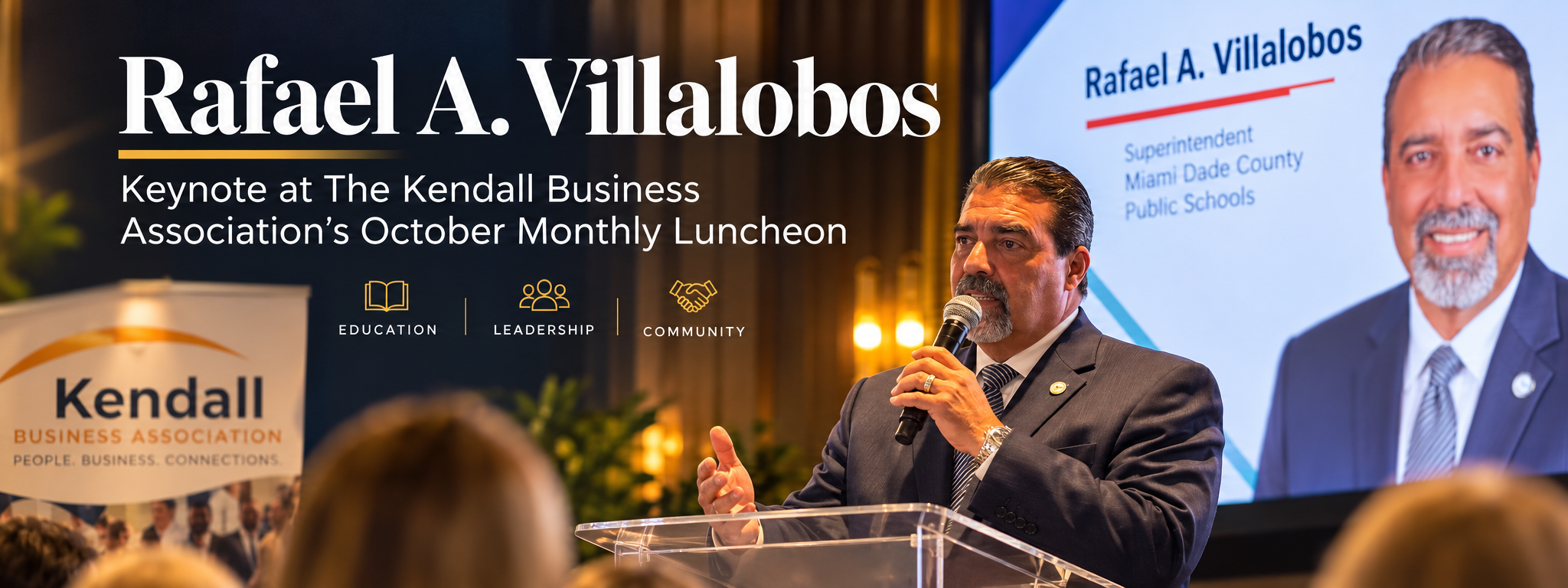
Superintendent Rafael A. Villalobos Shares His Vision for Miami-Dade Public Schools at Greater Kendall Business Association Luncheon

New superintendent highlights academic excellence, workforce readiness, community partnerships, and the challenges shaping the future of education in Miami-Dade County.

October 22, 2026
Kendall, Miami-Dade County

KENDALL, FL — Education, leadership, and the future of Miami-Dade County took center stage as Rafael A. Villalobos, Superintendent of Miami-Dade County Public Schools, delivered the keynote address at the Greater Kendall Business Association (GKBA) October Signature Luncheon on Thursday, October 22, 2026.
Held at Fogo de Chão Brazilian Steakhouse in Kendall, the gathering brought together business professionals and community leaders for a discussion extending well beyond the classroom.
Under the theme “The State of Miami-Dade County Public Schools: Navigating Change, Protecting Opportunity,” Villalobos shared his perspective on one of the nation’s largest public school districts, its accomplishments, and the decisions necessary to ensure that students continue receiving a quality education.
His message emphasized that strong public schools are not simply an educational priority. They are essential to Miami-Dade County’s economic vitality, workforce development, and long-term prosperity.
A Career Built on Education and Service
For Villalobos, leading Miami-Dade County Public Schools is personal.
A product of the district himself, he began his educational career in 1994 as a teacher at South Dade Senior High School. Over more than three decades, he advanced through teaching and administrative leadership positions, including serving as principal of several schools and South Region Superintendent.
In July 2026, the Miami-Dade County School Board unanimously selected him to lead the district. He officially assumed the position in September 2026.
During his keynote, Villalobos spoke with pride about the educators, administrators, support professionals, and school police officers whose contributions make student success possible.
He emphasized that the district’s accomplishments are the result of dedicated professionals who care deeply about children and understand the responsibility of preparing them for life beyond graduation.
Academic Excellence and Opportunities for Every Student
One of the most encouraging portions of Villalobos’s address centered on academic achievement.
He highlighted the district’s performance in graduation rates, advanced placement coursework, industry certifications, and dual enrollment opportunities.
Villalobos described an educational system offering students a wide range of pathways, whether their ambitions include attending college, entering a technical profession, or pursuing careers in emerging industries.
Students today can explore programs involving automotive technology, refrigeration, HVAC systems, drones, artificial intelligence, and many other specialized areas.
He also emphasized that dual enrollment programs allow qualifying high school students to earn college credits, and in some cases even an associate degree, before graduating from high school.
These opportunities, he explained, help families reduce educational costs while giving students a meaningful head start.
For the business professionals in attendance, his remarks underscored an important connection: Miami-Dade County Public Schools is developing the future talent that local employers will depend upon.
Addressing Declining Enrollment and Miami’s Cost of Living
While celebrating the district’s achievements, Villalobos was equally candid about the challenges confronting public education.
A central topic was declining student enrollment and the pressures created by Miami-Dade County’s rising cost of living.
He identified several contributing factors, including declining birth rates, fewer international student arrivals, and families relocating to more affordable communities outside South Florida.
As enrollment changes, the district must also reconsider how its facilities, staffing, and educational resources are allocated.
Villalobos explained that some underenrolled schools may eventually require consolidation or closure. However, he emphasized that those decisions must be approached carefully, with consideration for students, families, transportation, facility conditions, and access to academic programs.
He discussed his decision to pause the district’s proposed consolidation process upon becoming superintendent so that the plans could receive additional review and communities could be heard.
His central concern was educational equity: ensuring that students attending smaller schools have access to the same enriching opportunities available elsewhere in the district.
Investing in Teachers, Student Well-Being, and School Safety
Villalobos also addressed the importance of supporting the people responsible for educating and protecting students.
He spoke about teacher compensation in a community where housing and living expenses continue to place financial pressure on working families.
In addition, he discussed school safety and the importance of maintaining a strong school police presence.
His remarks extended beyond academics to the emotional and social needs of children, recognizing that students experiencing hunger, personal difficulties, or emotional distress may struggle to succeed in the classroom.
The district’s mental health counselors, support services, and school safety professionals, he emphasized, are essential components of a successful educational environment.
Preparing Students for an Artificial Intelligence Economy
Technology and artificial intelligence were another important part of the conversation.
Villalobos discussed the district’s adoption of tools such as Google Gemini and its efforts to introduce students to emerging technologies.
However, he also recognized a challenge facing educators everywhere: ensuring that artificial intelligence supports learning rather than replacing students’ ability to think independently.
The discussion reinforced the importance of critical thinking, responsible technology use, and preparing young people for careers that will continue evolving alongside artificial intelligence.
For Miami’s business community, these initiatives represent an important investment in the region’s future workforce.
Community Partnerships Are Essential to Student Success
Throughout his presentation, Villalobos returned to the importance of relationships between public education and the wider community.
He emphasized that successful schools require more than funding and academic programs. They also depend upon partnerships with business owners, civic organizations, community leaders, and families.
Miami-Dade County’s extraordinary cultural diversity adds another dimension to that responsibility, as its schools serve students from numerous nationalities, languages, and socioeconomic backgrounds.
Villalobos described his efforts to visit communities throughout Miami-Dade County, meet with local leaders, listen to concerns, and identify opportunities for improvement.
During the question-and-answer portion of the luncheon, an attendee raised concerns about differences in educational resources among schools across the county.
Villalobos acknowledged the importance of addressing those disparities and reiterated his commitment to visiting communities, listening to stakeholders, and pursuing improvements throughout the district.
A Shared Vision for Miami-Dade County’s Future
The October luncheon provided business leaders with an opportunity to hear directly from a superintendent who has spent his professional career serving the same school system he now leads.
His keynote balanced optimism about educational achievement with a practical recognition of the financial, demographic, and operational challenges ahead.
Most importantly, Villalobos reinforced the belief that every child deserves access to opportunities that can shape a successful future.
For the Greater Kendall Business Association and Miami’s broader business community, the message was particularly relevant.
Strong schools help attract families, support economic development, prepare future employees, and strengthen neighborhoods.
As Villalobos continues his leadership of Miami-Dade County Public Schools, his appearance at the October luncheon offered an important reminder that the future of Miami’s business community begins, in many ways, in its classrooms.

Read More

Why AI Monitoring Cannot Replace Recovery Planning

Miami business leaders need a tested plan for what happens after an automated alert

Estimated reading time: 6 minutes
What You Need to Know
Artificial intelligence can help companies detect unusual activity, identify possible failures and alert technical teams faster. It cannot guarantee that backups will restore, decide which customer service must return first or replace a business-continuity plan that employees have practiced.
For Miami organizations that depend on cloud applications, digital communications and always-available services, the most important question is not whether an alert arrives quickly. It is whether the business can recover within a timeframe customers and operations can tolerate.
Key Takeaways

AI-enabled monitoring improves detection but does not automatically create recovery readiness.
A completed backup job is not proof that data and applications can be restored successfully.
Leaders must establish priorities, responsibilities and acceptable recovery times before an incident.
Communication with employees, customers and vendors is part of recovery.
Exercises reveal gaps that software dashboards may not show.

Who This Article Is For
This article is for Miami business owners, executives, operations leaders and technology decision-makers responsible for cybersecurity, business continuity, customer service and organizational resilience.
The Alert Is Only the Beginning
Imagine receiving an automated warning at 4 a.m. that a critical business system is unavailable.
The monitoring platform worked. It recognized a problem and notified the appropriate people. But the alert does not answer the questions that determine the business outcome.
Which system should be restored first? Is the newest backup complete and protected from the incident? Who can authorize emergency changes? Can employees continue essential work? When should customers be notified, and what should they be told?
AI can help organize technical information, identify patterns and accelerate analysis. It cannot retroactively create decisions, procedures and responsibilities that leadership never established.
Detection Is Not Recovery
Monitoring and recovery are different capabilities.
Monitoring observes systems and identifies conditions that may require attention. Recovery restores data, applications, communications and operating capacity after a disruption.
An alarm can indicate that smoke is present. It does not extinguish a fire, account for employees or reopen the building. In the same way, an AI-enabled platform may flag an unavailable server, unusual login, failed process or suspicious activity. The organization still needs a tested method for containing the incident and restoring essential services.
The value of faster detection is realized only when the business knows what to do next.
What AI Cannot Guarantee
A Successful Data Restoration
A dashboard may show that backups completed on schedule. That does not prove that every required file, database, configuration and application can be restored in a real incident.
Testing provides that evidence. A meaningful restoration exercise confirms that the correct information was captured, restored files open properly, applications function and recovery can be completed within an acceptable period.
Federal cybersecurity guidance continues to emphasize protected backups and regular recovery testing. The reason is practical: organizations should discover incomplete, corrupted or inaccessible backups during a controlled exercise—not during an emergency.
The Right Business Priority
Several systems may fail at once, and the technically easiest service to restore may not be the one that matters most to customers or revenue.
Leadership must determine which functions are essential, how long each can remain unavailable and what dependencies must be addressed first. A reservation platform, payment system, patient portal or logistics application may deserve priority because of its direct effect on customers and operations.
AI can present information and recommendations. The organization remains accountable for the decision.
Clear Human Responsibility
Recovery efforts slow down when no one knows who has authority to declare an incident, approve changes, contact outside providers or communicate with customers.
A tested playbook should assign those responsibilities and identify alternates. Disruptions do not wait until every executive, employee and technology partner is available.
The plan should be understandable to the people expected to use it. A highly technical document that only one person understands can become another point of failure.
Customer Communication
An outage becomes a reputation problem when customers receive no information, conflicting explanations or unrealistic promises.
Miami’s economy includes industries where responsiveness is central to the customer experience, including hospitality, finance, healthcare, real estate, professional services, transportation and international trade. In these sectors, prolonged silence can be interpreted as a lack of preparation.
Recovery planning should identify who communicates, which channels remain available and how often updates will be provided. AI may help draft or summarize information, but people must verify the facts and own the message.
Practice Under Pressure
A plan can appear complete until employees attempt to use it.
Exercises reveal expired credentials, missing documentation, outdated contacts, unavailable equipment and dependencies that were never recorded. They also give teams experience making decisions before the pressure of a real incident.
Practice turns a written document into an operational capability.
Questions Miami Business Leaders Should Ask

When did we last restore a critical backup successfully?
Which systems must return first to protect customers and revenue?
How long can each essential service remain unavailable?
Who can make emergency technology and operational decisions?
How will employees work if normal applications or communications are unavailable?
Who will update customers, vendors and partners?
Are recovery instructions accessible if the primary network is down?
Which outside providers must participate in recovery?
What did our last exercise reveal, and were the gaps corrected?

Unclear answers indicate that the company may have strong monitoring but an incomplete recovery strategy.
Building a More Complete Safety Net
A practical approach combines intelligent monitoring with proven recovery fundamentals:

Identify essential services. Document the systems, people and vendors required to deliver them.
Define recovery objectives. Establish how quickly each function should return and how much data loss is tolerable.
Protect backup copies. Use appropriate security and isolation so an incident affecting production systems does not automatically reach every backup.
Test restoration. Recover representative data and applications, then document the results and actual recovery time.
Assign responsibilities. Give decision-makers, technical teams and communicators clear roles and alternates.
Prepare alternate workflows. Determine how essential work can continue while primary systems are unavailable.
Exercise and improve. Treat every test and incident as an opportunity to update the plan.

AI can make monitoring more useful and analysis faster. Tested preparation connects those capabilities to business resilience.
Frequently Asked Questions
Can AI automatically restore a failed business system?
Some tools can automate limited actions, such as restarting a service or moving a workload. Complete recovery still requires validated backups, established priorities, safety checks and human oversight.
Does AI monitoring replace a disaster-recovery plan?
No. Monitoring identifies potential problems. A disaster-recovery plan establishes how systems and data will be restored, who is responsible and how the business will operate during the interruption.
How often should recovery plans be tested?
The schedule should reflect the importance and rate of change of each system. Critical services should be tested regularly and after significant changes to infrastructure, applications, providers or staffing.
What is the difference between backup and business continuity?
Backup protects recoverable copies of data. Business continuity addresses how the organization maintains or resumes essential operations, including people, communications, vendors, applications and customer service.
Why is communication included in recovery planning?
Customers and employees need accurate information during a disruption. Clear communication reduces confusion, prevents conflicting instructions and helps preserve confidence while technical recovery continues.
Final Takeaway
Artificial intelligence can recognize warning signs and help people interpret complex technical information. It cannot build organizational readiness after an outage begins.
Businesses recover more effectively when leaders define priorities, test backups, assign responsibility and practice the process before it becomes urgent.
When the 4 a.m. alert arrives, the goal is not to begin inventing a response. It is to execute a plan the organization already knows can work.
Call to Action
Miami-area organizations that want to evaluate backup testing and recovery readiness can contact ulltium consulting®. The firm helps business leaders understand what is protected, what has been tested and how technology supports operational resilience.
Call 305-823-2200 ext. 150 or visit ulltium.com to schedule a technology discovery conversation.
About ulltium consulting®
ulltium consulting® helps organizations align cybersecurity, cloud services, automation and business continuity with practical operating goals and long-term growth.

Read More