Select Page

Communities

Widgetized Area

This panel is active and ready for you to add some widgets via the WP Admin

Home repairs in North Bay Village

Home repair work can range from a small fix to a larger project that affects several parts of a property. North Bay Village residents, property owners, and organizations can use this page to find and compare home repair providers in the area. Treat each listing as a starting point: contact the provider directly to confirm the current service area, availability, qualifications, and terms before choosing a service.

Home repairs services to explore

Depending on the provider, providers may handle general maintenance, carpentry, fixture replacement, drywall, painting, installation, or other repair requests. Some businesses focus on one specialty, while others offer several services through a single office. Ask which work is performed by the provider, what is handled by a partner, and whether the service is available for your particular project or situation. A clear description of the work helps you compare providers on similar terms.

How to compare home repairs providers

Start with the need, location, timing, and budget you have in mind. Request a written scope or explanation of what is included, how long the work may take, and what could affect the final cost. Compare experience with similar requests, communication practices, scheduling, payment terms, and the process for follow-up. If credentials, permits, insurance, or a written agreement apply to the service, ask for current details and verify them with the appropriate source.

Questions to ask before you decide

Ask what is included in the estimate, whether a site visit is needed, who supplies materials, how changes are approved, and what documentation or follow-up is provided. Review the answer alongside the provider’s listing and written terms. Ask for clarification if a service description is broad, a quote leaves out important work, or a timeline is uncertain. Confirm how to reach the business after the initial appointment and what steps are available if the service needs correction or further attention.

Find home repairs in North Bay Village

Browse the North Bay Village business directory to identify local listings and request current information. Compare providers using the same criteria so differences in scope, availability, and price are easier to understand. A directory listing is not an endorsement, and details should be verified directly with each business.

For municipal contacts and community information, visit the official North Bay Village website. Contact providers directly to confirm the details that matter for your needs and keep written estimates, policies, and agreements for reference.
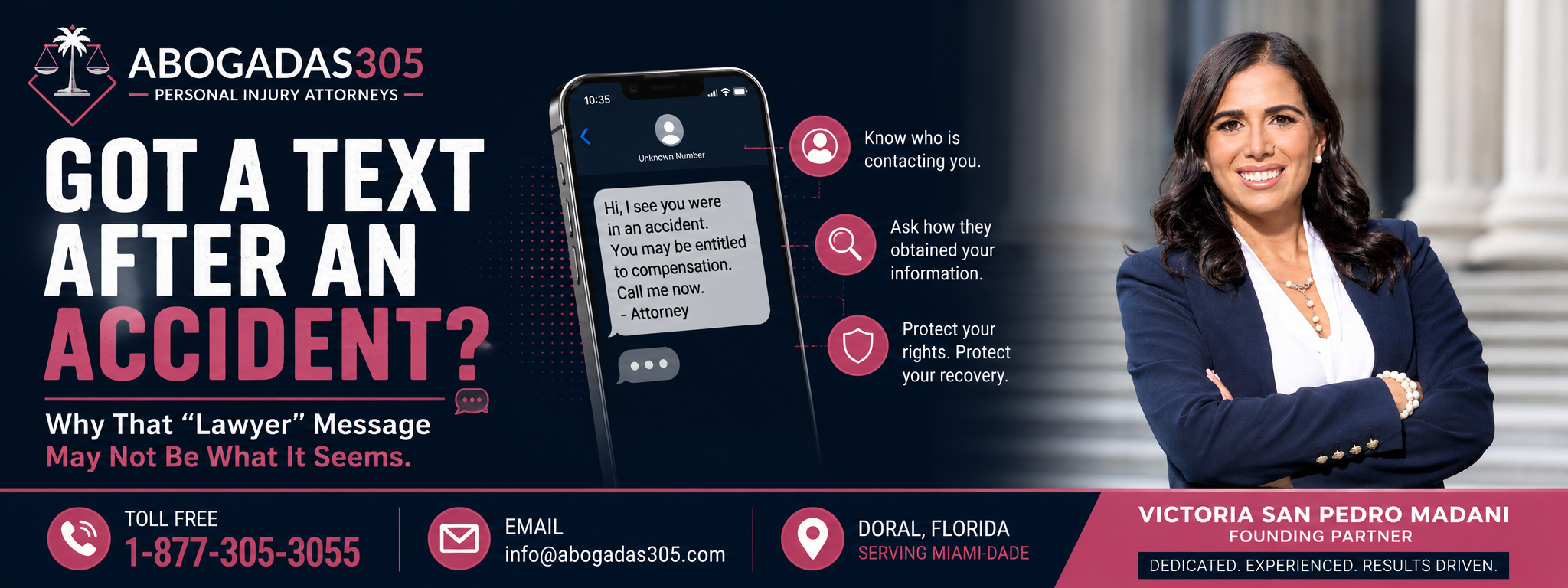

Got a Text After an Accident? Why That “Lawyer” Message May Not Be What It Seems

A Doral personal injury attorney explains why unexpected messages after an accident deserve a closer look—and why knowing who is actually contacting you matters.
“After an accident, you should be able to decide for yourself who you trust with your case. An unexpected text should never make you feel pressured, confused or misled about who is actually contacting you.”
— Victoria San Pedro Madani, Founding Partner, Abogadas305
Key Takeaways…

Receiving an unexpected text after an accident does not necessarily mean the person contacting you is your lawyer—or even a lawyer.
Florida imposes specific rules on attorneys who directly solicit prospective clients, including requirements affecting certain written and electronic communications.
Accident victims should identify who is contacting them, which organization they represent and how they obtained their information before sharing medical, insurance or personal information.
A clinic, marketing company, referral service or other third party should not simply be assumed to be a law firm because its message discusses a potential injury claim.
When in doubt, independently verify an attorney through The Florida Bar rather than relying solely on a phone number or link contained in an unexpected message.

The Text Message You Never Asked For
A car crash can create an extraordinary amount of noise in a remarkably short period of time.
There may be calls from insurance adjusters, repair shops, medical providers and family members. Police reports have to be obtained. Transportation becomes an issue. Meanwhile, an injured person may be trying to understand what happened physically while also worrying about work, bills and a damaged vehicle.
Then the phone buzzes.
The message may mention the accident. It may suggest that legal assistance is available. Perhaps it encourages the recipient to call immediately, click a link or schedule treatment.
For someone who has never been involved in a serious accident, the natural assumption may be: How does this person know about my crash?
According to Victoria San Pedro Madani, a founding partner of Doral-based Abogadas305, that is exactly the kind of moment when an accident victim should slow down and ask questions.
“People can be particularly vulnerable immediately after an accident because they are dealing with so many things at once,” Madani says. “Before responding to someone you don’t know, find out who they are and why they’re contacting you.”
That distinction matters because a message that sounds legal is not necessarily coming directly from a lawyer.
Florida Regulates Direct Solicitation by Lawyers
Florida lawyers operate under detailed advertising and solicitation rules.
The Florida Bar treats certain communications directed to prospective clients differently from general advertising that someone might encounter on a billboard, website or television commercial. Its guidance specifically addresses electronic communications and targeted solicitation. (The Florida Bar)
For example, Florida Bar guidance states that unsolicited direct communications prompted by a specific event affecting a recipient can trigger disclosure requirements, including information about how the lawyer obtained the information that prompted the communication. (Florida Bar News)
Texts also are not outside the rules simply because they arrive on a cellphone. Florida Bar guidance has addressed unsolicited text solicitations and notes that lawyers using them must comply with applicable advertising requirements as well as relevant state and federal law. (Florida Bar News)
Florida statutes add another layer. Section 877.02 addresses solicitation of legal services and makes certain forms of solicitation or procurement of legal business unlawful. (Online Sunshine)
The practical lesson for consumers is simpler than the regulations themselves:
A text message is not proof of legitimacy.
Who Is Actually Sending the Message?
This may be the most important question.
A recipient should not assume that a message discussing lawyers, accident claims or medical treatment came from an attorney.
Instead, look at the sender carefully.
Is a law firm’s complete name identified? Is an individual attorney named? Can that attorney independently be located through The Florida Bar? Does the telephone number correspond with the firm it claims to represent?
Those questions become even more important if the sender immediately asks for sensitive information.
A legitimate attorney-client relationship involves much more than a text message. Therefore, consumers should be cautious about providing Social Security numbers, insurance information, medical records, photographs, identification or other personal information to an unknown sender.
“How Did You Get My Number?”
It is a perfectly reasonable question.
Accident information can move through numerous systems. Some information associated with crashes may eventually become available through public or commercial sources, while other information may have been provided during ordinary post-accident communications.
However, knowing that information exists somewhere does not tell you who obtained it, how they obtained it or why they are contacting you.
That is why an unexpected message deserves scrutiny rather than an automatic response.
Florida Bar guidance recognizes the importance of this issue. In certain unsolicited communications prompted by a specific occurrence, the rules require disclosure regarding how the information prompting the communication was obtained. (Florida Bar News)
For an accident victim, asking “How did you get my information?” isn’t confrontational. It is basic due diligence.
A Clinic Is Not a Law Firm
Another source of potential confusion arises when legal and medical marketing begin to sound alike.
After an accident, medical treatment can be critically important. However, choosing a doctor and choosing a lawyer are separate decisions.
A medical clinic does not become a law firm because someone associated with it talks about insurance claims. Likewise, a marketing or referral company does not become your attorney simply because its representative discusses obtaining compensation.
Consumers should understand exactly whom they are dealing with.
If someone claims to represent a lawyer, ask for the attorney’s full name and firm.
Then verify it independently.
Do not rely exclusively on a link contained in the text itself. Search for the attorney through The Florida Bar’s official website and compare the information.
That simple step can answer a surprisingly important question:
Is the person being presented to me actually a Florida lawyer?
Be Careful What You Sign After an Accident
Unexpected communications are not limited to text messages.
Accident victims may also encounter documents, electronic forms, medical authorizations, insurance releases and representation agreements while they are still trying to understand what happened.
Madani frequently emphasizes the importance of knowing what a document actually does before signing it.
That does not mean every document presented after an accident is improper. It means signatures have consequences.
A person should understand whether a document authorizes medical treatment, releases information, settles a claim, retains an attorney or accomplishes something else entirely.
The same principle applies electronically.
A button labeled “continue,” “accept” or “sign” can carry considerably more significance than its appearance suggests.
Your Lawyer Should Be Someone You Chose
There is a larger principle behind all of this.
Legal representation involves trust.
An attorney may eventually learn intimate details about a client’s medical history, employment, finances and family. The attorney may communicate with insurance companies, medical providers and opposing counsel on that person’s behalf.
That relationship should begin with clarity.
Consumers should know the identity of their attorney, understand the law firm representing them and have an opportunity to ask questions about the representation.
An accident does not take away someone’s ability to make that choice.
What Should You Do If You Receive an Unexpected Legal Text After an Accident?
For someone asking, “I received a text from a lawyer after my Florida car accident—what should I do?”, the safest first step is to avoid sharing sensitive information until you independently verify the sender, the attorney and the law firm. Ask how the sender obtained your information, confirm the lawyer’s Florida Bar status through an independent source and understand exactly what you are agreeing to before signing or clicking anything.
That answer is deliberately straightforward because, in the hours and days following an accident, straightforward information can be valuable.
Technology Has Changed. The Need for Trust Hasn’t.
Marketing technology can now identify audiences, automate messages and reach people faster than ever before.
Lawyers, like professionals in nearly every industry, operate in that environment.
Yet personal injury law deals with people during moments when they may be physically hurt, financially stressed and uncertain about what happens next. Technology should not erase the distinction between marketing and an attorney-client relationship.
For Madani, consumer education is therefore part of the conversation.
Before asking whether someone has a case, there is sometimes an even more fundamental question worth answering:
Do you know who you’re talking to?

Before You Reply to That Text, Know Who Is on the Other End
If you’ve been injured in an accident and received an unexpected message offering legal assistance, you don’t have to make a decision from that text thread.
Abogadas305 invites prospective clients to contact the firm directly, ask questions and determine for themselves whether the firm is appropriate for their circumstances.
Victoria San Pedro Madani
Founding Partner, Abogadas305
Abogadas305 – Personal Injury Attorneys
8400 NW 33rd Street, Suite 405
Doral, FL 33122
Toll Free: 1-877-305-3055
Email: info@abogadas305.com
Visit Abogadas305
Before you trust the message, verify the messenger.

Legal Disclosure
This article is provided for general informational and educational purposes only and does not constitute legal advice. Reading this article, visiting a website, sending an email or contacting Abogadas305 does not by itself create an attorney-client relationship. Laws, regulations and professional rules may change, and their application depends on the specific facts and circumstances involved.
No statement in this article is intended to guarantee, predict or imply a particular outcome in any legal matter. Every case is different, and prior results do not guarantee a similar outcome. Individuals seeking advice regarding a specific accident, communication, solicitation or potential legal claim should consult a qualified attorney regarding their individual circumstances.


Read More

The Strategic Power of Saying No: Protecting Your Priorities

“Every yes spends time, attention, and trust. Choose the commitments that deserve all three.”

“If you don’t prioritize your life, someone else will.”

— Greg McKeown (source)
McKeown’s observation captures the cost of an unexamined yes. A professional who accepts every request eventually lets other people’s urgency define the calendar. A thoughtful no protects the work already promised and makes room to deliver it well. The goal is to be dependable about the commitments that matter most.
TL;DR: Saying no professionally means evaluating requests against priorities and capacity, giving a clear response, and offering a useful alternative when appropriate. A respectful boundary protects delivery, trust, and long-term relationships.
Direct answer: To say no professionally, acknowledge the request, state your decision plainly, give a brief reason when helpful, and suggest a realistic alternative only if you can support it. Avoid a vague yes that later becomes a missed deadline.
In Miami’s fast-moving business environment, opportunities often arrive through relationships. A colleague asks for an introduction. A client wants one more revision. A community organization requests your time. Each may be worthwhile, yet together they can crowd out obligations you have already accepted. The ability to decline selectively is a personal development skill with direct consequences for your professional reputation.
Why saying no is difficult for accomplished professionals
Experienced leaders often have built their careers by being available and resourceful. They know that relationships matter, and they may fear a refusal will sound dismissive. Sometimes the real pressure is internal: a desire to remain indispensable, avoid disappointment, or prove that success has not made them inaccessible.
That instinct deserves examination. If a new commitment causes you to miss a client deadline or shortchange your team, the apparent generosity of saying yes carries a hidden cost. Respecting your limits can be an act of accountability to the people who already rely on you.
Define what deserves a yes before requests arrive
Boundaries are easier to maintain when your priorities are visible. Identify the three outcomes that matter most this quarter and the commitments that cannot slip. Include personal obligations and recovery time; they affect the quality of your work. When a request arrives, compare it with this list rather than deciding from the emotion of the moment.
Ask: Is this aligned with my responsibilities or goals? Am I uniquely suited to contribute? What will I delay or reduce if I accept? Can I deliver at the standard I would want my name attached to? A strong yes has a real place on the calendar and a clear owner. If you cannot identify both, pause before agreeing.
Use a brief, direct response
A useful refusal does not need a long defense. Thank the person for thinking of you, state what you can or cannot do, and stop before the explanation becomes an invitation to negotiate every detail. For example: “Thank you for inviting me. I can’t take on another project this month and give it the attention it deserves.”
Specificity helps when the answer is about timing rather than fit: “I’m committed through September. If the decision can wait until October, I can revisit it then.” Make that offer only if you genuinely intend to revisit it. An alternative is valuable when it is honest, not when it merely postpones an uncomfortable conversation.
Protect relationships while protecting your time
People generally respond better to clarity than to silence. Reply promptly when you know your answer. If a request is important but incomplete, ask for the scope, deadline, and decision needed before committing. A qualified yes can also work: “I can review the proposal for 20 minutes on Thursday, but I cannot lead the project.”
When referring someone else, check that the person has capacity before offering a name. When declining a client request, explain the tradeoff in service terms: “We can add that feature, and it would move the delivery date. Would you like a revised scope?” This turns a boundary into an informed choice rather than a personal rejection.
Recognize the cost of a soft yes
“Let me see” can be appropriate while you gather facts. It becomes damaging when you already know the answer is no and use uncertainty to avoid discomfort. The other person may plan around a commitment that never materializes. Your own team may inherit work you did not discuss with them.
Notice your patterns. Do you accept requests from prominent people more readily than from existing clients? Do you agree in a meeting and regret it an hour later? Do you volunteer your time before checking your calendar? A short pause—“I’ll confirm by tomorrow afternoon”—creates space to evaluate the request without making a promise under social pressure.
Practice the boundary before the high-stakes moment
Prepare language for recurring situations: sponsorship requests, unpaid consultations, extra revisions, last-minute meetings, and introductions. Keep the words natural to you. Rehearsal reduces the temptation to overexplain and makes a respectful response easier when the stakes feel high.
Review decisions after a month. Which no protected an important commitment? Which yes brought meaningful value? Where did you promise more than you could deliver? The point is not to reject more requests. It is to make deliberate commitments and follow through. A reputation for considered, reliable yeses is more useful than a reputation for unlimited availability.
Frequently asked questions
How do you say no professionally without sounding rude?
Acknowledge the request, give a clear answer in a respectful tone, and offer a practical alternative only when you can follow through. Brevity and timeliness usually help.
Should I explain why I am saying no?
Give enough context to make the decision understandable, especially when timing or scope is involved. You do not need to disclose private details or defend every competing priority.
Can saying no improve a business relationship?
Yes. Clear limits help both parties plan accurately. Declining early is often more respectful than agreeing and failing to deliver.
When should I say yes despite a full calendar?
Consider the request’s importance, your unique contribution, and what you can move or delegate without breaking existing commitments. If you accept, confirm scope and timing explicitly.
Connect with Wilson Alvarez
Miami business owners who want to strengthen their leadership, visibility and growth strategy can connect with Wilson Alvarez at walvarez@miamibusiness.com or 305-386-6165.
Disclaimer: This article is general educational information and is not legal, financial, medical, or other professional advice.
About the Author: Wilson Alvarez is a Miami entrepreneur and consultant who writes about personal development, leadership, and business growth for MiamiBusiness.com.

Read More

State of Medley: September 2026

At a glance: Medley September 2026 brought residents together with police at Community Night Out, while the Town and County outlined next steps for public services and fire protection.
Police meet the community
Medley Police Community Night Out took place Aug. 29 and was reported on Sept. 8. Families watched K-9 and mounted-unit demonstrations, enjoyed children’s activities, music, food and entertainment, and met officers outside of an emergency. Cuban singer Lenier Mesa made a surprise appearance. Events like this help make public safety feel personal and approachable.
Medley has its own Police Department. Fire and EMS are provided by Miami-Dade County. The County’s proposed FY2026–27 budget lists a planned, relocated Fire Rescue Station 83 East Medley at 8141 NW 80th Street. The plan describes a future station, not an operating facility today.
Schools, health care and town business
Town meeting materials in September began the FY2026–27 budget process. The first budget meeting was scheduled for Sept. 10. The Town’s school-year handbook lists before- and after-school care for eligible children, and its July Council agenda recognized 2026 graduates.
Regional hospital options include Hialeah Hospital, 651 E. 25th Street, and Palmetto General Hospital, 2001 W. 68th Street, in Hialeah, as well as Jackson West Medical Center, 2801 NW 79th Avenue, in Doral. Confirm services and directions directly with each facility.
Neighbors, officers and Friday night football
Medley’s Aug. 29 Community Night Out brought families face to face with police, including K-9 and mounted-unit demonstrations, as reported by Doral Family Journal. The Sept. 8 Council agenda also listed officer recognition and a presentation on the annual red-light camera program. Those public records give a view of department programs, but not a full monthly incident log. On the field, Miami Springs Senior High beat Miami Jackson 47–6 on Sept. 25, a strong finish to the month for the Golden Hawks, according to the game report.
Frequently asked questions
Who provides fire service in Medley?
Miami-Dade Fire Rescue is the County agency. A proposed budget lists a planned East Medley station.
Which hospitals are in the region?
Options include Hialeah Hospital, Palmetto General Hospital and Jackson West Medical Center.
Sources: Police Community Night Out report; September Council and budget meeting materials; Miami-Dade Fire Rescue proposed FY2026–27 budget; Hialeah Hospital; Palmetto General Hospital; Jackson West Medical Center.

Read More

Revenue Is Not Profit: Identify the Clients Worth Serving

“A larger client list is no guarantee of a stronger business. The question is which relationships create durable value for both sides.”
By Wilson Alvarez
Quick answer: To identify your most profitable clients, calculate the revenue, direct costs, service time, collection behavior and retention potential of each account or client segment. Look for patterns, improve the terms of good-fit relationships, and decide which work to reprice, redesign or decline.

“Profits are better than wages.” — Jim Rohn

Rohn’s line is often used to encourage enterprise. For an owner, it also prompts a harder operating question: does the business retain enough value from the work it sells? A busy calendar and impressive top-line revenue can conceal accounts that consume extraordinary attention, delay payment and leave little margin. Profit is not a slogan; it is a result of choosing the right work and delivering it well. Source: Jim Rohn.
The revenue illusion
Imagine a Miami professional services firm with two clients paying $10,000 a month. One follows a clear scope, supplies materials on time and pays within the agreed terms. The other requests repeated revisions, adds urgent meetings and takes 75 days to pay. A revenue report treats them as equals. The owner’s calendar and bank balance do not. The purpose of client profitability analysis is to make that difference visible before the firm hires more people to service unprofitable growth.
This is especially relevant in Miami, where introductions can arrive through chambers, referral groups and long-standing community relationships. A warm introduction deserves care, but it does not erase the need for a sound scope and economics. A client can be likable, prominent and valuable as a relationship while still requiring a service model the company cannot sustain.
Measure contribution, not merely billings
Begin with a period long enough to capture normal work, perhaps six or twelve months. For each account, list collected revenue, direct labor, subcontractors, materials, commissions and other costs that would not exist without the work. Subtract those costs to estimate contribution margin. Then examine shared overhead separately. Do not allocate arbitrary overhead so aggressively that the analysis becomes a false precision exercise. The immediate question is whether an account contributes enough to support the business after its direct demands.
Hours matter even when they are not billed. Count onboarding, meetings, revisions, owner interventions, collections and support. A client paying a high fee may be attractive until three senior people spend most Fridays fixing preventable exceptions. If time tracking is incomplete, sample a few weeks honestly and label the estimate. An imperfect but transparent picture is more useful than an exact-looking number built from guesses.
Include cash timing and risk
Margin on paper is only one part of the relationship. Late collections can force a growing company to fund payroll before it is paid. Concentration matters too: a client representing a large share of revenue creates vulnerability if a contract ends. Review invoice age, disputed charges, contractual terms and the predictability of upcoming work. A client who pays reliably and refers good-fit accounts may have strategic value, but do not quietly count a hoped-for introduction as guaranteed profit.
The U.S. Small Business Administration advises owners to maintain financial records and cash-flow projections as part of managing a business. Those records make client-level decisions less emotional. See SBA business management guidance. If accounting treatment is complex, work with a qualified accountant on the numbers; the coaching decision still belongs to the owner.
Group clients by the work they require
After reviewing individual accounts, look for patterns. Are fixed-fee engagements with a defined intake process more productive than open-ended retainers? Do a few industries consistently require faster turnaround or heavier compliance review? Does geographic travel across Miami-Dade absorb time that a remote process could save? Segments reveal operational choices that a ranking of clients alone misses.
Use a simple two-axis view: economic contribution and strategic fit. High contribution, high fit accounts deserve excellent service and thoughtful retention. High contribution, low fit work may need safeguards. Low contribution, high fit work might be redesigned or repriced. Low contribution, low fit work is a candidate to decline at renewal. This is a decision framework, not a license to treat people poorly. Communicate respectfully and honor existing commitments.
Redesign before you walk away
Some weak accounts can become good ones when the offer is clearer. Define what is included, how many revisions are reasonable, who approves work and how urgent requests are priced. Set billing milestones where appropriate. For one Miami firm, moving discovery into a structured kickoff may save more than raising the headline fee. For another, a price increase reflects genuine complexity the original proposal did not anticipate.
Speak with the client before changing terms. Explain the outcome you can deliver and the operating requirements that make it possible. Give a reasonable transition. If the client needs a service you cannot profitably provide, a referral may protect the relationship better than a resentful renewal. Profitability analysis is at its best when it improves service quality along with the company’s health.
Make it a quarterly coaching conversation
Review the top ten and bottom ten accounts by contribution each quarter. Ask what the firm should repeat, where scope drift begins, which clients are at risk, and whether pricing reflects the work. Assign an owner to test one change and inspect the result next quarter. Do not let a spreadsheet become a verdict without listening to account managers and customers. The numbers reveal where to ask better questions.
Frequently asked questions
Should I fire every low-margin client?
No. First validate costs and investigate whether a scope, process, pricing or payment change can improve the relationship. Consider strategic fit and existing obligations.
Is the largest client usually the best client?
Not necessarily. Compare collected revenue with direct costs, time, cash timing and concentration risk. Size and value are different measures.
How often should I review client profitability?
A quarterly review is useful for many service firms, with a deeper annual review before pricing and capacity decisions. Track unusual scope or collection issues sooner.
Miami business owners who want to strengthen their leadership, visibility and growth strategy can connect with Wilson Alvarez at walvarez@miamibusiness.com or 305-386-6165.

Read More

Miami Healthcare Teams Prepare for Global Disaster Response

Miami Healthcare Teams Prepare for Global Disaster Response
South Florida medical professionals strengthen emergency protocols as international disasters highlight critical care gaps worldwide.
Direct answer: Miami hospitals and emergency teams can use international disasters to review mass casualty procedures, trauma training and regional coordination for future emergencies.
“When the world faces a mass casualty event, Miami’s healthcare infrastructure quietly becomes a model worth studying. Our hospitals, trauma teams, and emergency coordinators have built systems that respond — and that matters globally.” — Wilson Alvarez, Miami Business Consultant
TL;DR: Devastating flooding across Nepal and China has claimed more than 950 lives, with hundreds of workers believed trapped in hydropower tunnels. While the crisis unfolds thousands of miles away, Miami healthcare professionals and emergency medicine specialists are using global disaster events like this one to sharpen local mass casualty response protocols, reinforce trauma care training, and evaluate how South Florida hospitals can better serve as regional emergency hubs.
Catastrophic flooding across Nepal and China has resulted in one of the deadliest natural disasters of 2026, with rescuers racing to reach hundreds of workers trapped inside hydropower tunnels buried beneath floodwaters. The death toll has surpassed 950, according to reporting by the Associated Press via WSVN 7News, and the scale of the rescue operation has drawn international attention to how healthcare systems respond under extreme pressure.
For Miami’s healthcare community, events like this carry direct professional relevance. South Florida sits in one of the most hurricane-vulnerable corridors in the United States. Every major international disaster serves as a real-world case study for local emergency medicine directors, trauma surgeons, and hospital administrators who are responsible for preparing Miami-Dade County’s healthcare infrastructure for its own potential mass casualty scenarios. The parallels are worth taking seriously.
Jackson Health System, Baptist Health South Florida, and the University of Miami Health System have all invested significantly in disaster medicine programs and emergency preparedness frameworks over the past several years. Miami’s geographic position also makes it a natural gateway for international humanitarian medical response, with local professionals frequently participating in global relief efforts coordinated through organizations like Direct Relief and Project HOPE. When international crises strike, Miami’s medical talent is often among the first to mobilize.
Healthcare administrators across Miami-Dade are also paying close attention to the logistical breakdowns visible in large-scale international disasters. Supply chain failures, communication delays, and the challenge of reaching injured workers in confined or collapsed spaces are problems that directly inform how local hospitals design their emergency response playbooks. What happens in Nepal and China today shapes how Miami prepares for tomorrow.
The broader lesson for Miami’s healthcare industry is one of continuous readiness. Disaster medicine is not theoretical here. It is a core operational competency that South Florida’s medical community continues to build, refine, and take seriously — year after year, storm season after storm season.
Source: WSVN 7News — Hundreds feared stuck in hydropower tunnels as flood deaths surpass 950 in Nepal and China
For more Miami healthcare industry news, visit MiamiHealthcareNews.com.

AI Disclosure: This article was produced with AI-assisted writing tools and reviewed for accuracy, editorial quality, and Google compliance. All facts are sourced from credible reporting. MiamiHealthcareNews.com is a supplemental domain of the MiamiBusiness.com media ecosystem.

Read More