

Select Page

Communities

Widgetized Area

This panel is active and ready for you to add some widgets via the WP Admin

Hotel and travel in North Bay Village

Visitors and residents can use local travel listings to compare lodging, transportation, and trip-planning options. North Bay Village residents, property owners, and organizations can use this page to find and compare hotel and travel providers in the area. Treat each listing as a starting point: contact the provider directly to confirm the current service area, availability, qualifications, and terms before choosing a service.

Hotel and travel services to explore

Depending on the provider, businesses may offer hotel stays, travel planning, local transportation, tours, or assistance with booking a trip. Some businesses focus on one specialty, while others offer several services through a single office. Ask which work is performed by the provider, what is handled by a partner, and whether the service is available for your particular project or situation. A clear description of the work helps you compare providers on similar terms.

How to compare hotel and travel providers

Start with the need, location, timing, and budget you have in mind. Request a written scope or explanation of what is included, how long the work may take, and what could affect the final cost. Compare experience with similar requests, communication practices, scheduling, payment terms, and the process for follow-up. If credentials, permits, insurance, or a written agreement apply to the service, ask for current details and verify them with the appropriate source.

Questions to ask before you decide

Ask about dates, occupancy, transportation arrangements, booking conditions, deposits, cancellation terms, accessibility, and any extra charges that may apply. Review the answer alongside the provider’s listing and written terms. Ask for clarification if a service description is broad, a quote leaves out important work, or a timeline is uncertain. Confirm how to reach the business after the initial appointment and what steps are available if the service needs correction or further attention.

Find hotel and travel in North Bay Village

Browse the North Bay Village business directory to identify local listings and request current information. Compare providers using the same criteria so differences in scope, availability, and price are easier to understand. A directory listing is not an endorsement, and details should be verified directly with each business.

For municipal contacts and community information, visit the official North Bay Village website. Contact providers directly to confirm the details that matter for your needs and keep written estimates, policies, and agreements for reference.
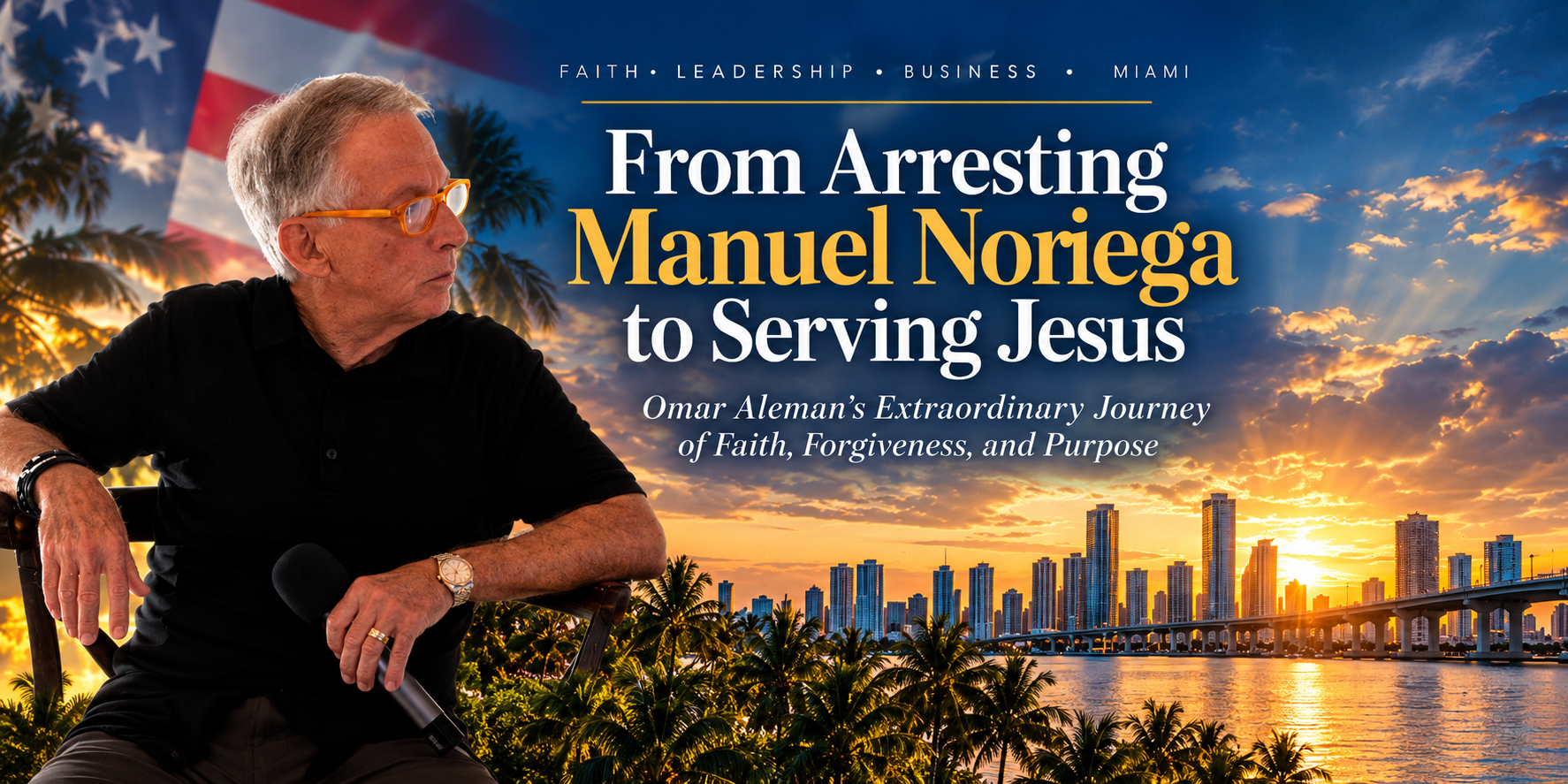

From Arresting Manuel Noriega to Serving Jesus

Omar Aleman’s Extraordinary Journey of Faith, Forgiveness, and Purpose

October 29, 2026 | Miami, Florida

At a Christian business luncheon in Miami, retired DEA Special Agent Omar Aleman shared how one of the most extraordinary assignments of his federal career became a defining moment in his walk with Jesus Christ.
Promotions, recognition, and accomplishments measure some careers. Others are remembered for the lives they touch.
For Omar Aleman, a retired Drug Enforcement Administration special agent whose career spanned more than three decades, the most significant transformation in his life did not come from capturing a notorious international figure. It came from discovering what it truly meant to surrender his life to Christ.
Speaking at the Christian Business Men’s Connection (CBMC) West Dade Luncheon on October 29, 2026, at Miami’s 94th Aero Squadron Restaurant, Aleman reflected on his law enforcement career, his encounter with Panamanian dictator Manuel Noriega, the personal cost of his convictions, and the lessons that continue to shape his approach to business, generosity, and Christian service.

A Career Built on Courage and International Service
Born and raised in Cuba, Aleman immigrated to the United States, graduated from high school in Key West, and earned a criminology degree from Florida State University in 1970.
He subsequently joined the DEA, serving for 32 years in assignments involving undercover investigations, international intelligence, drug enforcement, training, and public relations.
His career took him from Miami to Mexico City, Caracas, and El Paso. After retiring in 2003, he founded Aleman & Associates, providing consulting and training services.

Yet behind the professional achievements was a spiritual struggle that Aleman would eventually describe with remarkable openness.
He had embraced Christianity in the early 1980s, but for years he remained reluctant to share his faith publicly. He described himself as an undercover Christian, someone comfortable practicing his faith privately but hesitant to make it known professionally.
That changed dramatically in Panama.
The Encounter with Manuel Noriega That Changed Everything
In December 1989, the United States invaded Panama during Operation Just Cause, an intervention that ultimately led to the surrender and arrest of Manuel Noriega.
Aleman recounted being called upon because of his familiarity with Panama and his experience in federal law enforcement.
What followed would become one of the most consequential experiences of his life.
During Noriega’s transfer into U.S. custody in January 1990, Aleman recalled sitting beside the handcuffed former dictator aboard a military aircraft.
The circumstances were extraordinary. One man had been the leader of a nation. The other had dedicated his career to enforcing the law.
But Aleman began seeing the encounter through a different lens.
Noriega was a prisoner of the American justice system. Aleman realized that, despite professing Christianity, he had allowed fear to keep him from openly sharing his faith.
He described an approximately three-and-a-half-hour conversation in which he discussed Scripture with Noriega, including the contrasting biblical examples of King Saul and King David.
The conversation turned toward leadership, accountability, sin, repentance, and the need for forgiveness.
Rather than treating the encounter solely as a law enforcement assignment, Aleman saw an opportunity to share his Christian testimony.
It was a turning point.
In a previously recorded interview, Aleman explained that sharing his testimony with Noriega helped remove his fear of speaking publicly about Jesus. If he could share his faith in such an extraordinary international situation, he could share it anywhere.

When Faith Comes with a Professional Price
Aleman’s decision to place his convictions above professional expectations was not without consequences.
During the luncheon, he described later becoming involved in Noriega’s legal proceedings, including testifying for the defense rather than the prosecution.
He also recounted facing professional repercussions, including an approximately ten-month suspension.
For someone whose identity had been closely tied to federal service, professional credibility, and public responsibility, the experience was deeply challenging.
The circumstances tested not only his career but also his trust in God.
It is easy to speak about faith when life is going well. Faith takes on a different meaning when convictions threaten reputation, security, and relationships.
For Aleman, the experience became another chapter in his spiritual development.
His circumstances had changed. His commitment to Christ would have to remain.
The Unexpected Lesson of Forgiveness
Among the most moving parts of the luncheon was Aleman’s account of learning to forgive someone he believed had seriously wronged him.
He described driving through South Florida shortly after his suspension, overwhelmed by frustration and resentment.
His initial reaction was to ask God to deal harshly with the person responsible for his suffering.
Then something changed.
As he reflected on his own life, his shortcomings, and the forgiveness he believed he had received through Jesus Christ, Aleman began reconsidering his anger.
Instead of asking God to punish the other person, he began praying for mercy.
That moment helped him understand forgiveness not merely as a religious instruction but as a personal responsibility.
The message resonated with the biblical teaching of Romans 8:28, which reminds believers that God works through circumstances for the good of those who love Him and are called according to His purpose.
For business owners and professionals, the lesson extends beyond personal relationships. Betrayals, disputes, disappointments, and professional setbacks can leave lasting wounds.
Aleman’s testimony challenges listeners to consider whether genuine freedom comes not from winning every battle but from releasing resentment and allowing God to transform the heart.
From a Federal Agent to Jesus & Associates
Retirement did not mark the end of Aleman’s professional activity or his desire to serve.
He continued speaking, consulting, teaching, and participating in Christian organizations.
But his understanding of work underwent a significant transformation.
He began describing his new spiritual assignment as working for Jesus & Associates.
The premise was simple yet profound: Christians may have employers, clients, business partners, or companies, but their ultimate accountability is to Jesus Christ.
Aleman applied this principle directly to the business professionals attending the luncheon.
What would change if they approached every workday believing that Jesus was their ultimate employer?
Would they negotiate differently? Treat customers differently? Manage employees with greater compassion? Make decisions with greater integrity?
For Aleman, Christian ministry was no longer something confined to Sunday mornings or church activities. Every professional relationship became an opportunity for service.
His perspective was reinforced through his involvement in leadership development, ministry, education, and charitable organizations.
Life Insurance, Death Insurance, and the Question of Eternity
Aleman also shared an analogy drawn from the insurance industry.
Traditional life insurance provides financial protection for beneficiaries after a person’s death.
He challenged listeners to think about another kind of security: their eternal destination.
Using the memorable concept of death insurance, Aleman explained that the greatest assurance he could help others discover was not a financial product but the promise of salvation through Jesus Christ.
His message was not that business or financial planning lacked importance.
Rather, he challenged his audience to consider whether they devoted as much attention to their eternal future as they did to their financial security.
The question was simple: What happens after this life?
For Aleman, the answer is found in his relationship with Jesus Christ.
Generosity: Understanding That Everything Belongs to God
Another recurring theme was financial stewardship.
Aleman spoke about how he and his wife, Julianne, approach their resources with a desire to support Christian ministries and charitable causes.
He discussed the example of a Christian philanthropist who committed to increasing his charitable giving by one percentage point each year.
The principle demonstrated how generosity could grow through intentional, consistent decisions.
Rather than waiting until someone becomes wealthy to start giving, the approach encourages developing generosity as a lifelong discipline.
Aleman reflected on how he and Julianne have experienced God’s provision as they have continued supporting Kingdom-focused work.
Their story was a reminder that financial success can be viewed not only as something to accumulate but also as an opportunity to help others.
Delayed Gratification: Learning to Wait on God’s Timing
The discussion turned to another important principle: delayed gratification.
In a culture accustomed to immediate results, instant purchases, and constant convenience, Aleman challenged Christian business leaders to rediscover the value of patience.
He used a personal story involving an item he had wanted and waited months to obtain. Its importance was not simply the possession itself, but the discipline learned through waiting.
The broader lesson was particularly relevant to entrepreneurs and professionals.
Businesses often require years of sacrifice before they produce meaningful results. Relationships take time to develop. Character grows through testing. Spiritual maturity cannot be purchased or rushed.
Aleman pointed to Jesus’ years of preparation before beginning His public ministry as a model of patience and purpose.
The Christian life, he suggested, requires learning the difference between what we want immediately and what God knows we truly need.
Waiting is not necessarily wasted time.
Sometimes it is the season in which God prepares a person for the responsibility that comes next.
Using Professional Talents for God’s Kingdom
Throughout the luncheon, the interviewer emphasized that business professionals possess abilities that can have a powerful impact beyond their industries.
Communication, relationship-building, management, sales, leadership, and financial stewardship are not merely commercial skills.
They can become instruments of service.
A talented salesperson can become an effective communicator of faith. An experienced manager can mentor younger professionals. A business owner can create opportunities for employees and families. A consultant can help nonprofit organizations operate more effectively.
The conversation challenged attendees to reconsider what professional success means.
The measure of a career is not necessarily how much a person earns, how many people they supervise, or how impressive their accomplishments appear.
There is also the question of what they have done with the opportunities entrusted to them.
Aleman’s own journey illustrated that professional experience can become preparation for an entirely different calling.
His federal career had taught him discipline, communication, courage, investigation, and leadership.
Those same abilities eventually helped him communicate his Christian testimony to audiences far removed from the world of federal law enforcement.
A Life of Service That Continues
Aleman’s commitment to serving others extends into education, nonprofit leadership, and Christian ministry.
His background includes teaching roles at Florida International University and Trinity International University, service with Christian organizations, and involvement with grief-support ministry.
He has also contributed to Christian publications, sharing reflections on faith, failure, personal responsibility, and spiritual growth.

Together with Julianne, he continues supporting causes that reflect their shared Christian values.
His message to the business community is both challenging and encouraging: professional success and spiritual purpose need not compete.
When approached with humility and intentionality, the workplace itself can become a place of ministry.
A Closing Reflection: What Are We Really Working For?
The most memorable part of Omar Aleman’s story may not be his involvement in an internationally significant arrest.
It may be his willingness to admit that, despite his achievements, he still had important lessons to learn about courage, forgiveness, obedience, and surrender.
His journey reminds us that no professional title places someone beyond the need for spiritual growth.
A federal agent can learn humility. A successful businessman can learn generosity. A respected leader can learn forgiveness. And someone approaching retirement can discover that God’s next assignment is only beginning.
At the heart of Aleman’s testimony is a question every Christian professional can carry into the workplace:
If Jesus is truly the one we work for, does the way we conduct our business reflect that relationship?
For Omar Aleman, that question has helped redefine an extraordinary career into an ongoing mission of service.
And perhaps that is the greatest success of all.

About the speaker
Omar A. Aleman is a retired DEA special agent and founder of Aleman & Associates. His career included 32 years of federal service, international assignments, and law enforcement training. He remains involved in Christian leadership, education, and charitable organizations. He and his wife, Julianne, support faith-based initiatives in South Florida and beyond.
Editorial note: This feature is based on the October 29, 2026 luncheon transcript, event photographs, and published biographical materials. Omar’s descriptions of his private conversation with Noriega, testimony in court, suspension, and personal spiritual experiences are presented as his own account. The automated transcript contains unclear passages; those details and any exact quotations should be confirmed with Omar before publication.
 

Read More

State of Medley: October 2026

State of Medley October 2026: Neighbors are showing up, young people are finding their stride, and practical work is underway to keep the town moving. Here is what the public record and local scoreboards tell us so far this month.
State of Medley October 2026: safety, water and neighborhood projects
The Oct. 5 Town Council agenda recognized an officer for mentoring the Police Explorers and thanked former Explorers for their service. It also listed proposed police staffing actions, including appointments of three officers and a part-time communications officer, along with several interagency public-safety agreements. These agenda entries show the matters before Council; the agenda itself does not confirm every final action.
Infrastructure and community projects were part of the same conversation. Council’s agenda included a proposed stormwater loan of up to $2.5 million, a state revolving loan application for utility capital improvements, a public transit safety plan, and a county grant agreement for a Lakeside Hydroponic Garden initiative. The garden proposal is a welcome reminder that even in a town known for business and industry, community spaces and fresh food matter. The agenda also listed discussion of commercial water and sewer rates and a transfer station proposal.
Golden Hawks bring the Friday-night energy
School sports offered a reason to cheer. Miami Springs Senior High’s Golden Hawks beat Goleman 42–0 on Oct. 14, then edged Key West 14–10 on Oct. 23, according to the team’s varsity football results. Those wins belong to the players and coaches, and to every family member in the stands who makes the long week feel a little lighter. For Medley families, the Town’s school-year handbook lists transportation to Miami Springs Senior High for eligible after-school participants.
Public safety, with people at its heart
October’s agenda focused on training, coordination and recognition: the Police Explorers program, cooperation among local law-enforcement agencies, and additional department staffing for Council consideration. The Town’s public records do not provide a monthly police incident blotter, so this report does not present an invented crime count. For a specific police report, residents can contact the Medley Police Records Unit.
For the month before, read our September State of Medley report.
Frequently asked questions
What did Medley’s October 2026 Council agenda focus on?
It included police recognition and staffing, public-safety agreements, stormwater and utility financing, transit safety, and a proposed Lakeside Hydroponic Garden grant agreement.
What were the Golden Hawks’ October football results?
Miami Springs Senior High beat Goleman 42–0 on Oct. 14 and Key West 14–10 on Oct. 23.
Does Medley publish a monthly police blotter?
The Town’s public agenda is not a police blotter. Residents can request specific records from the Medley Police Records Unit.
Sources: Town of Medley Oct. 5, 2026 Council agenda; Miami Springs Senior High varsity football results; Town school-year handbook; Medley Police Records Unit.

Read More

AIG Exec Joins Palantir to Lead Global Financial Services

A senior executive from insurance giant AIG is moving to Palantir Technologies to lead the data-analytics company’s global financial services business, according to reporting from Refresh Miami. For South Florida’s banking, insurance, and asset-management community, the move is a signal worth tracking: it underscores how aggressively enterprise AI and data-infrastructure vendors are building dedicated financial services verticals, and how freely talent is now moving between legacy carriers and technology platforms.
Why the hire matters to Miami. Miami’s financial services sector has expanded well beyond traditional private banking and trade finance. The region now hosts hedge funds, crypto and payments firms, family offices, insurance brokerages, and a growing bench of fintech operators. Each of those categories is evaluating how to deploy AI across underwriting, compliance, anti-money-laundering screening, claims processing, and client onboarding. When a company of Palantir’s scale installs an insurance-industry veteran at the head of its financial services unit, it typically indicates a push toward deeper, industry-specific deployments rather than generic software sales. South Florida institutions sit squarely inside that addressable market.
Deal-flow context. Executive migration from incumbents to platform companies is one of the clearer leading indicators that venture investors, growth-equity funds, and family offices monitor. It often precedes expanded go-to-market activity, new partnership announcements, and a wave of adjacent startup formation as operators leave large organizations to build their own tools. Miami-based allocators tracking AI, cybersecurity, data infrastructure, and insurtech should expect continued movement of this kind over the coming quarters, alongside increased competition for compliance-literate AI talent in the Brickell and Wynwood corridors.
What to watch next. Three signals are worth following in the next 60 days: whether large carriers and banks disclose expanded AI vendor relationships; whether South Florida financial institutions publicly name AI or data leadership roles of their own; and whether early-stage founders in the region begin positioning insurance and risk workflows as a core wedge. Refresh Miami’s coverage of the appointment reflects the local tech ecosystem’s growing overlap with institutional finance — a convergence that has become one of the defining themes of Miami’s business landscape.
Today’s signals: one executive transition tracked; sectors touched include artificial intelligence, enterprise software, data infrastructure, and insurance technology. Most notable emerging trend: vertical-specific AI leadership hires inside large platform companies.
Source: Refresh Miami
DISCLAIMER: This report is provided solely for educational, informational, and journalistic purposes. Nothing herein constitutes investment, financial, legal, or tax advice, a recommendation to buy or sell securities, or a solicitation of investment. Companies discussed are presented for informational purposes only; inclusion does not constitute endorsement or verification. Readers should conduct independent due diligence and consult qualified professional advisors. Funding activity, media coverage, and investor participation do not guarantee future results.

This article was AI-generated from public sources & humanized (occasionally edits). MiamiBusiness.com is committed to transparent AI journalism. Please verify with original outlets.

Read More

Miami’s Rise as a Coastal Metropolis Fuels Tech Growth

Why Miami’s Coastal Metropolis Moment Matters to the Technology Sector
TL:DR: Refresh Miami reports that Miami is emerging as America’s next great coastal metropolis. For technology founders, engineers, and investors across Miami-Dade County, that shift signals a deeper talent pool, more durable capital, and a maturing business ecosystem. The story matters because Miami’s identity is moving beyond tourism and real estate into a diversified economy where technology plays a central role.
So what actually happened? Refresh Miami, the region’s long-running technology and startup publication, published a feature describing Miami’s arrival as America’s next coastal metropolis. The framing is simple but significant. A city that was once viewed as a seasonal destination is now being measured against the country’s established urban economic centers, and technology is one of the clearest engines behind that reclassification.

“Miami stopped auditioning for the role years ago,” said Wilson Alvarez, Editor at MiamiBusiness.com and a Miami business consultant. “What we are watching now is the quiet part, the infrastructure, the hiring pipelines, and the second-time founders who chose to stay. That is what turns a moment into a metropolis.”

What This Means for Miami Technology Companies
Metropolitan status is not a trophy. It is a set of conditions. Deeper labor markets, denser professional networks, and a broader base of service providers all reduce the friction of building a company. For Miami technology firms, that translates into shorter hiring cycles, easier access to specialized talent, and more sophisticated partners in legal, accounting, and venture finance.
It also changes the conversation with outside capital. Investors who once treated South Florida as an experiment increasingly treat it as a market. Founders in Brickell, Wynwood, Coral Gables, and Doral are no longer asked to justify the zip code, which frees them to focus on product and revenue instead of geography.
Who It Affects Across South Florida
The effects reach well past the startup class. Established enterprises in logistics, healthcare, trade, and hospitality are the natural customers for Miami-built software. As those industries modernize, local technology vendors gain the kind of reference accounts that make national expansion possible.
Professionals benefit as well. A broader employer base gives engineers, product managers, designers, and data specialists more mobility without relocation. That retention effect compounds, because experienced operators who stay in the region eventually become the mentors, angel investors, and second-generation founders a mature ecosystem requires.
Conclusion
Miami’s recognition as a rising coastal metropolis is less a headline than a milestone. The practical work continues in office parks, coworking floors, and university labs across Miami-Dade County, where the region’s technology economy is being built one hire and one customer at a time. Business leaders who plan around that trajectory, rather than reacting to it, will be the ones positioned best over the next decade.
For more Miami technology news, market insight, and coverage of the companies shaping South Florida’s innovation economy, visit MiamiTechnologyNews.com.
Source: Refresh Miami

This article was AI-generated from public sources & humanized (occasionally edits). MiamiBusiness.com is committed to transparent AI journalism. Please verify with original outlets.

Read More

Miami’s Housing Supply Gap Opens Door for Builders

Why South Florida’s construction slowdown has become the region’s most important real estate conversation
“Miami doesn’t have a demand problem. It has a delivery problem,” says Wilson Alvarez, Editor and Miami Business Consultant. “The developers who solve for land, permitting, and insurance costs in the next few years will own the next decade of this market.”
TL:DR: A new Realtor.com analysis finds that Miami is falling behind much of Florida on homebuilding and affordability, even as metros across the state push forward with new construction. The gap matters because limited supply keeps pressure on prices and rents across Miami-Dade, affecting buyers, renters, agents, lenders, and developers alike. For real estate professionals, the story is less about bad news and more about where the opportunity now sits.
Here is the short answer. Miami is not building housing at the pace the rest of Florida is, and that shortfall is a central reason local affordability remains stretched. While cities in Central and North Florida continue to add inventory at a healthy clip, South Florida’s pipeline moves slower, constrained by scarce developable land, higher costs, and a dense urban footprint that leaves little room for the sprawling subdivisions that define growth elsewhere in the state.
Geography Is the First Obstacle
Miami-Dade sits between the Atlantic and the Everglades, a narrow corridor with an Urban Development Boundary that deliberately limits outward expansion. Orlando, Tampa, and Jacksonville can grow horizontally. Miami largely cannot. That reality pushes builders toward vertical projects, infill parcels, and redevelopment, all of which carry longer timelines and heavier capital requirements than a greenfield tract north of the city.
Add construction financing costs, insurance premiums, and labor expenses, and the math for workforce-priced housing becomes difficult. Luxury condos still pencil. Attainable product takes creativity, and often public participation.
What It Means for Miami Professionals
For brokers and agents, constrained supply continues to support values in established neighborhoods, while widening the spread between what buyers want and what the market delivers. For lenders and investors, the scarcity narrative strengthens the case for well located multifamily and mixed-use assets. For commercial developers, suburban-style conversions and transit-oriented projects near Metrorail corridors remain among the most defensible plays in the county.
Property managers and landlords should expect sustained rental demand from households priced out of ownership, though rent growth has cooled from its pandemic-era peak. Meanwhile, municipalities from Doral to Homestead continue exploring density incentives and streamlined approvals, which is where the next wave of supply is most likely to originate.
The Constructive Read
Shortages invite solutions. Miami’s challenge is also an invitation for builders, architects, and capital partners who can execute in a complex environment. The firms that master entitlement timelines, resilient construction standards, and insurance-conscious design will find less competition here than almost anywhere else in Florida.
Affordability will not be fixed by one project or one ordinance. It will be fixed by consistent delivery over years, and Miami’s professional community is well positioned to lead that effort.
Call to Action: For more Miami real estate market coverage, development news, and local industry insight, visit MiamiRealEstateNews.com.
Source: Realtor.com

This article was AI-generated from public sources & humanized (occasionally edits). MiamiBusiness.com is committed to transparent AI journalism. Please verify with original outlets.

Read More