

Select Page

Communities

Widgetized Area

This panel is active and ready for you to add some widgets via the WP Admin

Faith in North Bay Village

Faith communities can offer a place for worship, reflection, fellowship, and community participation. North Bay Village residents, property owners, and organizations can use this page to find and compare faith communities and services in the area. Treat each listing as a starting point: contact the provider directly to confirm the current service area, availability, qualifications, and terms before choosing a service.

Faith services to explore

Depending on the provider, local organizations may offer worship gatherings, study groups, pastoral support, youth or family activities, and volunteer opportunities. Some businesses focus on one specialty, while others offer several services through a single office. Ask which work is performed by the provider, what is handled by a partner, and whether the service is available for your particular project or situation. A clear description of the work helps you compare providers on similar terms.

How to compare faith providers

Start with the need, location, timing, and budget you have in mind. Request a written scope or explanation of what is included, how long the work may take, and what could affect the final cost. Compare experience with similar requests, communication practices, scheduling, payment terms, and the process for follow-up. If credentials, permits, insurance, or a written agreement apply to the service, ask for current details and verify them with the appropriate source.

Questions to ask before you decide

Ask about service times, participation options, accessibility, language, family programs, and how newcomers can learn about the community before attending. Review the answer alongside the provider’s listing and written terms. Ask for clarification if a service description is broad, a quote leaves out important work, or a timeline is uncertain. Confirm how to reach the business after the initial appointment and what steps are available if the service needs correction or further attention.

Find faith in North Bay Village

Browse the North Bay Village business directory to identify local listings and request current information. Compare providers using the same criteria so differences in scope, availability, and price are easier to understand. A directory listing is not an endorsement, and details should be verified directly with each business.

For municipal contacts and community information, visit the official North Bay Village website. Contact providers directly to confirm the details that matter for your needs and keep written estimates, policies, and agreements for reference.
Cuba Sanctions Expansion Raises Miami Compliance Stakes

The Trump administration has expanded U.S. sanctions on Cuba, extending restrictions to additional industries and targeting an offshore network tied to the island’s economy, according to reporting by the Miami Herald. For South Florida’s financial services sector, the policy shift is less a political headline than an operational one: Miami remains the primary U.S. corridor for Cuba-linked remittances, trade inquiries, legal work, and cross-border wealth flows, and every expansion of the sanctions perimeter translates directly into new screening, documentation, and reporting obligations.
Miami banks, credit unions, money services businesses, and broker-dealers operate some of the most sanctions-sensitive compliance programs in the country. When the Office of Foreign Assets Control adds industries or offshore entities to its restricted universe, institutions must refresh watchlists, re-screen existing customer books, revisit beneficial-ownership files, and review correspondent banking relationships that may touch newly covered counterparties. Because the Herald reports the action reaches an offshore network, the practical burden falls heaviest on entity-resolution work — tracing shell structures, nominee directors, and intermediary jurisdictions that do not appear on a simple name match.
That burden is also a market signal. Compliance technology — sanctions screening, adverse-media monitoring, graph-based ownership mapping, and AI-assisted alert triage — has been one of the more durable categories of enterprise software demand in financial services, and South Florida’s concentration of international private banking, trade finance, family offices, and fintech licensing makes it a natural proving ground. Institutions facing expanded lists typically respond first with staffing, then with tooling, which is why periods of regulatory expansion often correlate with increased procurement activity among regtech vendors serving mid-market and community institutions.
Professionals across Miami’s financial ecosystem should expect downstream effects beyond the banks themselves. Law firms and advisory practices will field licensing and exemption questions. Remittance operators serving Cuban-American households will need clear customer communication on what remains permitted. Trade and logistics finance desks will re-examine counterparty exposure in affected industries. Wealth managers with internationally mobile clients will revisit source-of-funds documentation. In each case, the differentiator is speed of interpretation — institutions that can translate a sanctions update into revised internal controls within days, rather than quarters, carry materially less regulatory risk.
The guidance of record remains OFAC’s own published determinations and general licenses. Firms are advised to monitor official notices directly rather than rely on secondary summaries.
Source: Miami Herald
DISCLAIMER: This article is provided solely for educational, informational, and journalistic purposes. Nothing herein constitutes investment, financial, legal, tax, or compliance advice, or a recommendation regarding any security. Readers should conduct independent due diligence and consult qualified professional advisors. MiamiFinancialServices.com, MiamiBusiness.com, and their affiliates make no representations regarding the accuracy or completeness of any matter discussed.

This article was AI-generated from public sources & humanized (occasionally edits). MiamiBusiness.com is committed to transparent AI journalism. Please verify with original outlets.

Read More

WIRED World Fair Puts Miami Tech Culture on Display

Miami’s technology scene gained another marquee moment as the inaugural WIRED World Fair brought conversation, demonstration and experience together under one roof. Covered by Refresh Miami, the event paired stage programming with hands-on activations, giving attendees a chance to see emerging technology in practice rather than simply hear about it. For South Florida professionals, the format signals something larger. Miami is no longer just hosting tech events. It is helping define what they look like.
TL:DR:WIRED launched its first World Fair, a gathering where technology leaders took the stage while immersive, hands-on experiences brought the ideas to life. Refresh Miami covered the event, reflecting the region’s growing role in the national technology conversation. For Miami founders, investors and operators, it matters because experiential programming is quickly becoming the standard for how innovation gets introduced, tested and remembered.
Why the Format Matters
The traditional conference model has been showing its age for years. Panels end, slides fade, and attendees leave with a tote bag and little else. The World Fair approach flips that structure by treating technology as something to be touched, tried and questioned in real time. That shift carries weight in Miami, where business culture has always favored the personal over the procedural. Deals here still happen in rooms, not inboxes.
Miami technology companies should read this as a practical lesson in positioning. Whether a firm builds fintech infrastructure in Brickell, develops health platforms in Coral Gables or runs a logistics software team near Doral, the ability to demonstrate value in person is becoming a competitive advantage. Product demos, founder storytelling and experiential activations now carry as much persuasive weight as a polished pitch deck.
The Local Opportunity
There is also an economic layer worth noting. Large-scale technology events support hotels, venues, production crews, catering operations and transportation providers across Miami-Dade County. Each gathering of this scale functions as a short business cycle of its own, while creating introductions that continue long after the exhibits close.
Editor’s Note, Wilson Alvarez, Miami Business Consultant: “Miami has always sold experience better than almost any city in America. The companies that learn to apply that instinct to technology will be the ones people remember.”
Conclusion
The WIRED World Fair reflects a maturing moment for the industry. Technology is being presented as something lived rather than described, and Miami’s hospitality-driven business culture is well suited to that evolution. Local founders should take note, because the next generation of attention will belong to those who can turn complex products into experiences worth standing in line for.
For more Miami technology coverage, market insight and local innovation news, visit MiamiTechnologyNews.com.
Source: Refresh Miami

This article was AI-generated from public sources & humanized (occasionally edits). MiamiBusiness.com is committed to transparent AI journalism. Please verify with original outlets.

Read More

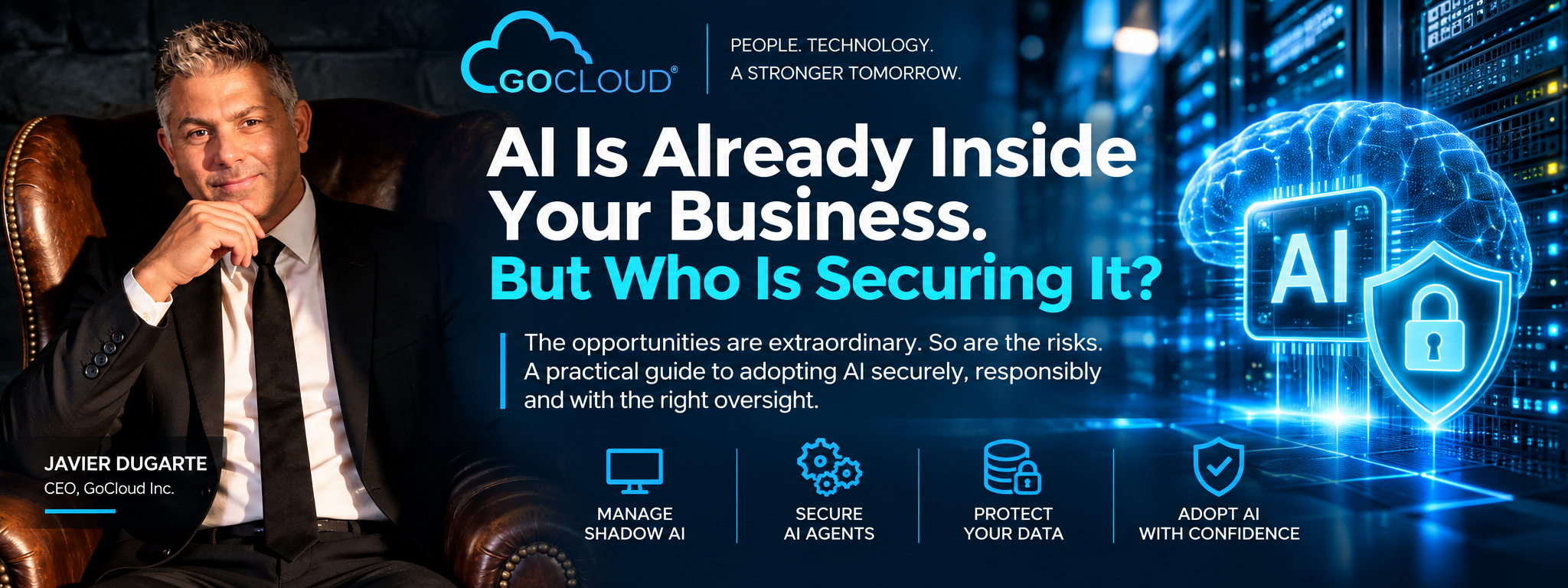
AI Is Already Inside Your Business. But Who Is Securing It?

GOCLOUD INC. | TECHNOLOGY & CYBERSECURITY | NOVEMBER 2026
As artificial intelligence moves from answering questions to taking action, businesses face a new challenge: securing the digital workforce they may not even know they have.
By Javier Dugarte, Chief Executive Officer, GoCloud Inc.
Estimated reading time: 9 minutes
The next employee may not be human
Imagine arriving at the office on Monday morning and discovering that several new employees have begun working for your company.
They are processing documents, organizing customer information, drafting correspondence, analyzing financial reports and communicating with other business systems. They work around the clock, rarely ask questions and complete assignments in seconds.
There is just one problem.
Nobody in your IT department hired them.
Nobody established their access permissions.
And nobody is entirely certain what information they can see, share or modify.
Welcome to the emerging world of artificial intelligence in business.
For years, cybersecurity largely focused on protecting computers, networks, servers, applications and the people using them. Today, another participant is entering that environment: artificial intelligence capable of performing tasks, accessing business information and, increasingly, taking actions on behalf of employees.
This changes the conversation.
The question is no longer simply whether your company should use artificial intelligence. Many businesses already do.
The more important question is whether your company understands how that artificial intelligence is being used, what information it can access and who is responsible for securing it.
For business leaders, that distinction may become one of the defining technology challenges of the next several years.
What you need to know
Artificial intelligence introduces new cybersecurity and governance challenges because AI applications can process confidential information, connect to business systems and sometimes act autonomously. Businesses should establish approved tools, access restrictions, employee training, vendor oversight and monitoring before allowing AI systems to handle sensitive information or perform consequential actions.
Key takeaways

AI security is becoming a business governance issue, not simply an IT concern.

Employees may introduce unapproved AI tools without understanding data-protection risks.

AI agents require special attention because they can perform actions, not merely generate answers.

Existing cybersecurity principles—including least privilege, identity management and monitoring—remain essential.

Businesses should adopt AI through a coordinated strategy that balances innovation, productivity, compliance and security.

Who should read this article?
Business owners, CEOs, CFOs, CIOs, IT directors, operations executives and professional service organizations exploring AI-powered productivity, workflow automation and cloud technology.
The question every business leader should ask
How can businesses adopt AI without exposing confidential information or creating new cybersecurity vulnerabilities?
The answer begins with treating AI as part of the organization’s technology environment rather than as an isolated productivity tool. Companies need visibility into approved applications, the information those applications can access, the permissions granted to AI agents, and the safeguards governing automated actions. AI should operate within established cybersecurity, privacy, compliance and accountability policies.

1. Shadow AI: The technology your employees may already be using
Not every technology risk arrives through a malicious email or an outside attacker.
Sometimes, it arrives through an employee trying to work more efficiently.
Consider a sales representative who uploads a customer spreadsheet into an AI application to generate a forecast. Or a human resources employee who asks a chatbot to summarize an internal personnel document. Perhaps a finance professional connects an AI assistant to a cloud application to automate reporting.
The intentions may be entirely reasonable.
The security implications may not be.
When employees use artificial intelligence applications without organizational approval or oversight, the practice is commonly called shadow AI.
This is a modern extension of shadow IT, the longstanding problem of employees adopting software and services outside established technology-management procedures.
The difference is that AI systems may receive unusually sensitive information in ordinary prompts, uploaded files and connected workflows.
An employee may believe they are simply asking for help preparing a report. In reality, they may be transferring confidential business information to an external service operating under terms they have never reviewed.
That does not mean every public AI tool is unsafe. It means the security of any particular tool depends on its configuration, data-handling policies, contractual protections, integrations and intended use.
The solution is not necessarily to prohibit artificial intelligence throughout the organization.
A blanket prohibition can discourage productive experimentation without providing employees with approved alternatives.
A more practical approach is to establish clear guidelines explaining which AI tools are authorized, what information may be shared and when additional review is required.

Featured Insight | Innovation Without Visibility Is a Risk
A company cannot effectively secure technology it does not know is being used. AI adoption should begin with visibility, approved applications and clear rules for handling sensitive business information.

2. From chatbots to AI agents: A fundamental shift
There is an important distinction between artificial intelligence that provides information and artificial intelligence that performs actions.
A traditional chatbot might summarize a document, answer a question or draft an email.
An AI agent may be connected to tools that allow it to retrieve files, update records, interact with applications, create tasks or initiate business workflows.
That is a significant expansion of capability.
It also creates a new security consideration: what happens when software can act on behalf of a person?
Imagine an AI agent assisting an accounting department. With the appropriate integrations, it might retrieve invoices, categorize expenses and prepare reports. Depending on the permissions and controls provided, an agent might also be capable of modifying financial records or initiating additional workflows.
The productivity potential is substantial.
But so is the importance of managing permissions.
If an AI agent has access to confidential files, its ability to retrieve and process that information must be controlled. If it can modify records, organizations need safeguards around which changes are permitted and which require human approval.
An agent should not receive unrestricted access simply because doing so makes implementation easier.
This is where the cybersecurity principle of least privilege becomes particularly relevant.
In practical terms, least privilege means giving users, applications and automated systems only the access necessary to perform their authorized responsibilities.
An AI agent preparing a monthly sales summary should not automatically have permission to modify payroll records or retrieve confidential legal documents.
The same principle applies to third-party integrations, application programming interfaces and automated workflows.
As AI agents become more capable, the organizations using them must become more disciplined about how those capabilities are authorized and monitored.
The next generation of cybersecurity will not only protect people using technology. It must also govern technology acting on behalf of people.
3. The new threat: When instructions become an attack
One of the more distinctive cybersecurity risks associated with generative AI is prompt injection.
Unlike traditional malware, which often attempts to exploit software vulnerabilities, prompt injection can involve malicious instructions placed in information an AI system is asked to read or process.
Consider an AI assistant summarizing an external document. An attacker may attempt to hide instructions inside that document, hoping the AI system will treat those instructions as authoritative rather than as untrusted source material.
In an inadequately protected environment, that could cause the system to produce misleading information, misuse connected tools or attempt actions outside the user’s original intent.
The risk becomes especially important when AI systems can access internal applications or perform automated tasks.
The OWASP Foundation identifies prompt injection among the major security risks affecting large language model applications.
The lesson for business leaders is that AI security cannot depend exclusively on traditional antivirus software or perimeter defenses.
Organizations must also consider how AI applications interpret external content, access connected systems, handle confidential data and obtain authorization before performing sensitive operations.
This does not make AI inherently unsuitable for business use. It reinforces the importance of implementing it with appropriate technical and organizational safeguards.
4. Microsoft 365, cloud applications and the permissions problem
For many businesses, artificial intelligence will not arrive as an entirely separate technology platform.
It will increasingly become part of software employees already use.
Microsoft 365, cloud collaboration platforms, customer relationship management systems, accounting applications and enterprise software providers are incorporating AI capabilities into familiar business environments.
That makes adoption convenient.
It also means existing identity and access-management practices become even more important.
An AI assistant connected to an organization’s information environment may be able to retrieve content that the authenticated user is authorized to access.
If employees have accumulated excessive permissions, poorly governed shared folders or outdated access rights, AI-powered search and retrieval can make those existing problems more visible and consequential.
A business therefore should not assume that activating a new AI feature automatically resolves underlying data-governance issues.
Before expanding AI capabilities, organizations should review access permissions, sensitive information classifications, application integrations and the security settings governing their cloud environment.
For GoCloud, this is an area where managed IT, cloud administration, cybersecurity and governance naturally intersect.
The goal is not merely to enable the newest technology.
It is to make sure the surrounding infrastructure is prepared to support it responsibly.
5. What federal cybersecurity agencies are warning businesses about in 2026
The emergence of autonomous AI is no longer simply a theoretical concern discussed at technology conferences.
On May 1, 2026, the U.S. Cybersecurity and Infrastructure Security Agency (CISA), the National Security Agency and international cybersecurity partners released joint guidance addressing the careful adoption of agentic AI services.
The guidance identified risks involving excessive permissions, unexpected agent behavior, security weaknesses introduced by connected systems and gaps in accountability. It recommended limiting agent autonomy, strengthening identity management, monitoring activity and aligning AI security with established cybersecurity practices.

GovDelivery

That is an important development.
Governments are not advising organizations to abandon AI. They are emphasizing that its deployment requires appropriate controls.
The OWASP GenAI Security Project’s August 2026 list of major large-language-model application risks also places prompt injection, sensitive information disclosure and excessive agency among its leading concerns.

GitHub

For business executives, these developments reinforce an essential point: the security practices that protect traditional IT environments must now extend to AI-powered applications and autonomous workflows.
Did You Know?

2026 CYBERSECURITY DEVELOPMENT
May 1, 2026 – U.S. and international cybersecurity agencies issued joint guidance specifically addressing the risks of agentic artificial intelligence, including autonomy, permissions and accountability.

NCSC NZ

This is a useful milestone because it demonstrates that AI governance has become part of mainstream cybersecurity planning.
6. The business case for responsible AI adoption
Artificial intelligence offers businesses compelling opportunities.
It can reduce repetitive administrative work, assist with research, improve information retrieval, support customer service and accelerate certain business processes.
However, productivity should not be evaluated independently of security.
Consider an organization that saves hours each week through AI automation but introduces uncontrolled access to confidential customer information.
The operational improvement may be real, yet the resulting exposure could undermine its value.
Responsible adoption requires business leaders to evaluate both sides of the equation: what the technology makes possible and what new responsibilities accompany that capability.
NIST’s Artificial Intelligence Risk Management Framework provides a voluntary structure for identifying and managing AI-related risks. Its Generative AI Profile addresses additional considerations associated with generative systems.

NIST

For business leadership, this creates an opportunity to bring AI investment into the same strategic discussions as cybersecurity, cloud infrastructure, compliance, employee productivity and operational resilience.
An AI project should have a clear business objective, an accountable owner, an approved information-access model and a way to evaluate whether it is delivering value.
Technology should serve the business—not introduce unmanaged complexity simply because a new capability is available.
7. Seven questions every CEO should ask before expanding AI
Organizations do not need to become artificial intelligence developers to establish meaningful oversight. They do, however, need a framework for evaluating how AI fits into their operations.
The following seven questions offer a practical starting point.

1. Which AI tools are employees currently using?

Establish visibility into approved and unapproved applications.

2. What information can those tools access?

Identify confidential customer, financial, legal and operational data.

3. Are AI agents permitted to take action?

Determine which automated tasks require human approval.

4. Who manages AI permissions?

Assign responsibility for access, authentication and integration security.

5. What happens when an AI system makes a mistake?

Establish escalation procedures, monitoring and accountability.

6. Do our vendors provide appropriate protections?

Review data retention, privacy, contractual terms and security controls.

7. How does AI fit into our cybersecurity strategy?

Integrate AI governance with existing IT, compliance and risk-management processes.

These questions should be revisited as the organization’s AI capabilities expand.
A system initially approved to summarize documents may later gain access to email, customer records or operational software. Its security requirements can change significantly as its responsibilities grow.
8. Where GoCloud fits into the AI security conversation
At GoCloud, we believe technology decisions should begin with an understanding of the business they are intended to support.
That principle is especially important as artificial intelligence becomes part of everyday operations.
AI should not be approached as an isolated software purchase. It belongs within a broader technology strategy encompassing infrastructure, cloud services, cybersecurity, governance, compliance and business continuity.
GoCloud’s service portfolio includes IT as a Service, cybersecurity mitigation and remediation, cloud services, compliance and risk management, professional consulting, and disaster recovery.
These capabilities provide a foundation for helping organizations evaluate the technology environments into which AI applications are introduced.
For example, before expanding an AI deployment, a business may need to review its Microsoft 365 permissions, strengthen identity security, assess cloud configurations, examine vendor integrations or establish more consistent information-governance practices.
Those are familiar IT and cybersecurity responsibilities, but AI makes their importance increasingly apparent.
The objective is not to slow innovation.
It is to help businesses move forward with greater confidence, clearer accountability and stronger control over their information.
The most successful AI strategies will not necessarily belong to the organizations adopting the greatest number of tools. They will belong to organizations that understand how to use those tools effectively, responsibly and securely.
Frequently Asked Questions
What is shadow AI?
Shadow AI refers to employees or departments using artificial intelligence applications without appropriate organizational approval, visibility or governance. It can create data-security, privacy and compliance risks when sensitive information is shared with unreviewed services.
What is the difference between an AI chatbot and an AI agent?
A chatbot primarily responds to questions or generates content. An AI agent may also use connected tools to retrieve information, execute tasks or interact with business applications. The distinction matters because agents may require additional permissions, monitoring and controls.
Can AI applications expose confidential company information?
Yes. Exposure can occur through inappropriate data sharing, excessive permissions, insecure integrations, malicious instructions or other weaknesses. The actual risk depends on the application’s design, configuration and safeguards.
What is prompt injection?
Prompt injection is an attack technique in which malicious instructions attempt to influence an AI system’s behavior. Such instructions may appear in external documents, websites, emails or other material processed by an AI application.
Does Microsoft 365 Copilot automatically make a company secure?
No. AI features operate within a broader environment of identity management, permissions, information governance and security controls. Organizations still need to review and maintain those controls.
Should businesses prohibit employees from using AI?
Not necessarily. A practical approach is to establish approved tools, clear usage policies, appropriate employee training and controls proportionate to the organization’s risks.
Can a managed IT provider help with AI security?
Yes. A qualified managed IT and cybersecurity provider can help assess infrastructure, access controls, cloud configurations, application integrations, monitoring and governance requirements associated with AI adoption.
A perspective worth remembering
“The future is already here — it’s just not evenly distributed.”
— William Gibson
The observation is particularly relevant to artificial intelligence. Some organizations are already integrating AI deeply into operations, while others are only beginning to explore its capabilities.
Regardless of adoption speed, cybersecurity and accountability should remain part of the journey.
Final Takeaway: The Future of AI Depends on Trust
Artificial intelligence represents an extraordinary opportunity for businesses to improve productivity, expand capabilities and rethink how work gets done.
But every technological advancement introduces responsibilities alongside its benefits.
The arrival of AI agents makes those responsibilities particularly important because businesses are moving toward systems that do more than provide information. They can increasingly act on it.
That requires a different level of visibility, governance and security.
Business leaders should not be asking only how much work artificial intelligence can perform.
They should also be asking what information it can access, what decisions it can influence and who remains accountable for the results.
The future of business technology is not simply artificial intelligence. It is artificial intelligence operating within a secure, responsible and well-managed technology environment.
And that future begins with the decisions organizations make today.
Secure Your Business Before Expanding AI
Artificial intelligence may be changing how your business operates. Is your technology infrastructure prepared?
Javier Dugarte and the GoCloud Inc. team help organizations evaluate and strengthen their IT infrastructure, cybersecurity, cloud environments and technology risk management.
Whether your business is beginning to explore AI or expanding its use of automated systems, understanding your existing technology environment is an important first step.
Contact GoCloud to discuss your technology and cybersecurity needs.
GoCloud Inc.
8400 NW 36th Street, Suite 450, Miami, FL 33166
Phone: (844) 442-5628
Email: info@gocloudinc.net
Website: GoCloud Inc.
Editorial disclaimer: This article is intended for general educational purposes and does not constitute a security assessment, legal advice or a guarantee of protection against cyber threats. Organizations should evaluate AI-related risks according to their particular systems, regulatory obligations and operating environments.

Read More

Amendment 3 Property Tax Cuts Stir Miami Real Estate

Florida’s property tax measure puts Miami-Dade owners, buyers and brokers on alert
By Wilson Alvarez, Editor and Miami Business Consultant: “Property taxes are the quiet line item that decides whether a Miami deal pencils out. Any change to that number changes the math for every owner, buyer and broker in the county.”
TL:DR: The Miami Herald is examining what Amendment 3, a Florida property tax measure, could mean for Miami’s real estate market. The short answer is that lower property tax bills would ease carrying costs for homeowners and investors across Miami-Dade, while raising questions about how local services are funded. It matters because property taxes shape affordability, monthly payments, rental pricing and long-term investment returns throughout South Florida.
What happened is straightforward. Florida voters weighed Amendment 3, a measure aimed at reducing property taxes, and the Miami Herald has turned its attention to the practical consequences for one of the most tax-sensitive housing markets in the country. In Miami-Dade, where rising assessments and insurance premiums have squeezed budgets for years, the property tax line is not a footnote. It is often the difference between a comfortable mortgage payment and an uncomfortable one.
Why it matters is a matter of arithmetic. Lenders qualify buyers on the full monthly obligation, which includes taxes and insurance. When the tax portion drops, borrowing capacity improves, and buyers who were sitting just outside a price band may find themselves inside it. Sellers notice that effect quickly. So do investors, who underwrite small multifamily and commercial assets on net operating income, where taxes are one of the largest fixed expenses in the column.
Who it affects reaches well beyond homeowners in Coral Gables, Kendall or Little Havana. Brokers, title agents, appraisers, property managers, condominium associations and developers all respond to shifts in carrying costs. Commercial landlords in Doral and Wynwood pass taxes through to tenants under triple net leases, which means relief at the assessment level can travel directly into a small business’s rent. Municipalities, meanwhile, rely on property tax revenue to fund services, so cities across Miami-Dade will be studying their budgets closely.
What Miami businesses should know is that policy changes of this scale take time to show up in closing statements. Real estate professionals would be wise to review how proposed changes interact with Save Our Homes caps, portability and homestead rules before advising clients. Investors should revisit pro formas rather than assume a uniform benefit, since commercial and non-homesteaded properties are treated differently than primary residences. Buyers should ask lenders to re-run qualification scenarios as details become final.
Conclusion
Miami’s market has always rewarded professionals who read the fine print before the crowd does. Amendment 3 is a reminder that tax policy is market policy, and that the smartest response is preparation rather than speculation.
For continuing coverage of Miami-Dade property values, tax policy and market trends, visit MiamiRealEstateNews.com for more news in Miami.
Source: Miami Herald

This article was AI-generated from public sources & humanized (occasionally edits). MiamiBusiness.com is committed to transparent AI journalism. Please verify with original outlets.

Read More

Miami US Attorney Exit Signals Legal Market Shift

Leadership changes at the Southern District of Florida often reshape Miami’s private bar within months.
TL:DR: Law.com reports that Miami’s U.S. Attorney and the chief of the Justice Department’s National Security Division are stepping down as part of a broader wave of federal legal departures. For Miami’s legal industry, the news matters less as a headline and more as a market signal. Senior federal prosecutors typically move into private practice, and South Florida firms are usually the first to compete for them.
The short answer for Miami professionals is this. A leadership transition at the U.S. Attorney’s Office for the Southern District of Florida does not pause the office’s work, but it does tend to accelerate lateral hiring across the local bar. Miami remains one of the busiest federal districts in the country, covering international trade, cross border finance, maritime commerce, healthcare, and national security matters. When senior attorneys leave that environment, their experience carries real value to firms serving corporate clients.
Wilson Alvarez, Editor and Miami Business Consultant, put it plainly. “Every time a top federal prosecutor leaves Miami public service, three or four local firms quietly rewrite their hiring plans. That is not drama, that is the legal economy working exactly as it always has.”
Why Miami Firms Pay Attention
Federal prosecutorial experience is among the most portable credentials in law. Attorneys who have managed complex investigations understand how charging decisions are made, how evidence is assembled, and how negotiations unfold. Corporate clients in Brickell, Coral Gables, and Doral pay premium rates for that perspective, particularly in white collar defense, compliance, internal investigations, and regulatory counseling.
South Florida’s business base makes the demand steady. Miami serves as a gateway for Latin American capital, international banking relationships, and trade finance, all of which require careful regulatory navigation. Companies operating across borders tend to invest in compliance before problems arise, and former government lawyers are frequently the ones building those programs.
What Businesses Should Take From It
Continuity remains the practical reality. Career prosecutors, line attorneys, and support staff keep federal cases moving regardless of who occupies the top post. Companies with pending matters should expect process to continue, while recognizing that priorities can shift gradually under new leadership, as they do with every transition.
For law firms, the opportunity is recruitment. For general counsel, the opportunity is access to seasoned advisers entering private practice. For younger Miami attorneys, the lesson is durable. Government service remains one of the strongest launching points in the profession, and the Southern District of Florida continues to produce some of the region’s most respected practitioners.
Conclusion
Miami’s legal market has absorbed many transitions and grown stronger through each one. Talent circulates, firms adapt, and the city’s position as a center for international business law holds steady. Professionals who watch these movements closely are usually the ones best positioned when the next hiring cycle begins.
Visit MiamiLegalNews.com for more legal industry news in Miami.
Source: Law.com

This article was AI-generated from public sources & humanized (occasionally edits). MiamiBusiness.com is committed to transparent AI journalism. Please verify with original outlets.

Read More